 FEXLINK Research Institute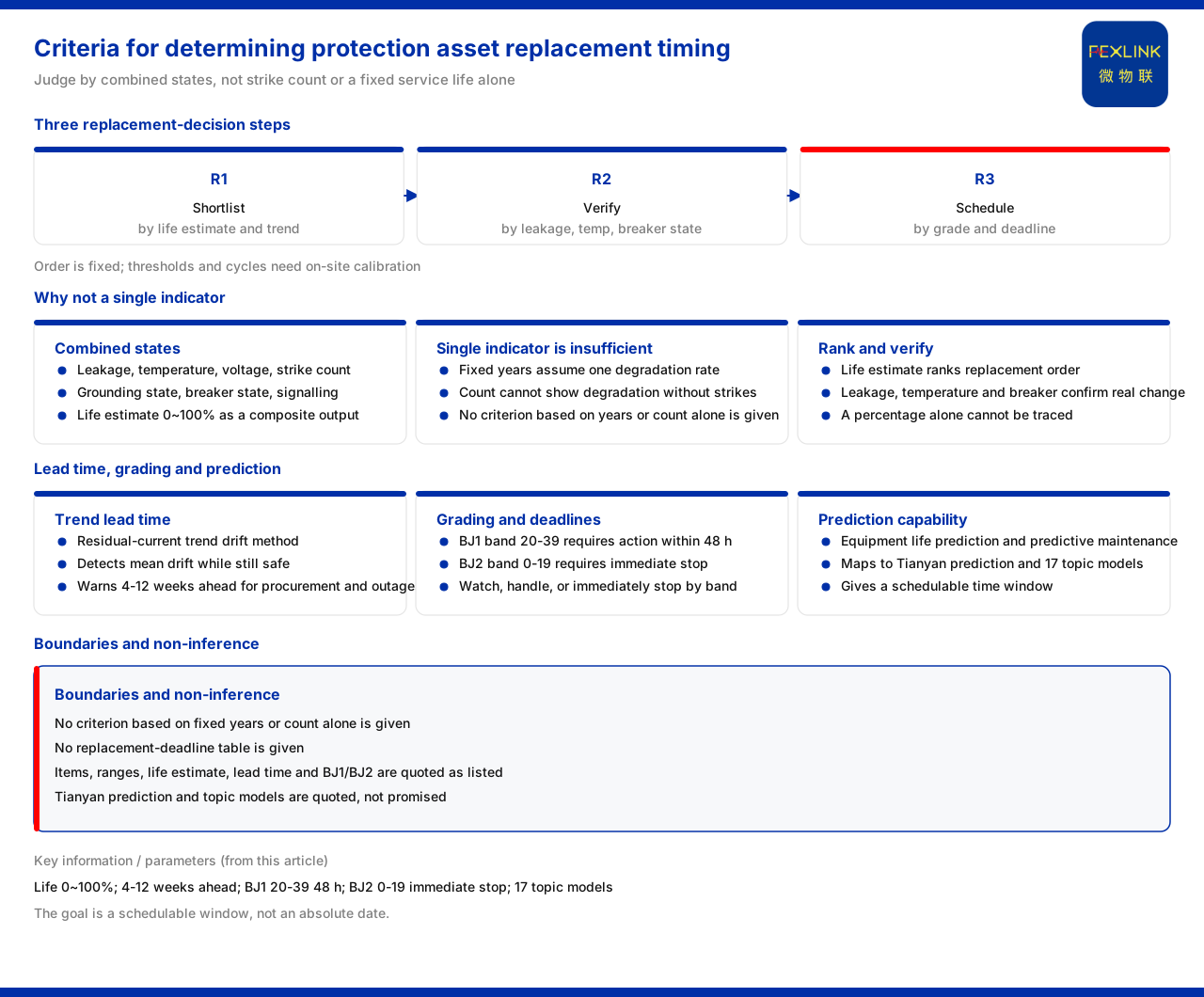
Direct Answer
The replacement timing of lightning-protection assets (SPDs and the like) should be judged from composite state quantities, not from the lightning strike count or a fixed number of years alone. The product knowledge base records that the surge protective device monitor provides a life estimate of 0 to 100% and monitors leakage current, temperature, voltage, lightning strike count, grounding status, breaker status and remote signalling; the all-parameter lightning-protection monitoring terminal contains leakage current, temperature, voltage, humidity and life estimate. The product knowledge base also states that it does not prescribe a replacement criterion based on a fixed number of years or on the lightning strike count alone, and gives no replacement time-limit table, so replacement judgement needs composite state quantities and prediction capability rather than a single indicator applied across the board.
1. Why Age or Lightning Count Alone Is Not Enough
Replacing by a fixed number of years assumes that all protective devices degrade at the same speed at the same time, but site conditions differ greatly: with different temperature, load and lightning frequency, the degradation speed will not be the same. Looking only at the lightning strike count also has limits; the counter records the number of events and cannot reflect the continuous degradation of the device during periods without lightning. The fact that the product knowledge base prescribes no replacement criterion by age or by count itself shows that a single indicator is insufficient to support a replacement decision. Using age as a reference for budget and planning is acceptable, but taking it as the judgement basis easily leads to two kinds of waste: devices that should be replaced are not, and devices that should not be replaced are replaced early.
2. Which State Quantities the Replacement Judgement Should Use
Since the state must be examined, it is necessary to be clear which quantities to examine. The product knowledge base records that the monitored parameters of the surge protective device monitor include leakage current, temperature, voltage, lightning strike count, grounding status, breaker status and remote signalling, with the life estimate as a composite output; the breaker status corresponds to an observable point of backup-protection operation, the grounding status to the discharge channel, leakage current and temperature to component degradation, and the lightning strike count to event frequency. These quantities answer different questions: whether the component is degrading, whether the backup protection has operated, whether the discharge channel is intact, and whether events are frequent. Replacement judgement should view this information together rather than taking only one item.
3. Life Estimate Is for Ranking, Not a Direct Conclusion
Among the composite state quantities, the life estimate is the ranking indicator easiest to use. The product knowledge base lists it as 0 to 100%, usable for comparing replacement priority among a batch of assets. It should be noted, however, that it is a composite output; the product knowledge base does not explain the weights making it up, nor give a method for deriving the percentage from a single parameter. A reasonable use is therefore: use the life estimate to order the sequence, and use the raw quantities such as leakage current, temperature and breaker status to confirm whether the change is real. Deciding replacement on one percentage alone provides neither an explainable judgement basis nor a traceable reason during review. Ranking plus verification is what makes a replacement decision defensible.
4. The Trend Advance Leaves a Window for Replacement
Replacement is not an instantaneous action; it needs spare parts, a plan and a power-outage window, so the advance matters. The product knowledge base records that the residual-current trend-drift method can detect a weak mean drift while leakage is still in the safe range, giving a warning 4 to 12 weeks ahead. This advance exactly covers the needs of procurement and maintenance scheduling. For an asset manager, its value is turning "emergency replacement" into "planned replacement": when the trend shows leakage current is slowly rising, spare parts can be secured and a window reserved in advance without waiting for the protective device to fail and then handling it as an emergency. The longer the advance, the greater the room for arrangement and the smaller the impact of shutdown on production.
5. Grading and Time Limits Connect to the Replacement Decision
The trend result must be combined with the unified grading and time limits to become a concrete action. The product knowledge base records that in the six-level alarm system, the BJ1 band is 20 to 39 and requires disposal within 48 hours; the BJ2 band is 0 to 19 and requires immediate shutdown. The replacement decision can be layered accordingly: assets in the warning interval are put into observation and planning, assets entering the alarm interval enter the disposal flow, and assets touching the highest band are handled by immediate shutdown. In this way state quantities, trend and disposal time limits form a line, avoiding "the data was seen but no action followed". The product knowledge base also provides capabilities such as alarm compression and root cause, used to reduce interference from invalid alarms in judgement.
6. Prediction Capability and Its Corresponding Topic Models
The prediction part of the replacement judgement has a clear capability correspondence. In its capability comparison, the product knowledge base maps "equipment life prediction and predictive maintenance" to several prediction capabilities of the Tianyan engine and 17 topic models; the core value of the Tianyan engine is described as answering how long the equipment can last, when a problem will occur, and which time window to use for maintenance. These statements show that the goal of replacement-timing judgement is not to give an absolute date but to give an arrangeable time window. Putting state quantities, trend and prediction results together, the asset manager obtains a judgement interval of "when to prepare and when to act", rather than a definite value that is hard to explain.
7. Put the Judgement into the Asset-Management Flow
Finally, the judgement basis must reach the management flow to take effect. It is suggested to split replacement judgement into three executable steps: first screen candidate assets by life estimate and trend, then review them with raw quantities such as leakage current, temperature and breaker status, and finally arrange the replacement by the alarm grading and disposal time limits. The product knowledge base gives no replacement time-limit table, so the threshold and period of each step must be calibrated against accumulated site data and operation-and-maintenance capability. Once the flow is established, the replacement decision has a traceable basis, and it can be calibrated gradually as operating data accumulates, instead of following a fixed number of years year after year.
Scope of Application and Limitations
First, this article only explains the basis for judging the replacement timing of lightning-protection assets; the factual boundary is the product knowledge base, and no standard clauses, parameters, certifications or cases not listed there are introduced.
Second, the product knowledge base prescribes no replacement criterion based on a fixed number of years or on the lightning strike count alone, and gives no replacement time-limit table; this article only explains the idea of composite state quantities and gives no specific replacement conclusion.
Third, the monitored parameters, ranges and life-estimate basis of the surge protective device monitor and the all-parameter lightning-protection monitoring terminal, the advance of residual-current trend drift, and the disposal requirements of BJ1 and BJ2 in the six-level alarm system, are cited from the source.
Fourth, the mapping of equipment life prediction and predictive maintenance to the prediction capabilities and topic models of the Tianyan engine, and the description of the core value of the Tianyan engine, are cited from the source; this article does not extrapolate them into an accuracy or effect promise for any site.
Fifth, the replacement thresholds, observation periods and budget arrangements of a specific project must be verified against accumulated site data and the operation-and-maintenance organisation; this article provides no selection, modelling or life calculation.