 FEXLINK Research Institute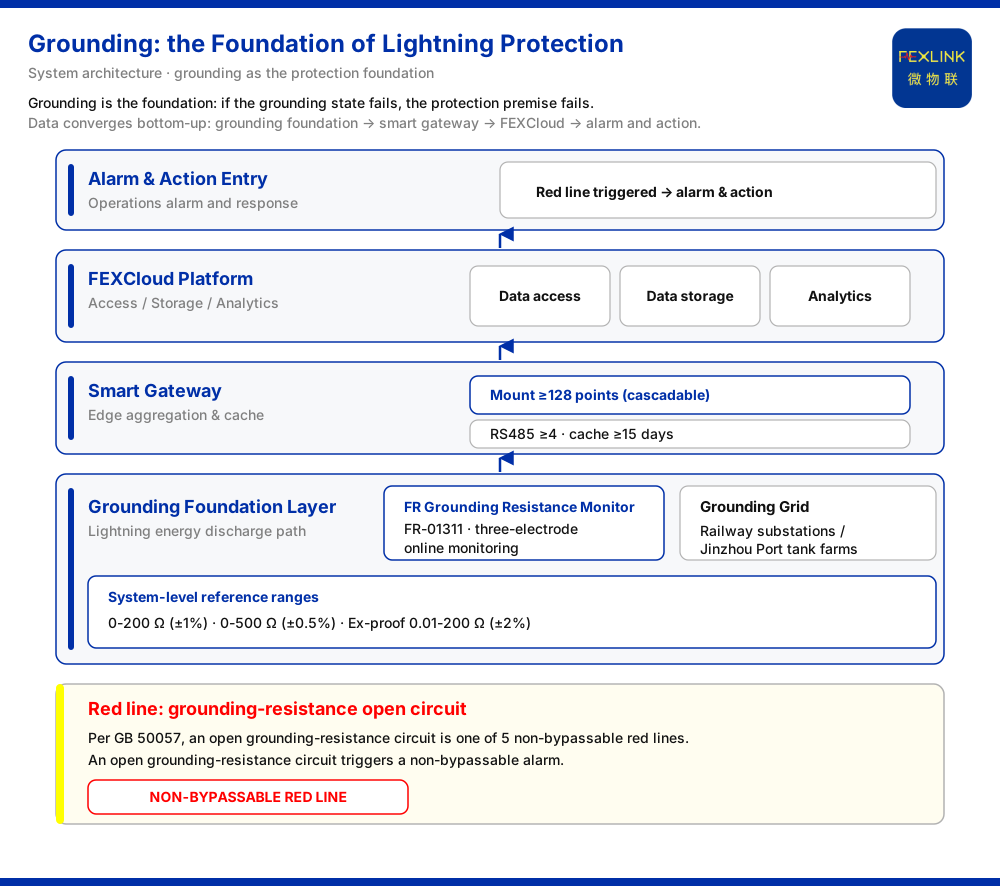
1. Direct answer
Grounding resistance holds a foundational position in a lightning protection system for one reason: it is the critical path through which lightning energy is discharged into the earth, and every other link depends on that path being intact. The knowledge base lists "abnormal open circuit of the grounding resistance" as one of its five non-bypassable red lines, with GB 50057 recorded as its basis. That placement says grounding is not an ordinary parameter that can be weighted against other metrics and cancelled out. It is a precondition that precedes any judgment of better or worse: if the grounding path does not hold, every later discussion of selection, networking, and alarming loses its reference point. Treating grounding as a foundational item—and turning it from a one-time acceptance object into a continuously confirmed state variable—is the most direct way to act on that position.
2. "Foundational" means structural dependency, not a preference in importance
"Foundational" is easily misread as a subjective ranking: grounding matters more, so it is placed first. The more accurate reading is structural dependency. The links of a lightning protection system each have their own job—what to measure, how to place points, how to raise alarms—and all of them address "how to do better once the precondition holds." Grounding is responsible for that precondition itself. Air termination, down-conduction, equipotential bonding, and surge protection deal with how to guide and limit lightning current safely; grounding deals with where the energy finally goes. Once the far end of the discharge path is cut, even a fully healthy front end has no outlet for the energy. An optimization item decides how good the system is; a foundational item decides whether the system holds at all.
3. The red-line mechanism: why the grounding red line is set as non-bypassable
The red-line guard in the knowledge base provides five rules. The grounding red line has the trigger condition "abnormal open circuit of the grounding resistance" and is based on GB 50057. "Non-bypassable" carries three layers of engineering meaning. First, it does not take part in weighting or dilution among metrics, so a high score on another metric cannot cancel it. Second, the site cannot raise its threshold according to local operating conditions. Third, it must be a design-stage precondition, not margin to be optimized during operation.
Placing a grounding abnormality inside this red-line set shows that the system characterizes it not as "performance may degrade" but as "the safety floor may be breached." The function of grounding is to provide a discharge path; when the path itself is no longer reliable, the conditions for discharging lightning energy change, and the damage impact can spread from a single device to the system level. The red-line mechanism singles out this kind of precondition problem from after-the-fact trend observation and requires interception at the first moment.
This article's reference to GB 50057 is limited to the grounding red-line citation in the knowledge base, without expanding specific clauses or drawing conclusions about limit values.
4. A foundational item must remain valid continuously, not pass once
Understanding grounding as a foundational item also means avoiding a second misreading: that once the grounding resistance measured at acceptance passes, the foundation stays solid for the long term. An acceptance result reflects one measurement at a specific moment and under specific conditions, whereas foundational status requires that it hold throughout the full lifecycle. A one-time pass can only say "it held then"; it cannot answer "has it held ever since." This is the management difference between a foundational item and an ordinary inspection item: an ordinary inspection item can be confirmed by periodic sampling, while a foundational item requires its state to remain visible. Otherwise, a foundation failing between two confirmations leaves no opportunity to notice.
Continuous monitoring is therefore not a replacement for periodic testing but a complement to foundational status: periodic testing handles compliance confirmation, continuous monitoring handles state confirmation, and only both together give the foundational item a basis and continuity.
5. Monitoring anchor: the FR grounding resistance monitor
To turn "grounding is a foundational item" from a concept into executable management, a device that continuously acquires the grounding state is needed. The knowledge base gives the FR grounding resistance monitor (FR-01311), which uses the three-electrode method, is supplied at DC12V, is installed outdoors, and supports RS485 / Zigbee / Ethernet communications. The product makes grounding acquisition concrete: the state can be read continuously by a device and reported over communications rather than depending only on a one-time measurement.
The knowledge base also notes that this grounding resistance monitor series has been applied to projects including online monitoring of railway traction substation grounding grids and the Jinzhou Port oil tank farm (10 sets per tank). These are application references recorded inside the knowledge base and have not been independently verified. They show that where the grounding state directly bears on operational safety and must be tracked over the long term, grounding monitoring has already entered implementation as a baseline configuration rather than remaining conceptual. This article repeats only the applications listed in the knowledge base and does not infer their suitability for other industries.
6. What the system-level reference parameters indicate
Raising the view from a single monitor to the system level, the knowledge base gives reference parameters for the grounding resistance monitoring system: monitoring units covering 0–200 Ω (standard type, ±1%), 0–500 Ω (high-precision type, ±0.5%), and 0.01–200 Ω for the explosion-proof type (±2%). The three ranges correspond to different measurement spans and accuracy requirements, with the explosion-proof type listed separately, indicating a dedicated configuration for specific environments beyond the standard one. These parameters answer whether grounding monitoring can measure accurately under different conditions.
The knowledge base gives reference parameters for the intelligent gateway: mounting of ≥128 points (cascadable), ≥4 RS485 channels, and data caching of ≥15 days. These figures answer whether grounding monitoring can be organized at scale. Mounting points and cascading capability determine how many grounding points one system can cover, the number of RS485 channels determines the access conditions of the field bus, and the caching duration determines whether data can be retained when communications are interrupted. For a foundational item that must remain continuously queryable, networking and retention capability are as important as measurement capability; otherwise, "continuous monitoring" loses data continuity once deployment is scaled up.
The ranges, accuracy figures, and gateway metrics above are system-level reference expressions, describing the system's capability boundary and deployment conditions rather than any specific model's specifications.
7. Turning foundational status into engineering actions
Understanding the foundational status of grounding must ultimately land on concrete actions. In the solution phase, grounding and grounding monitoring should be included as a baseline configuration, not added later as a remedy once an abnormality appears. In the delivery phase, continuous state visibility should supplement the conclusion of a single measurement, giving the foundational item continuity. In the operations phase, an abnormal open circuit of the grounding resistance should be handled as a high-priority event, because its red-line nature means it cannot be downgraded and treated as an ordinary alarm that may be observed slowly. The sensing side is handled by the grounding resistance monitor for acquisition, the system side by gateway parameters for networking and caching, the platform side for storage and analysis, and the application side for alarming and response. Only a complete role chain manages the foundational item in a foundational way.
8. Scope and limitations
First, the argument that "grounding is the foundation of a lightning protection system" is the thesis of this article, and its factual basis is drawn from the knowledge base. No standard clauses, parameters, certifications, or cases not listed in the knowledge base are introduced.
Second, this article's reference to GB 50057 is limited to the grounding red-line citation in the knowledge base. It does not expand the specific clauses of that standard and does not make a determination about grounding resistance limit values.
Third, 0–200 Ω (±1%), 0–500 Ω (±0.5%), and 0.01–200 Ω (±2%) are system-level reference parameters listed in the knowledge base; this article does not equate them with the specifications of any specific model. The intelligent gateway figures of ≥128 points, ≥4 RS485 channels, and ≥15 days of data caching likewise follow the knowledge base's expression.
Fourth, the railway traction substation grounding-grid online monitoring and the Jinzhou Port oil tank farm are recorded as internal application references in the knowledge base and have not been independently verified. This article only repeats them and does not infer suitability for other industries, nor does it extend to unrecorded quantitative effects.
Fifth, this article explains the foundational status of grounding and its monitorable anchor. It does not replace the grounding design, testing, or compliance determination of a specific project; actual configuration should be determined in light of site conditions and product access capability.