 FEXLINK Research Institute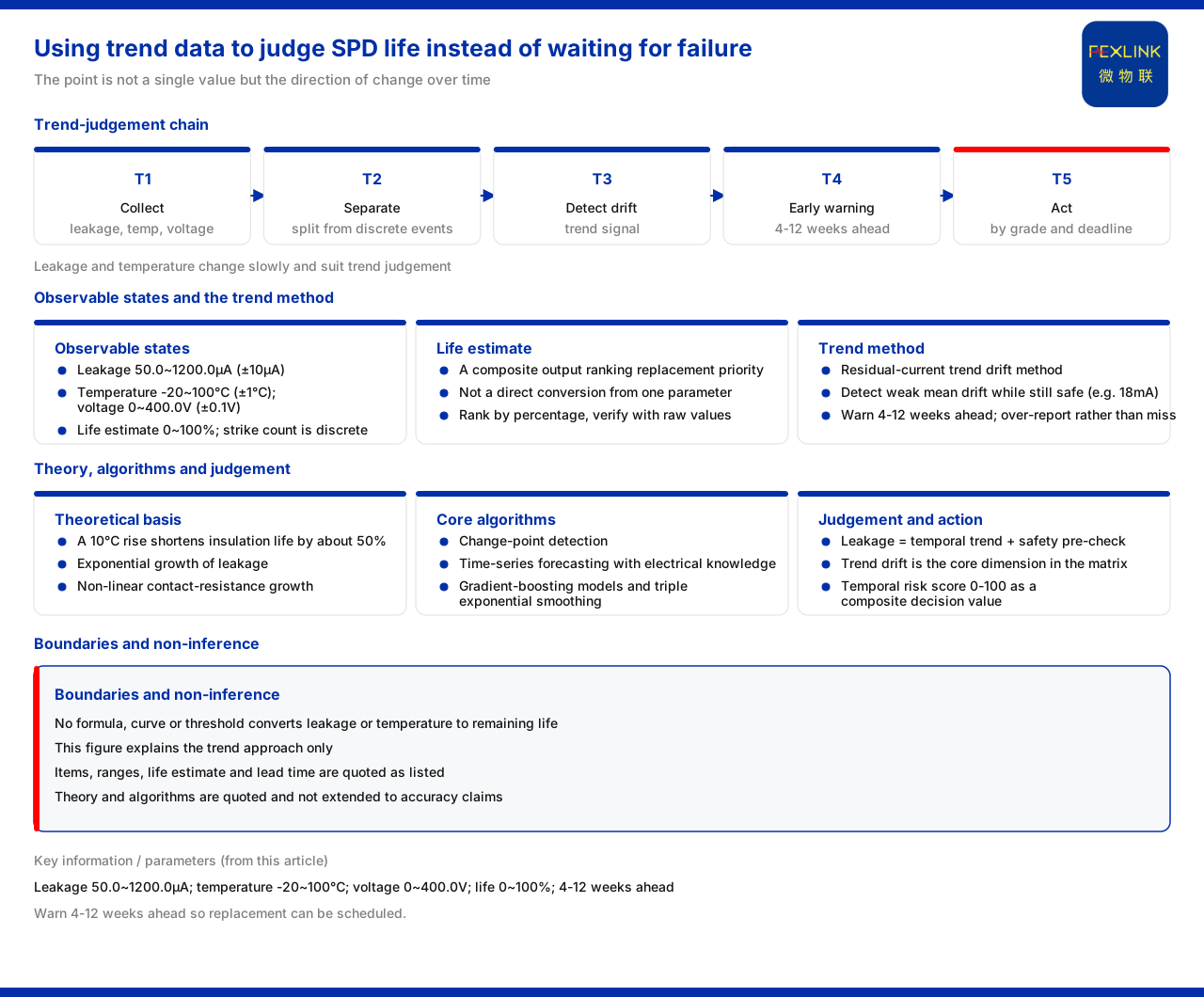
Direct Answer
Judging SPD life should not wait until protection has failed but should use the drift trend of state quantities such as leakage current and temperature to judge ahead of time. The product knowledge base records that the surge protective device monitor provides a life estimate of 0 to 100% and monitors leakage current 50.0 to 1200.0μA (±10μA), temperature -20 to 100°C (±1°C) and voltage 0 to 400.0V (±0.1V); the all-parameter lightning-protection monitoring terminal contains leakage current, temperature, voltage, humidity and life estimate. More valuable is the trend capability: the product knowledge base records that the residual-current trend-drift method can detect a weak mean drift while leakage is still in the safe range, giving a warning 4 to 12 weeks ahead. In other words, the point of life judgement is not a single instantaneous value but the direction in which the value changes over time.
1. The Problem with Waiting for Failure
Unlike other equipment, a protective device stays "quiet" for long periods in the normal state, and when it fails there is often no obvious external change. Waiting until the protective device can no longer discharge effectively before discovering that it needs replacement may result in equipment damage or even system interruption. The core demand of SPD operation and maintenance is therefore not "replace when broken" but "replace within a time that can still be arranged". This requires turning an invisible degradation process into a visible trend. The product knowledge base gives no specific formula, curve or threshold for converting leakage current or temperature alone into remaining SPD life, so this article only explains the idea of trend judgement and the capabilities already listed, and gives no life-conversion relation.
2. First See Which Observables Exist
The first step of trend judgement is to confirm what can be measured on site. The product knowledge base records that the monitored parameters of the surge protective device monitor include leakage current, temperature, voltage, lightning strike count, grounding status, breaker status and remote signalling, with the life estimate as a composite output. Among these, leakage current reflects the degree of leakage of the protective component under continuous voltage, and temperature reflects the heating state of the component and its connections; both change slowly over time and are suitable for trend judgement. Voltage is used to confirm whether operating conditions are stable, and the lightning strike count records discrete events. Only by viewing slow variables separately from event quantities can a transient change after a lightning strike be prevented from being mistaken for a long-term trend.
3. Life Estimate Gives an Interval, Not a Conclusion
The product knowledge base lists the life estimate as 0 to 100%. The use of this percentage is to combine multiple kinds of information into a comparable indicator that helps judge replacement priority. It should be clear, however, that it is a composite output, not a direct conversion result of a single parameter. The product knowledge base does not explain what weights make up the life estimate, nor give a specific method for deriving the percentage from leakage current or temperature. When using the life estimate, therefore, it should be observed together with the raw quantities such as leakage current and temperature: the percentage is used to rank priority, and the raw quantities are used to judge whether a change is real and whether it is driven by a particular point or period. Looking only at one percentage easily loses the basis of judgement.
4. The Trend Method: Finding the Signal in Mean Drift
One specific method given by the product knowledge base is residual-current trend drift. The method can detect a weak mean drift while leakage is still in the safe range, for example 18mA, and give a warning 4 to 12 weeks ahead, with a parameter strategy of "prefer over-reporting to missing". The insight of this method is that danger does not equal having already exceeded a limit; a slow upward movement of the mean is itself a signal. If only a limit threshold is set, by the time it triggers the device is often close to failure; monitoring mean drift moves the observation window earlier. Mapped to an SPD, a slow rise in leakage current is the same kind of signal and is better judged by a trend method than by a single-point threshold.
5. Theoretical Basis: the Non-linearity of Temperature Rise and Leakage
Trend judgement holds because degradation itself follows rules. The product knowledge base records that the theoretical basis of its prediction capability includes the Arrhenius equation, that is, a 10°C temperature rise shortens insulation life by about 50%, as well as the exponential growth pattern of leakage and the non-linear growth curve of contact resistance. These three rules together show that temperature and leakage current are not isolated indicators but are directly related to the degradation speed of insulation and connections. Temperature rise accelerates ageing, leakage rises exponentially with degradation, and contact resistance increases non-linearly. Precisely because the relations are non-linear, early changes may be very small, but once the acceleration stage is entered, changes are fast, which further highlights the need to observe the trend in advance.
6. Algorithms Support Trend Judgement
Turning a trend from a concept into a usable result requires algorithmic support. The product knowledge base records that its core algorithms include CUSUM change-point detection, time-series forecasting with injected electrical knowledge, gradient-boosting models, and triple exponential smoothing. Change-point detection identifies the moment at which the mean or trend turns; time-series forecasting gives the direction over a future period; gradient-boosting models build non-linear relations among multiple variables; exponential smoothing extracts a relatively smooth trend from noise. The combination of these algorithms shows that trend judgement is not simply drawing a line but distinguishing "real drift" from "random fluctuation" within measurement noise.
7. Connect the Trend to Judgement and Disposal
The trend result must ultimately connect to state judgement and disposal arrangement. The product knowledge base records that the leakage item among the basic vital signs uses a combination of time-series trend and safety front-end, and that in the seven-dimensional perception matrix trend drift is the core dimension and the time-series risk score is a composite decision value from 0 to 100. This shows that the trend is not a branch independent of the existing system but a core input within it. For SPD operation and maintenance, the trend results of leakage current and temperature can accordingly be brought together with the life estimate into a composite score, and disposal can then be arranged by the unified grading and time limits. The point of a 4 to 12 week advance is to leave arrangeable time for replacement.
Scope of Application and Limitations
First, this article only explains how to use trend data to judge SPD life; the factual boundary is the product knowledge base, and no standard clauses, parameters, certifications or cases not listed there are introduced.
Second, the product knowledge base gives no formula, curve or threshold for converting leakage current or temperature alone into remaining SPD life; this article only explains the trend idea and gives no life-conversion relation.
Third, the monitored parameters, ranges and life-estimate basis of the surge protective device monitor and the all-parameter lightning-protection monitoring terminal, as well as the advance of residual-current trend drift, are cited from the source.
Fourth, the theoretical bases such as the Arrhenius equation, the exponential leakage-growth pattern and the non-linear contact-resistance curve, and the algorithms of change-point detection, time-series forecasting, gradient-boosting models and exponential smoothing, are cited from the source.
Fifth, the trend decision thresholds, observation periods and replacement arrangements of a specific project must be verified against site data quality and operation-and-maintenance capability; this article provides no modelling, parameter setting or life calculation.