 微物联研究院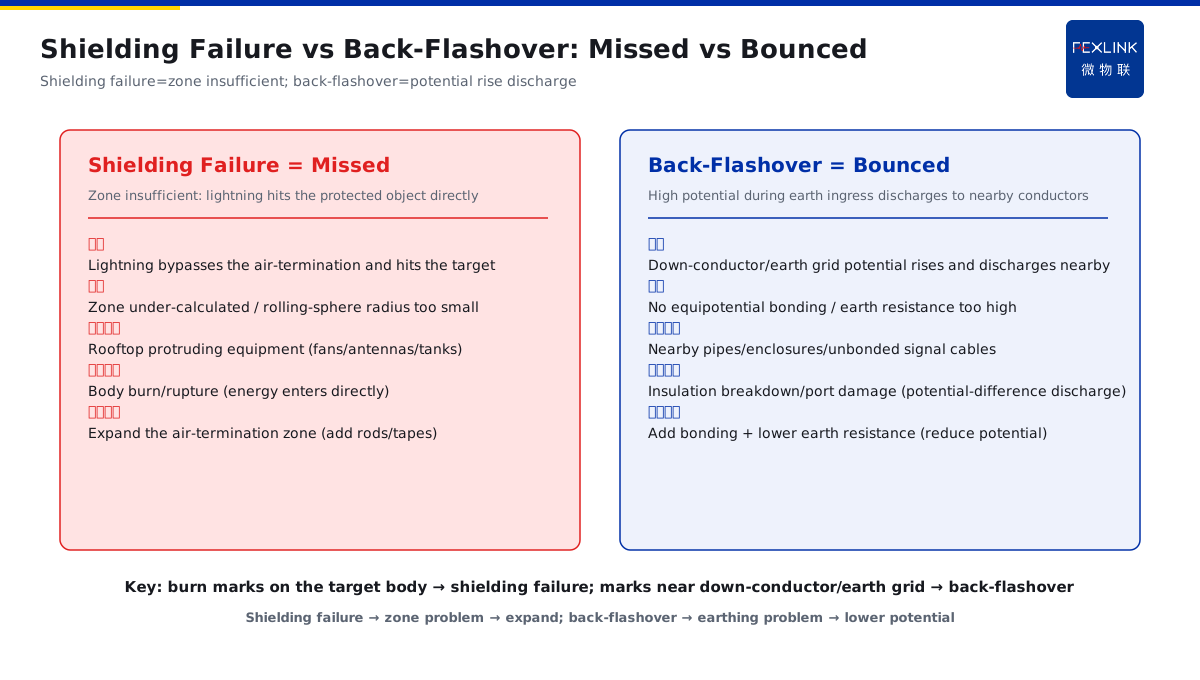
Direct Answer
In design reviews you often hear "shielding failure" and "back-flashover". Where exactly does the lightning strike and why does it damage equipment? The answer: a shielding failure means the lightning bypasses the air-termination system and strikes the protected object directly (the protection zone is insufficient); a back-flashover means the lightning current, after entering the ground via the air-termination and down-conductor, discharges from the earthing system to nearby metallic objects not bonded to it (caused by a rise in earth potential or down-conductor potential). For the former you expand the protection zone; for the latter you add equipotential bonding and lower the earth potential rise.
An industrial building had an intact air-termination tape, yet a rooftop fan was damaged after a thunderstorm. Inspection showed the fan stood outside the air-termination protection zone (beyond the rolling-sphere radius), so the lightning bypassed the tape and struck the fan directly — a shielding failure. In another plant, a water-pump motor failed; inspection found the motor sat close to the down-conductor without equipotential bonding — when the lightning current entered the ground, the down-conductor potential rose and discharged to the motor — a back-flashover. The key distinction: a shielding failure is "protection zone not enough" (air-termination problem), while a back-flashover is "potential-difference discharge" (earthing/bonding problem) — mixing them up sends the rectification in the wrong direction.
Why:
- Shielding failure is about position: the strike point is on the protected object (outside the air-termination zone);
- Back-flashover is about path: the lightning "jumps" from the down-conductor/earth grid to a neighbouring metallic part;
- Shielding failure → expand the zone: add air-termination devices / re-adjust the protection range;
- Back-flashover → lower the potential: add equipotential bonding + reduce the earth potential rise.
Key insight: "A shielding failure is a missed strike; a back-flashover is a bounce-over" — one expands the zone, the other balances the potential. Misjudge it and the rectification goes off course.
A station once treated a shielding-failure incident as a back-flashover (adding only bonding, no air-termination) and the same location failed again the following year. After re-calculating the protection zone and installing an additional air-termination rod, no recurrence was observed. Lesson: a shielding failure needs a wider protection zone, not better earthing — misclassification makes the fix ineffective.
1. Shielding Failure: Insufficient Air-Termination Zone, Lightning Strikes the Protected Object Directly
Step one: how does a shielding failure happen.
Definition:
- Lightning bypasses the air-termination device and hits the target;
- The target lies outside the air-termination protection zone;
- It is not that the air-termination failed (it is that the zone is insufficient);
- A typical "missed strike".
Causes:
- Protection zone under-calculated (rolling-sphere radius too small);
- Target protrudes (higher than the air-termination device);
- Air-termination devices spaced too far apart;
- Complex target geometry (corners/protruding parts).
Typical positions:
- Rooftop protruding equipment (fans/antennas/water tanks);
- Building edges (air-termination tape coverage insufficient);
- Parts higher than the air-termination device;
- Equipment near the boundary of the protection zone.
Key insight: "Shielding failure = zone not enough" — the equipment sits outside the protected circle and is hit directly. Calculate the protection zone first, then talk about anything else.
2. Back-Flashover: High Potential During Ingress/Down-Conduction Discharges to Nearby Conductors
Step two: how does a back-flashover happen.
Definition:
- Lightning current enters the ground via the air-termination/down-conductor;
- The potential of the down-conductor/earth grid rises instantaneously;
- It discharges to nearby metallic parts not equipotentially bonded;
- A typical "bounce-over".
Causes:
- Down-conductor too close to the protected object;
- No equipotential bonding (potential difference not equalized);
- Earth resistance too high (larger potential rise);
- Protected object "floating" (not earthed/not connected to the air-termination system).
Discharge targets:
- Nearby metal pipes/equipment enclosures;
- Signal/power cables without equipotential bonding;
- People (touching metal near the down-conductor);
- Weak insulation points (breakdown).
Key insight: "Back-flashover = potential rise + potential difference" — the lightning does not strike you from the sky; it jumps from the ground or the conductor. Equipotential bonding is the core measure.
3. How the Two Differ in On-Site Damage Phenomena
Step three: how to tell them apart on site.
Strike-point position:
- Shielding failure: strike point on the protected object itself (burn marks);
- Back-flashover: strike point not on the equipment (the equipment is "discharged to");
- Shielding failure: direct hit (damage trace on the target);
- Back-flashover: nearby discharge (trace near the down-conductor/earth grid).
Damage mode:
- Shielding failure: the target body is burned/ruptured (energy enters directly);
- Back-flashover: insulation breakdown/port damage (potential-difference discharge);
- Shielding failure: single-point damage (the struck target);
- Back-flashover: multi-point damage (related to potential distribution).
On-site judgment:
- Check the position of the lightning trace (on the body vs nearby);
- Check the positional relationship between equipment and air-termination;
- Check whether equipotential bonding is complete;
- Combine lightning-current monitoring records (FL monitor).
Key insight: "Shielding failure shows on the body, back-flashover shows nearby" — the damage location is the key to classification. Where the strike landed tells you which type it is.
4. Rectification Directions Compared
Step four: how to fix each type properly.
Shielding-failure rectification:
- Expand the protection zone (add air-termination devices);
- Re-arrange air-termination devices (reduce spacing);
- Raise the air-termination (cover protruding equipment);
- Re-calculate the rolling-sphere radius (per code).
Back-flashover rectification:
- Add equipotential bonding (equipment to the air-termination system);
- Lower the earth resistance (reduce the potential rise);
- Increase the separation distance (down-conductor away from equipment);
- Shielding/isolation (protect sensitive equipment).
Correspondence:
- Shielding failure → air-termination problem → expand the zone;
- Back-flashover → earthing problem → lower the potential;
- Shielding failure → add air-termination rods/tapes;
- Back-flashover → add bonding/reduce earth resistance.
Key insight: "Shielding failure expands the zone, back-flashover balances the potential" — the rectification direction is decided by the failure type. Get the direction right and the investment pays off.
5. On-Site Quick Judgment Based on Damage Location
Step five: a fast judgment flow.
Judgment flow:
- Step 1: inspect the lightning trace (on the body vs nearby);
- Step 2: check the protection zone (inside the air-termination circle or not);
- Step 3: check the bonding (is the equipment connected);
- Step 4: comprehensive judgment (shielding failure / back-flashover);
- Step 5: targeted rectification + verification.
Judgment points:
- Body burn marks → shielding failure (zone insufficient);
- Nearby discharge → back-flashover (potential difference);
- Both combined → handle separately;
- Use monitoring records as supporting evidence (FL current records).
Verification methods:
- Lightning-protection testing after rectification (zone / earth resistance);
- FR earth-resistance monitoring (tracking back-flashover risk);
- Lightning-event review (does it recur);
- Archive of protection-zone calculations.
Key insight: "Classify first, rectify second, verify last" — a closed loop cures the root cause. Accurate classification means the fix works in one pass.
6. Product Implementation: Intelligent Lightning-Protection Online Monitoring
WeiWuLian products turn shielding-failure/back-flashover protection into practice:
- FR Earth-Resistance Monitor: tracks earth resistance (the back-flashover risk indicator);
- FL Lightning-Current Monitor: records lightning events (distinguishing the strike path);
- Platform: event records + trend analysis + protection status;
- Combined with protection-zone calculations and bonding rectification.
The design principle in one sentence: "Shielding failure expands the zone, back-flashover balances the potential, and monitoring verifies." Classify accurately and fix accordingly — lightning incidents stop recurring.
7. Common Misjudgments
- Treating a shielding failure as a back-flashover: only adding bonding. Result: the same position fails again next year. Correct: expand the air-termination protection zone.
- Treating a back-flashover as a shielding failure: only adding an air-termination rod. Result: the potential difference still discharges. Correct: add bonding + reduce earth resistance.
- "Intact air-termination means safe": ignoring the protection zone. Result: protruding equipment is struck. Correct: re-calculate the rolling-sphere radius.
- "Low earth resistance means safe": ignoring equipotential bonding. Result: back-flashover between equipment due to potential difference. Correct: bond the equipment.
- Not recording lightning events: no evidence to classify. Result: classification by guesswork. Correct: FL monitoring records + review.
Scope and Limitations
This article distinguishes the two easily-confused direct-strike concepts — shielding failure and back-flashover — and gives the rectification directions for each, applicable to lightning-protection design review and lightning-damage troubleshooting. Protection-zone calculations (rolling-sphere method) and equipotential design must be performed professionally per GB 50057 and similar codes; the target earth-resistance value must be determined by the lightning-protection class; on-site classification is best supported by lightning-current monitoring records. All cases are anonymized (an industrial building, a station) and do not refer to any specific customer.