 微物联研究院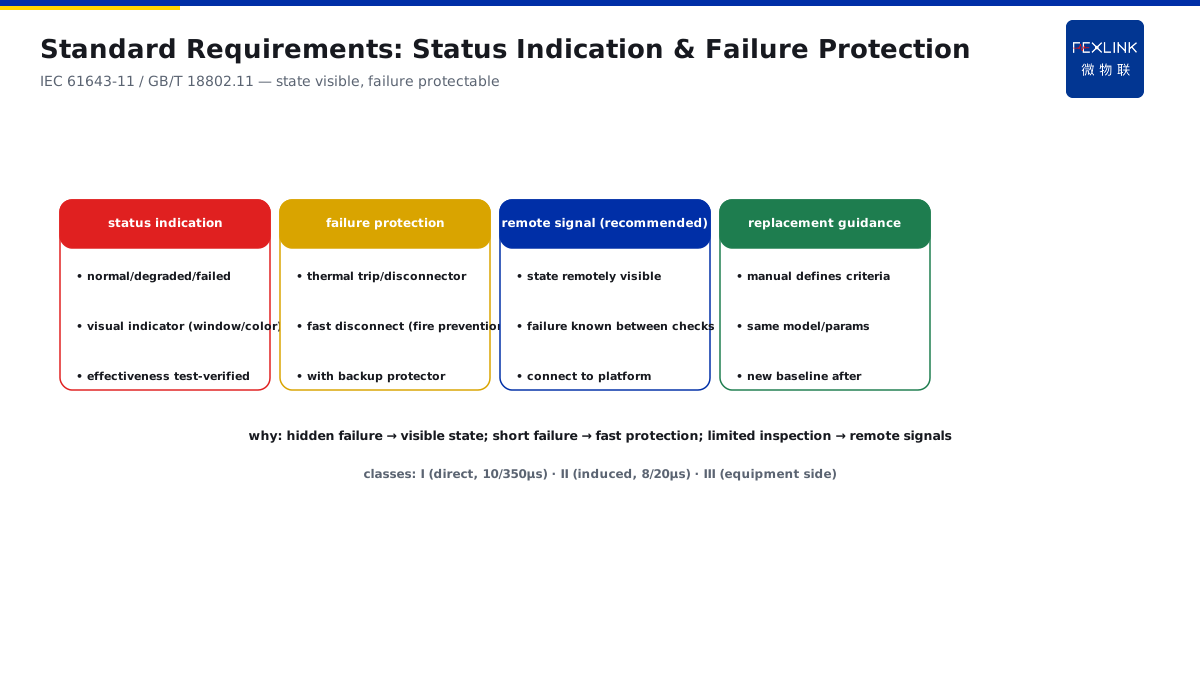
Direct Answer
How do O&M personnel distinguish a normal, degraded, and failed SPD, and decide when to replace it? The answer: SPD degradation can be judged by combining "leakage-current trend (μA-level precision), trip/remote-signal state, and backup-protector state"; the standards (IEC 61643-11 / GB/T 18802.11) require SPDs to have status indication and failure protection — on-line monitoring makes the "degradation trend" visible, which is more reliable than single-point measurement.
At one power distribution room, 6 SPD groups were managed by "annual inspection + visual check"; after one lightning strike, 2 groups were found already failed (no visual anomaly, remote signals not connected). Rectification: added SPD monitors (FS/ESM, μA-level leakage current + remote signals), established a baseline per group and tracked continuously; six months later one group's leakage rose slowly from 35μA to 120μA (others stable), replaced early, avoiding failure exposure at the next strike. Judgment core: leakage-current trend + trip/remote signal + backup protector — three signals judged jointly, degradation discoverable before the next strike.
Because:
- SPD degradation has no visual sign: MOV aging is internal; the eye cannot see it;
- Leakage current is the "probe": μA-level trend changes reflect MOV degradation;
- Standards require status indication: IEC 61643-11 / GB/T 18802.11 mandate status indication and failure protection;
- Single-point measurement is unreliable: absolute values are affected by temperature/voltage; only trends are reliable.
Key insight: "three-signal joint judgment (leakage trend + remote signal + backup protection)" is the correct way to judge SPD state. Standard requirements + on-line monitoring — degradation trend visible, replacement justified.
At one plant, management relied only on "visual SPD checks + annual multimeter leakage measurement"; after one lightning strike a failed SPD went unnoticed (MOV cracked but housing intact), and equipment was damaged. Rectification: connected remote signals + added monitoring, leakage trends entered the ledger. Lesson: visual and single-point checks miss failures — trend monitoring + remote signals are the reliable judgment.
1. Why SPDs Degrade
Step one: what is the degradation mechanism.
MOV aging mechanism:
- MOV (zinc-oxide varistor) repeatedly discharges lightning/operating overvoltages;
- Each discharge causes micro-damage (grain-boundary degradation);
- Long-term accumulation: leakage current grows, varistor voltage drifts;
- Extreme case: thermal runaway (short-circuit failure).
Failure modes:
- Degradation: leakage grows but protection still works (warning period);
- Open failure: MOV burns open (protection lost);
- Short failure: MOV breaks down (backup protection must disconnect);
- Hidden failure: no visual anomaly (most dangerous).
Degradation triggers:
- Repeated lightning impulses (count and amplitude);
- Switching overvoltages (frequent operations);
- Environmental factors (heat/humidity accelerate aging);
- Grid harmonics/voltage anomalies (long-term stress).
Key insight: "MOV aging is gradual" is the theoretical basis of monitoring. Each discharge is micro-damage and the trend is measurable — that is why the leakage trend can find degradation early.
2. Standard Requirements for Status Indication and Safety Protection
Step two: what the standards say.
IEC 61643-11 points:
- SPDs must have failure indication (visual status indicator);
- Must have failure protection (disconnector/thermal trip);
- Status-indication effectiveness verified by testing;
- Classification tests (Class I/II/III) correspond to different applications.
GB/T 18802.11 corresponding requirements:
- Status indication: normal/degraded/failed distinguishable;
- Failure protection: thermal trip/backup protector;
- Remote-signal output: state remotely visible (optional but recommended);
- Replacement guidance: the manual defines replacement criteria.
Logic behind the standards:
- Why status indication: SPD failure is hidden (no visual anomaly);
- Why failure protection: short-circuit failure needs fast disconnection (fire prevention);
- Why remote signals recommended: remotely visible (inspection coverage is limited);
- On-line monitoring fits the standard spirit: makes the degradation trend visible.
Key insight: the standards require "state visible + failure protectable." Status indication is the baseline, remote signals are the upgrade — on-line monitoring fulfills the standard requirements properly.
3. The Role of Leakage Current in Degradation Judgment
Step three: how to read leakage.
Leakage-current composition:
- Capacitive component: determined by varistor capacitance (varies with voltage);
- Resistive component: determined by MOV grain-boundary state (varies with degradation);
- Normal range: μA level (tens to hundreds of μA);
- Degradation signal: resistive component grows (total leakage climbs).
Reading points:
- Baseline first: reference value of the same model and voltage;
- Look at trend: slow climbing is degradation (fluctuation is not);
- Look at relative value: compare with own group/same model (absolute value has limited meaning);
- Look at superposition: decouple seasonal temperature/voltage fluctuations (remove interference).
Magnitude references:
- Normal: tens of μA (within baseline);
- Watch: continuous climb to the hundreds-of-μA level;
- Degraded: obvious trend (deviation beyond threshold);
- Combined: confirm with trip/remote signal (joint reading).
Why μA-level precision is the key:
- SPD normal leakage is in the tens-to-hundreds-of-μA range; degradation trends often change at the ±10–20μA level;
- Insufficient precision (e.g., mA level or "yes/no" judgment) cannot resolve the trend — equivalent to no monitoring;
- The monitor must have μA-level resolution with temperature/voltage compensation so trend data is credible;
- When reading, first exclude measurement error and seasonal fluctuation, then conclude degradation.
Key insight: "μA-level precision + trend judgment" is the core of leakage monitoring. Absolute values deceive (temperature/voltage effects); trends are reliable — without precision the trend is untrustworthy.
4. On-Line Monitoring vs Periodic Inspection
Step four: how to choose between the two.
Periodic inspection:
- Approach: visual + multimeter single-point measurement;
- Pros: low cost, simple equipment;
- Cons: single-point absolute values unreliable; failures invisible between inspections;
- Suitable for: low-importance/few-point sites.
On-line monitoring:
- Approach: μA-level leakage + remote signals + trend records;
- Pros: trend visible, failure reported immediately, unattended;
- Cons: equipment investment (monitor) required;
- Suitable for: critical circuits/many points/unattended rooms.
Complementary relationship:
- On-line monitoring covers "trend + timeliness";
- Periodic inspection covers "on-site confirmation + supplementary checks";
- Recommended combination: on-line monitoring primary + inspection review;
- Monitor alarm → on-site confirmation → replacement decision.
Key insight: "on-line monitoring + inspection review" is the best combination. Monitoring gives trend and timeliness; inspection gives on-site confirmation — complementary makes it complete.
5. Practical SPD Replacement Decision Flow
Step five: how to decide whether to replace.
Replacement criteria (any one met):
- Leakage-current trend clearly degraded (continuous climb + threshold exceeded);
- Status indicator shows failure;
- Remote signal reports trip/failure;
- Backup protector operated (disconnected);
- Post-strike test fails (varistor-voltage drift beyond limit).
Decision flow:
- Step 1: record the alarm/anomaly (leakage/remote/trip);
- Step 2: on-site review (status indicator/visual/multimeter);
- Step 3: compare baseline (trend confirms degradation);
- Step 4: arrange replacement (de-energize + safe operation);
- Step 5: post-replacement test (verify new SPD + update ledger).
Notes:
- Replacement must be de-energized (shock prevention);
- Replace with the same model and parameters (system matching);
- Establish a new baseline immediately after replacement;
- Archive records (replacement ledger and reasons).
Key insight: "alarm → review → confirm → replace → archive" is the replacement closed loop. Three-signal joint judgment, process-managed — replacement is evidence-based.
6. Product Landing: Intelligent Lightning-Protection On-Line Monitoring
FEXLINK products land SPD state judgment:
- FS/ESM SPD Monitor: μA-level leakage monitoring + remote signals;
- FSS Intelligent Surge Protective Device: built-in status indication + thermal trip;
- Monitoring platform: trend records + threshold alarms + baseline management;
- Joint reading: leakage + remote signal + backup-protector state summarized.
Design principle in one sentence: "three-signal joint, trend judgment, standard landing." Leakage trend + remote signal + backup protection — SPD degradation visible before the next strike.
7. Common Judgment Misconceptions
- Visual-housing judgment: intact housing = healthy. Consequence: internal MOV degradation invisible. Correct: leakage trend + status indicator.
- Single-point leakage reading: judging from one absolute measurement. Consequence: temperature/voltage effects mislead. Correct: build a baseline, watch the trend.
- Remote signals not connected: state not remotely visible. Consequence: failure unknowable between inspections. Correct: connect remote signals to the platform.
- Ignoring degradation: keep using after leakage grows. Consequence: failure exposed at the next strike. Correct: replace once the trend is confirmed.
- Replacement without records: no reason recorded. Consequence: ledger gaps, no traceability. Correct: closed-loop replacement with archiving.
Scope and Limitations
This article provides SPD degradation-judgment methods (leakage-current trend, trip/remote signal, backup-protector joint reading) and standard basis (IEC 61643-11 / GB/T 18802.11), applicable to SPD state monitoring and replacement decisions in low-voltage distribution systems. Specific leakage-magnitude references must follow the equipment model and system voltage; standard clauses follow the latest effective versions; replacement work must be de-energized and follow safety codes. All cases are anonymized (a certain power distribution room/a certain plant) and do not refer to any specific customer.