 微物联研究院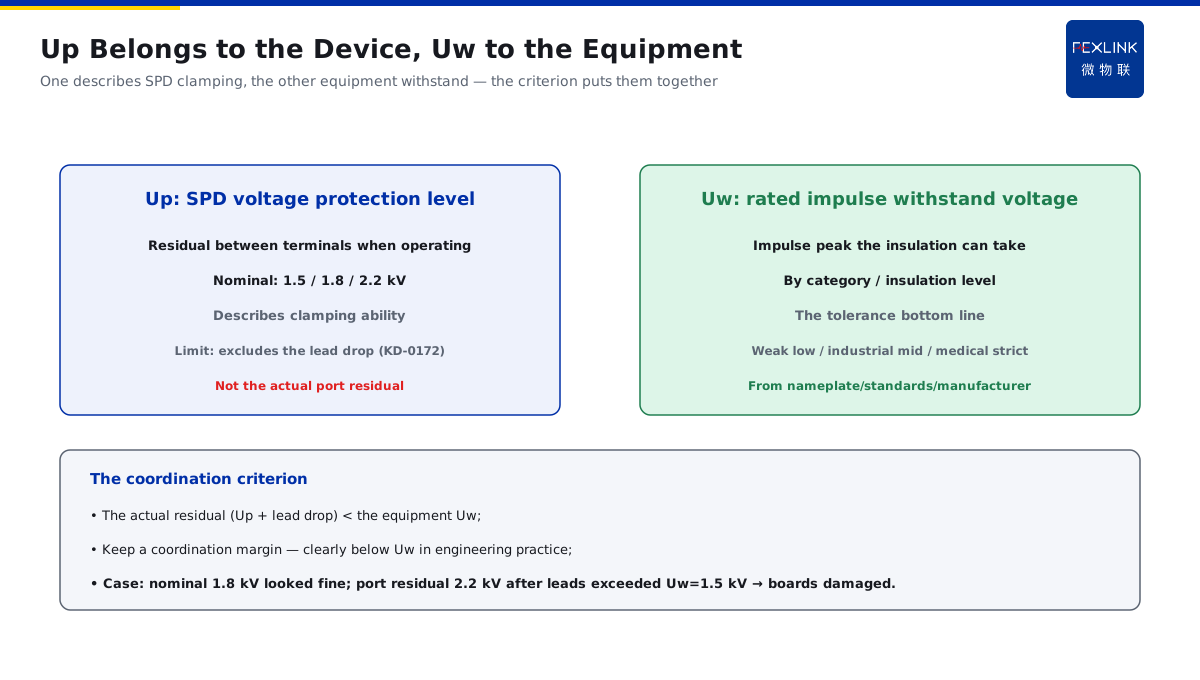
Direct Answer
You selected an SPD with Up = 1.8 kV — how do you know whether the protected equipment can really withstand it and whether the margin is enough? The answer: compare the actual residual voltage at the SPD installation point (Up plus the lead-inductance voltage drop) with the equipment's rated impulse withstand voltage Uw, and require the SPD residual to be below Uw with a coordination margin (engineering practice: clearly below Uw). Looking only at the nominal Up while ignoring the lead residual and the equipment Uw level is the common cause of "installed SPD but equipment still damaged".
In a server room, equipment had Uw = 1.5 kV and an SPD with nominal Up = 1.8 kV was chosen — "same class, feels fine". But the SPD leads were long, and the actual port residual after superposition reached about 2.2 kV, clearly exceeding Uw. After a strike, multiple boards were damaged. The key distinction: Up is the SPD device residual, Uw is the equipment insulation withstand — the coordination criterion is "the actual residual at the installation point < Uw with margin", not comparing the nominal Up with the equipment model by feel.
Why:
- Up: the residual voltage level of the SPD after operation (device level);
- Uw: the impulse withstand voltage the equipment insulation can take (equipment level);
- Coordination criterion: the residual (including the lead superposition) < Uw with margin;
- Margin tightening: after the lead-inductance residual is added, the margin clearly shrinks.
Key insight: "Coordination is not just installing an SPD — the actual residual at the installation point must be below the equipment Uw with margin, otherwise 'installed SPD, equipment still damaged'."
At a hospital, a medical device was configured with an "industrial-grade SPD", but its Uw level is lower than ordinary industrial equipment; after a strike its power board was damaged. Review: reselected an SPD with lower residual (FSS series) per the device's actual Uw and shortened the leads — the problem disappeared. Lesson: different equipment has different impulse-withstand levels — select the SPD by the equipment Uw, not by "convention".
1. Up: The Residual Voltage Level of the SPD after Operation
Step one: what Up says.
The definition of Up:
- Up = the SPD voltage protection level;
- It is the residual voltage between the SPD terminals when it operates;
- The nominal value is rated by the manufacturer (e.g. 1.5/1.8/2.2 kV);
- It reflects the SPD's own "clamping ability".
How Up is measured:
- Under standard waveshapes (e.g. 8/20 μs, 1.2/50 μs);
- Corresponding to the nominal discharge current In;
- The lower the value, the better the protection;
- But lower usually costs more.
The limits of Up:
- It is only a device-level parameter;
- It excludes the lead voltage drop (connecting to KD-0172);
- It excludes the effect of the installation method;
- It cannot be used directly as the "equipment-port residual".
Key insight: "Up is the nominal device residual of the SPD — it describes the clamping ability, but it is not yet the residual the equipment port actually sees."
2. Uw: The Impulse Withstand Voltage the Equipment Insulation Can Take
Step two: what Uw says.
The definition of Uw:
- Uw = the equipment rated impulse withstand voltage;
- The impulse voltage peak the equipment insulation can take;
- Determined by the equipment category/insulation level;
- It is the equipment's "tolerance bottom line".
Uw level differences:
- Weak-current equipment (information/control) has a lower Uw;
- Industrial equipment is medium;
- Medical and other sensitive equipment has dedicated requirements;
- The same equipment type may have different Uw levels.
The use of Uw:
- Compare with the SPD residual to judge coordination;
- Sets the Up ceiling of the SPD;
- Is the equipment-side input of the coordination criterion;
- Look it up from the nameplate/standards/manufacturer data.
Key insight: "Uw is the equipment insulation's tolerance bottom line — the level differences are real, and the equipment-side input of the coordination criterion must be checked accurately."
3. The Coordination Criterion: Residual < Uw with Margin
Step three: how to put the two parameters together.
The coordination criterion:
- The actual residual at the installation point < the equipment Uw;
- The residual = Up + lead-inductance residual;
- Keep a margin (residual clearly below Uw);
- Insufficient margin = nominal coordination, actual danger.
Why keep a margin:
- The residual varies with the lightning-current amplitude;
- Lead/connection impedance has dispersion;
- Equipment withstand falls with ageing;
- The margin is the "safety allowance".
How to take the margin:
- Engineering experience: residual clearly below Uw;
- Standards verify level by level along the coordination chain;
- Sensitive equipment takes a larger margin;
- Review rechecks against the actual residual.
Key insight: "The criterion in one sentence: the actual residual at the installation point (Up + lead) < the equipment Uw with margin — the margin is the safety allowance and must not be just barely enough."
4. Why the Margin Tightens after the Lead Residual Is Added
Step four: why "installed SPD, equipment still damaged".
Where the lead residual comes from:
- Lead inductance × lightning-current rate of change;
- The larger the di/dt, the larger the drop;
- The longer the lead, the larger the inductance;
- Port residual = Up + lead drop.
The consequence of tightening:
- The nominal Up is below Uw;
- But the port residual may exceed Uw;
- Overvoltage at the equipment → damage;
- "Nominal coordination" becomes "actual non-coordination".
How to hold the margin:
- Shorten the leads (V-type routing, connecting to KD-0172);
- Select an SPD with lower Up;
- Check Uw accurately before selection;
- Measure/recheck the port residual.
Key insight: "After the lead-inductance residual is added, the port residual may exceed Uw — 'installed SPD, equipment still damaged' usually comes from this; shorten the leads and select by the actual residual."
5. How to Select the SPD for Different Uw Levels
Step five: select by the equipment category.
Uw levels and selection:
- Weak-current/information equipment: low Uw → select low-Up SPD (e.g. 1.2 kV class);
- Industrial equipment: medium Uw → conventional Up coordination;
- Medical/sensitive equipment: per dedicated standards → stricter;
- Power side and signal side configured separately (connecting to KD-0165).
The selection logic:
- Check the equipment Uw first;
- Set the Up ceiling (residual < Uw with margin);
- Select the SPD model + shorten the leads;
- Graded coordination (coarse at the entrance, fine at the end).
Common errors:
- One SPD for everything;
- Selecting only by capacity, not by Uw;
- Leaving long leads unhandled;
- Not rechecking the port residual after installation.
Key insight: "Select the SPD by the equipment Uw: check Uw first, set the Up ceiling, shorten the leads, grade the coordination — different equipment withstands differently, so the configuration must differ."
6. Product Implementation: Building Coordination into Selection and Operations
WeiWuLian products build Up–Uw coordination into the process:
- FSS Intelligent SPD: multiple Up classes covering weak-current/industrial/medical scenarios;
- Selection tool: recommends the SPD class by the equipment Uw;
- FS/ESM SPD Monitor: leakage/temperature/event monitoring keeps the SPD healthy;
- Residual recheck: verify the coordination margin against the actual conditions after installation.
The design principle in one sentence: "Check Uw first, then set Up, shorten the leads, keep the margin — coordinate at selection time, and the equipment is truly protected."
7. Common Misjudgments
- "A low Up means safe": ignoring Uw and the leads. Result: the port residual still exceeds the withstand. Correct: compare by the actual residual.
- "Same-class configuration is fine": ignoring the equipment Uw level. Result: weak-current equipment damaged. Correct: select by the equipment Uw.
- "Installing an SPD solves everything": ignoring the coordination criterion. Result: nominal coordination, actual danger. Correct: residual < Uw with margin.
- "Long leads do not matter": ignoring the inductance residual. Result: margin eaten away. Correct: short V-type leads.
- "Barely enough margin is fine": no allowance. Result: a large strike exceeds it. Correct: clearly below Uw.
Scope and Limitations
This article explains the coordination criterion between the SPD voltage protection level Up and the equipment rated impulse withstand voltage Uw (actual residual at the installation point < Uw with margin), the effect of the lead residual on the margin, and the logic of selecting SPDs by equipment category, applicable to SPD selection and coordination verification. The exact Up/Uw values and coordination-chain methods follow IEC 61643-11, GB/T 18802.11 and the relevant product standards; the engineering margin is set jointly by experience and standards. All cases are anonymized (a server room, a hospital) and do not refer to any specific customer.