 FEXLINK Research Institute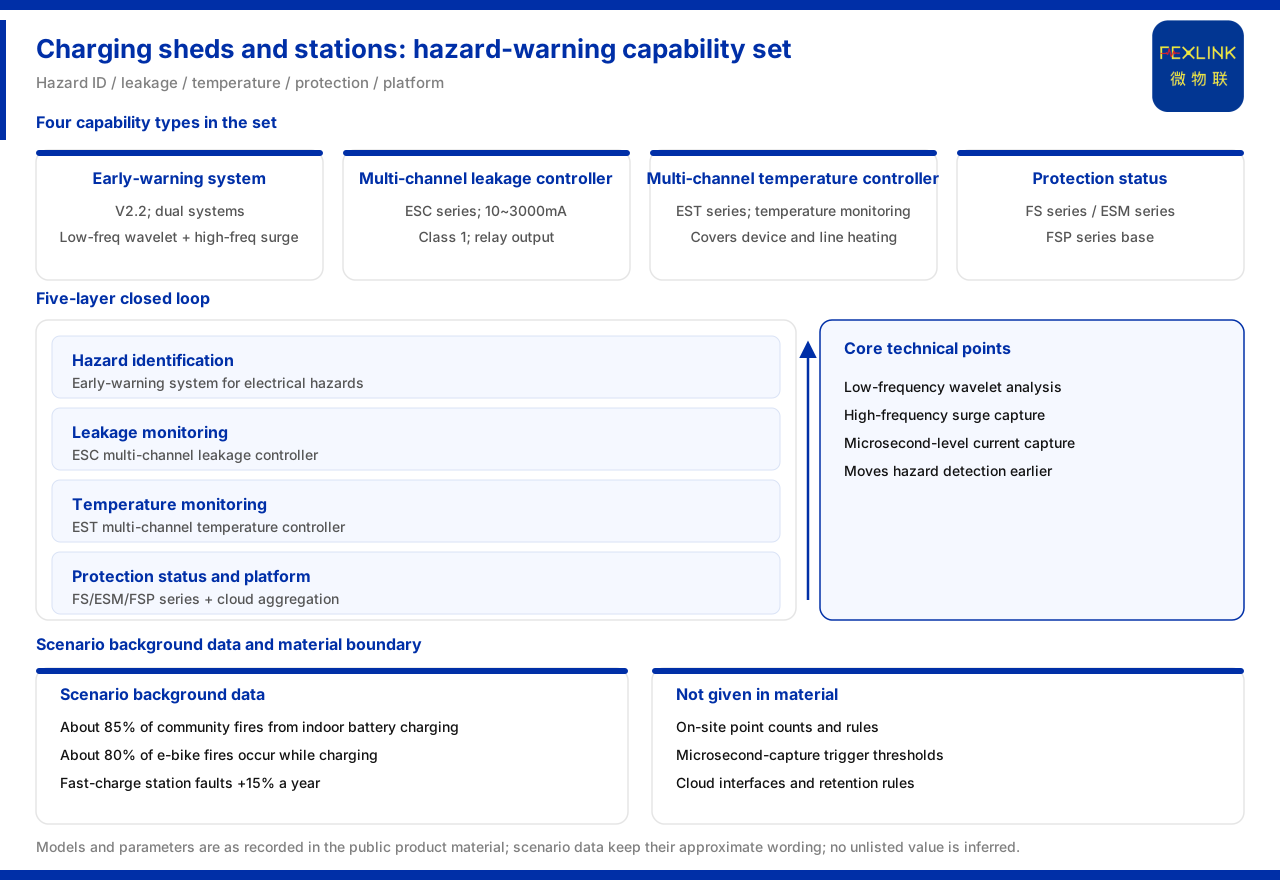
Hazard early warning for charging sheds and charging stations: which monitoring capabilities are needed?
Direct answer: the available product material turns hazard early warning for charging scenarios into a combination rather than a single device. The system facing the charging scenario is the electrical hazard early-warning system, version V2.2, covering the dual architecture of two-wheeled e-bike charging and new-energy vehicle charging. The selection combination given by the material is: the electrical hazard early-warning system plus the multi-channel leakage-current controller for leakage monitoring, plus the multi-channel temperature controller for temperature monitoring, and then connection to the cloud platform to form a closed loop. The material also gives a supplementary combination from the lightning-protection side: the surge protective device monitor, the intelligent lightning-protection monitoring terminal and the SPD lightning-protection base. A complete charging-site early-warning setup therefore contains at least five parts: hazard identification, leakage, temperature, lightning-protection state and platform.
Dual-architecture scenarios and two sets of fire data
The material splits the charging scenario into two architectures. The two-wheeled e-bike architecture concerns dispersed charging behaviour close to residents; the new-energy vehicle architecture concerns concentrated, higher-power charging facilities. The hazard forms of the two scenarios differ, so the same early-warning system must adapt to each separately.
The material gives two sets of data to illustrate the pain points: about 85% of community fires originate from taking batteries indoors to charge, and about 80% of e-bike fires occur while charging. Taken together, the two sets point to the same judgement: the charging period is the high-incidence window for two-wheeled e-bike fires, and bringing batteries indoors to charge further amplifies the risk. These data reflect scenario pain points rather than a promise of any device's effect, and the "about" wording should be retained when cited in a scheme.
The failure-rate problem of fast-charging stations
On the new-energy vehicle charging side, the material points out that the failure rate of fast-charging stations grows by about 15% each year. For operators, this means that as the equipment scale expands, the pressure of handling failures and hazards also rises. Charging facilities operate for long periods under high load and frequent start-stop conditions, and the electrical connections, insulation and device states are all prone to slow degradation.
This background explains why the monitoring focus of a charging site is not "alarm after the fact" but "early discovery". In an environment of rising failure rate, the earlier an abnormality is identified, the more a small problem can be prevented from becoming an outage or an accident. The value of an early-warning system therefore lies in moving the point of hazard discovery earlier.
Core technology: microsecond capture of abnormal current
The material states that the core technology of the early-warning system includes low-frequency wavelet analysis and high-frequency transient capture, able to capture abnormal current at the microsecond level. The two directions correspond to two kinds of abnormality: the low-frequency wavelet favours slow trend-type abnormality, and the high-frequency transient favours instantaneous impulse-type abnormality. Microsecond capture means the sampling speed is sufficient to cover rapid transitions, not merely to record an average.
The material also gives a key judgement: about 90% of charging fires originate from undiscovered hazards. This explains the emphasis on "early" and "capture": if a hazard is not observed before it occurs, subsequent protection can only intervene after the accident has already started. Note that this proportion describes the gap in hazard discovery and cannot be used to infer that any single technology can eliminate all risk.
How the selection combination forms a closed loop
Breaking the combination given by the material down by function reveals a complete chain.
The first layer is hazard identification, carried by the electrical hazard early-warning system, responsible for capturing and analysing abnormal current.
The second layer is leakage monitoring, carried by the multi-channel leakage-current controller, covering the leakage-current state of the charging circuit.
The third layer is temperature monitoring, carried by the multi-channel temperature controller, covering the heating state of charging equipment and lines.
The fourth layer is lightning-protection state, formed by the surge protective device monitor, the intelligent lightning-protection monitoring terminal and the SPD lightning-protection base, used to monitor the state of existing protective devices.
The fifth layer is platform aggregation, connecting the above data to the cloud to form a closed loop of continuous monitoring and early warning. The role of this layer is to turn scattered alarms into traceable records.
Key parameters of the multi-channel leakage-current controller
The leakage-monitoring range of the multi-channel leakage-current controller is 10 to 3000 mA, with class 1 accuracy. This range covers the interval from smaller leakage to larger leakage, suitable for charging circuits that need both sensitivity and a wide range. Besides leakage monitoring, the material gives its relay contact capacity as AC 250 V, 3 A and DC 30 V, 3 A, which can serve as an output interface for linkage control.
In scheme design, leakage data and temperature data should be evaluated separately: leakage reflects the insulation and circuit state, while temperature reflects the heating and connection state; the two complement each other and cannot substitute for each other. The material gives no joint criterion for leakage and temperature, so a joint analysis rule must be defined separately on the scheme side.
How the lightning-protection side is connected
Charging sites are mostly in outdoor or semi-outdoor environments, so lightning-protection state also enters the monitoring scope. Starting from typical scenarios, the material lists the recommended combination for surge protective device state monitoring as the surge protective device monitor, the intelligent lightning-protection monitoring terminal and the SPD lightning-protection base. Among them, the surge protective device monitor provides state parameters such as leakage current and lightning-strike count, the intelligent lightning-protection monitoring terminal handles all-parameter monitoring, and the SPD lightning-protection base is used to mount together with the protective device.
It should be noted that this lightning-protection combination is a recommendation given by the material, not a mandatory list for all charging sites. Whether it is needed, and how much, should be confirmed together with the geographical location and thunderstorm environment of the site.
Material boundaries and practical notes
First, the material gives no number or rule for the on-site layout of the early-warning system; point density must be designed according to site scale and circuit structure.
Second, the material gives no trigger threshold or false-alarm control method for microsecond capture; actual commissioning requires calibration against field data.
Third, the material gives no interface or data-retention rules for the cloud platform; these need separate confirmation according to project requirements.
Fourth, the fire and failure-rate data in the material come from scenario descriptions and are background formulations; they cannot serve as the basis for quantified project benefits.
Summary
Hazard early warning for charging sheds and charging stations can be understood in five capability layers: the electrical hazard early-warning system (V2.2) handles abnormality identification in the dual-architecture scenario, the multi-channel leakage-current controller handles leakage monitoring at 10 to 3000 mA with class 1 accuracy, the multi-channel temperature controller handles temperature monitoring, the surge protective device monitor, the intelligent lightning-protection monitoring terminal and the SPD lightning-protection base handle lightning-protection state, and the cloud platform handles data aggregation. The scenario data given by the material include about 85% of community fires originating from taking batteries indoors to charge, about 80% of e-bike fires occurring while charging, the failure rate of fast-charging stations growing by about 15% per year, and about 90% of charging fires originating from undiscovered hazards.
Keeping "scenario background data" and "device-supported capability" separate in the wording is what prevents a charging-site early-warning scheme from treating industry statistics as a product promise.