 FEXLINK Research Institute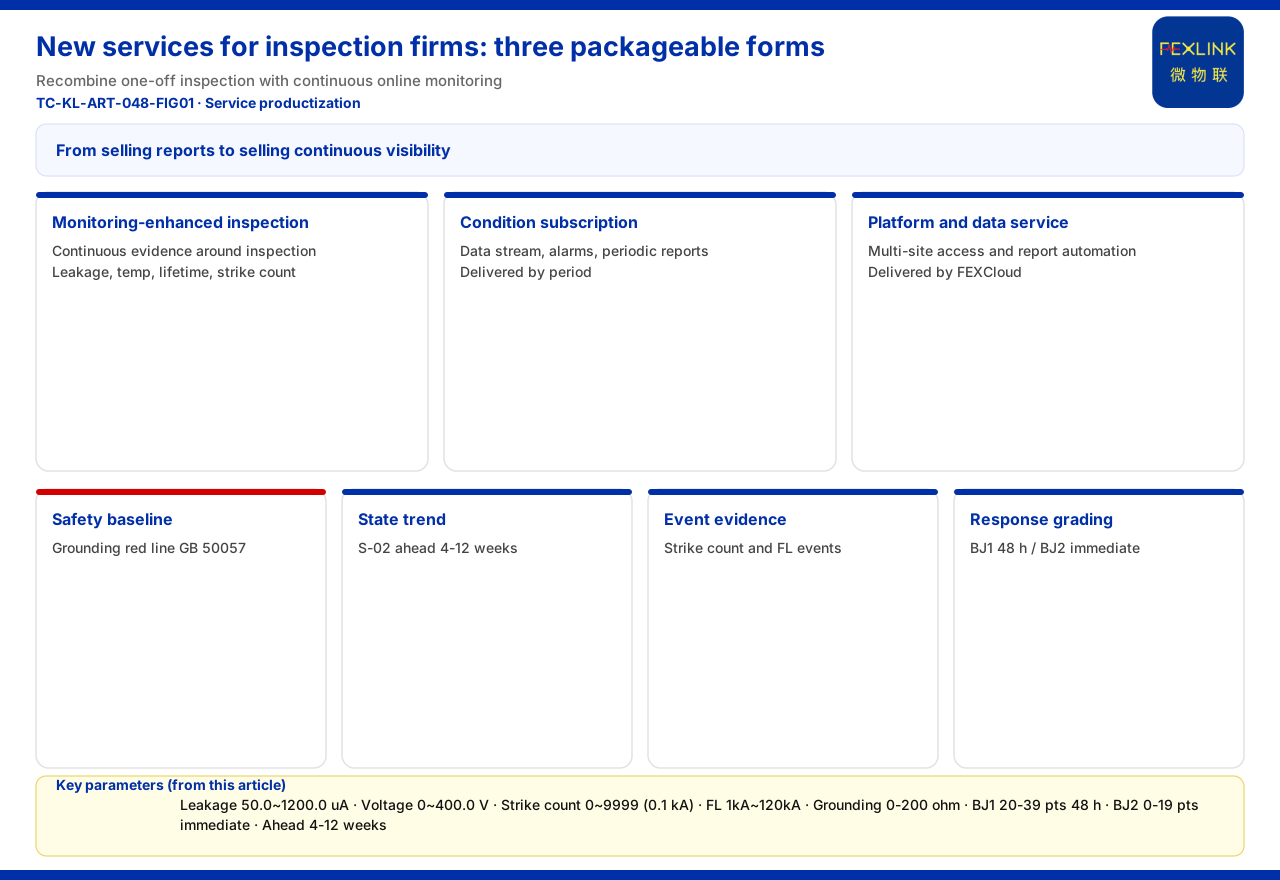
A lightning-protection inspection firm's traditional revenue is periodic: billed by project or year, the report issued, the fee settled, the service concluded. Growing a new line is not about inspecting more often; it requires recombining one-off manual inspection with continuous online monitoring into packageable, reusable service products.
The boundary is clear. This article answers which new services an inspection firm can design, how to package them, and where data-service value comes from, focused on the market-facing product combination. It does not assess technical feasibility of the shift to continuous risk service (see "From Annual Inspection to Continuous Risk Service"), internal role rearrangement (see the project-to-O&M piece), or contract clauses, metering and renewal (see the long-term O&M contract piece). All four share one knowledge-base foundation but differ in focus.
Why Inspection Alone Rarely Grows a New Service Line
Inspection's structure makes new products hard to extend. Its deliverable is a snapshot of one day: the conclusion is realised when the report is issued, and no action must then continue, so no fresh charging basis appears. Customer contact is infrequent, once a year or per project, too few touchpoints to sustain a relationship. And there is no reusable digital asset: each inspection starts near zero, and prior data rarely becomes material the next round can use. All three point to one gap: no carrier that continuously generates data and can be delivered repeatedly. When online monitoring turns "is it safe?" into a state visible daily, that carrier appears and the new line has material to package.
Productizable Material Comes from the Monitoring Capability List
The knowledge base supplies the skeleton: defines monitoring as a four-layer architecture of perception, edge, platform and application layers. The perception layer collects FS/FR/FL/ES modules and sensor data, the edge gateway uploads to FEXCloud, and the application layer presents visualisation, alarms, reports and mobile inspection.
The capability list is verifiable. The FS surge protective device monitor covers remote signalling, air-switch status, grounding status, lightning-strike count, leakage current, temperature, voltage and lifetime estimation, with leakage current 50.0~1200.0μA (±10μA), voltage 0~400.0V (±0.1V), lightning-strike count 0~9999 (minimum trigger 0.1kA) and lifetime estimation 0~100%. The ESM intelligent lightning-protection monitoring terminal adds switching values, grounding, lightning-strike count, leakage current, temperature, voltage, humidity and lifetime estimation, with DC5V or AC220V supply. The FR grounding resistance monitor FR-01311 uses the three-electrode method, DC12V and outdoor installation, with RS485/Zigbee/Ethernet communications. Lightning and transient events are handled by FL: FL-01222 (indoor) and FL-01212 (outdoor) cover 1kA~120kA with energy monitoring, while FL-11122 (indoor) covers 0.1kA~1kA. Data is uplinked by the FG lightning-protection intelligent gateway, a protocol-conversion type with RS485/Zigbee downlink, Ethernet uplink and DC12V supply, in models FG-0221-ER and FG-0221-EZ. For retrofits, the FSP SPD lightning-protection base offers FSP-21000-R and FSP-21100-R, both AC220V with RS485, remote signalling and lightning-strike counting, the latter adding temperature. The scenario table gives packaging anchors: existing SPD retrofit maps to FS/ESM/FSP; grounding-grid online monitoring to FR-01311 (one set per point) plus FG gateway plus FEXCloud; tank-farm/petrochemical explosion protection to explosion-proof grounding resistance plus FL plus FS.
These are not isolated selections but a material list of continuously obtainable data, and thus of the products that can stand; the firm must map it onto service forms customers will keep paying for.
Three Packageable Service Product Forms
One, monitoring-enhanced inspection. Inspection continues, but online data serves as continuous evidence around it: trend data beforehand pinpoints key locations, continuous data afterwards corroborates the conclusion. Leakage current, temperature, lifetime estimation and lightning-strike count suit this corroboration, turning the report into one backed by a trend.
Two, condition subscription service. Data streams, alarms and reports are packaged into a subscription delivered by period; the customer buys continuous watching rather than a one-off report. Its semantic layering comes from the knowledge base: the red line (grounded in GB 50057) maps to the safety-floor class, while the S-02 residual-current trend drift maps to the trend-warning class.
Three, platform and data service. For multi-site customers, platform onboarding, centralised monitoring and report automation are the deliverable: FEXCloud handles device onboarding, time-series database and AI inference, and the application layer provides alarms and reports. It serves not a single inspection but the visibility of many sites. The forms stack: inspection keeps the compliance touchpoint, while subscription provides recurring cash flow.
The Core of Packaging: Translating Monitoring Elements into Service Items
Whether packaging holds depends on whether monitoring elements translate into service items the customer can accept. The knowledge base already provides a usable semantic layering.
The safety-floor class maps to grounding status and the red line: a red-line trigger emits the highest-level alarm directly and takes no part in weighted scoring, suiting a commitment never to relax the red line for staffing or budget.
The condition-trend class maps to S-02 residual-current trend drift (CUSUM): it detects a weak mean shift while leakage is still safe, and the knowledge base states it can warn 4-12 weeks ahead, suiting predictive warning plus planned maintenance.
The event-evidence class maps to lightning-strike counts and FL event-parameter records, answering what happened recently, suiting an event and traceability report.
The response-grading class maps to the six-level alarm system: BJ1 (20-39 points) requires action within 48 hours, BJ2 (0-19 points) immediate shutdown, converting into tiered response-time items.
Writing clearly which quantity, which threshold, how fast a response and what evidence is retained turns the service from a vague inspection-plus-warranty arrangement into a measurable, acceptable product; this is the article's methodological proposal.
Where a Data Service Gets Its Value
This article's judgment focuses on three points: evidence, because events and records are traceable; trend, because continuous data supports early discovery of slow change, such as S-02's warning; and grading, because data maps to risk levels and response deadlines to form a manageable order. What they share is turning an invisible operating state into deliverable, traceable, continuous information. The knowledge base states data capability but not how it should be priced.
What This Article Does Not Claim
Implementation must be confirmed item by item against company qualifications and customer conditions.
Second, the quantitative indicators (electrical-hazard identification rate 95%+, alarm compression ratio 80%, 4-12 weeks' warning lead time, fault-localisation time from days to 2 hours, MTTR reduced by 60%, comprehensive energy-saving potential 8-20%) are all vendor self-reports. They may be cited as vendor capability claims, but not as service commitments, pricing basis or performance marketing.
Third, notes that the FR/FRP series has been applied to railway traction-substation grounding-grid online monitoring and the Jinzhou Port tank farm (10 sets per tank), among other projects; this internal knowledge-base reference, is cited only as a source note, not performance evidence.
Fourth, this article provides no pricing model, package price, subscription condition, return-on-investment (ROI) calculation or effect commitment; it claims no model, parameter, certification or case absent from the knowledge base; all parameters are limited to the corresponding knowledge base entries, without extrapolation. Nor does it claim online monitoring can replace statutory or contractual periodic inspection.
Conclusion
For an inspection firm, building new services from online monitoring does not mean inspecting more often but combining inspection and monitoring into packageable service products: first establish reusable material from the four-layer architecture and the FS/ESM/FR/FL/FG/FSP capabilities, then package it through monitoring-enhanced inspection, condition subscription, and platform and data service, and finally translate monitoring elements into four acceptable service-item classes: safety floor, condition trend, event evidence and response grading. For the firm, this means moving from selling reports to selling continuous visibility; for the customer, the procurement subject expands from a single inspection to continuous information. Specific combinations and commercial terms still require review against the company's actual situation.