 FEXLINK Research Institute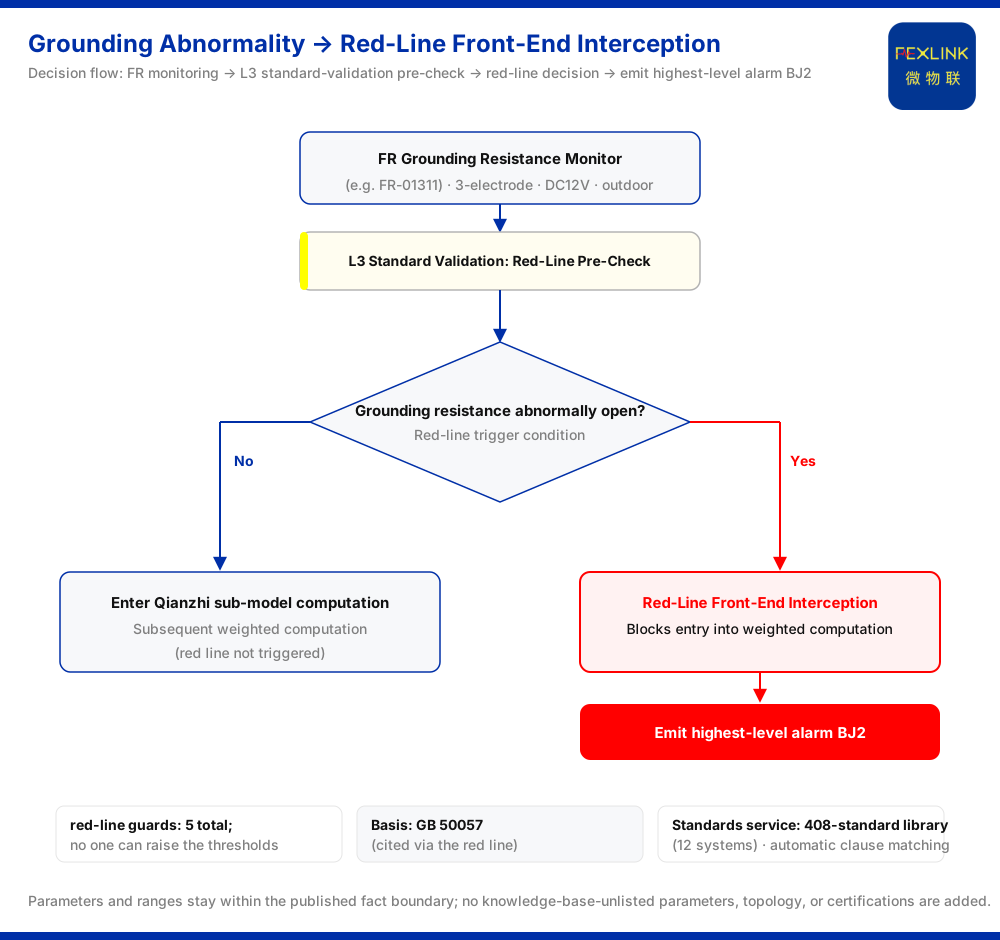
Direct answer. In the knowledge base, the relationship between GB 50057 and lightning-protection monitoring is not a clause-by-clause comparison but a convergence: the standard is reduced to one point that can be monitored and verified — grounding. The grounding red line takes "abnormal open circuit of the grounding resistance" as its trigger condition and cites GB 50057 as its basis. In monitoring terms, the standard's requirement on grounding becomes "the grounding state is observable and an abnormality cannot be bypassed." The four steps below — landing point, interception, acquisition and evidence — unpack that sentence.
1. The landing point: why "abnormal open circuit of the grounding resistance"
The practical constraint when connecting a standard to a monitoring system is that clauses cannot become alarms verbatim. What can be implemented is to single out the class of conditions that are state-decidable and whose consequence is unacceptable, then make them a red line. The grounding red line selects exactly "abnormal open circuit of the grounding resistance".
An open grounding path is not a gradual trend but a question of whether the safety path holds at all: once grounding — the foundation of lightning protection — is broken, every downstream protective measure loses its reference. Because it admits no compromise and needs no comparison against other indicators, it is suitable as a state that cannot be bypassed. The first meaning of "compliant with GB 50057" in monitoring is therefore that the grounding state is continuously sampled and an abnormality is not silenced.
This is also why the monitoring system does not import the whole standard. Monitoring needs acquirable signals, not the complete set of clauses; GB 50057 covers a wide scope, and the knowledge base links it only at the grounding red line. Mapping requirements onto acquirable quantities one by one is what makes a red line faithful to its basis and genuinely executable.
The boundary must be drawn first: this article's citation of GB 50057 is limited to the grounding red-line entry in the knowledge base and does not cite clauses the knowledge base does not list.
2. Interception: why the L3 pre-check runs before model computation
A red line becomes non-bypassable through execution order, not assertion. The knowledge base states that L3 standard validation — the red-line pre-check — executes before the Qianzhi engine sub-model computation; once a red line triggers, it emits the highest-level alarm BJ2 directly and skips all weighted operations.
Precedence is the essential point. If the red line came after scoring, the model could return a weighted result that "does not look serious," and the red line's absoluteness would be diluted by the average. Placing it up front is a compliance judgement before analysis begins, so an open grounding path cannot be masked by a composite score. L3 and the analysis layers are a one-way gate: data must pass standard validation before assessment is considered.
The pre-check does not replace the Qianzhi engine sub-model computation or scenario-level analysis; it intercepts the non-negotiable part early. Once data trips a red line it no longer enters the weighted path, avoiding a case where "composite health still looks acceptable" while the compliance floor is already crossed.
3. Output: what BJ2 means
A triggered red line outputs BJ2. The knowledge base defines a six-level alarm system in which BJ2 is the highest level, with a value range of 0–19 and a corresponding action of immediate shutdown.
Two points matter when reading it. First, it is a state-type conclusion, not a trend judgement; it need not be compared with other indicators first. Second, its action is explicit: the site should carry out the immediate-shutdown requirement first, then trace the grounding-path problem. Treating BJ2 as "a somewhat more serious prompt" to be worked through slowly erodes the meaning of the pre-check.
4. Acquisition: where the grounding state comes from
Before a standard requirement can become a monitoring action there must be a data source. This link is carried by the FR grounding resistance monitor (FR-01311). The monitor uses the three-electrode method, is powered by DC12V, and is installed outdoors; by communication method it divides into three variants: the RS485 model (FR-01311-R), the Zigbee model (FR-01311-Z), and the Ethernet model (FR-01311-E).
The three suffixes are not aliases of one interface; selection must match the site's networking method to the specific model, and they are not interchangeable. The FR grounding resistance monitor (FR-01311) answers "where the state comes from": without continuous acquisition, the grounding red line loses its precondition of observability and the red line has no basis.
The variants agree on the three-electrode method, DC12V and outdoor installation, and differ only in communication method, so the field decision falls mainly on "how the grounding state is uplinked," not "how grounding resistance is measured." A wrong uplink channel keeps acquired data out of the validation chain, making the grounding red line nominal.
5. Evidence: the 408-standard library and clause traceback
Once the abnormality is intercepted, acceptance and audit still ask: what is the basis? This link is supported by the standard service of the Taiyi intelligent control hub system (V2.0). The knowledge base states that the service contains a 408-standard library covering 12 systems including GB, GB-T, DL, IEC and UL, supports automatic clause matching, and does not permit red lines to be relaxed.
The value for compliance scenarios is that the standards library is linked to real-time monitoring: an alarm states not only what happened but which class of requirement it corresponds to, turning compliance evidence from a manual clause search into a system output. The service is also a component of the Taiyi intelligent control hub system (V2.0), working with the access, cleansing and analysis layers rather than standing alone; being embedded in the pipeline, automatic clause matching supplies the basis when an alarm is generated, not in a later query.
6. Three common misjudgements
First, equating "a grounding monitoring device is installed" with "compliant with GB 50057." The standard sets a requirement on grounding; the device only makes the grounding state observable. Between the two lie whether acquisition is continuous and whether anomalies are intercepted. A conforming device is not established compliance.
Second, queueing BJ2 as an ordinary alarm. BJ2 is the highest-level output after a red-line trigger; its action is immediate shutdown, not a prompt pending assessment.
Third, treating automatic clause matching as an acceptance conclusion. The standards library resolves the basis and the class of requirement; whether the requirement is met still comes back to the grounding state itself.
7. Division of labour: who acquires, who validates, who evidences
The links above require three roles. Acquisition is handled by the FR grounding resistance monitor (FR-01311), which continuously records the grounding state; validation by L3 standard validation, which places the red line early in the execution order; evidence by the standard service of the Taiyi intelligent control hub system. The three answer "where the state comes from," "when the abnormality is intercepted," and "how the basis is stated." If any one is absent, the conversion chain breaks.
The knowledge base establishes five red lines in total, and no person can raise their thresholds. The grounding red line is the one directly corresponding to GB 50057; its non-bypassability comes from "thresholds cannot be relaxed" plus "pre-execution," not from the severity of any single alarm.
Read as a chain, deployment is not a single-point action but a link from observable (acquisition) to interceptable (pre-check) to evidenceable (standard service). Its strength is set by the weakest link: no acquisition means no trigger; no pre-check means the red line is diluted by the average; no standard service means interception cannot be justified afterwards. For the client's safety and compliance lead, these are the three points worth questioning link by link at acceptance.
Applicability and limits
First, this article's citation of GB 50057 is limited to the grounding red-line entry in the knowledge base; it does not cite clauses the knowledge base does not list, nor draw conclusions about specific grounding-resistance limits.
Second, the five red lines are those defined in the knowledge base; this article does not elaborate the trigger conditions and basis standards of the other four red lines.
Third, the three-electrode method, DC12V, outdoor installation and the R/Z/E communication variants of the FR grounding resistance monitor (FR-01311) are limited to the monitor's model table in the knowledge base; the suffixes correspond to different communication interfaces and must not be mixed.
Fourth, the 408-standard library and automatic clause matching are as described in the knowledge base; this article does not infer matching accuracy or standards systems beyond the stated coverage.
Fifth, the six-level alarm system, BJ2's 0–19 value range, and the immediate-shutdown action are as defined in the knowledge base.