 FEXLINK Research Institute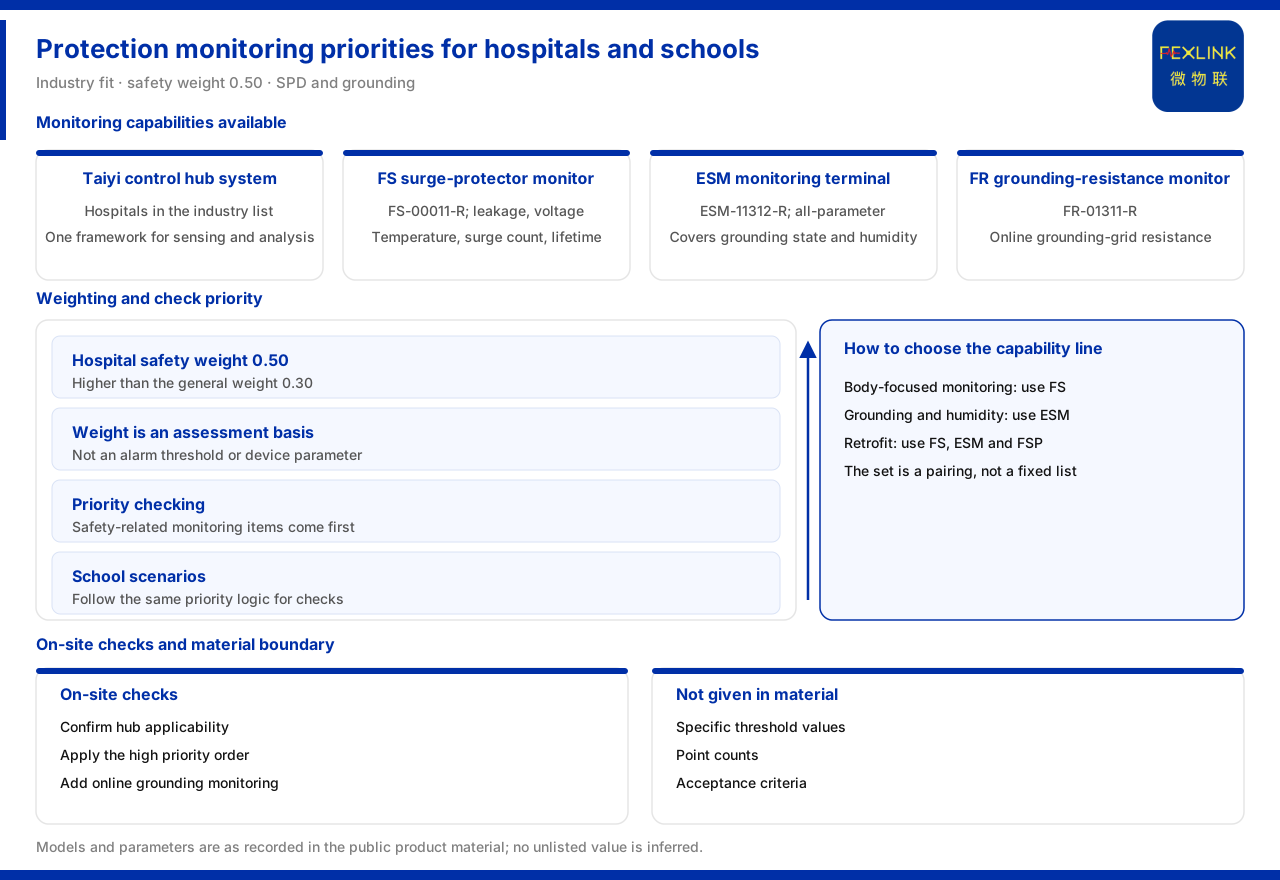
Monitoring priorities for lightning protection in public buildings such as hospitals and schools
Direct answer: hospitals and schools are both building types with dense occupancy and heavy public-safety responsibility, and both are priority objects for lightning-protection monitoring. The material includes medical institutions in the list of applicable industries of the Taiyi intelligent control hub system; in the dynamic weights of the four-dimensional impact assessment, the hospital safety weight is 0.50, higher than the general safety weight of 0.30. Around monitoring capability, the FS surge protective device monitor can monitor leakage current, voltage, temperature, lightning-strike count and life prediction; the ESM intelligent lightning-protection monitoring terminal is the all-parameter version and further covers grounding state and humidity; and the FR grounding resistance monitor takes grounding-grid resistance as its acquisition object and achieves online monitoring. For existing buildings, the recommended combination is the FS device, the ESM device and the FSP SPD lightning-protection base; and abnormal open circuit of grounding resistance is a high-priority item based on GB 50057.
Why hospitals and schools are listed as priorities
A hospital carries diagnosis and treatment functions, and its key equipment needs to run continuously; a school has dense occupancy, is mainly composed of minors, and places high demands on evacuation and safety management. The need shared by both is to keep continuous knowledge of electrical and lightning-protection state and to receive a prompt before or at the beginning of an abnormality. From the industry list in the available material, medical institutions have been clearly included in the applicable industries of the Taiyi intelligent control hub system, which shows that lightning-protection and electrical-safety monitoring for public buildings can be organised within a unified hub framework. Industry applicability means the framework can carry the work; device selection still has to be confirmed point by point on site, and schools can organise their priorities by reference to the hospital scenario.
Why the safety weight of the hospital scenario is high
In the dynamic weight setting of the four-dimensional impact assessment, the hospital safety weight is 0.50, higher than the general safety weight of 0.30. A weight is a value used in an assessment to express how important a certain impact is. The 0.50 safety weight assigned to hospitals reflects that once a power or electrical-safety problem occurs, the effect may spread to diagnosis and treatment and to the safety of people. For project staff, monitoring items directly related to safety should therefore be treated with priority in a hospital scenario, and their attention level should not be lowered merely because nothing has gone wrong so far. A weight is not directly equal to an alarm threshold, nor to a device parameter; the correct use is to let it determine the priority order of screening and the device capability determine which monitoring means to adopt. The school scenario follows the same priority-screening logic.
Priority one: the state of the protective device itself
For lightning-protection monitoring in public buildings such as hospitals and schools, the material gives a clear capability line: the FS surge protective device monitor (for example FS-00011-R) can monitor parameters such as leakage current, voltage, temperature, lightning-strike count and life prediction. Around the surge protective device itself, a state picture can be built from whether leakage current is present, whether voltage and temperature are normal, how many lightning strikes have been experienced, and how much life remains. These parameters have direct meaning for public buildings: a leakage-current trend can indicate device ageing, a temperature abnormality may correspond to poor contact or overload, the lightning-strike count reflects the intensity of lightning activity at the location, and life prediction provides a reference for replacement planning. Which items a particular building or distribution room needs to monitor still has to be determined together with the site.
Priority two: all-parameter monitoring
Another capability line comes from the ESM intelligent lightning-protection monitoring terminal (for example ESM-11312-R). It is positioned as all-parameter monitoring, covering grounding state, lightning-strike count, leakage current, temperature, voltage, humidity and life prediction. Compared with monitoring focused on the protective device itself, the all-parameter terminal also brings grounding state and humidity into scope. The two lines are not contradictory: if only a relatively focused state picture around the protective device itself is needed, the surge protective device monitor can be preferred; if grounding state and ambient humidity are also to be known, the all-parameter terminal should be brought into the scheme. For hospitals and schools, continuous observation of grounding state and humidity helps identify risks early in humid seasons and helps keep key equipment running continuously.
Priority three: online grounding-resistance monitoring
The grounding grid itself needs independent attention. The FR grounding resistance monitor (for example FR-01311-R) takes grounding-grid resistance as its signal-acquisition object and provides online grounding-resistance monitoring. It turns whether the grounding system is still usable from a one-off field measurement into continuous online observation, and suits continuous monitoring of the grounding system of public buildings such as hospitals and schools. For crowded premises, grounding is the last reliance of lightning protection and electrical safety. Bringing grounding resistance into online monitoring is the concrete way to put a high safety weight into practice: once an abnormal trend appears, the review process can start earlier rather than waiting for a routine test.
The capability combination for an existing retrofit
In the surge protective device state monitoring scenario, the material gives a recommended combination for existing retrofits: the FS surge protective device monitor, the ESM intelligent lightning-protection monitoring terminal and the FSP SPD lightning-protection base. For an existing building that already has surge protective devices installed and wants to add state-monitoring capability, this combination offers a clear path: without tearing out the original devices, state data is acquired through the monitor and the matching base. The correct reading is a capability match, not a fixed list. Project implementation still has to return to the site: the model and mounting method of the existing devices, whether there is installation space in the cabinet, and whether what needs monitoring is the leakage current and temperature of the device itself or also grounding state and humidity. The material does not give which model and how many units to use at each point.
One safety red line that cannot be bypassed
The material lists abnormal open circuit of grounding resistance as a red-line condition that cannot be bypassed, with the basis pointing to GB 50057. An abnormal open circuit means the grounding path may already be interrupted, and the grounding system is precisely the last reliance of lightning protection and electrical safety. For high-safety-weight scenarios such as hospitals and schools, this item should be near the front of the screening list. In implementation, the online monitoring capability of the grounding resistance monitor should be used to keep continuous knowledge of grounding-grid resistance; once an abnormal trend or sign of open circuit appears, the project's established procedure should be followed to review it immediately rather than waiting until the annual test.
On-site check list
- Confirm hub compatibility and clarify the responsibility interface for data uplink and unified management.
- In a hospital scenario, place safety-related monitoring items in priority positions and agree the screening order according to the 0.50 safety weight; the school scenario follows the same logic.
- When focused on leakage current, voltage, temperature, lightning-strike count and life prediction, assess the FS surge protective device monitor; when grounding state and humidity must also be covered, assess the ESM intelligent lightning-protection monitoring terminal.
- Use the FR grounding resistance monitor for online grounding monitoring, moving open-circuit abnormalities from after-the-fact discovery to online visibility.
- Use the FS device, the ESM device and the FSP SPD lightning-protection base as the capability reference for an existing retrofit, then confirm quantity and mounting method point by point on site.
- Where the material gives no specific threshold, count or acceptance formulation, confirm them separately as on-site items and record them.
Summary
The monitoring priorities for public buildings such as hospitals and schools can be summed up as one framework, two capability lines and one red line. The framework is that medical institutions have been included in the applicable industries of the Taiyi intelligent control hub system; as an assessment formulation, the hospital safety weight is 0.50, higher than the general safety weight of 0.30. Capability line one is the FS surge protective device monitor, covering leakage current, voltage, temperature, lightning-strike count and life prediction; capability line two is the ESM intelligent lightning-protection monitoring terminal, covering grounding state, lightning-strike count, leakage current, temperature, voltage, humidity and life prediction; grounding resistance is monitored online by the FR grounding resistance monitor; and for existing retrofits there is a recommended combination of the FS device, the ESM device and the FSP SPD lightning-protection base. The red line is abnormal open circuit of grounding resistance, based on GB 50057. What can be monitored follows the device-capability list, and what should be prioritised follows the scenario weight.