 微物联研究院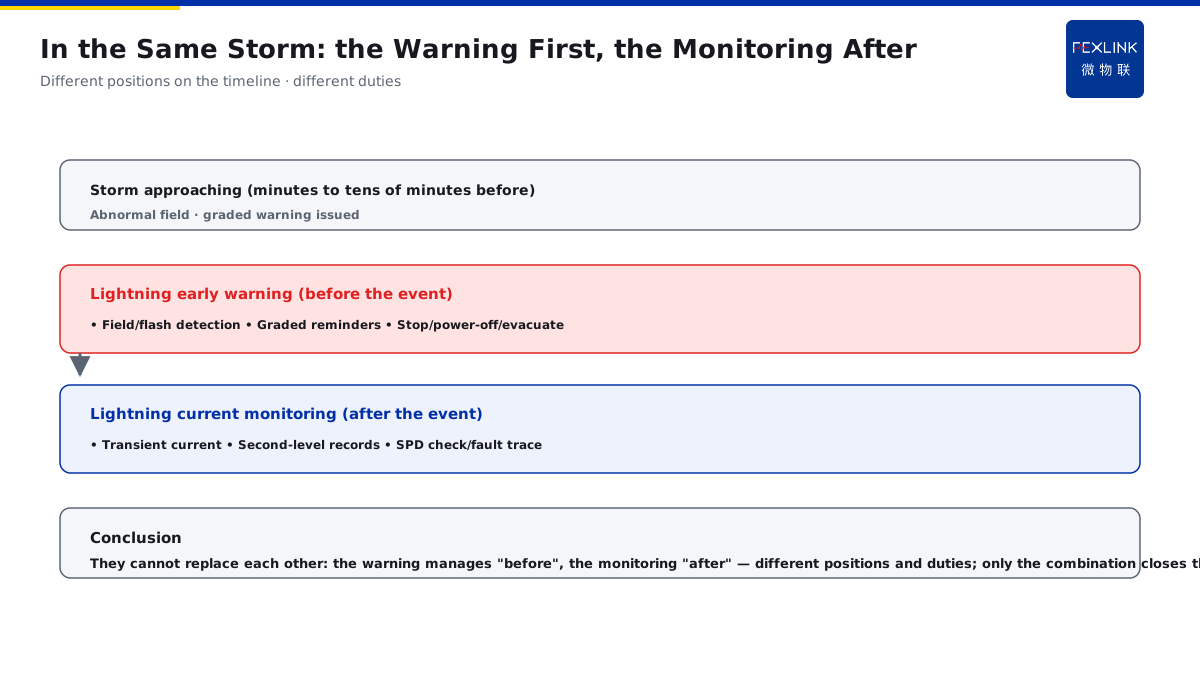
Direct Answer
Many people treat "receiving a reminder before a strike" and "seeing the current record after a strike" as the same system — what exactly is the difference? The answer: the two are complementary as "protection before the event" and "evidence after the event" — lightning current monitoring (e.g., the FL) records the magnitude and count of strikes that have already happened, which is passive evidence; lightning early warning detects through the atmospheric electric field and issues graded warnings minutes to tens of minutes before the storm arrives, which is active avoidance; the two cannot replace each other.
A logistics park with a limited budget installed only current monitoring. Before each storm no one stopped work in advance and the on-site personnel worked as usual; they only knew "it struck" after the fact. Later they added early warning, which issued graded reminders 20 minutes ahead — personnel withdrew first, equipment was powered off first, and after the strike the monitoring records were used to verify the damage. The key distinction: the warning manages "before the strike" and the monitoring manages "after the strike" — the warning detects through the atmospheric electric field and gives graded reminders in advance (active avoidance); the monitoring records the magnitude and count of strikes that have happened (passive evidence); with monitoring only and no warning, you are still caught off guard when the storm comes.
Why:
- The timeline: the warning sits minutes to tens of minutes before the storm; the monitoring records at second level after the strike;
- The detected object: the warning measures the atmospheric electrostatic field / cloud-to-ground flash location; the monitoring measures the transient lightning current in the conductor;
- The output and actions: the warning triggers work stoppage/power-off/evacuation; the monitoring triggers SPD state checks and fault tracing;
- The combined value: the warning + monitoring form the "avoid the peak — protect — gather evidence" loop.
Key insight: "The warning is protection before the event and the monitoring is evidence after the event — the warning gives graded reminders in advance (active avoidance); the monitoring records the strikes that happened (passive evidence); the two cannot replace each other, and combined they form a loop."
At a factory only the early warning was installed. After a strike, no one knew the current magnitude or whether the SPD operated, and the cause of the equipment damage could not be explained. Lesson: with only the warning and no monitoring, the after-the-event evidence is blank — neither the strike intensity nor the protection operation is recorded, and the fault tracing has nowhere to begin.
Overview: run "the timeline → the detected object → the output and actions → the combined value" as one clear concept distinction. Lightning early warning and lightning current monitoring sound similar but work completely differently. The warning is "protection before the event": when the atmospheric electric field is abnormal, it issues graded reminders in advance, leaving time for evacuation and power-off. The monitoring is "evidence after the event": it records the magnitude and count of strikes that have happened, providing data for SPD checks and fault tracing. With a limited budget, first decide whether you want to "avoid" or "gather evidence" — the two are not alternatives but complementary. The four layers are unfolded below.
Why a site with "monitoring only" loses the most: a common budget decision is that "monitoring leaves data and looks more real", so only the lightning current monitoring is installed. But the monitoring is passive evidence — it records only after a strike and cannot give any lead time before the storm. The result: personnel keep working outdoors and equipment keeps running energized, and they only respond passively at the moment of the strike. For personnel-intensive places (construction, inspection, outdoor operations), the missing warning equals discarding "avoidance time", the most expensive resource; after adding the warning, for the same storm the site can evacuate and power off 20 minutes ahead — a completely different situation. "Monitoring only" loses the most: passive evidence gives no lead time — personnel keep working and equipment keeps energized; for personnel-intensive places, the missing warning equals discarding the most expensive "avoidance time".
1. The Timeline Comparison: the Warning First, the Monitoring After
Step one: in the same storm, the two sit at different positions.
The position of the warning:
- Minutes to tens of minutes before the storm arrives;
- Triggered when the atmospheric electric field is abnormal;
- Graded reminders (blue/yellow/orange/red);
- Leaving time for avoidance on site.
The position of the monitoring:
- The instant of the strike (second level);
- Recording the current magnitude and count;
- Data available after the event;
- Leaving evidence for later analysis.
Why it matters:
- Missing the warning = no preparation on site;
- Missing the monitoring = no evidence after the event;
- Different positions, different duties;
- They cannot replace each other.
Key insight: "The warning sits before the storm (graded reminders in advance), and the monitoring at the strike instant (second-level recording) — different positions and different duties; missing the warning leaves the site unprepared, and missing the monitoring leaves no evidence after the event."
2. The Detected Object Difference: Electric Field vs. Current
Step two: the measured things are fundamentally different.
What the warning measures:
- The atmospheric electrostatic field strength;
- The abnormal accumulation of the storm-cloud field;
- Cloud-to-ground flash location information;
- Judging how close the storm is.
What the monitoring measures:
- The transient lightning current in the conductor;
- The current magnitude (kA);
- The waveform and the count;
- The strikes that have happened.
The meaning of the difference:
- The electric field can be detected in advance (before it happens);
- The current can only be recorded afterwards (already happened);
- The detected object decides the timeline position;
- The two systems measure different physical quantities.
Key insight: "The warning measures the atmospheric electric field (detectable in advance before it happens), and the monitoring measures the transient current in the conductor (already happened, recorded only afterwards) — the detected object decides the timeline position, and the two measure different physical quantities."
3. The Output and Action Difference: Avoidance vs. Evidence
Step three: after receiving the result, the actions are completely different.
The output and actions of the warning:
- Graded warning notifications;
- Triggering work stoppage/power-off/evacuation;
- Outdoor operations withdraw first;
- Dangerous areas powered off first.
The output and actions of the monitoring:
- Strike event records;
- Triggering SPD state checks (relating to KD-0161);
- Fault tracing and locating;
- Data kept for review.
The meaning of the actions:
- The warning turns "unknown" into "known";
- The monitoring turns "it happened" into "it is recorded";
- One manages people, the other manages equipment;
- The duties are clear and not mixed.
Key insight: "The warning outputs avoidance actions (work stoppage/power-off/evacuation), and the monitoring outputs evidence records (SPD checks/fault tracing) — one manages people and the other manages equipment, with clear duties."
A site example of graded warning response: the lightning warning outputs by grade, and the site responds by grade — neither overdone nor missed. Blue (attention): watch the weather and check the outdoor work arrangements; yellow (warning): suspend outdoor operations and pull personnel back; orange (alarm): power off dangerous areas and put key equipment into the protected state; red (emergency): fully stop outdoor operations and suspend electrical operations. The monitoring automatically records the magnitude and count after each strike; after the storm, compare with the graded-response records to verify — whether the avoidance happened before the event, whether the protection was in place during the event, and whether the evidence is complete after the event, all in one loop on one screen. A graded-response example: blue→attention, yellow→suspend outdoor work, orange→power off, red→full stop; the monitoring records the strikes and operations, and after the storm the comparison closes the before/during/after loop on one screen.
4. The Combined Value: Avoid the Peak — Protect — Gather Evidence
Step four: only the combination forms a complete loop.
The loop of the combination:
- The warning: avoid the peak before the storm (evacuation/power-off);
- The protection: the SPD/grounding and other protection on duty;
- The evidence: the monitoring records the strikes and operations;
- The loop: full coverage of before-during-after.
The value of the combination:
- Personnel safety with a lead time;
- Equipment protection with evidence;
- The accident cause explainable;
- The rectification direction with data.
The landing suggestion:
- Personnel-intensive places: the warning first;
- High-equipment-value places: the monitoring first;
- Both: the loop is the most complete;
- With a limited budget, choose by risk.
Key insight: "The warning + monitoring = the avoid-protect-gather-evidence loop — a lead time before the event, protection during the event, and evidence after the event; personnel-intensive places prefer the warning, high-equipment-value places prefer the monitoring, and having both is the most complete."
5. Product Implementation: Both Avoid and Gather Visible
How to choose with a limited budget: put the two systems into one decision table and choose by the site attributes. High-personnel-risk places (construction sites, outdoor inspections, hazardous operation areas): the warning first — personnel safety needs a lead time that the monitoring cannot give; high-equipment-value places (data centers, precision production lines, communication rooms): the monitoring first — the after-the-event evidence and SPD checks decide the equipment protection loop; both risks high (large parks, hub stations): the warning + monitoring combination, complete at once. The rule of thumb: first ask "fear of people getting hurt or equipment getting damaged" — fear for people, choose the warning; fear for equipment, choose the monitoring; fear for both, combine; with a limited budget, rank by risk, not by name.
WeiWuLian products land both systems into verifiable monitoring:
- The FL Lightning-Current Monitor: records the strike magnitude/count/waveform;
- Lightning early warning access: graded warnings trigger avoidance actions;
- Linked protection: the warning + monitoring + SPD states on one screen;
- The data loop: reminders before, evidence after, rectification with evidence.
The design principle in one sentence: "The warning is protection before the event and the monitoring is evidence after the event — the FL records the strikes and the warning reminds in advance; the two combine into the avoid-protect-gather-evidence loop, and the lightning-protection system is complete."
6. Common Understanding Misjudgments
- "The warning = the monitoring": duties mixed. Consequence: only one system. Correct: distinguish before/after.
- "Monitoring only is enough": missing the avoidance. Consequence: caught off guard when the storm comes. Correct: add the warning by risk.
- "The warning only is enough": missing the evidence. Consequence: the accident cause cannot be explained. Correct: add the monitoring for evidence.
- "The warning accuracy is low": fearing false alarms. Consequence: giving up on it. Correct: respond to the graded warnings by grade.
- "The monitoring data is useless": underestimating the evidence. Consequence: no basis for rectification. Correct: trace with the data.
Scope and Limitations
This article distinguishes the two systems of lightning early warning and lightning current monitoring (protection before the event vs. evidence after the event), and gives the value of the combined loop and landing suggestions, applicable to the lightning-protection selection and investment decisions. The specific detection-principle details and device parameters follow the product specifications; this article explains only the concept boundary and the combination logic. All cases are anonymized (a logistics park/a factory) and do not refer to any specific customer.