 FEXLINK Research Institute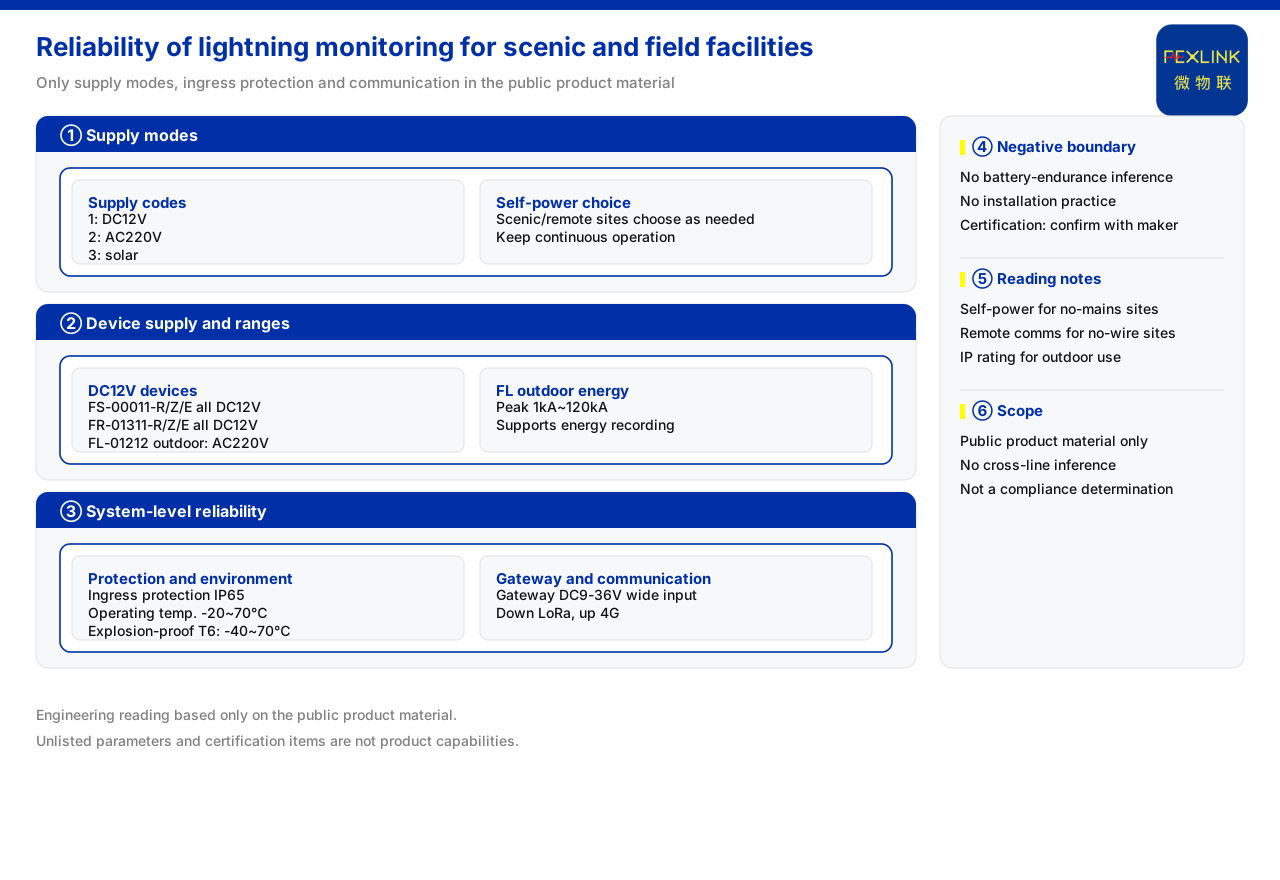
Direct answer
The reliability of lightning-protection monitoring at scenic sites and field installations depends on whether three things hold at once: whether power can continue, whether the equipment can withstand the outdoor environment, and whether data can be returned without wired infrastructure. The product knowledge base provides checkable specifications: the power-supply code for lightning-protection products has four options, DC12V, AC220V, solar and lithium battery; the system-level parameters include IP65 protection and an operating temperature of -20℃ to 70℃ (the explosion-proof T6 variant reaching -40℃ to 70℃), while the smart gateway uses a DC9-36V wide-voltage supply and IP65; and for communication, device downstream supports LoRa and upstream supports 4G. Checking these three points item by item shows whether a field solution has the basis for continuous operation.
Three constraints in field scenarios
Scenic sites and field installations share a common feature: mains power is not always available, equipment is left unattended for long periods, and the environment is harsher than a machine room. These three constraints correspond to power supply, environmental tolerance and communication; the absence of any one affects the continuity of monitoring.
For these three aspects the knowledge base gives configurable options and checkable parameters, which shows that field reliability is not a vague notion but can be broken down into power-supply method, protection rating, operating temperature and communication path, confirmed item by item.
Separating the three constraints also prevents "reliable" from being treated as a single label. Insufficient power, an out-of-range environment and a broken communication link are three different problems with three different parameters; meeting one does not mean the other two are met. Item-by-item confirmation shows which link is weakest.
Power supply is a configurable option
The knowledge base records that the power-supply code for lightning-protection products is 1 for DC12V, 2 for AC220V, 3 for solar and 4 for lithium battery, so field or remote sites can choose a self-powered method to secure continuous operation. Listing solar and lithium battery separately shows that self-powering is a definite option for field scenarios, not a fallback compromise.
Looking at specific products, the surge protective device monitor (for example FS-00011-R) uses DC12V supply, the grounding resistance monitor (for example FR-01311-R) uses DC12V supply, and the outdoor variant of the lightning current / transient current monitor (for example FL-01212-R) uses AC220V supply. Different products have different supply specifications, so selection must match the power form the site can provide.
Outdoor installation and wide-temperature protection
Field equipment must be assessed under outdoor conditions. The knowledge base records that the grounding resistance monitor uses DC12V supply, is installed outdoors and measures by the three-electrode method, with communication selectable as RS485, Zigbee or Ethernet; the lightning current / transient current monitor also offers an outdoor variant whose range covers 1kA to 120kA and supports energy recording. The combination of outdoor installation and a wide range shows that these products are themselves designed for field conditions.
At the system level, the knowledge base gives protection rating IP65 and operating temperature -20℃ to 70℃, and notes that the explosion-proof T6 variant is -40℃ to 70℃. The protection rating addresses dust and water, while the operating temperature addresses the ambient temperature interval; together they define the boundary within which the equipment can run over the long term. Comparing these two with the site's temperature, humidity, dust and rainfall conditions shows whether they match.
The explosion-proof T6 variant extends the lower temperature limit to -40℃, which shows that different models in the same system do not share the same environmental range. Selection should not remember only one system-level temperature interval but return to the note of the specific model. For sites needing a wide temperature range or explosion protection, confirm whether the chosen model covers that interval rather than assuming the system-level parameter already includes all cases.
Communication paths without wired infrastructure
Field scenarios often have no usable wired network, so communication must find another route. The knowledge base records that in the communication protocol matrix, device downstream supports LoRa and upstream supports 4G, so field data can be uploaded without wired infrastructure. Choosing different technologies for downstream and upstream shows that field networking and remote backhaul are two relatively independent problems.
The grounding resistance monitor can select RS485, Zigbee or Ethernet, of which Zigbee is a wireless short-range method; the system-level smart gateway can select 4G, 5G or LoRa and supports local caching of not less than 15 days. Wireless downstream with wide-area upstream and local caching forms the complete path from the field to the platform, with the cache protecting data when the link is broken.
The fact that downstream and upstream can use different technologies gives field networking flexibility: the short-range segment can connect scattered measurement points wirelessly, and the wide-area segment can then use a cellular network for backhaul. When checking, confirm the conditions of the two segments separately, whether a usable short-range link exists on site and whether stable cellular coverage exists in the backhaul area, rather than measuring both with one standard.
Explosion-proof combinations for restricted sites
Some field scenarios impose additional constraints on equipment, such as oil and gas environments. The knowledge base lists "oil-tank-area / petrochemical lightning and explosion protection" as a typical application scenario, with a recommended combination of explosion-proof grounding resistance monitoring, lightning current monitoring and surge-protector monitoring. Placing explosion-proof grounding monitoring together with lightning current and surge-protector monitoring shows that reliability at restricted sites also includes the explosion-proof dimension.
Correspondingly, the explosion-proof variant of the grounding monitoring unit has a range of 0.01Ω to 200Ω, an explosion-proof rating of Ex d IIB T4/T6 Gb, and an operating temperature interval extended to -40℃ to 70℃. These parameters show that explosion protection is not a label but a concrete requirement on range, rating and temperature interval.
Turning reliability into checkable parameters
Taken together, assessing the reliability of lightning-protection monitoring at scenic and field installations can follow one sequence: first confirm which power form the site can provide for the equipment; then check whether the protection rating and operating temperature cover the site environment; then confirm whether the downstream and upstream communication methods suit the absence of wired infrastructure; and finally, at restricted sites, check the explosion-proof range, rating and temperature parameters. The knowledge base gives these specifications through power-supply codes, system-level parameters and the protocol matrix, which suggests that reliability should be supported by checkable parameters.
Applicability and limits
First, this article explains only the checking approach to the reliability of lightning-protection monitoring at scenic and field installations; its factual boundary is limited to the product knowledge base, and it introduces no standard clauses, parameters, certifications or cases the knowledge base does not list.
Second, the meanings of the power-supply codes, the supply and installation specifications of the surge protective device monitor, the grounding resistance monitor and the lightning current / transient current monitor, the system-level protection rating, operating temperature, gateway supply and cache parameters, the range and rating of the explosion-proof grounding monitoring unit, and the description of the communication protocol matrix are all items listed in the knowledge base; this article does not extend them to other models.
Third, this article does not infer protection ratings such as IP65 to be a guarantee for any specific rainfall, immersion or corrosion condition, nor does it infer the endurance time of a self-powered solution at a particular location; the related parameters follow the values listed in the knowledge base.