 微物联研究院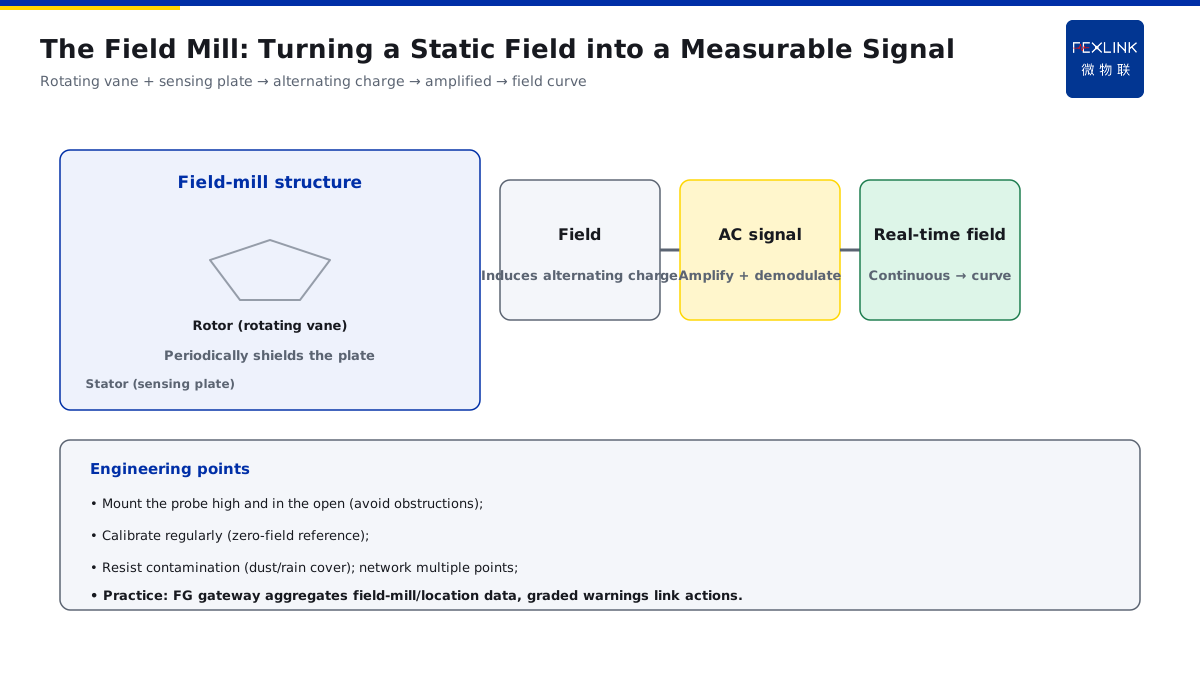
Direct Answer
Lightning warning goes off a few minutes before the strike — what does it actually measure, and how can it be early? The answer: as a thunderstorm cloud approaches, the atmospheric electric field at the ground continuously deviates from the fair-weather level and can reverse polarity; an atmospheric electric-field mill continuously measures that field strength and its rate of change, and when the slope and magnitude cross the thresholds it declares an imminent strike risk — it measures the field change of "a storm approaching", not a return stroke that has already fallen, which is why it provides a minute-level lead time, though it is fundamentally probabilistic rather than precisely localized.
At an open-pit mine with an atmospheric electric-field warning system, the field mill gave a "warning" as the storm approached, and dispatch stopped open-air crane work and evacuated personnel about 8 minutes before the strike; in one storm, the first return stroke near the site appeared about 10 minutes after the warning. The key distinction: field warning measures the field change caused by an approaching storm — before any return stroke lands, the ground field has already deviated persistently from the normal level; that is where the lead time comes from. It is not "alarm after seeing lightning" but "sensing that a storm is approaching".
Why:
- Fair weather vs storm: the fair-weather field is stable; when a storm approaches the field deviates and may reverse polarity;
- Field-mill measurement: a field mill continuously measures the ground field strength and its rate of change;
- Threshold triggering: the slope and magnitude crossing the thresholds → imminent-risk declaration;
- Probabilistic nature: minute-level lead time, but fundamentally probabilistic rather than precisely localized.
Key insight: "Field warning alarms early on the field change of an approaching storm — it measures the precursor, not the strike; the lead time comes from the persistent deviation."
A substation once used "the lightning-location system sees a return stroke, then act" as its basis; the action coincided with the strike and left no time to withdraw sensitive equipment. After adding atmospheric field warning, the field signal triggered the lightning-protection plan a few minutes early (suspending switching, disconnecting vulnerable circuits), and the action window clearly widened. Lesson: lightning location is a record of "already happened"; field warning is a prediction of "about to happen" — together they give the operation real lead time.
1. Fair-Weather vs Storm Ground-Field Characteristics
Step one: how the ground field "lies".
The fair-weather field:
- The fair-weather ground field is stable (about 100–200 V/m);
- It is set by the atmosphere–surface charge balance;
- The direction is roughly constant;
- The diurnal variation is predictable.
When a storm cloud approaches:
- The lower part of a storm cloud carries a large negative charge (typically);
- Positive charge is induced on the ground below;
- The ground field strength rises significantly;
- The field direction may reverse (polarity reversal).
What the field change means:
- A stronger field → a storm approaching;
- Polarity reversal → the cloud-base charge polarity is confirmed;
- A fast rate of change → fast approach;
- The field level is the reading of the "storm precursor".
Key insight: "The fair-weather field is stable; as a storm approaches it deviates, strengthens and may reverse — the ground-field change is the weather forecast of an approaching storm."
2. How a Field Mill Measures the Invisible Field
Step two: how the instrument measures a field you cannot see.
Field-mill structure:
- A rotating vane (rotor) plus a fixed sensing plate (stator);
- The rotor periodically shields the sensing plate;
- The field induces alternating charge on the plate;
- The output signal is proportional to the field strength.
The measurement process:
- Rotation makes the induced charge vary periodically;
- The alternating signal is amplified and demodulated;
- A real-time field-strength value is obtained;
- Continuous measurement → a field curve.
Engineering points:
- Mount the probe high and in the open (avoid obstructions);
- Calibrate regularly (zero-field reference);
- Resist contamination (dust/rain cover);
- Network multiple points (spatial distribution).
Key insight: "The field mill turns a static field into an alternating signal and back into field strength — continuous measurement is what reveals the deviation and the rate of change."
3. How Thresholds and Rate of Change Trigger Warnings
Step three: how the field curve becomes an "alarm".
Warning criteria:
- Field-magnitude threshold (how far from the fair-weather level);
- Field-rate-of-change threshold (how fast it is approaching);
- Polarity reversal (cloud-base charge feature);
- A combination of criteria (fewer false alarms).
Graded warnings:
- Level 1 (watch): the field starts to deviate;
- Level 2 (warning): threshold crossed, fast rate;
- Level 3 (alarm): high imminent-strike risk;
- Each level maps to different actions.
Why use the rate of change:
- Large but stable magnitude → possibly a distant storm;
- Moderate magnitude but violent change → fast approach;
- The rate reflects the "approach speed";
- Magnitude + slope combined is more accurate.
Key insight: "The threshold says how far it has deviated; the rate says how fast it is approaching — the combination triggers graded warnings and turns 'possible storm' into 'imminent strike'."
4. Why It Is a Probabilistic Lead Time, Not Precise Localization
Step four: the boundary of the warning must be clear.
Where the lead time comes from:
- The field change precedes the return stroke (the field change is the precursor);
- The storm-cloud movement speed gives a "minute-level" window;
- The lead time varies as the storm develops;
- It is fundamentally a "probabilistic warning".
Sources of uncertainty:
- The return-stroke landing point cannot be predicted precisely;
- The field and the strike location are not one-to-one;
- Intensifying/weakening storms change the window length;
- Misses are possible (rapidly forming storms).
Correct use:
- Treat the warning as a "risk-rising" signal;
- Combine it with an action plan (stop work / evacuate / disconnect);
- Cross-check with the lightning-location system;
- Do not demand "precise localization".
Key insight: "Field warning gives a probabilistic lead time — it signals that risk has risen minutes ahead; the landing point and moment are handled by on-site action plans."
5. The Relationship between Warnings and On-Site Actions
Step five: what to do after the alarm.
Graded actions:
- Watch level: intensify monitoring, confirm the weather;
- Warning level: suspend high-altitude/open-air work;
- Alarm level: evacuate dangerous areas, disconnect vulnerable circuits;
- Clear level: field returns, confirm safety, resume.
Engineering cases:
- Open-pit mine: stop crane work and evacuate on warning;
- Substation: suspend switching and withdraw sensitive equipment on warning;
- Hazardous site: close open-air loading on warning;
- Every level is written into the plan.
Monitoring loop:
- The field mill monitors continuously;
- The FG Lightning-Protection Intelligent Gateway aggregates events;
- The platform links the action;
- After-action review (warning–strike–loss).
Key insight: "The value of a warning lies in the action — each field signal level maps to a clear action; with the plan written down, the lead time becomes protection."
6. Product Implementation: Intelligent Lightning-Protection Online Monitoring
WeiWuLian products put field warning into practice:
- FG Lightning-Protection Intelligent Gateway: aggregates atmospheric field-mill and lightning-location data;
- Graded warning platform: magnitude + rate triggers, multi-level actions;
- Event correlation: correlate warnings with strikes and equipment interference;
- Action loop: warning → action → review, end to end.
The design principle in one sentence: "Field precursor + graded plan + after-action review — turn the minute-level lead time into real protection."
7. Common Misjudgments
- "Alarm only after seeing lightning": treating the warning as detection. Result: no lead time. Correct: rely on the field precursor.
- "A large field means an immediate strike": large but stable does not mean an imminent strike. Result: false alarms, crying wolf. Correct: combine magnitude and rate.
- Demanding precise localization: the field ≠ the landing point. Result: misplaced expectations. Correct: use it as a risk-probability signal.
- No action plan after the alarm: the lead time is wasted. Result: the warning is in name only. Correct: a graded action plan.
- No calibration / single-point deployment: the measurement is unreliable. Result: false and missed alarms. Correct: multiple points + regular calibration.
Scope and Limitations
This article explains the physical principle of atmospheric field warning: the fair-weather vs storm ground-field difference, field-mill measurement, magnitude-and-rate threshold triggering, the boundary of the probabilistic lead time, and the relationship between warnings and on-site actions, applicable to understanding and selecting lightning-warning systems. The field thresholds, rate criteria and warning levels depend on local storm characteristics and on-site sensitivity, set jointly by the manufacturer and operations; the warning is fundamentally a probabilistic prompt and does not replace lightning location or lightning-protection engineering measures. All cases are anonymized (an open-pit mine, a substation) and do not refer to any specific customer.