 FEXLINK Research Institute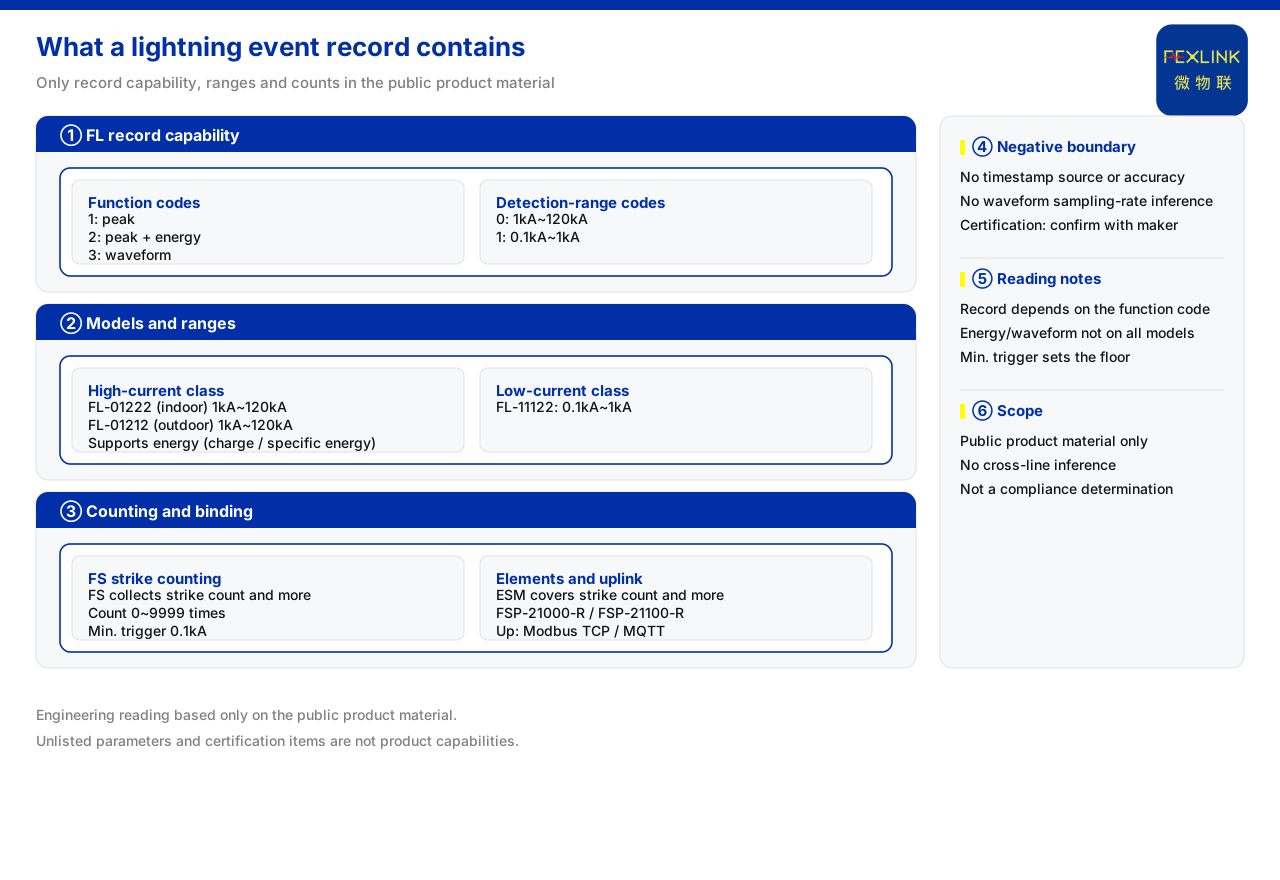
Direct answer
A lightning-strike event record can answer "what is included" at several levels: whether only a peak value is kept, whether peak and energy are kept together, whether the waveform is also retained, and how large a current can be captured at all. The lightning current / transient current monitor described in the product knowledge base uses function codes to define four recording capabilities: peak; peak plus energy; waveform; and waveform plus energy. Its detection-range code separates two tiers, 1kA to 120kA and 0.1kA to 1kA. Alongside this, a surge protective device monitor can collect strike counts, remote signalling, air-switch status and grounding status, and an SPD lightning-protection base also carries a remote-signalling input and a strike counter. An event record and a count record come from different sources and answer different questions.
What an event record can hold
The product knowledge base defines what the lightning current monitor can record by function code: function code 1 is peak, 2 is peak plus energy, 3 is waveform, and 4 is waveform plus energy. These four capabilities show that a complete record of one event is not limited to "it happened"; it may also include the current peak, the energy, and the waveform that varies with time.
Separating these categories makes the layering of an event record clear. The peak answers "how large", the energy answers "how much accumulated", and the waveform answers "how the process unfolded". The combination of function codes is precisely a trade-off among these layers. When choosing a model, first decide which layer the record must reach, then match it to the function code.
This also shows that "event record" does not have a single meaning. Depending on the function code, the same monitor may retain only a peak, or may keep the energy or the waveform as well. If a requirement is stated only as "we need to record lightning strikes", the missing layer is often discovered afterwards. Settling the layer first, then the model, avoids that mismatch.
Peak versus energy: the function-code distinction
The separation of peak and energy is the most basic tier in the function codes. When only the peak is recorded, the record is the maximum current of the event; when energy is recorded at the same time, the charge or specific energy of that event is also reflected. The knowledge base states that the lightning current / transient current monitor supports energy recording, which means that, beyond the peak, energy is an available element of an event record.
This distinction matters for understanding what the device experiences: the peak reflects instantaneous intensity, while the energy reflects cumulative effect. Placed side by side, they give the event record a fuller set of information dimensions.
Range tiers determine the current that can be recorded
Whether an event can be recorded depends on whether its current falls inside the range. The knowledge base states that the detection-range code of the lightning current monitor has two tiers: one covers 1kA to 120kA, and the other covers 0.1kA to 1kA. The range tiers mean that large-current and small-current monitoring targets are handled by different models.
In terms of models, the indoor and outdoor variants cover 1kA to 120kA and support energy recording, while another model covers 0.1kA to 1kA. The split into two ranges means that selection must first judge the current interval that may occur on site; otherwise an event beyond the range is missed.
The indoor and outdoor distinction also points to installation conditions as a further dimension. For the same 1kA to 120kA range, the indoor variant is intended for cabinet or indoor installation and the outdoor variant for outdoor installation; the two agree on range and energy-recording capability, and differ in deployment location. Confirming both the current interval and the installation location is what settles the right model. The FL lightning current / transient current monitor illustrates this: the indoor FL-01222 and the outdoor FL-01212 both reach 1kA to 120kA, while the FL-11122 covers 0.1kA to 1kA.
The SPD side is a separate record source
Besides the dedicated lightning current monitor, the SPD side also provides strike-related records. The knowledge base states that the surge protective device monitor collects strike counts, remote signalling, air-switch status and grounding status; its strike-count range is 0 to 9999 counts with a minimum trigger of 0.1kA. A count record answers "how many times it happened", which complements the event record's "what each event looked like".
The knowledge base also records that the model table of the intelligent lightning-protection monitoring terminal includes strike counting, digital inputs, grounding status, leakage current, temperature, voltage, humidity and life estimation, which can bind a strike event to multiple elements. The SPD lightning-protection base carries a remote-signalling input and a strike counter; one variant has 0 temperature channels and another has 1, both using RS485 and AC220V. All of this shows that count records can sit on different SPD-side products.
How records travel up to the platform
Once a record is formed, it must travel up through a gateway before it enters unified analysis. The knowledge base states that device upstream supports Modbus TCP and MQTT over Ethernet and 4G, with optional gateway-level IEC 61850. This means the records of the lightning current monitor and the SPD-side products can be merged at the gateway and then reported.
Placing the event record and the count record on the same upstream link makes it possible to relate the peak, energy and waveform of one event to its corresponding count. Support for upstream protocols is the condition that lets event recording move from standalone storage to platform analysis.
IEC 61850 is an optional gateway-level path, while Modbus TCP and MQTT run over Ethernet and 4G; the three paths are not described in the same way. An event record is a relatively large body of data, so which upstream path is chosen depends on the network conditions available on site and the way the platform is connected. When checking, confirm the upstream conditions first and the record content second; the order should not be reversed.
Matching recorded information to real requirements
Taken together, judging what a lightning-strike event record should contain can follow one sequence. First, decide whether each event must be distinguished; second, decide whether the event record should reach peak, energy or waveform; third, check whether the range covers the on-site current interval; fourth, confirm whether an SPD-side count record is needed as a supplement; and finally, confirm that the upstream link is complete. The knowledge base defines recording capability through function codes and detection-range codes, which itself suggests that selection should settle the recording requirement first and match capability afterwards.
The sequence begins with "whether each event must be distinguished" because event records and count records answer different questions: the former serves per-event analysis, the latter cumulative statistics. If the need only reaches the statistical level, an SPD-side count is enough; if per-event analysis is required, it is necessary to return to the function codes of the lightning current monitor. Separating the requirement level first, then matching the product, is the core of this sequence.
Applicability and limits
First, this article explains only the information types contained in a lightning-strike event record; its factual boundary is limited to the product knowledge base, and it introduces no standard clauses, parameters, certifications or cases the knowledge base does not list.
Second, the meaning of the lightning current / transient current monitor's function codes, the two detection-range tiers, the range and energy-recording capability of the indoor and outdoor variants, the strike counting and status quantities of the surge protective device monitor, the element combination of the intelligent lightning-protection monitoring terminal, the two configurations of the SPD lightning-protection base, and the upstream protocol description are all items listed in the knowledge base; this article does not extend them to other models.
Third, this article does not treat a count record as a substitute for an event record, nor does it infer a model's field event-capture rate; the recording capability indicated by the function codes follows the knowledge base definition.