 FEXLINK Research Institute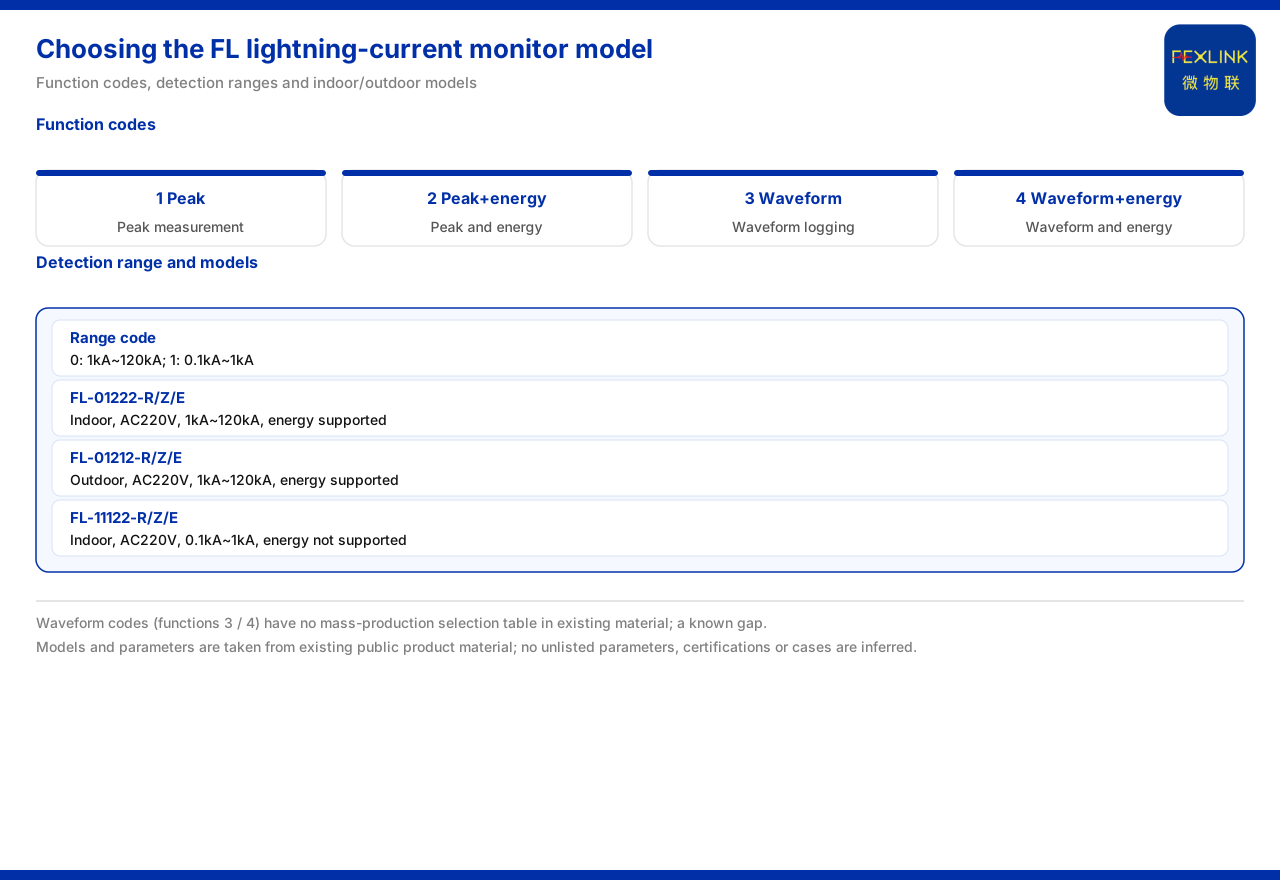
Direct answer
Reconstructing a single lightning strike from lightning current data is essentially stitching together the dimensions in which the same event was recorded: when it happened, how strong it was, how much energy it released, what the waveform looked like, and how many times it occurred. The product documentation lists the function code of the lightning current monitor in four grades — 1 peak, 2 peak plus energy, 3 waveform, and 4 waveform plus energy — and lists the detection-range code in two grades — 0 for 1kA to 120kA, and 1 for 0.1kA to 1kA. The former decides which dimensions one device can output, and the latter decides how large a current magnitude it can capture. Align the two code segments with the site, then stitch by dimension, and one can approach the process of a lightning strike.
The waveform grade exists in the code, but the product documentation also states that waveform-grade models do not yet have a mass-production selection table. On this basis this article can only explain the path of reconstruction and does not give specific models or parameters for the waveform grade.
1. Which data dimensions are needed to reconstruct a lightning strike
Reconstruction is not reading one number larger but aligning several dimensions. The peak answers how large, the energy answers how much, the waveform answers what shape, and the count answers how many times. The product documentation lists the function code of the lightning current monitor as 1 peak, 2 peak plus energy, 3 waveform, and 4 waveform plus energy, which amounts to dividing the reconstructable dimensions into two groups: one facing the peak side and one facing the waveform side.
The more complete the dimensions, the finer the process that can be reconstructed. A model that records only the peak can answer the intensity but cannot answer the waveform; a model that records waveform and energy can reconstruct both shape and strength. In selection, first ask to which layer the reconstruction must reach, and then choose the corresponding function grade.
2. Lock the event scale by range first
Before stitching dimensions, first confirm the current scale the device covers. Detection-range code 0 corresponds to 1kA to 120kA, and code 1 corresponds to 0.1kA to 1kA. The two grades cover different currents and correspond to different monitored objects.
The landing points given by the model table are: the lightning current / transient current monitor (e.g. FL-01222-R) is indoor, AC220V, peak 1kA to 120kA, and supports energy; the lightning current monitor (FL-01212-R) is outdoor, the same range, and supports energy; and the lightning current monitor (FL-11122-R) is indoor, peak 0.1kA to 1kA, and does not support energy. If what is reconstructed on site is a large-current lightning strike, it should fall in the 1kA to 120kA grade; if a smaller current range is the concern, it corresponds to the 0.1kA to 1kA grade. If the range is wrong, the event is either missed or falls outside the range.
3. Intensity reconstruction: reading the event scale from the peak
Intensity is the first dimension of reconstruction. Models with a peak of 1kA to 120kA directly give the peak magnitude of the event current; models with a peak of 0.1kA to 1kA face smaller currents. Putting the peaks of several events at the same measurement point together makes it possible to judge the lightning intensity characteristics of that point.
The peak is only the instantaneous maximum; it answers how large this strike was but does not answer energy or waveform, so it is the starting point of reconstruction rather than the whole. To reconstruct the process, other dimensions must be added beyond the peak.
4. Energy reconstruction: understanding how much the event released
Function grades 2 and 4 both contain energy, showing that some models record energy in addition to the peak, that is, charge or specific energy. The model table records the two models with a peak of 1kA to 120kA as supporting energy, and records the model with a peak of 0.1kA to 1kA as not supporting energy.
Whether energy can be reconstructed therefore depends on the combination of the chosen model's function grade and range grade. At the same magnitude, a model that supports energy can give one more dimension; a model that does not support energy can only stop at the peak. Only by bringing the energy dimension in does reconstruction advance from how strong to how much was released.
5. Waveform reconstruction: the function grade and the documentation gap
The waveform is the dimension that reconstructs the shape. Function codes 3 and 4 correspond to waveform and to waveform plus energy respectively, showing that the waveform grade is already reserved at the code level. But the known information gaps of the product documentation also state that waveform-grade models do not yet have a mass-production selection table.
This gap directly limits the depth of reconstruction. Being able to reconstruct the waveform means seeing the rise, peak, and decay form of the event; but until the mass-production selection table is completed, this article can only explain the position of the waveform grade in the code, cannot give the specific models or parameters corresponding to the waveform grade, and should not assemble a model from the coding rule by itself. Keeping exists-in-the-code apart from already-has-a-mass-production-model is the key to understanding the boundary of reconstruction capability.
6. The count dimension and its associated data source
The reconstruction also needs to answer how many times. The product documentation records the lightning strike count of the surge protective device monitor as 0 to 9999, with a minimum trigger of 0.1kA, which can serve as an associated data source for lightning event counting. It answers the number of events and complements the peak, energy, and waveform recorded by the lightning current monitor.
When the two classes of data are used together, the count gives a rough outline of the events, and the current data gives the intensity and shape of each event. This article states only the record of this associated data and does not infer conversion or joint criteria between the two classes of data.
7. Stringing the dimensions into a reconstruction path for one event
Combining the dimensions above, the reconstruction path can be divided into three steps. First, select the detection-range grade according to the on-site magnitude, so that the event falls inside the range; second, select the function grade according to the depth to be reconstructed, determining which of peak, energy, and waveform are output; third, align the records of the same event across the dimensions in time order and piece together the course of the event — what appeared first, how large the peak was, how it continued and decayed, and how many times it occurred.
In the third step the waveform dimension is limited by the documentation gap; until the mass-production selection table is completed, reconstruction can only advance to the peak and energy side, or await a later update. This article does not unfold the specific methods of time synchronization or data alignment.
8. The boundary of reconstruction capability
The accuracy of reconstruction depends on whether the recorded dimensions are complete, and the recorded dimensions depend on the chosen model's function grade and range grade. This is not something that post-processing of the data can make up: a model without waveform recording cannot reconstruct the waveform afterwards, and a model with a mismatched range may have its events fall outside the recorded range.
Thus reconstructing a lightning strike from lightning current data starts with selection, not analysis. Choose the range and function grades correctly first, then speak of stitching by dimension; when selection is limited, state truthfully which layer can be reconstructed rather than treating the peak as the whole process.
Scope and limitations
First, this article restates only what the product documentation lists, with the factual boundary limited to the function code and detection-range code of the lightning current monitor, the records of the three models in the model table, the waveform-grade entry in the known information gaps, and the lightning strike count of the surge protective device monitor.
Second, the values of the function code and the detection-range code are cited as listed in the model rule; this article does not infer combinations or meanings beyond the codes.
Third, the installation environment, supply, peak range, energy support, and communication of the three models are cited as listed in the model table; this article does not infer the configuration of unlisted models.
Fourth, the absence of a mass-production selection table for the waveform grade is cited as listed in the known information gaps; this article does not assemble specific waveform-grade models from the coding rule.
Fifth, the lightning strike count range and minimum trigger of the surge protective device monitor are cited as listed; this article does not infer conversion or joint criteria between the two classes of data, nor specific time-synchronization or data-alignment methods beyond the raw waveform.