 微物联研究院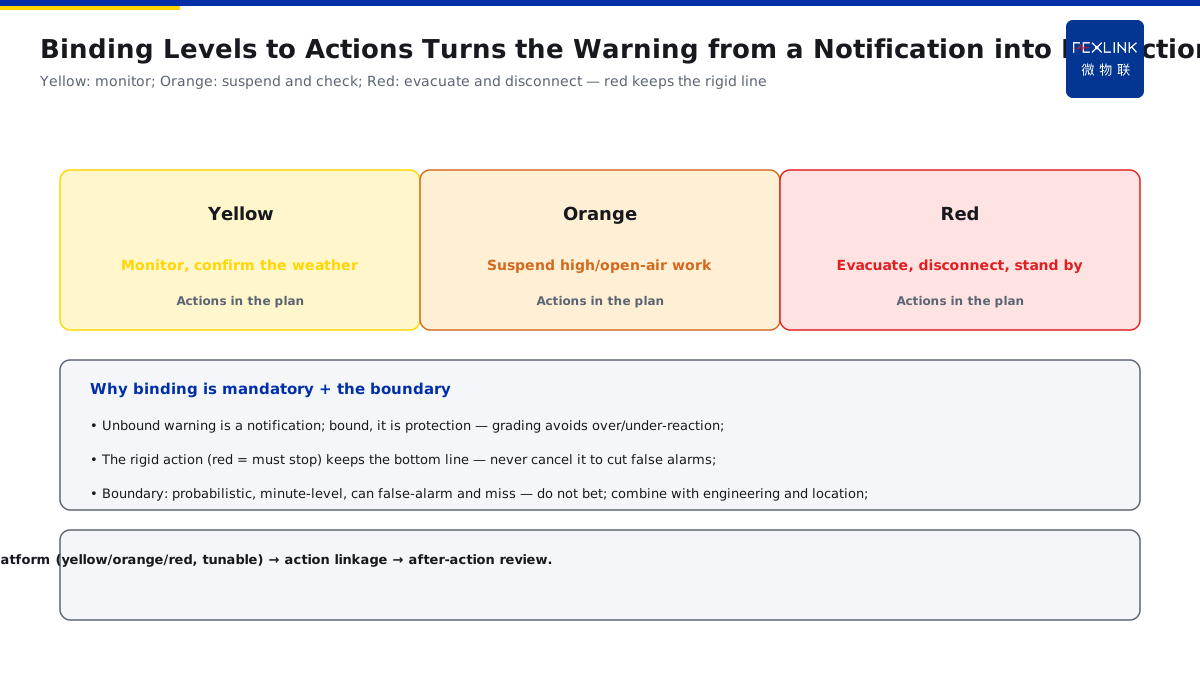
Direct Answer
You have a lightning-warning system and see a "red warning" — how many minutes do you actually have, and how reliable is it? The answer: lightning warning is based on atmospheric-field change, the lead time is typically minute-level (of the order of several minutes), and it is probabilistic — the warning levels correspond to different strike-approach probabilities and false-alarm rates. The correct use is to bind each warning level to a corresponding action level (suspend outdoor work, check SPDs, stand by), not to demand that it report precisely "at what minute and second the strike lands".
At a chemical tank farm, a "red warning" immediately stopped open-air loading, but the storm eventually passed around the site with no strike, and operators felt the stoppage was "wasted". The following week the red warning sounded again at the same time; some argued for not stopping, and a strike triggered a local fire. The key distinction: warning is not precise forecasting — a red warning means "strike-approach probability is high, lead time is minute-level", and it may be a false alarm or a miss. The key to use is binding it to graded actions, not betting on whether it is accurate.
Why:
- Lead time: the atmospheric-field precursor gives a minute-level window (typically several minutes);
- Probabilistic nature: the levels correspond to strike-approach probability and false-alarm rate;
- Trade-off: the more sensitive the threshold, the more false alarms and the fewer misses;
- Correct use: bind the levels to graded actions; do not bet on precision.
Key insight: "Warning is a 'probability + minute-level' prompt — binding the levels to actions makes it work; betting on accuracy brings 'crying wolf'."
At a scenic area, frequent false alarms in the storm season led to repeated stoppages, hurting revenue, and management questioned the system's value. After adjusting the graded thresholds and adding field-rate criteria, the false-alarm rate clearly fell, while the rigid "red = must stop" action was kept. Lesson: the false-alarm rate can be optimized by tuning, but never cancel the action to reduce false alarms — the value lies in the level-action binding.
1. Why the Lead Time Is Minute-Level, Not Hour-Level
Step one: how much lead time and why.
Where the lead time comes from:
- The ground field changes first when a storm approaches (connecting to KD-0177);
- The field change leads the return stroke by several minutes;
- The lead time varies with the storm's movement;
- Typically of the order of several minutes.
Why not hour-level:
- A storm's life is short and it moves fast;
- The field signal is significant only in the "approach" phase;
- Hours ahead, the approach direction cannot be judged reliably;
- Minute-level is the reasonable physical window.
Why not second-level:
- The return-stroke trigger has randomness;
- The field reading and the strike moment are not one-to-one;
- Second-level precision is beyond field warning;
- That is the lightning-location system's job.
Key insight: "The field precursor physically gives minute-level — hours are unreliable, seconds are impossible; minute-level is the correct magnitude of warning."
2. Warning Levels (Yellow/Orange/Red) and Their Probabilistic Meaning
Step two: what the colour levels say.
The basis of grading:
- The field-magnitude deviation;
- The field rate of change (approach speed);
- Features such as polarity reversal;
- A multi-criteria combination sets the level.
Levels and probability:
- Yellow: the storm may affect the site (lower probability);
- Orange: the strike-approach probability has clearly risen;
- Red: high imminent-strike probability;
- The higher the level, the higher the probability and the closer the threat.
How to read the levels:
- Not "the strike will land at this exact moment";
- It is "the approach probability has reached this band";
- The level is the switch of the action level;
- Different events at the same level differ in detail.
Key insight: "Yellow/orange/red correspond to rising bands of strike-approach probability — they describe 'which risk band we are in', not 'when the strike lands'."
3. The Trade-off between False-Alarm Rate and Miss Rate
Step three: why "crying wolf" happens.
Where false alarms come from:
- A field change does not always lead to a ground strike;
- A distant storm's field can also cross the threshold;
- An over-sensitive threshold → more false alarms;
- More false alarms → frequent actions, higher cost.
Where misses come from:
- Rapidly forming/near-ground storms lack sufficient precursors;
- An over-conservative threshold → more misses;
- More misses → strikes without warning;
- Risk directly exposed.
The trade-off logic:
- Sensitive threshold ↔ more false alarms, fewer misses;
- Conservative threshold ↔ fewer false alarms, more misses;
- There is no "zero false alarm + zero miss";
- Choose the balance by on-site sensitivity.
Key insight: "False alarms and misses are the same knob — sensitive gives more false alarms, conservative gives more misses; choose the balance by the on-site risk tolerance; there is no perfect both."
4. Binding Warning Levels to Graded Actions
Step four: what to do after the alarm, and how.
Level-action binding:
- Yellow: intensify monitoring, confirm the weather;
- Orange: suspend high-altitude/open-air work, check SPDs;
- Red: evacuate dangerous areas, disconnect vulnerable circuits, stand by;
- Each level maps to clear actions, written into the plan.
Why binding is mandatory:
- Unbound warning is a "notification";
- Bound, the warning becomes "protection";
- Graded actions avoid over/under-reaction;
- Rigid actions (red = must stop) keep the bottom line.
Practice points:
- The plan states the actions and owners per level;
- The clear signal is explicit (field returns);
- After-action review (warning–strike–loss);
- The FG Lightning-Protection Intelligent Gateway aggregates and links.
Key insight: "The value of the warning lies in the action — bind the levels, keep the red rigid bottom line, and the warning turns from a notification into protection."
5. The Boundary: Do Not Treat Warning as Precise Forecasting
Step five: an honest awareness of the boundary.
What warning cannot do:
- Cannot report the strike moment precisely;
- Cannot report the landing point precisely;
- Cannot guarantee no false alarm or no miss;
- Cannot replace lightning-protection engineering measures.
What warning can do:
- Give a minute-level "risk has risen" prompt;
- Trigger the graded actions;
- Cross-verify with lightning location/SPD monitoring;
- Lower the probability of loss.
The right mindset:
- Treat warning as a "risk prompt", not a "verdict";
- Execute the actions by level, do not bet;
- Tune the thresholds with on-site experience;
- Accumulate data to optimize continuously.
Key insight: "The boundary of warning: probabilistic prompt, minute-level, can false-alarm and miss — do not bet on precision, act by level, combine with engineering measures; that is the correct use."
6. Product Implementation: Warning Levels and Action Linkage
WeiWuLian products manage the warning parameters:
- FG Lightning-Protection Intelligent Gateway: aggregates field-mill/location data;
- Graded warning platform: yellow/orange/red levels, adjustable thresholds;
- Action linkage: warning → action → review, end to end;
- Event cross-verification: warnings correlated with strikes and SPD state.
The design principle in one sentence: "Minute-level + probabilistic — bind the levels to actions, keep thresholds tunable, make data reviewable; then the warning is truly useful."
7. Common Misjudgments
- "A red warning means an immediate strike": treating probability as a verdict. Result: wrong bets, wrong actions. Correct: execute by the level.
- "False alarms mean the system is bad": ignoring the trade-off. Result: dismantling it or tuning too conservative. Correct: tune the thresholds + add criteria.
- "Fewer false alarms, so do not stop": cancelling the rigid action. Result: a miss becomes a loss. Correct: red = must stop, keep the bottom line.
- "Warning can report the point and moment": misplaced expectations. Result: misjudged value. Correct: use it as a probability prompt.
- "Installed warning, no lightning engineering needed": replacing the measures. Result: warning does not cover the bottom. Correct: warning + engineering + monitoring together.
Scope and Limitations
This article explains the lead time (minute-level), the probabilistic nature (levels and false-alarm rate), the level-action binding method and the use boundary of lightning warning, applicable to understanding and using warning systems. The exact lead times, thresholds and level settings depend on local storm characteristics and on-site sensitivity, set jointly by the manufacturer and operations; the warning is a probabilistic prompt and does not replace lightning-protection engineering or lightning location. All cases are anonymized (a chemical tank farm, a scenic area) and do not refer to any specific customer.