 FEXLINK Research Institute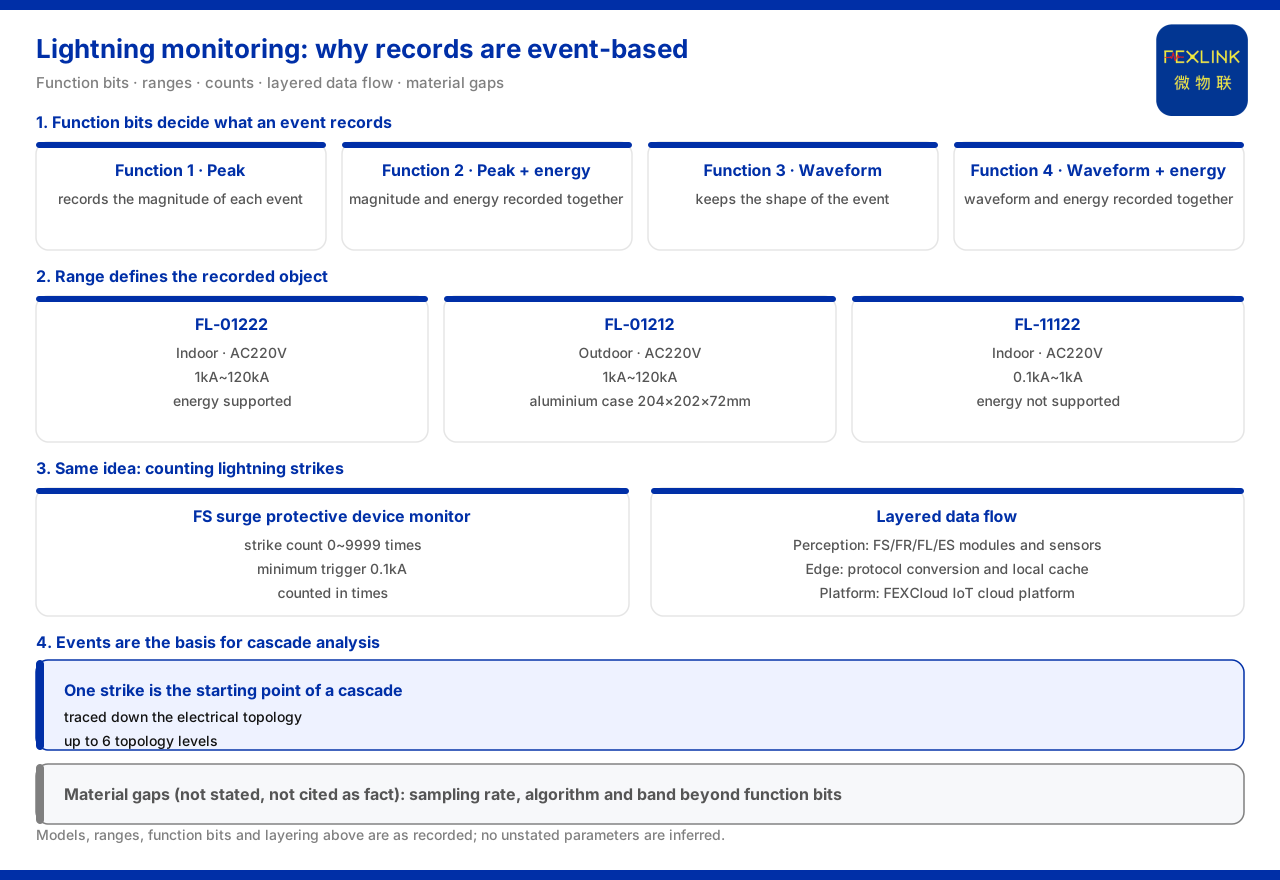
Direct answer
The product material shows that the unit of lightning-current monitoring is not a "continuous waveform stream" but an "event". In the model rule of the FL lightning current / transient current monitor (e.g. FL-01222) there is a function position that can record peak, peak plus energy, waveform, or waveform plus energy respectively, showing that each lightning strike is recorded as a nameable unit that can carry information; the surge protective device monitor from the same manufacturer also counts lightning in units of "times", with a definite upper limit for the count range. Using the event as the unit facilitates statistics, traceability and alarms, and also avoids the storage and analysis burden of retaining all continuous data. Further, event-based recording is the data precondition for subsequent cascade analysis: one lightning event can serve as a traceability starting point and be modelled as conducting downward through several levels of the electrical topology.
1. Event-based recording is embodied in the function position of the model
The product material stipulates that the model rule of the lightning current / transient current monitor consists of positions for detection range, channel count, function, installation method and supply, and finally the communication position. The function position corresponds directly to the information granularity of event-based recording: it can record peak, peak plus energy, waveform, or waveform plus energy.
Making the function an independent coding position shows that "what is recorded" is itself a choice dimension of the product. Peak answers "how large this event was", energy answers "how much energy this event carried", and waveform retains the event's form information. Different function positions give different degrees of information completeness. The meaning of event-based recording here is therefore very concrete: each lightning strike is recorded as one event carrying magnitude, energy or waveform, rather than being submerged in continuous sampling.
2. The detection range distinguishes the object of recording
The model table in the product material gives three example lightning-current monitors: two cover 1kA to 120kA and support energy, distinguished by indoor and outdoor installation; the other covers 0.1kA to 1kA and does not support energy. The detection-range coding position corresponds to these two intervals.
The range is not simply "the larger the better". The 1kA to 120kA interval faces recording of larger-amplitude lightning current, while the 0.1kA to 1kA interval faces smaller transient currents. Which tier to choose depends on what is to be recorded: a large event on the main lightning-current path, or a smaller-amplitude transient disturbance. Listing the range together with installation environment and whether energy is supported shows that the object of event recording is determined by the range, while the completeness of the record is jointly determined by the function position and the energy support.
3. Counting by "times": the basic unit of lightning statistics
The product material records that the lightning count of the surge protective device monitor ranges from 0 to 9999 times, with a minimum trigger of 0.1kA. Here "times" is explicitly used as the counting unit.
The choice of counting unit itself expresses a way of organising data. Counting by "times" means the system cares how many strikes occurred and whether each reached the trigger threshold, rather than retaining all waveforms continuously. The minimum trigger value gives the threshold for entering the statistics: disturbances below that amplitude do not enter the count, avoiding mistaking noise for lightning. The count range gives an upper limit, showing that the statistics are carried out within a bounded window. For monitoring on the SPD side, this approach of carrying lightning statistics as event counts is consistent in idea with lightning-current monitoring treating the event as the unit: both treat lightning as discrete events rather than fragments of a continuous signal. The statistics obtained thereby are naturally suited to comparison and traceability by time window — how many occurred in a period and whether there was concentration can be read directly without first reprocessing the raw waveform.
4. Event-based recording travels upward along the architecture
The product material summarises the monitoring system as a general four-layer architecture: perception layer, edge layer, platform layer and application layer. The perception layer contains the surge protective device monitor (FS series), the grounding resistance monitor (FR series), the lightning current / transient current monitor (FL series) and electrical safety monitoring modules; lightning-current monitoring data is generated at the perception layer and uplinked to the platform layer through protocol conversion and local caching at the edge layer.
Event-based recording matches this data flow. Each strike produces one event, which is converted and cached by the edge layer and then uplinked; the number of events is limited, so the caching and uplink burden is controllable. If it were changed to a continuous waveform stream, the caching and uplink bandwidth pressure at the edge layer would rise significantly. In other words, organising data by event is one of the preconditions that let the collection and uplink chain carry lightning information robustly.
5. Event-based recording is the precondition for cascade analysis
The product material records that the topology-cascade impact engine of the Wanxiang engine can trace at most six levels of topology impact. One lightning event can serve as a traceability starting point and be modelled as conducting downward through several levels of the electrical topology.
This explains a deeper meaning of event-based recording. Cascade analysis needs a definite starting point: where it begins, along which path it conducts, and which levels the impact reaches. Recording a strike as a discrete event provides exactly such a locatable starting point. Conversely, if the data is only an unsegmented continuous signal, it is difficult to point to "this one" event and its conduction path. Event-based recording is therefore not merely a simplification of storage but prepares a usable data unit for subsequent impact analysis.
6. Deployment differences between outdoor and indoor
The product material states that the lightning-current monitor has a lightning-monitoring enclosure in two colours, white and black; the outdoor version uses an aluminium enclosure with specific dimensions. The installation-environment code in the model distinguishes indoor from outdoor.
The deployment method must match the site environment. The outdoor version faces wind, rain and temperature difference and uses an aluminium enclosure, while the indoor version is used in indoor positions. Making the installation environment a coding position means this choice should be fixed at the selection stage rather than added at installation. For an event-monitoring unit, the deployment position not only affects the device form but also which events it can record — installed on the main path versus on a branch, the recorded objects differ.
Scope and limitations
First, the citations in this article are limited to the product material and the corresponding fact pack, and introduce no model, parameter or case not listed.
Second, the detection-range, channel-count, function, installation-method and supply codes in the model rule, and the recorded content corresponding to the function position, are limited to the material statement.
Third, the installation environment, supply, peak range and energy support of the three example models are limited to the material entries; this article extends no other models.
Fourth, the lightning count range and minimum trigger value of the surge protective device monitor are limited to the material statement.
Fifth, the four-layer architecture is limited to the perception layer, edge layer, platform layer and application layer described by the material; this article does not infer the transmission performance of a specific link.
Sixth, the "at most six levels" of topology-cascade tracing is a material statement; this article promises no site's event conduction range or analysis conclusion on that basis.
Seventh, this article explains only the meaning and basis of event-based recording, and provides no selection or configuration calculation for a specific project.