 微物联研究院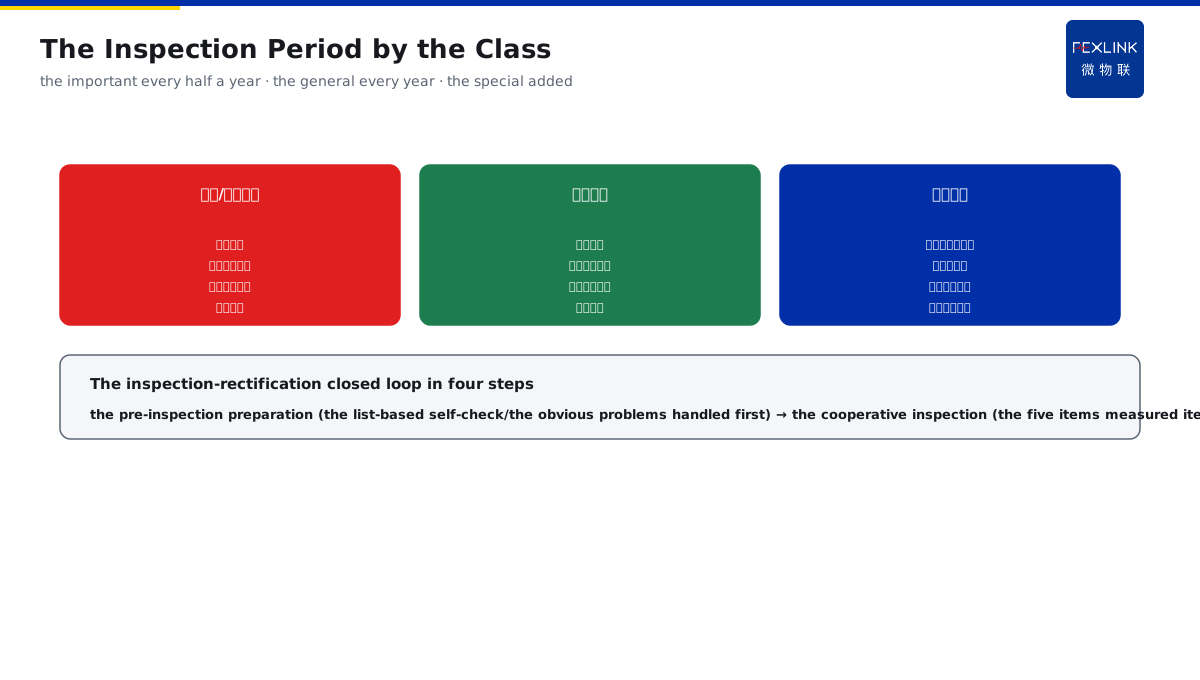
Direct Answer
What exactly does the annual lightning-protection inspection test, how long is the period, and what is the pass basis? The answer: GB/T 21431 provides that the inspection covers the air-termination, the down-conductor, the earthing device, the equipotential, and the SPD/surge-protection state; the inspection period is determined by the building lightning-protection class (the important/explosive-hazard places usually once every half a year, and the general places once a year); the pass or fail is compared item by item with the design values and the standard limits, and the inspection report is the statutory evidence of the lightning-protection compliance.
At a large hospital performing the half-year inspection as a Class-II building, the inspection covered the air-termination strip, the down-conductor, the earthing resistance, the equipotential bonding and the SPD state; one inspection found the equipotential bonding in the operating room disconnected, judged unqualified and required the rectification within a deadline, and after the re-inspection passed, the report was issued as the compliance basis for the health-department inspection. The design core: the full coverage of the items, the period by the class, and the pass by the comparison — the air-termination/down-conductor/earthing/equipotential/SPD inspected item by item, the important places inspected every half a year, and the pass compared with the design values and the limits.
Why:
- The full coverage of the items: the air-termination/down-conductor/earthing/equipotential/SPD;
- The period by the class: the important places every half a year, the general every year;
- The pass by the comparison: the design values and the standard limits;
- The report is the evidence: the statutory basis of the lightning-protection compliance.
Key insight: "The inspection has three points — the full coverage of the items (the five categories inspected item by item), the period by the class (the important every half a year/the general every year), and the pass by the comparison (the design values × the standard limits) — the report is the statutory compliance evidence."
At a general office place performing the yearly inspection, the inspection found the air-termination strip rusted and broken, judged unqualified and required the rectification within a deadline; after the rectification and the re-inspection passed, the report was obtained. Lesson: the inspection is not a formality — with the item-by-item comparison, the rectification within the deadline and the re-inspection passed, the report has the statutory force.
Overview: run "what the inspection items are → how the period is set → how the pass is judged → how the report is used" as one GB/T 21431 inspection-standard interpretation. The national standard GB/T 21431 provides that the inspection covers the air-termination, the down-conductor, the earthing device, the equipotential, and the SPD/surge-protection state, and the inspection period is determined by the building lightning-protection class. The four layers are unfolded below.
A "car annual inspection" analogy: think of the lightning-protection inspection as the car annual inspection. The annual inspection does not test only one item — the brakes (the air-termination), the tires and the chassis (the down-conductor and the earthing), the seat belts and the lights (the equipotential bonding), and the battery and the emissions (the SPD state) are checked item by item, and any unqualified item means no pass sticker. The inspection period is not one-size-fits-all either: the operating vehicles (the important/explosive-hazard places) are inspected every half a year, and the private cars (the general places) once a year; the car involved in an accident (after the lightning event) should be inspected early. The annual-inspection pass only proves "the car condition is qualified at this moment", not that the car will not break in the next year — the daily tire-pressure monitoring and the fault lights (the online monitoring) are the real safety guarantee between the two annual inspections. The lightning-protection inspection works the same: the annual inspection certifies the qualification, and the monitoring guarantees the process. The annual-inspection analogy: the brakes = the air-termination, the tires and the chassis = the down-conductor and the earthing, the seat belts and the lights = the equipotential bonding, the battery and the emissions = the SPD state, the operating vehicle half-year inspection = the important place half-year inspection, the accident early inspection = the post-strike additional inspection, and the fault lights = the online monitoring filling the period blind spot — the annual inspection certifies the qualification, and the monitoring guarantees the process.
1. The Inspection Items: What the Five Categories Test
Step one: first look at the GB/T 21431 inspection-item list.
The air-termination device:
- The air-termination strip/rod;
- The rust and the fracture check;
- The connection reliability;
- The protection-range review.
The down-conductor and the earthing:
- The down-conductor continuity;
- The earthing-resistance measurement;
- The earthing-device state;
- The connection-point check.
The equipotential and the SPD:
- The equipotential-bonding check;
- The SPD appearance and state;
- The leakage and the degradation;
- The installation position verification.
Key insight: "The inspection items have five categories — the air-termination device (the rust/fracture and the protection range), the down-conductor and the earthing (the continuity and the earthing resistance), and the equipotential and the SPD (the bonding/state/leakage) — checked item by item, none missing."
2. The Inspection Period: How It Is Set by the Class
Step two: determine the inspection period by the building lightning-protection class.
The important/explosive-hazard places:
- Once every half a year;
- The hospitals and the schools key;
- The explosive-hazard places;
- The densified inspection.
The general places:
- Once a year;
- The general civil buildings;
- The ordinary industrial places;
- The routine period.
The special situations:
- The additional inspection after the lightning event;
- The re-inspection after the retrofit;
- The additional inspection for the abnormal precursors;
- The period dynamically adjusted.
Key insight: "The period is by the class — the important/explosive-hazard places every half a year (the hospitals and schools/the hazardous places densified), the general places once a year (the routine period), and the special situations dynamically added (after the lightning/after the retrofit/the abnormal precursors) — the class sets the period, and the special situations require the additional inspection."
3. The Pass Judgment: How the Comparison Works
Step three: the pass or fail is compared item by item with the design values and the standard limits.
The design-value comparison:
- The earthing resistance compared with the design;
- The SPD parameters compared with the design;
- The connection specifications compared with the design;
- The design is the benchmark.
The standard-limit comparison:
- The limits executed by the standard;
- The measured values compared with the limits;
- The exceeding means unqualified;
- The limits are the bottom line.
The item-by-item judgment:
- The five items all inspected and judged;
- One unqualified means unqualified;
- The re-inspection after the rectification;
- The report annotates the conclusion.
Key insight: "The pass judgment has three things — the design-value comparison (the earthing/SPD/connection specification with the design as the benchmark), the standard-limit comparison (the measured exceeding means unqualified), and the item-by-item judgment (the five items all judged/one unqualified means unqualified/the rectification and re-inspection) — with the comparison justified, the judgment unique."
4. The Report Role: How the Compliance Evidence Is Used
Step four: the compliance role and the limitation of the inspection report.
The compliance evidence:
- The report is the statutory evidence;
- The basis of the competent-department inspection;
- The basis of the responsibility definition;
- The compliance traced.
The report limitation:
- The inspection is the time-point data;
- The period gap is the blind spot;
- The degradation occurs within the period;
- The online monitoring fills the blank.
The monitoring complement:
- The online monitoring continuously records;
- The inspection report regularly confirms;
- The time-point + the continuous double guarantee;
- The compliance more solid.
Key insight: "The report role has three things — the compliance evidence (the statutory basis/the inspection basis/the responsibility definition), the report limitation (the time-point data/the period gap/the degradation within the period), and the monitoring complement (the online continuous record + the report regular confirmation) — the time-point plus the continuous, the compliance more solid."
5. Product Implementation: The Inspection and Monitoring Closed Loop
WeiWuLian makes the lightning inspection "the regular confirmation and the continuous visibility":
- The inspection-item list: the air-termination/down-conductor/earthing/equipotential/SPD item by item;
- The online monitoring filling the blank: the state continuously recorded between the periods;
- The data supporting the report: the monitoring data corroborating the inspection conclusion;
- The closed-loop management: the inspection-rectification-re-inspection-report traced.
The design principle in one sentence: "The full coverage of the items, the period by the class, and the pass by the comparison — the inspection certifies the qualification, and the monitoring guarantees the process; the lightning-protection compliance has the evidence."
6. Common Understanding Misjudgments
- "The inspection as a formality is enough": wrong. With the item-by-item comparison, the rectification within the deadline and the re-inspection passed, the report has the force.
- "All the places once a year": wrong. The important/explosive-hazard places are inspected every half a year.
- "Testing only the earthing resistance is enough": wrong. The air-termination, the down-conductor, the equipotential and the SPD must all be inspected.
- "The report passed means qualified forever": wrong. The inspection is the time-point data, and the period gap relies on the monitoring.
- "The inspection has nothing to do with the monitoring": wrong. The monitoring data corroborates the report, with the time-point + the continuous double guarantee.
Scope and Limitations
This article interprets the GB/T 21431 lightning-protection inspection standard (the inspection items, the inspection period, the pass judgment and the report role), applicable to the regular inspection and the compliance management of the lightning-protection devices. The specific inspection follows GB/T 21431-2015; this article explains only the standard logic. All cases are anonymized (a large hospital/a general office place) and do not refer to any specific customer.