 FEXLINK Research Institute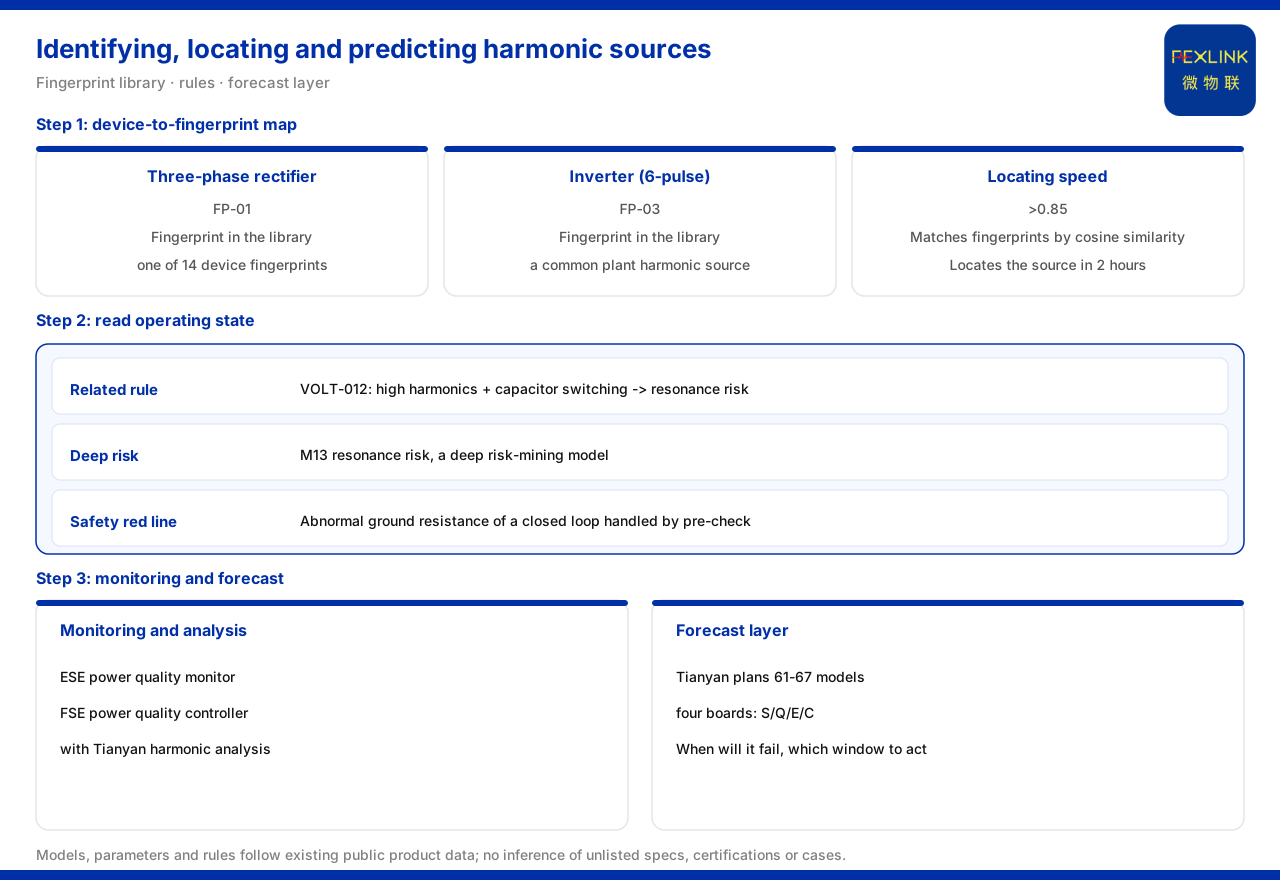
Direct answer
In an industrial plant, the hard part of a harmonic problem is often not whether harmonics exist but which device they come from. The product knowledge base records that the Qianzhi engine / large model maintains a harmonic fingerprint library holding 14 device fingerprints, among which FP-01 is a three-phase rectifier and FP-03 is a variable-frequency drive (6-pulse), meaning that a drive-class device in a plant can itself be identified as a harmonic source. The library matches by cosine similarity greater than 0.85 and supports locating the polluting source within 2 hours, whereas conventional troubleshooting often takes weeks. Once the source is located, risk and trend still have to be judged: a cross-dimensional association rule of the Wanxiang engine / large model pairs a high harmonic level with reactive power compensation being switched in, pointing to resonance risk, and in the deep hidden-hazard mining sub-models of the Qianzhi engine, M13 is resonance risk. Down at the monitoring devices, the scenario mapping of the product knowledge base recommends the ESE power-quality monitor and the FSE multi-parameter electrical intelligent controller (power quality type), together with harmonic analysis of the Tianyan engine / large model. The Tianyan engine, as the prediction layer, answers when a problem will appear and in which time window to act. The whole path pushes harmonic management from after-the-fact troubleshooting toward identify, locate, judge and predict.
1. Build the device-to-fingerprint mapping first
The first step of harmonic tracing is to map a device type to its harmonic signature. The product knowledge base records that the harmonic fingerprint library of the Qianzhi engine / large model holds 14 device fingerprints, among which FP-01 corresponds to a three-phase rectifier and FP-03 to a variable-frequency drive (6-pulse). This means that the drives and rectifiers common in an industrial plant need not be lumped together as nonlinear loads; each has its own fingerprint label for comparison. In selection and treatment, it is more orderly to find out which device types are on site and then ask whether they fall within the library's 14 classes than to guess the polluting source from experience.
2. From matching to locating: similarity and time
The value of the fingerprint library is that it turns likeness into a computable comparison. The product knowledge base records that the library uses a cosine similarity greater than 0.85 as its matching criterion, supports locating the polluting source within 2 hours, whereas the conventional way often takes weeks. For engineering, this contrast shows that harmonic tracing is no longer just measuring harmonic content but pointing out the most likely source after comparison with known fingerprints. The similarity threshold sets how strict the match is: the closer to a known fingerprint, the easier to locate within a shorter time. Note that this article only relays the matching method and the order of magnitude of time listed in the materials and does not expand on algorithm implementation or on-site verification.
3. Resonance: a deeper hazard dimension beyond harmonics
Harmonics are the phenomenon; resonance is a risk they may induce. The product knowledge base records that the Qianzhi engine / large model has 20 dedicated sub-models, of which the deep hidden-hazard mining group runs from M13 to M20 and M13 is resonance risk. This shows that resonance is assessed as a hidden hazard related to harmonics but standing as its own dimension, rather than being folded into the single indicator of harmonic content. In treatment, looking only at harmonic content may miss resonance as a class of risk; bringing in the M13 dimension explains a case where harmonics are not extreme yet the system behaves abnormally.
4. Cross-dimensional association: judging harmonics with the operating state
Looking at harmonics alone easily yields a one-sided conclusion. The product knowledge base records that the Wanxiang engine / large model contains 49 cross-dimensional association rules, among which VOLT-012 is high harmonics plus reactive power compensation switched in, pointing to resonance risk. This rule judges harmonics together with the switching state of reactive power compensation: at the same harmonic level, resonance risk differs depending on whether reactive power compensation is switched in. Its engineering meaning is that a harmonic environment must be judged together with the system operating state, not by a single parameter in isolation. This associative approach in the judgment layer complements a monitoring layer that merely reports a harmonic value.
5. Safety red-line: grounding and electrical hazards in one frame
In the system's front-end pre-check, some risks are set as safety red-lines that cannot be bypassed. The product knowledge base records that in the safety red-line guard, an abnormal open circuit of the grounding resistance is one of the 5 non-bypassable safety red-lines, based on GB 50057. This red-line belongs to different dimensions from harmonics and resonance, yet is handled within the same front-end pre-check system: when the grounding condition is abnormal, the related assessment will not be skipped because other quantities look normal. For an industrial plant, this shows that lightning-protection and grounding risks and electrical hazards are not two unrelated checks but are treated together at the same front-end gate.
6. Where monitoring and analysis land
Identification and judgment must finally land on devices. In the scenario mapping of the product knowledge base, dedicated power-quality and harmonic treatment recommends the ESE power-quality monitor and the FSE multi-parameter electrical intelligent controller (power quality type), together with harmonic analysis of the Tianyan engine / large model. The ESE power-quality monitor shares an architecture with similar monitors and covers the harmonic dimension on top of phase monitoring; the FSE multi-parameter electrical intelligent controller (power quality type) folds power-quality-related multi-parameter measurement and control into one device. Taking these two according to the scenario mapping binds the acquisition and analysis of harmonic data into one system and keeps acquisition and judgment from telling different stories.
7. The prediction layer: when a problem appears, when to act
Monitoring answers what is happening now; prediction answers what comes next. The product knowledge base records that the Tianyan engine / large model is the prediction brain and decision layer, planning 61 to 67 models in four blocks — S safety, Q power quality, E energy use and C energy saving — and answering when a problem will appear and in which time window to act. For harmonics and hidden hazards, the meaning of this layer is to move trend judgment earlier: not only to alarm after a limit is exceeded, but to give the time window in which a problem may appear, so that action can be scheduled. Note that the four blocks and the number of models are planning terms listed in the product knowledge base; this article relays them and does not infer the schedule or effect of any specific project from them.
Scope and limitations
First, this article only restates what the product knowledge base lists; its factual boundary is limited to the device-fingerprint classes and matching method of the harmonic fingerprint library, the deep hidden-hazard mining and cross-dimensional association rules, the safety red-line items, the monitoring devices recommended by the scenario mapping, and the prediction-layer blocks and model counts, and it introduces no unlisted parameter, certification or case.
Second, the library's 14 device fingerprints, FP-01 three-phase rectifier, FP-03 variable-frequency drive (6-pulse), cosine similarity greater than 0.85 and 2-hour source location, the M13 resonance risk within M13 to M20, and VOLT-012 of the 49 association rules, as well as the safety red-line item of an abnormal open circuit of the grounding resistance with its count of 5 and its GB 50057 basis, are all quoted on the terms listed in the product knowledge base; this article does not expand on algorithm or implementation details, and the safety red-line described here is a system front-end pre-check rule and does not represent any on-site test conclusion.
Third, the monitoring devices recommended by the scenario mapping and the prediction-layer blocks and model counts are quoted on the terms listed in the product knowledge base. This article only explains the identify, locate, judge and predict path of industrial harmonic pollution; it provides no specific engineering treatment scheme, selection calculation or rectification conclusion, and the related conclusions must be verified against the on-site devices and operating conditions, subject to the latest product materials and the project scheme.