 微物联研究院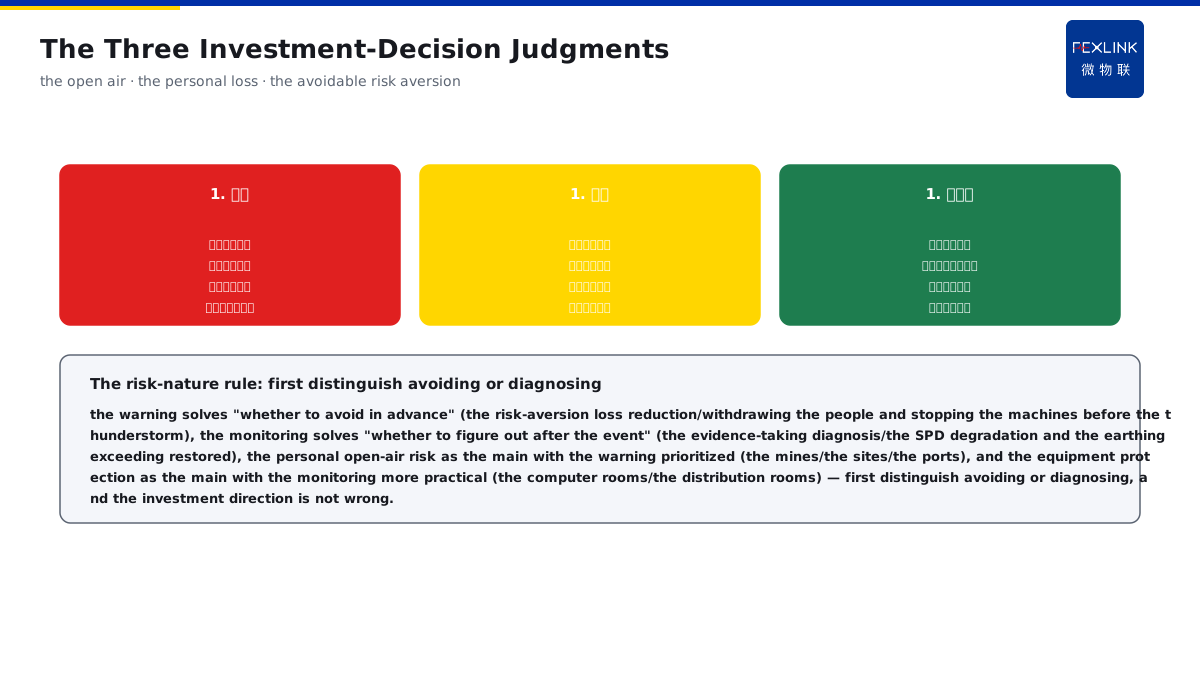
Direct Answer
When the boss asks "should we deploy the lightning early-warning system", how do we judge whether it is worth it from the risk and the cost? The answer: whether to deploy the warning depends on whether "the personal/outage losses caused by the strike can be avoided through the early risk aversion": the scenes with the open-air personnel operations, the high-value open-air equipment, and the possible early outage risk aversion are worth deploying; for the purely indoor scenes, the scenes with the high outage cost or the low strike probability, prioritize investing the budget in the passive protection such as the earthing, the SPDs and the monitoring; the warning and the monitoring are the complement of "the risk-aversion loss reduction" and "the evidence-taking diagnosis", and when choosing one of the two, look at the risk nature first.
At an open-pit mining project with the open-air personnel operations and the frequent operations in the thunderstorm season, after the lightning early-warning system was deployed, the thunderstorm approach automatically triggered the work-stop risk aversion, and two personnel hazards were avoided in one thunderstorm season; the project judged: the open-air + the personal risk + the avoidable risk aversion, so the warning investment was worth it. The design core: look at whether the loss can be avoided by the risk aversion, decide by the scene, and complement the warning with the monitoring — the open-air personal-risk avoidable scenes deploy the warning, and the purely indoor low-risk scenes invest in the passive protection first.
Why:
- Look at whether the risk aversion is possible: whether the personal/outage losses can be avoided in advance;
- Decide by the scene: the open-air high-risk deploys the warning, and the indoor low-risk invests in the passive;
- The different values: the warning avoids the loss, and the monitoring takes the evidence and diagnoses;
- The complementary combination: when choosing one of the two, look at the risk nature first.
Key insight: "The warning investment has three points — the open-air personal high-risk avoidable scenes are worth investing (the risk-aversion loss reduction), the purely indoor low-risk scenes invest in the passive protection first (the earthing/the SPDs/the monitoring), and the warning and the monitoring are complementary (the risk aversion + the evidence taking, and when choosing one of the two, look at the risk first) — calculate the account by the risk nature, and do not blindly deploy."
At a purely indoor data center once deploying the warning system, the thunderstorm-season warnings were frequent, but the indoor equipment was protected by the SPDs and the monitoring with no work-stop risk-aversion need, so the system value was limited; after the evaluation, the budget was turned to the SPD upgrade and the monitoring improvement. Lesson: the value of the warning lies in "whether the risk aversion is possible" — without the open-air operations and the work-stop risk-aversion needs, the warning is an idle investment.
Overview: run "the applicable-scene list → the risk-aversion loss reduction vs the evidence-taking diagnosis → the three judgments → the combination cost" as one warning-investment decision interpretation. Whether to deploy the warning depends on whether the strike losses can be avoided through the early risk aversion. The four layers are unfolded below.
An "umbrella and raincoat division" analogy: think of the warning system and the monitoring system as the umbrella and the raincoat on a rainy day. The umbrella is the "advance tool" (the warning): seeing the bad sky, hold the umbrella first, and the person is avoided before getting wet, corresponding to the warning triggering the risk aversion before the thunderstorm arrives; the raincoat is the "body-protection equipment" (the monitoring + the passive protection): wearing it, the rain cannot get in, and even without checking the sky in time, the body stays dry, corresponding to the SPDs, the earthing and the monitoring bearing the damage when the strike occurs. Can you buy only the umbrella without the raincoat? If a person spends most of the time outdoors and is often caught by the sudden rain (the open-air high-risk scene), the umbrella value is high; if a person is basically indoors and goes out occasionally (the purely indoor low-risk scene), the raincoat (the passive protection) is more practical. The umbrella cannot replace the raincoat — the umbrella only reduces the wetting, and when caught in the rain, the raincoat still blocks it; the warning cannot replace the protection — the warning only lets you avoid the risk early, and when the strike truly occurs, the SPDs and the earthing still bear it. The umbrella-and-raincoat analogy: the umbrella = the warning (the advance risk aversion/holding the umbrella when the sky looks bad), the raincoat = the monitoring + the passive protection (bearing the damage at the event/staying dry when wearing), the often-outdoor buying the umbrella = the open-air high-risk deploying the warning, and the often-indoor buying the raincoat = the low-risk scene investing in the passive — the umbrella cannot replace the raincoat, and the warning cannot replace the protection.
1. The Scene List: Where the Warning Is and Is Not Applicable
Step one: first look at the applicable and inapplicable scenes of the lightning early warning.
Worth deploying the warning:
- The open-air personnel operations;
- The high-value open-air equipment;
- The possible early work-stop risk aversion;
- The high personal risk.
Not in a hurry to deploy:
- The purely indoor environment;
- The extremely high outage cost;
- The low strike probability;
- The passive protection prioritized.
The boundary scenes:
- The outdoor + indoor mixed;
- Look at the personnel exposure;
- Look at the equipment value;
- Look at the risk-aversion feasibility.
Key insight: "The scene list has three groups — worth deploying (the open-air operations/the open-air equipment/the avoidable risk aversion), not in a hurry (the purely indoor/the high outage cost/the low probability), and the boundary looking at the three degrees (the exposure/the equipment value/the risk-aversion feasibility) — matching by the scene, the decision has the basis."
2. The Value Comparison: The Risk-Aversion Loss Reduction vs the Evidence-Taking Diagnosis
Step two: the value-division comparison between the warning and the monitoring.
The warning avoids the loss:
- The thunderstorm discovered in advance;
- The work-stop risk aversion triggered;
- The personnel and the equipment loss reduced;
- The advance prevention.
The monitoring takes the evidence and diagnoses:
- The lightning events recorded;
- The protection defects located;
- The responsibility definition supported;
- The after-event diagnosis.
The complementary relationship:
- The warning manages the advance;
- The monitoring manages the mid-event and after-event;
- The combination complete;
- The value maximized.
Key insight: "The value comparison has three things — the warning avoiding the loss (the advance prevention/the work-stop risk aversion/the personnel-equipment loss reduction), the monitoring taking the evidence and diagnosing (the mid-event and after-event/the event records/the defect location), and the complementary combination (the warning advance + the monitoring after-event = the protection complete) — each managing one stage, and the combination complete."
3. The Three Judgments: Whether It Is Worth Investing
Step three: the three core judgments of the investment decision.
Judgment one, the open air:
- Whether the operations are open-air;
- Whether the personnel are exposed;
- Whether the equipment is open-air;
- The open air is the high-risk marker.
Judgment two, the personnel:
- The personal loss of the strike;
- Whether the risk aversion is possible;
- The size of the risk-aversion value;
- The personal risk prioritized.
Judgment three, the avoidable risk aversion:
- Whether the advance work stop is possible;
- Whether the outage cost is acceptable;
- Whether the risk-aversion operation is feasible;
- All three satisfied, worth investing.
Key insight: "The three judgments — the open air (the personnel exposure/the open-air equipment as the high-risk markers), the personal loss (whether the risk aversion is possible/the risk-aversion value), and the avoidable risk aversion (the possible advance work stop/the acceptable cost/the feasible operation) — all three satisfied worth investing, and any unsatisfied one looks at the passive first."
4. The Combination Cost: How the Warning + the Monitoring Are Configured
Step four: the cost structure of the warning and the monitoring combination.
The warning cost:
- The warning-equipment investment;
- The annual service fee;
- The risk-aversion organization cost;
- Compared with the loss.
The monitoring cost:
- The monitoring-equipment investment;
- The online service fee;
- The operation-maintenance labor cost;
- Compared with the diagnosis value.
The combination decision:
- The high-risk scene with the warning + the monitoring;
- The low-risk scene with the monitoring prioritized;
- The budget allocated by the risk;
- The combination value maximized.
Key insight: "The combination cost has three things — the warning cost (the equipment/the service/the risk-aversion organization compared with the loss), the monitoring cost (the equipment/the service/the operation compared with the diagnosis value), and the combination decision (the high-risk with the warning + the monitoring/the low-risk with the monitoring prioritized/the budget allocated by the risk) — the cost compared against the value, and the combination not wasted."
5. Product Implementation: The Warning and Monitoring Coordination
WeiWuLian makes the lightning-protection investment "configured by the risk and coordinated in the combination":
- The warning linkage: the thunderstorm approach triggering the risk-aversion plan;
- The monitoring online: the SPD/earthing/lightning events continuously recorded;
- The data closed loop: the warning and the monitoring data analyzed in linkage;
- The investment visible: the protection effect accounted by the data.
The design principle in one sentence: "The open-air high-risk deploys the warning, the indoor low-risk invests in the passive, and the high-risk combines the warning + the monitoring — calculate the account by the risk nature, the investment not wasted, and the protection most complete."
6. Common Understanding Misjudgments
- "Lightning protection requires the warning": wrong. The warning is applicable to the open-air avoidable scenes, and the indoor low-risk invests in the passive first.
- "Choosing one of the warning and the monitoring is enough": wrong. The two are complementary, and the high-risk combination maximizes the value.
- "The warning can prevent the strike": wrong. The warning is a risk-aversion tool and cannot stop the strike; the protection relies on the earthing and the SPDs.
- "All the work-stop scenes deploy the warning": wrong. For the scenes with the extremely high outage cost, the warning risk-aversion value is limited.
- "No monitoring needed after the warning deployment": wrong. The warning manages the advance, and the monitoring manages the after-event evidence-taking diagnosis; neither is dispensable.
Scope and Limitations
This article analyzes the investment decision of the lightning early-warning system (the applicable scenes, the value comparison, the three judgments and the combination cost), applicable to the enterprise lightning-protection investment planning. The specific scheme follows the on-site risk assessment; this article explains only the decision logic. All cases are anonymized (an open-pit mine/a purely indoor data center) and do not refer to any specific customer.