 微物联研究院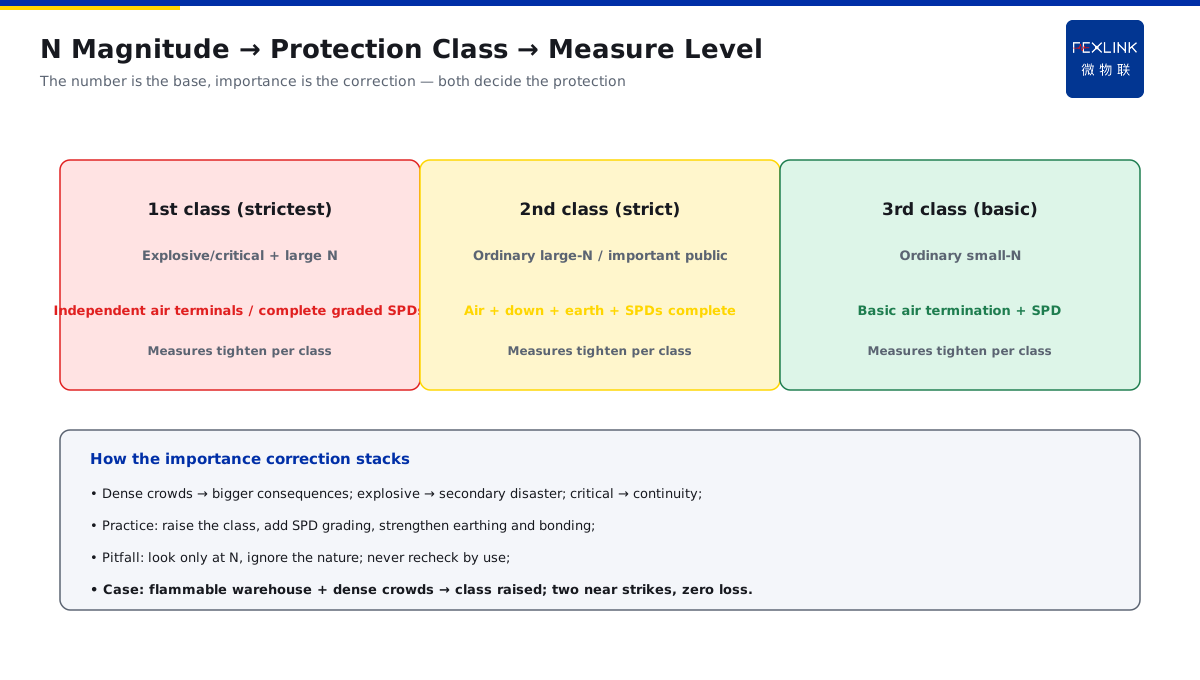
Direct Answer
Where does the "annual expected number of lightning strikes of 0.06 per year" in a design document come from, and what does this threshold decide? The answer: the annual expected number N is obtained by multiplying the building's equivalent interception area (which grows with length, width and height) by the local ground-flash density Ng — it is a probabilistic annual count; GB 50057 uses the magnitude of N (together with the building's importance and use) to classify the building into third-class, second-class or even first-class lightning protection — the larger N and the more important the building, the higher the protection level.
A project's design document stated "annual expected strikes 0.06/year, protected as third class", and review questioned it: the building was clearly tall, the equivalent interception area should be larger, and N should be more than 0.06. Recalculated with the actual height, N ≈ 0.12, which falls into second-class protection, and the measures were upgraded accordingly. The key distinction: N is not a form-filling number but a real criterion calculated as "interception area × ground-flash density" — if N is wrong, the classification is wrong, and the measure level is wrong.
Why:
- Interception area: the equivalent interception area grows significantly with building height (the taller the building, the more its sides intercept lightning);
- Composition: N = equivalent interception area × local ground-flash density Ng;
- Classification threshold: the magnitude of N + building importance → first/second/third class;
- Check points: review rechecks height, Ng value and importance correction.
Key insight: "N is the criterion for lightning-protection classification — calculated from interception area × ground-flash density, and its magnitude decides the measure level."
At a park, the owner of a multi-storey warehouse planned "ordinary third class", but the warehouse stored flammable goods and had heavy foot traffic. Design review: the importance correction required a higher class — lightning rods and graded SPD protection were added; in the following storm season two nearby strikes caused no loss. Lesson: the magnitude of N is only the first step — importance and use decide the class too; do not look only at the number.
1. The Logic of the Equivalent Interception Area Growing with Height
Step one: why a building "intercepts" lightning.
The concept of the interception area:
- A building acts like an "interception surface";
- The interception area = the equivalent ground area around the building that can take strikes;
- It is derived from length, width and height (including roof appendages);
- The taller the building, the larger the interception area.
Why height amplifies:
- The sides of tall buildings are exposed to lightning channels;
- The equivalent radius grows with height;
- The probability of strikes near the building rises;
- The area grows nonlinearly with height.
Engineering intuition:
- A low shed has a small interception area;
- A high-rise has a much larger one;
- Under the same Ng, the high-rise has a larger N;
- This is the numerical source of "the taller, the more protection needed".
Key insight: "The equivalent interception area is the size of the building's lightning-catching surface — the taller the building, the larger the area and the larger N; that is the numerical basis for protecting high-rises more."
2. The Composition of N = Interception Area × Ng
Step two: how the number is calculated.
The composition:
- N = equivalent interception area Ae × ground-flash density Ng;
- Ae is derived from the building geometry (with correction factors);
- Ng is the local lightning-location/meteorological statistic;
- Multiplying them gives the annual expected strikes.
What the units mean:
- Ng unit: flashes/(km²·a) — flashes per square kilometre per year;
- Ae unit: km²;
- N unit: flashes/year;
- It is a probabilistic annual count, not a certain event.
Calculation notes:
- The height includes roof equipment and protrusions;
- Correction factors follow the standard;
- Ng must be the local value (connecting to KD-0180);
- Recheck each input when recalculating.
Key insight: "N = Ae × Ng — interception area and ground-flash density are the two inputs; if either is wrong, N is distorted."
3. The Magnitude of N and the Corresponding Classification Thresholds
Step three: which line does N cross.
GB 50057 classification logic:
- The magnitude of N sets the base level;
- Building importance/use then corrects it;
- First class is the strictest (explosive, critical);
- Second and third classes relax in turn.
Typical thresholds (illustrative):
- N ≥ 0.05–0.25/year magnitude → ordinary buildings map to second/third class;
- Explosive-hazard/important buildings → directly first/second class;
- Densely populated/important public buildings → stricter;
- Exact values follow the GB 50057 clauses.
What the threshold means:
- The class decides the measure level;
- First class: independent air terminals / complete graded SPDs;
- Second class: air termination + down conductors + earthing + SPDs complete;
- Third class: basic air termination and SPD protection.
Key insight: "The magnitude of N + building importance → protection class → measure level — N is the key to classification and importance is the correction."
4. How Importance Corrections (Dense Crowds, Flammable/Explosive) Stack Up
Step four: beyond the number, look at "nature".
Where importance corrections come from:
- The same N, different risk for different buildings;
- Dense crowds → amplified consequences;
- Flammable/explosive → secondary-disaster risk;
- Critical facilities → high continuity requirements.
How the correction lands:
- Raising the protection class (stricter);
- Adding SPD grading and energy coordination;
- Strengthening earthing and equipotential bonding;
- Deciding measures together with the N magnitude.
Correction pitfalls:
- Looking only at N, ignoring the nature;
- Treating the class as "set once, done forever";
- Not rechecking by use;
- Protecting important buildings at a low class.
Key insight: "N is the base, nature is the correction — dense crowds, flammable/explosive and critical facilities are all stricter; both factors together decide the protection class."
5. The Check Points When N Is Challenged in Design Review
Step five: how to answer "is this number right".
The check list:
- Building size: does the length/width/height include protrusions;
- Height: does it include roof equipment/antennas/tanks;
- Ng: is it the local statistic (not a neighbouring area);
- Correction: is importance/use stacked;
- Recalculation: substitute and recompute each item.
Common challenges:
- "Why is N so small" → check height/Ng;
- "Similar projects are not calculated this way" → check the interception-area formula;
- "Where does Ng come from" → check the data source (connecting to KD-0180);
- "Should it be one class higher" → check the importance correction.
The value of review:
- N recheck → correct class → measures neither insufficient nor wasteful;
- Avoiding "over-protection" cost;
- Avoiding "under-protection" risk;
- It is the first gate of lightning-protection design quality.
Key insight: "When challenged, recheck 'size-height-Ng-importance correction' item by item — with N right, the class is right, and money is spent on the right things."
6. Product Implementation: Lightning Environment and Strike Monitoring
WeiWuLian products turn the "design value" of N into an "operational value":
- FL Lightning-Current Monitor: measures real strike amplitude/energy/count;
- Lightning-environment verification: operational data back-checks the design N and Ng assumptions;
- Graded-protection assessment: checks SPD configuration against measured intensity;
- Data loop: design → operation → review → redesign.
The design principle in one sentence: "N is the starting point of design; measurement is the verification of operation — operational data makes lightning-protection design increasingly accurate."
7. Common Misjudgments
- "N is a form-filling number": treating a classification criterion as process. Result: wrong calculation, wrong class. Correct: calculate and recheck item by item.
- "Look only at N, not the height": ignoring the interception-area amplification. Result: N too small, class too low. Correct: recalculate with height including protrusions.
- "Use a neighbouring Ng": improper value. Result: distorted N. Correct: use the local statistic (connecting to KD-0180).
- "Small N means unimportant": ignoring the importance correction. Result: important buildings under-protected. Correct: stricter by nature.
- "Done once the design is set": no operational verification. Result: design assumptions drift from reality. Correct: back-check with measured data.
Scope and Limitations
This article explains the composition of the annual expected strike number N (equivalent interception area × ground-flash density), its mapping to protection classes and the importance-correction logic, applicable to lightning-protection design and review. The exact formula coefficients, classification thresholds and correction rules follow GB 50057-2010 and its revisions; Ng must use the local authoritative statistic (connecting to KD-0180). All cases are anonymized (a project, a park) and do not refer to any specific customer.