 微物联研究院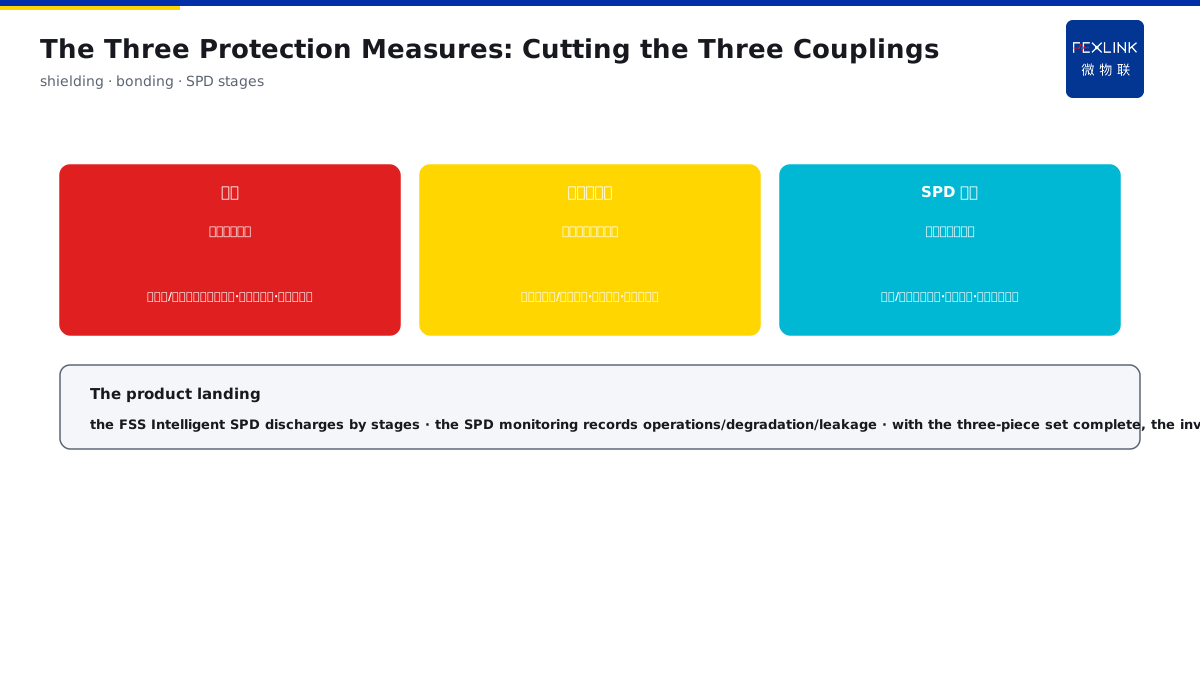
Direct Answer
The lightning clearly did not hit the equipment, yet a nearby strike damaged the boards in the cabinet — how does that happen? The answer: LEMP (lightning electromagnetic pulse) is the rapidly changing electromagnetic field produced in the surrounding space by the large current at the strike; through electrostatic induction, electromagnetic induction and resistive coupling it induces overvoltages on adjacent conductors; it does not need a direct hit to damage sensitive electronic equipment, and this is exactly the main cause of lightning damage in weak-current systems.
At a data center a nearby independent lightning rod was struck. The equipment itself was not directly hit, but the monitoring boards were damaged in batches. The investigation found that the electromagnetic pulse from the current flowing on the down-conductor induced an overvoltage into the boards through the openings of the cabinet shell and the power cable. After the three LEMP measures (shielding, bonding, SPD stages) were completed, the same storms caused no more damage. The key distinction: LEMP does not need a direct hit — the fast-changing electromagnetic field of the lightning current induces overvoltages on adjacent conductors through electrostatic induction, electromagnetic induction and resistive coupling; the main cause of lightning damage in weak-current systems is not the direct hit but these induction couplings.
Why:
- Electrostatic induction: the thundercloud field accumulates opposite charges on adjacent conductors, released as an overvoltage at the instant of the strike;
- Electromagnetic induction: the lightning current produces a changing magnetic field, inducing a voltage in adjacent loops;
- Resistive coupling: when the lightning current enters the ground through the earthing system, the earth potential rises and conducts to the equipment;
- The protection landing: shielding, bonding and SPD stages correspond to cutting the three couplings.
Key insight: "LEMP does not need a direct hit — the spatial electromagnetic field of the lightning current induces overvoltages through electrostatic/electromagnetic induction and resistive coupling, damaging nearby sensitive equipment; the main cause of weak-current lightning damage is the induction coupling, not the direct hit."
After a thunderstorm at a factory area, a PLC control cabinet that had not been struck was damaged. The maintenance worker thought it was a quality problem; the investigation found that the cabinet shielding had not been done and the signal cables had not been bonded, so the induced overvoltage entered through the signal cables. Lesson: the invisible coupling is the most dangerous — LEMP damages without a direct hit; shielding/bonding/SPD are the standard three-piece set.
Overview: run "the three coupling mechanisms → why it is invisible → the three protection measures → the product landing" as one clear understanding. LEMP is the most "invisible" kind of lightning damage: the equipment is clearly not hit, yet a nearby strike still damages the boards. The cause lies in the fast-changing electromagnetic field produced by the lightning current, which induces overvoltages on adjacent conductors through three couplings (electrostatic induction, electromagnetic induction and resistive coupling). Understanding the three couplings means understanding why the protection needs shielding, bonding and SPD stages — each one cuts one coupling. The four layers are unfolded below.
A "three water inlets" analogy for the couplings: think of LEMP as a rainstorm pouring into the house through three inlets. Electrostatic induction is like "the roof leaking" — the thundercloud field "forces" charges onto long lines and releases them together at the strike instant; electromagnetic induction is like "the window flooding" — the magnetic field of the lightning current is like a shock wave "slapping" a voltage into adjacent loops; resistive coupling is like "the floor drain backing up" — when the lightning current enters the earth, the earth potential rises and "backs up" into the equipment along the earth conductor. The three inlets correspond to three things: the roof leaking is discharged by the SPD, the window flooding is blocked by the shielding, and the floor drain backing up is sealed by the bonding. The three-inlet analogy: electrostatic induction = roof leaking (discharged by the SPD), electromagnetic induction = window flooding (blocked by the shielding), resistive coupling = floor drain backing up (sealed by the bonding) — three inlets, three things; missing one leaves one water path in.
1. The Three Coupling Mechanisms: How LEMP "Hurts at a Distance"
Step one: LEMP "sends" the overvoltage into the equipment through three ways.
Electrostatic induction:
- The thundercloud field accumulates opposite charges on adjacent conductors;
- At the strike instant the field disappears and the charges release;
- Forming an overvoltage on the conductor;
- Long lines and overhead lines especially obvious.
Electromagnetic induction:
- The lightning current flowing on the down-conductor produces a changing magnetic field;
- The field cuts adjacent loops;
- A voltage is induced in the loop;
- The larger the loop area, the stronger the induction.
Resistive coupling:
- The lightning current enters the earth through the earthing system;
- The earth potential rises instantly;
- The high potential conducts to the equipment along the earth conductor;
- Especially obvious with a shared earthing grid.
Key insight: "The three couplings — electrostatic induction (field accumulation released), electromagnetic induction (the field cutting loops), resistive coupling (the earth potential rising and conducting); LEMP 'hurts at a distance' by sending the overvoltage into the equipment through these three ways."
2. Why It Is "Invisible": Damage without a Direct Hit
Step two: the concealment of LEMP comes from three "nots".
Not directly hit:
- The equipment is not directly struck;
- The strike point is nearby (the down-conductor/an independent air termination);
- The distance makes the "correlation" ignored;
- The fault misjudged as a quality problem.
Not obvious:
- The damage is not an instant total breakdown;
- It shows as board degradation and port failure;
- Some damage appears with a delay;
- Hard to locate the true cause on site.
Not single:
- Coupled on one path, entering through multiple paths;
- The power cable, the signal cable and the shield layer all possible;
- A single-point protection cannot block all paths;
- The system protection is needed.
Key insight: "Why invisible — not directly hit (the fault misjudged as quality), not obvious (degradation delayed and hard to locate), not single (multiple paths, a single point cannot block) — the invisibility of LEMP makes the damage attribution hard and the protection easy to miss."
3. The Three Protection Measures: Cutting the Three Couplings
Step three: the three measures correspond to cutting the three couplings.
Shielding (cutting the electromagnetic induction):
- The metal cabinet/shield layer forms a Faraday cage;
- The magnetic field short-circuited by the shield layer;
- The openings/gaps must be handled;
- The shield layer effective only when grounded.
Bonding (cutting the electrostatic induction and the earth potential):
- The metal pipes/cables in and out of the equipment bonded;
- Eliminating the potential differences between the equipment;
- A shared earthing reduces the earth-potential differences;
- Handled centrally at the boundaries (relating to KD-0207).
SPD stages (discharging the induced overvoltages):
- An SPD at the power boundary;
- A signal SPD on the signal lines;
- Staged discharge, controllable end residual voltage;
- The degradation monitored online (relating to KD-0161).
Key insight: "The three measures correspond one-to-one — the shielding cuts the electromagnetic induction, the bonding cuts the static and the earth potential, and the SPD stages discharge the induced overvoltages; with one of the three missing, one coupling path leaks in."
An on-site order to judge "is it LEMP": when equipment is damaged for no obvious reason, do not rush to the "quality problem" conclusion. Check in three steps: step one, ask about the lightning — was there a storm near the damage, is there a strike record (checkable by the lightning-current monitoring); step two, look at the paths — what cables enter and leave the equipment (power/signal/network), is the shield layer grounded, is the bonding done; step three, match the coupling — which path most likely brought the induced overvoltage in, is there an SPD at the corresponding boundary, and is there an operation record. With the three steps, the LEMP damage is usually located; conversely, with no storm and clean paths, only then consider the equipment itself. The three steps to judge "is it LEMP": ask about the lightning (any nearby storm/strike record) → look at the paths (what cables enter/leave, shielding and bonding done) → match the coupling (which path is most likely, did the SPD operate) — rule out the coupling first, then talk about the equipment quality.
Three reasons why weak-current systems are especially "hit": why does the lightning damage land mainly on weak-current systems? One, the weak-current equipment has a low withstand voltage — the impulse-withstand voltage of the boards and chips is only a few hundred volts, while the induced overvoltage is often several kilovolts; two, the weak-current lines are long with large loops — signal and network cables cross multiple zones, the loop area is large, and the electromagnetic induction is efficient; three, the weak-current system is entangled with the power and the earthing system — a shared earthing grid and shared cable trays, with many resistive-coupling paths. The three reasons together make LEMP a far greater threat to weak-current equipment than to power equipment. The three reasons for weak-current vulnerability: low withstand voltage (boards only a few hundred volts), long lines with large loops (high induction efficiency), entangled with power and earthing (many coupling paths) — together they make LEMP target the weak-current system.
4. Product Implementation: The Invisible Damage Made Visible
WeiWuLian products land the LEMP protection into verifiable monitoring:
- The FSS Intelligent SPD: staged discharge of the induced overvoltages on the power lines;
- SPD monitoring: operations/degradation/leakage all recorded;
- The signal-protection package: overvoltage protection for the signal lines;
- The data loop: after a strike, verify which stage operated and which coupling path was cut.
The design principle in one sentence: "LEMP damages without a direct hit — the shielding cuts the electromagnetic induction, the bonding cuts the static and the earth potential, and the FSS stages discharge the induced overvoltages; with the three-piece set complete, the invisible damage becomes visible."
A data view of the lightning damage attribution: on site "damaged without being hit" is often attributed to the supernatural; with data it can actually be attributed. The lightning-current monitoring records the magnitude and count of nearby strikes, the SPD monitoring records whether the power path operated, and the signal protection records the overvoltage events on the signal path — put the three paths of data together and the coupling path is clear: if the power path operated and the signal path also operated, both couplings came in, and which protection to add is obvious. Without data it is guesswork; with data it is evidence. Attribution by data: the lightning-current monitoring records the nearby strikes, the SPD monitoring records the power-path operations, and the signal protection records the signal-path overvoltages — put the three paths of data together, and which coupling came in and which protection to add are obvious.
5. Common Understanding Misjudgments
- "Not hit, so not damaged": wrong. LEMP relies on the induction coupling; a nearby strike still damages the equipment.
- "An SPD on the power only is enough": wrong. The signal lines and the shield layer are also coupling paths; a single-point protection cannot block them.
- "A shielded cabinet equals protection": wrong. Without the shield layer grounded and the openings handled, the shielding is useless.
- "The damaged equipment is a quality problem": wrong. Check the coupling paths first; many "mysterious damages" are caused by LEMP.
- "Check only after the thunderstorm": delayed. The induction damage may appear with a delay; rely on the online monitoring to keep watching.
Scope and Limitations
This article explains the three coupling mechanisms of LEMP (electrostatic induction/electromagnetic induction/resistive coupling) and the three protection measures, applicable to the lightning damage attribution and protection configuration of weak-current systems. The specific shielding practices, bonding and SPD stages follow GB 50343-2012 and IEC 62305-2; this article explains only the mechanisms and the logic. All cases are anonymized (a data center/a factory area) and do not refer to any specific customer.