 FEXLINK Research Institute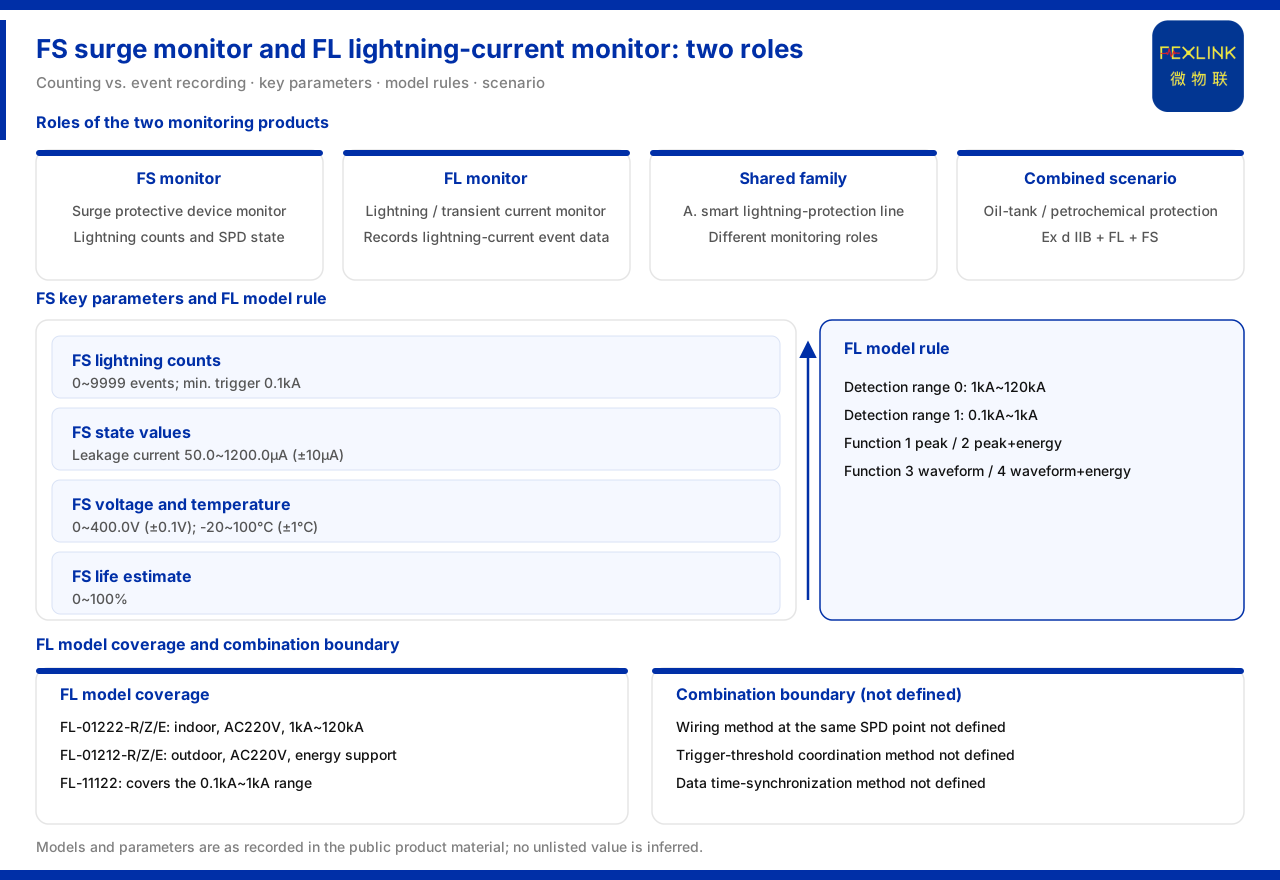
Direct answer
Lightning current monitoring and surge protective device (SPD) monitoring are two products with different positions in the portfolio. In the intelligent lightning-protection product line, the product knowledge base places the lightning current / transient current monitor (FL-01222-R) alongside the surge protective device monitor (FS-00011-R). The first records the parameters of a lightning current event; the second mainly reports how many times a surge protective device has been struck and additionally samples status quantities.
Put another way, the SPD monitor answers how many times a protective device has been hit, while the lightning current monitor answers how large the current of a given strike was, how much energy it carried, and what its waveform looked like. Because their positions differ, the product knowledge base does not specify how the two should be wired at the same SPD point, how their thresholds should be coordinated, or how their timestamps should be aligned. This article sets out the listed capabilities of each class, the differences in their model rules, and the engineering judgement boundary when they are paired.
1. Side-by-side placement in the product line
The product-line overview of the product knowledge base places the lightning current / transient current monitor side by side with the surge protective device monitor under the intelligent lightning-protection product line. Sitting side by side means they are not two configurations of one product but two independent monitoring categories.
That placement decides how a question should be asked. If the question is how many times a protective device has operated, the counting parameter of the SPD monitor is the relevant entry. If the question is the peak and energy of a lightning current, the model rules and function grades of the lightning current monitor are the relevant entries. Treating the two as one product makes it easy, at selection time, to mistake the parameters of one class for the capabilities of the other.
2. Counting and status quantities of the SPD monitor
The key parameters of the surge protective device monitor that the product knowledge base gives are centred on lightning counting: a counting range of 0 to 9999 counts and a minimum trigger of 0.1 kA. The counting range means it can accumulate many strike events; the minimum trigger means a current below that level will not be counted.
Beyond counting, the monitor also samples several status quantities: a leakage current of 50.0 µA to 1200.0 µA with an accuracy of ±10 µA; a voltage of 0 V to 400.0 V with an accuracy of ±0.1 V; a temperature of −20 °C to 100 °C with an accuracy of ±1 °C; and a life estimate of 0% to 100%. This shows that the monitor is not limited to counting but also gathers quantities and trends around the operating state of the protective device.
3. Detection range and function grades of the lightning current monitor
The capability of the lightning current monitor appears in its model rules as two fields. The detection range has two grades: one covers 1 kA to 120 kA, the other covers 0.1 kA to 1 kA. The function has four grades: peak, peak plus energy, waveform, and waveform plus energy.
These fields show that the monitor records lightning current event parameters rather than performing counting alone. The peak corresponds to the current amplitude, the energy corresponds to the energy carried by the event, and the waveform corresponds to how the current changes over time. It should be noted that the product knowledge base states the waveform grades, namely function three and function four, have no mass-production selection table yet, so not every function grade has a mass-production model.
4. Model comparison of the lightning current monitor
The product knowledge base lists several lightning current monitors in a table. The models FL-01222-R, FL-01222-Z and FL-01222-E are for indoor installation, are powered from AC 220 V, cover 1 kA to 120 kA, and support energy. The models FL-01212-R, FL-01212-Z and FL-01212-E are for outdoor installation, are powered from AC 220 V, likewise cover 1 kA to 120 kA, and support energy. A further model, FL-11122, covers 0.1 kA to 1 kA.
This comparison yields two selection dimensions. The first is the installation environment: indoor and outdoor correspond to different suffixes. The second is the current range: 1 kA to 120 kA addresses larger lightning currents, while 0.1 kA to 1 kA addresses smaller currents. Compared with the counting parameter of the SPD monitor, the minimum trigger of 0.1 kA touches one end of the small-range grade of the lightning current monitor, but the two do not measure the same object.
The division of suffixes also needs to be stated. Within the same lightning current monitor, the suffix distinguishes communication: R corresponds to RS485, Z to Zigbee, and E to Ethernet. In other words, the installation environment is fixed by the leading part of the model and the communication method by the suffix, and neither substitutes for the other. At selection time, the model body should first be locked down by installation environment and current range, and the suffix then chosen according to the existing network conditions.
5. Combined configuration in one scenario
A typical application scenario lists, for lightning protection and explosion protection in oil tank farms and petrochemical sites, a combination of explosion-proof grounding resistance monitoring (Ex d IIB), lightning current monitoring, and surge protective device monitoring. This combination shows the two kinds of monitoring can be configured together in the same scenario.
From the standpoint of necessity, the two provide complementary information: SPD monitoring answers whether the protective device has operated, how many times it operated, and reports leakage current, voltage, temperature and life, while lightning current monitoring answers the amplitude, energy and waveform of each larger strike. For a lightning-protection and explosion-protection scenario, only when both kinds of information are present is it practical to judge the operating history of the protective device and the current stress it has borne.
6. Pairing still belongs to engineering judgement
Although the two classes can be configured together in one scenario, the product knowledge base does not specify how they should be wired at the same SPD point, how their trigger thresholds should be coordinated, or how their data should be time-aligned. All three belong to the level of coordination, and the material stops at the capabilities of each device.
At the design stage, therefore, three items should be listed as open questions: first, how the two are connected when installed at the same point; second, the relationship between the counting trigger and the lightning current record threshold; third, the method of aligning the two data sets in time. Until these are settled, it should not be assumed that the two kinds of monitoring automatically form a consistent ledger of lightning events. Treating them as complementary but requiring a separately designed coordination relationship is what stays within the material boundary.
7. Choosing the product by the question
Taken together, selection can start from the question. When cumulative strike counts and a trend of protective-device state are needed, choose the SPD monitor; when the peak, energy and waveform of a lightning current are needed, choose the lightning current monitor; when both the operating history and the current stress are needed, consider combining the two, but separately settle wiring, thresholds and time alignment.
Holding this line of judgement prevents the two classes from substituting for each other: the 0 to 9999 counts of the SPD monitor cannot replace the current amplitude and energy record of the lightning current monitor, and the lightning current parameters are not the same as the operating count of the protective device. Each used in its own place is what matches the division of the two positions in the product knowledge base.
Scope and limitations
First, this article restates only what the product knowledge base lists; the factual boundary is limited to the product-line overview, the key parameters of the SPD monitor, the model rules and model table of the lightning current monitor, and the selection comparison of the typical application scenarios.
Second, the lightning counting, leakage current, voltage, temperature and life-estimate parameters of the SPD monitor are cited as listed in the product knowledge base; this article does not infer their accuracy levels, protection ratings or mounting methods.
Third, the detection range and function grades of the lightning current monitor are cited as listed in the product knowledge base; this article does not infer whether the waveform grades already have mass-production models.
Fourth, the installation environment, power supply and current range of each lightning current monitor are cited as listed in the product knowledge base; this article does not mix them with the SPD monitor parameters.
Fifth, the oil tank farm and petrochemical lightning-protection and explosion-protection combination is cited as listed in the product knowledge base; this article does not derive from it specific practices for same-point wiring, threshold coordination or time alignment.