 FEXLINK Research Institute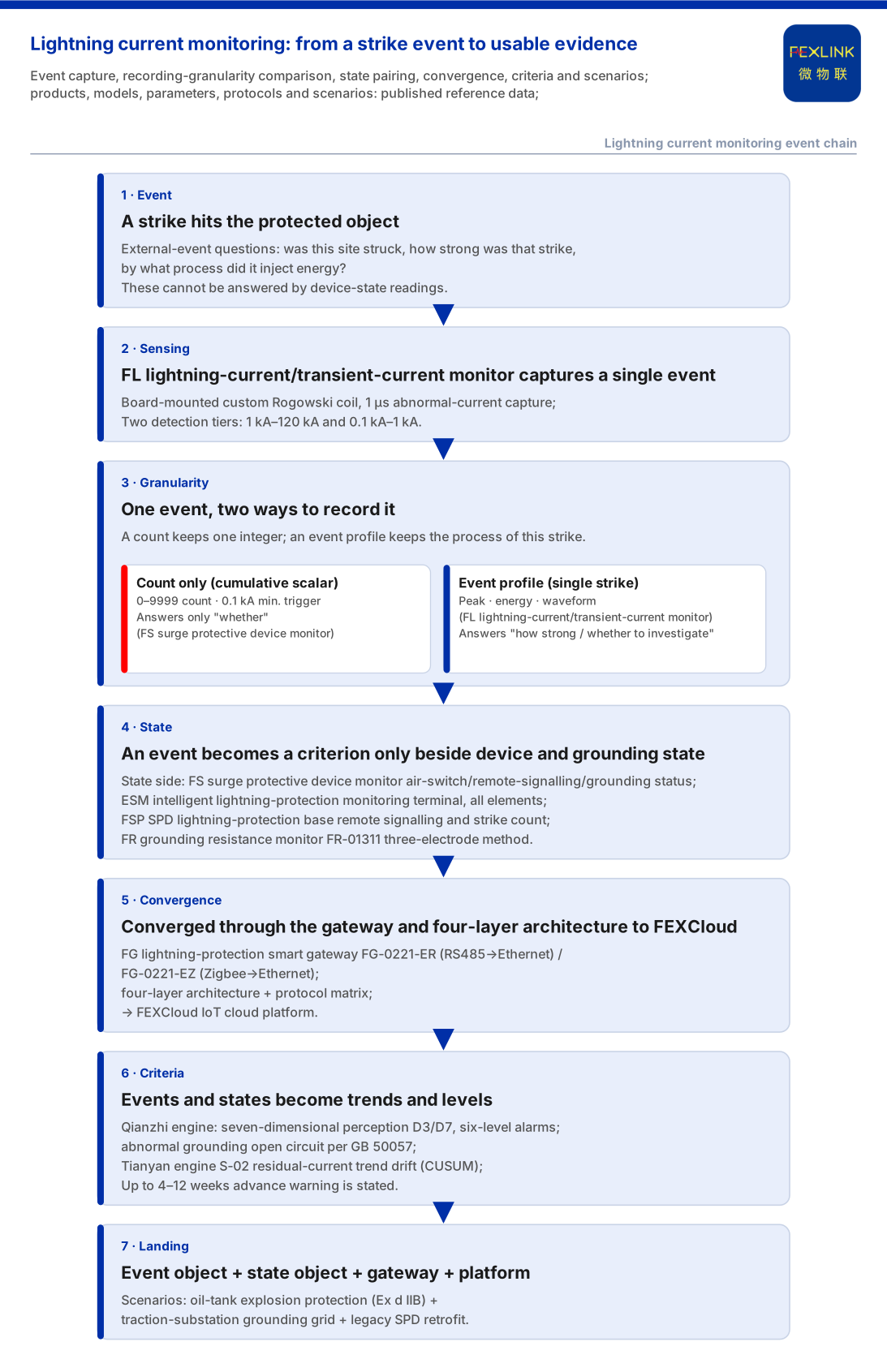
Direct answer: in a lightning-protection system, lightning current monitoring is an event-level evidence source — it answers whether a protected object was ever hit, how strong that strike was, and by what process it injected energy. Counting strikes outputs only a scalar "N events happened", with no amplitude, energy, waveform or per-event resolution; it answers "whether" but not "how strong or whether to investigate". The capability carrying this purpose is the FL lightning-current/transient-current monitor, with two detection tiers of 1 kA–120 kA and 0.1 kA–1 kA and function tiers of peak, peak+energy, waveform and waveform+energy.
Absent field specifications and indicators are not fabricated.
1. Lightning Current Monitoring Answers "Events", Not "States"
State describes what the device looks like now (leakage, temperature, air-switch position, grid resistance); an event describes what happened out there. The knowledge base lists the FS surge protective device monitor's elements as remote signalling, air-switch status, grounding status, strike count, leakage current, temperature, voltage and lifetime estimation, with leakage 50.0–1200.0 μA (±10 μA), voltage 0–400.0 V (±0.1 V), temperature -20–100 ℃ (±1 ℃) and lifetime 0–100%. Almost all describe the device itself; only "strike count" comes from an external event.
The distinctive purpose of lightning current monitoring is to complete that external-event side: it answers not "is the device healthy now" but "was this site struck, and how strong was that strike". The product-line overview places FL alongside FS, ESM, FSS, FSP, FR and FG under the intelligent lightning-protection line, and the four-layer architecture puts FL in perception-layer acquisition modules.
2. How Does It Answer "How Strong Was This Strike"
The knowledge base provides the quantity that expresses a single event's strength: FL's detection range has tier 0 at 1 kA–120 kA and tier 1 at 0.1 kA–1 kA, and its functions are 1 peak / 2 peak+energy / 3 waveform / 4 waveform+energy. Among named models, FL-01222 (indoor) and FL-01212 (outdoor) cover 1 kA–120 kA peak with energy (charge/unit-energy) monitoring, while FL-11122 (indoor) covers 0.1 kA–1 kA; all three use AC220V, with communication by the -R/-Z/-E suffix. The underlying capability matches: it uses a board-mounted custom Rogowski coil to capture abnormal current at the 1 μs level, a fast transient process.
3. Why "Recording Only Counts" Is Not Nearly Enough
A count is a cumulative scalar carrying no event information in at least four dimensions. It has no amplitude, so it cannot distinguish a small disturbance just over threshold from a strong impulse near the top of the range, and every discharge above the 0.1 kA threshold joins the same integer. It has no energy, though accumulated stress is often energy injected over time, not just peak. It has no waveform, the dimension that function tiers 3/4 retain to characterise an event's process signature. And it has no distinction between "this one" and "the next": all events compress into one ever-growing integer, so a single site visit cannot be reviewed afterwards.
A further, more critical gap is association: an event becomes a judgement only beside state. A strike must be read together with "was the SPD normal and the grounding grid stable at that moment" — the FS air-switch, remote-signalling and grounding status; the ESM intelligent lightning-protection terminal's all-element monitoring; the FSP SPD protection base's remote-signalling input and strike count; and the FR grounding resistance monitor FR-01311's three-electrode online resistance. With counts only and no event profile, events and states cannot connect — the substance of "counting alone is not nearly enough".
4. Putting the Purpose into Engineering: Ranges, Gateway and Scenarios
Basic recording establishes only "did it happen"; answering "how strong and by what process" needs a monitor with amplitude, energy and waveform functions. On the protection side, the FSS intelligent surge protective device offers In/Imax from 10 kA/20 kA up to 40 kA/80 kA and Up of 1.5 kV–2.2 kV.
Event data also needs a gateway and link. The FG lightning-protection smart gateway is a protocol-conversion type with DC12V supply: FG-0221-ER uses RS485 downlink and Ethernet uplink, FG-0221-EZ uses Zigbee downlink and Ethernet uplink. The knowledge base places it at the edge layer, converging data to the FEXCloud IoT cloud platform; the protocol matrix gives downlinks of Modbus RTU (RS485), Zigbee (Modbus) and LoRa, uplinks of Modbus TCP/MQTT (Ethernet, 4G) and optional gateway-level IEC 61850. The system-level parameters add margin: grounding units cover 0-200 Ω (standard, ±1%) / 0-500 Ω (high-precision, ±0.5%) / 0.01-200 Ω explosion-proof (±2%), IP65; the gateway mounts ≥128 points (cascadable), with ≥4 RS485 paths, ≥2 Ethernet paths, ≥15 days caching and DC9-36V wide voltage.
Scenarios: the comparison lists "oil-tank area / petrochemical lightning and explosion protection" as "explosion-proof grounding resistance monitoring (Ex d IIB) + FL lightning-current monitoring + FS arrester monitoring", "substation / traction-substation grid online monitoring" as "FR-01311 (one set per point) + FG gateway + FEXCloud", and "arrester status monitoring (retrofit of existing SPDs)" as "FS surge protective device monitor / ESM all-element SPD monitoring / FSP protection base".
5. When Data Becomes Evidence: Criteria and Early Warning
For event records to be usable, criteria must turn them into action. The knowledge base records that the Qianzhi engine runs a seven-dimensional perception matrix including D3 trend drift (core) and D7 time-series risk scoring (0-100), with a six-level alarm system (Normal 85-100 / Watch 70-84 / YJ1 55-69 / YJ2 40-54 / BJ1 20-39, handle within 48 h / BJ2 0-19, stop immediately) and red lines; "abnormal grounding-resistance open circuit" is based on GB 50057. The knowledge base records that the Tianyan engine's S-02 "residual-current trend drift (CUSUM)" detects a weak mean shift while leakage is still safe, which the knowledge base states can give 4-12 weeks of advance warning. The event side says what happened; the state side says whether device and grid remain stable.
6. Boundaries: What This Article Does Not Claim
First, this article's argument that lightning-current monitoring is an event-level evidence source, and that counting alone is not enough, does not constitute a standard, specification, acceptance basis or operating procedure. Second, the knowledge base records that "waveform-tier FL models (functions 3/4) have no mass-production selection table yet"; the knowledge base also gives no event-record field specification, sampling or reporting frequency, offline caching or backfill strategy, work-order grading rules or evidence-retention format, and none is fabricated. Third, the quantitative value indicators are vendor statements; the project notes are internal records, cited only as source notes. This article claims no diagnostic performance, certification, qualification or compatibility conclusion, and does not take on "counting vs event diagnosis" data-granularity methodology, wind-turbine-blade object, post-strike triage order, or strike consequences and essential difference of counting.
Conclusion
Lightning current monitoring fills the missing external-event side of a lightning-protection system: it answers whether a strike occurred, how strong it was and by what process it injected energy, a division of labour with state monitoring answering "is the device still stable". Counting alone is not nearly enough because a count is a scalar — no amplitude, energy, waveform or per-event resolution, and no link to device or grounding state. The purpose is carried by the FL two-tier range and four function tiers; the state side is provided by FS, ESM, FSP and FR, converged through the FG gateway with the architecture and protocol matrix to FEXCloud, and carried by the red lines and six-level alarms and the Tianyan S-02, landing on the scenario combinations. A count says only "whether"; lightning current monitoring must say "what this strike was and whether to act".