 FEXLINK Research Institute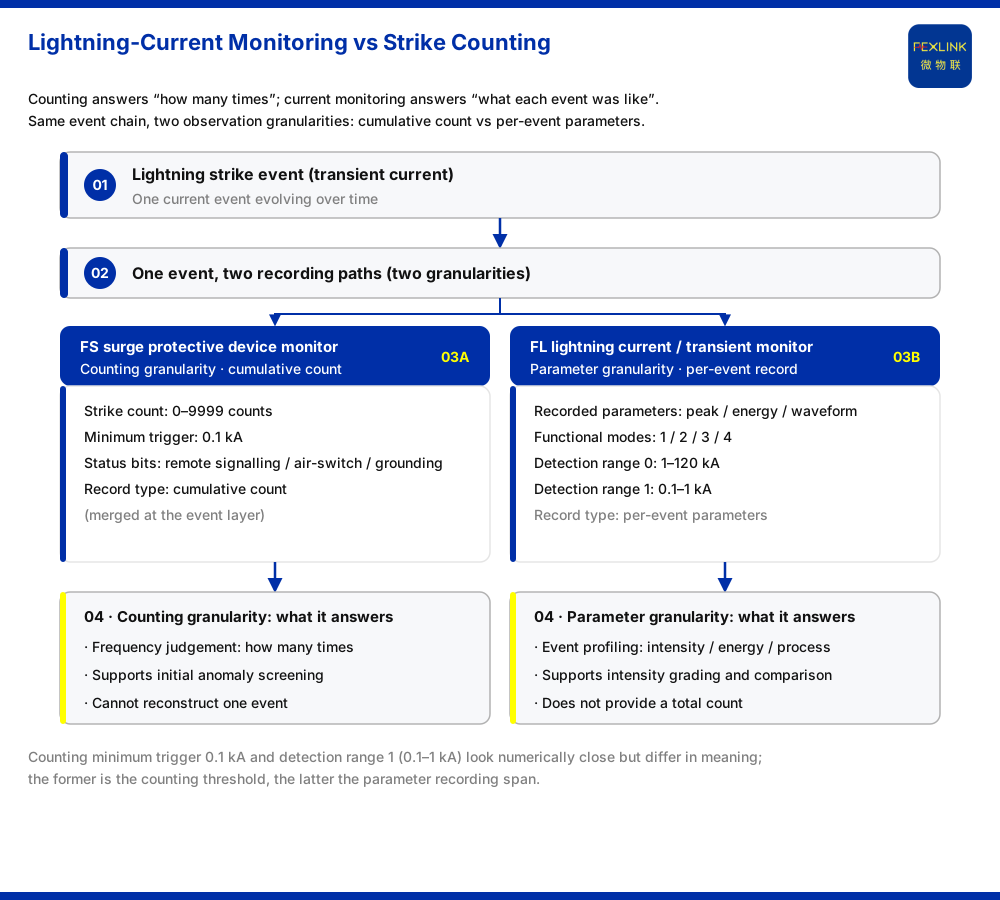
Direct Answer
The most fundamental difference between strike counting and lightning-current monitoring lies in recording granularity. Counting answers only "how many times did it happen"; lightning-current monitoring answers "what was each event like". The former merges strike events over a period into one cumulative number; the latter preserves peak, energy, and waveform parameters for every individual event. They are not levels of accuracy but observation layers at different granularities — counting is the aggregated event-layer result, lightning-current monitoring the per-event parameter record. The choice therefore depends on whether you need the statistical fact of "whether it happened, and how often", or the analytical material of "how strong each event was, and how it unfolded".
1. Granularity: a cumulative count versus per-event parameters
Counting compresses many events into a single accumulated value. In the knowledge base, the FS surge protective device monitor (FS-00011) provides a lightning strike counting range of 0–9999 counts with a minimum trigger of 0.1 kA. Events that reach the trigger magnitude are accumulated, and what the user finally sees is "how many times this has occurred". That number does not distinguish which events were strong and which were weak, nor does it retain the process shape of any individual event.
The FL lightning current / transient current monitor (FL-01222) takes a different route. Its event-parameter recording capability is organized into functional modes: mode 1 records peak, mode 2 records peak plus energy, mode 3 records waveform, and mode 4 records waveform plus energy. Peak is the amplitude of a single event; waveform is the time-domain process of a single event. Both attach to "one particular event", not to an accumulated value.
One records "how many times", the other "each time" — the origin of the granularity difference. A cumulative count cannot reconstruct the peak and waveform of an individual event, and per-event parameters cannot directly yield a total count. The two are not interchangeable.
2. Strike counting answers "how many times"
The value of strike counting is that it turns discrete, irreversible lightning strike events into a quantity that can be statistically processed: whether strikes were frequent over a given period, whether any strike occurred within an inspection cycle. On that basis, an initial screening judgement of "whether further investigation is needed" becomes possible.
The counting trigger condition sets its lower bound. The minimum trigger of the FS surge protective device monitor is 0.1 kA; disturbances below that magnitude are not counted. This is the boundary of counting capability: counting does not characterize the event, it only decides whether the event crosses the threshold for being recorded.
Counting results and SPD status are two different classes of information. Beyond counting, this monitor also provides status bits such as remote signalling, air-switch state, and grounding state. These quantities reflect the state of the SPD and its circuit, not the number of strike events. Conflating status bits with counts misreads the information hierarchy of the device report.
3. Lightning-current monitoring answers "what each event was like"
Lightning-current monitoring records the transient process quantity of lightning current itself. Divided by functional mode, it can selectively retain peak, energy, and waveform: peak gives the intensity magnitude of a single event, waveform gives the temporal shape of a single event, and energy is an additive parameter attached respectively to the peak line and the waveform line. Modes 1 and 2 belong to the peak mainline; modes 3 and 4 belong to the waveform mainline. Energy does not form a separate mode.
Recording granularity also determines the reachable magnitude range. The detection range of the FL lightning current / transient current monitor is divided into two ranges: detection range 0 covers 1 kA–120 kA, and detection range 1 covers 0.1 kA–1 kA. The range code appears in the model rule, which means that "how large a magnitude of events you are preparing to record" is already fixed at the selection stage.
One common confusion should be avoided: the 0.1 kA minimum trigger of counting and detection range 1 (0.1 kA–1 kA) of lightning-current monitoring look numerically close but mean different things. The former is the threshold for "whether this counts as one event"; the latter is the measurement span of "how large an amplitude can be recorded". The former outputs counts, the latter parameters; they cannot be substituted for one another.
4. Once granularity rises, the answerable questions change with it
At the counting granularity, the achievable task is frequency judgement: how many times occurred in a period, and whether that is more or fewer than historically. This suffices for the initial screening of "are there signs of anomaly", but cannot answer the intensity distribution of a single event.
At the parameter granularity, the achievable task is event profiling: which interval a single event's peak falls into, whether it accompanied larger energy, and what shape the waveform presents. Only when multiple events accumulate can intensity grading, energy statistics, and process comparison be discussed.
Thus, going from counting to lightning-current monitoring switches from one class of question to another, not from a lower configuration to a higher one: when only frequency is sought, counting suffices; when the intensity, energy, or process of individual events is involved, lightning-current monitoring is needed, with a further trade-off between functional modes and detection ranges.
5. Different monitoring objects, not depth settings of one function
In the product-line panorama, the two products sit under different entries of the intelligent lightning-protection product line and address different monitoring objects. The surge protective device monitor addresses the state of the SPD and its circuit plus strike counting; the lightning current / transient current monitor addresses the lightning-current transient process quantity — one around "what happened on the SPD", the other around "what flowed through the line".
They are therefore complementary: whether to deploy both depends on the set of questions to be answered.
6. Choosing by analysis purpose
Condense the preceding judgement into a path:
- If you only need to know whether a strike occurred and how many times, use counting as the landing point and attend to the counting range and minimum trigger of the FS surge protective device monitor.
- If you also need to judge the state of the SPD and its circuit, likewise use the surge protective device monitor and additionally use its remote signalling, air-switch, and grounding states.
- If you need to understand the intensity, energy, or process of each event, turn to the FL lightning current / transient current monitor and first decide whether to record the peak line or the waveform line, and whether to superimpose energy.
- After the functional mode is fixed, choose the detection range according to the expected event amplitude: larger amplitudes fall into the 1 kA–120 kA range, smaller amplitudes into the 0.1 kA–1 kA range.
The essence of this path is to clarify "what question is to be answered" first, then configure on either the counting capability or the parameter-recording capability — not to compare the two products first.
7. Placement in retrofit and lightning-protection scenarios
In the typical application-scenario mapping of the knowledge base, the "SPD status monitoring" combination for existing SPD retrofit comprises the FS surge protective device monitor, the ESM intelligent lightning-protection monitoring terminal (SPD monitor, e.g., ESM-11312-R), and the FSP SPD lightning-protection base (e.g., FSP-21000-R). Counting is one capability within this combination.
In explosion-proof scenarios such as oil tank farms and petrochemical plants, lightning-current monitoring and SPD monitoring are both listed in the recommended combination. Clearly, the two are not used interchangeably: SPD monitoring answers the status and count on the SPD side, while lightning-current monitoring answers the per-event parameters on the line side.
Returning to the core question: the essential difference between lightning-current monitoring and strike counting is the granularity difference between per-event parameters and a cumulative count. Only by recognizing granularity can "which one to choose" be transformed into "which class of question to answer".
Scope and Limitations
This article explains only the difference in recording granularity between strike counting and lightning-current monitoring. It is limited to the counting and status parameters of the FS surge protective device monitor in the knowledge base, the functional modes and detection ranges of the FL lightning current / transient current monitor, the product-line panorama, and the relevant entries in the typical application scenarios and selection mapping. The counting range, minimum trigger, functional modes, and detection ranges listed here are model- and capability-level definitions and do not constitute measurement conclusions for any specific field event. This article does not address standards-compliance determination, does not include knowledge-base parameters such as sampling rate, accuracy, or storage depth, and does not infer capability between model variants; parameters may not be transferred between indoor and outdoor versions, between detection-range positions, or between functional modes. For field configuration, the monitoring object, installation environment, functional mode, detection range, and communication fields should be checked item by item.