 FEXLINK Research Institute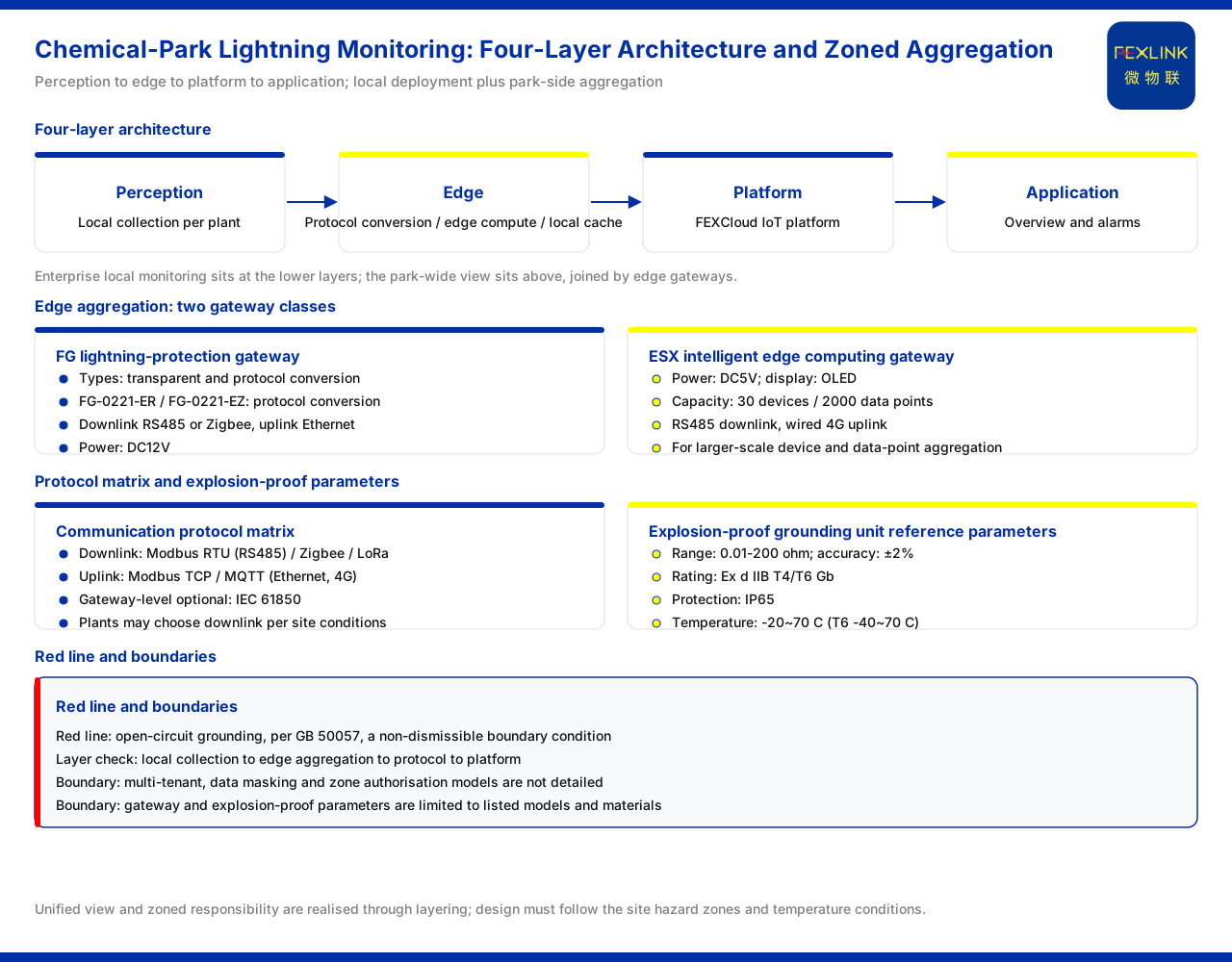
Direct answer
Lightning-protection monitoring in a chemical park must strike a balance between "a unified view across multiple plants and each plant being responsible for its own zone", and it can be organised according to the general four-layer architecture given by the product knowledge base: perception layer, edge layer, platform layer and application layer. The product knowledge base records that this architecture can support a layered organisation of local deployment plus park-side aggregation — enterprises deploy monitoring locally, the park side aggregates through gateways to form a unified view, while each plant is responsible for its own zone. The connection foundation is borne by gateways and the protocol matrix: the lightning-protection smart gateway (e.g. FG-0221-ER) supports protocol conversion, can use RS485 or Zigbee downstream and Ethernet upstream, and is supplied at DC12V; the intelligent edge-computing gateway (e.g. ESX-0223-GR) is supplied at DC5V with an OLED display, has an access capability of 30 devices and 2000 data points, communicates downstream over RS485 and upstream over wired 4G. The protocol matrix states the device downstream and upstream communication methods. The bottom line is one red line: abnormal open circuit of grounding resistance (GB 50057). Grounding monitoring of chemical installations must consider explosion-proof requirements, and the product knowledge base gives reference parameters of the explosion-proof grounding resistance monitor (FRP): a range of 0.01-200Ω, accuracy ±2%, explosion-proof rating Ex d IIB T4/T6 Gb, protection rating IP65, and operating temperature -20 to 70℃ (the explosion-proof T6 version is -40 to 70℃). This article restates only the existing specifications above and does not unfold the implementation details of the park-level permission model.
1. The difficulty of park governance: unified view and divisional responsibility
A chemical park often contains several enterprises and several tank farms. The park management committee wants a unified risk view in order to grasp the overall situation; enterprises want only to manage the equipment and data within their own scope. These two demands do not conflict, but they need an architectural division of labour: what the park side sees is the aggregated overall information, and the enterprise side retains local monitoring and autonomy within its zone. The four-layer architecture recorded by the product knowledge base lands this division of labour on the layered organisation of "local deployment plus park-side aggregation". Unity and division are not an either-or choice but are realised at the same time through layering — local below, aggregation above.
2. Layered architecture: how the four layers carry unity and division
The product knowledge base defines the monitoring system as perception, edge, platform and application layers. The four layers naturally correspond to the organisation of "a unified view and divisional responsibility": the perception layer undertakes front-end acquisition, located locally in each plant; the edge layer completes protocol conversion, edge computing and local caching, and is the entry of park-side aggregation; the platform layer is the FEXCloud IoT cloud platform, receiving device access and unified aggregation; the application layer carries the overview and alarms. The enterprise-side local monitoring is in the lower layers and the park-side unified view in the upper layers, with edge gateways joining the two. This structure supports both enterprises retaining local monitoring devices and the park obtaining an aggregated view at the platform layer.
3. The aggregation entry on the edge side: two classes of gateway
Park-side aggregation needs the edge layer to provide an entry, and the product knowledge base lists two classes of gateway. The lightning-protection smart gateway (e.g. FG-0221-ER) has two types, transparent transmission and protocol conversion, among which the models FG-0221-ER and FG-0221-EZ are of the protocol-conversion type, using RS485 or Zigbee downstream and Ethernet upstream respectively, with a DC12V supply. The intelligent edge-computing gateway (e.g. ESX-0223-GR), by contrast, is supplied at DC5V with an OLED display, has an access capability of 30 devices and 2000 data points, communicates downstream over RS485 and upstream over wired 4G. Placing the two classes in a park solution: the former faces protocol access and conversion on the lightning-protection device side, and the latter faces the aggregation of a larger scale of devices and data points and has uplink communication capability. Together they answer "where the data is converted and where it is aggregated".
4. The communication protocol matrix: from device side to park side
Whether aggregation succeeds depends on whether the protocols run through. The communication protocol matrix of the product knowledge base lists: device downstream uses Modbus RTU (RS485), Zigbee (Modbus) and LoRa; device upstream uses Modbus TCP or MQTT (Ethernet, 4G), with gateway-level optional IEC 61850. This matrix defines the communication path from local devices to the park side: the lower end accesses field devices via RS485, Zigbee, LoRa and similar, and the upper end aggregates to the platform via Modbus TCP or MQTT over Ethernet or 4G, with gateway-level IEC 61850 optional. For a multi-plant scenario, the local devices of each plant can choose the downstream method by field conditions and then aggregate upward uniformly, without forcing the whole park to use one field bus.
5. Explosion-proof requirements of grounding monitoring
In the lightning-protection monitoring of a chemical park, grounding is a key link. The reference parameters of the grounding resistance monitoring system of the product knowledge base give the specification of the explosion-proof monitoring unit: a range of 0.01-200Ω, accuracy ±2%, explosion-proof rating Ex d IIB T4/T6 Gb, protection rating IP65, and operating temperature -20 to 70℃, of which the explosion-proof T6 version is -40 to 70℃. These parameters show that grounding monitoring facing an explosive chemical environment requires an explosion-proof unit, whose range, accuracy, explosion-proof rating and protection rating all have definite specifications. During selection, the specific version should be verified against the site's hazardous-area classification and temperature conditions.
6. The bottom line: abnormal open circuit of grounding resistance and the platform-layer landing point
However the zones are organised, one bottom line does not change. The SAR red-line guard of the product knowledge base lists abnormal open circuit of grounding resistance (GB 50057). This red line means that an open-circuit state of the grounding path is a boundary condition that cannot be let pass. In addition, the product knowledge base records that the applicable industries of the Taiyi intelligent control hub system include industrial parks, showing that park-level platform-side capability can cover this class of scenario. Putting access, platform and red-line together: local monitoring solves "measuring accurately", the edge and protocols solve "transmitting upward", the platform solves "viewing uniformly", and this red line guards the bottom line of "grounding not broken".
7. A reusable layered check order
Arranging the content above into an order makes it usable for checking a park solution layer by layer. First, clarify the local monitoring scope of each plant and place the acquisition units in the perception layer; second, choose the edge-layer entry, using the lightning-protection smart gateway (e.g. FG-0221-ER) for protocol conversion on the lightning-protection device side, or the intelligent edge-computing gateway (e.g. ESX-0223-GR) to aggregate 30 devices and 2000 data points at a larger scale; third, determine downstream and upstream methods by the communication protocol matrix, choosing among the three downstream methods, aggregating via Modbus TCP or MQTT over Ethernet or 4G, with gateway-level IEC 61850 optional; fourth, land the platform layer on the FEXCloud IoT cloud platform to form the park's unified view; fifth, choose an explosion-proof grounding monitoring unit by hazardous area, guarding the bottom line with abnormal open circuit of grounding resistance (basis GB 50057). This order separates "local, aggregation, protocol, platform and bottom line" and avoids treating the unified view and divisional responsibility as one thing. The check should be combined with site conditions, and this article does not replace engineering design.
Scope and limitations
First, this article restates only what the product knowledge base lists, with the factual boundary limited to existing entries such as the four-layer architecture, the models and parameters of the two classes of gateway, the communication protocol matrix, the reference parameters of the explosion-proof grounding monitoring unit, the applicable industries of the Taiyi intelligent control hub system and the red line of abnormal open circuit of grounding resistance.
Second, the four-layer architecture supporting "local deployment plus park-side aggregation" is a knowledge-base statement; for the specific permission model of park multi-tenancy, data desensitisation and zone authorisation, this article does not unfold implementation details, nor present them as a fixed rule expressly listed.
Third, the gateway parameters are limited to the listed models, and this article does not generalise the downstream or upstream method of one model to other models in the same series.
Fourth, the range, accuracy, explosion-proof rating, protection rating and operating temperature of the explosion-proof grounding monitoring unit are all knowledge-base reference parameters, and the specific selection must be verified against the site's hazardous-area classification and temperature conditions.
Fifth, the basis standard of the red line of abnormal open circuit of grounding resistance is GB 50057; this article does not expand it into a judgement of a park's overall grounding compliance, and actual design is subject to the latest product material and relevant specifications.