 FEXLINK Research Institute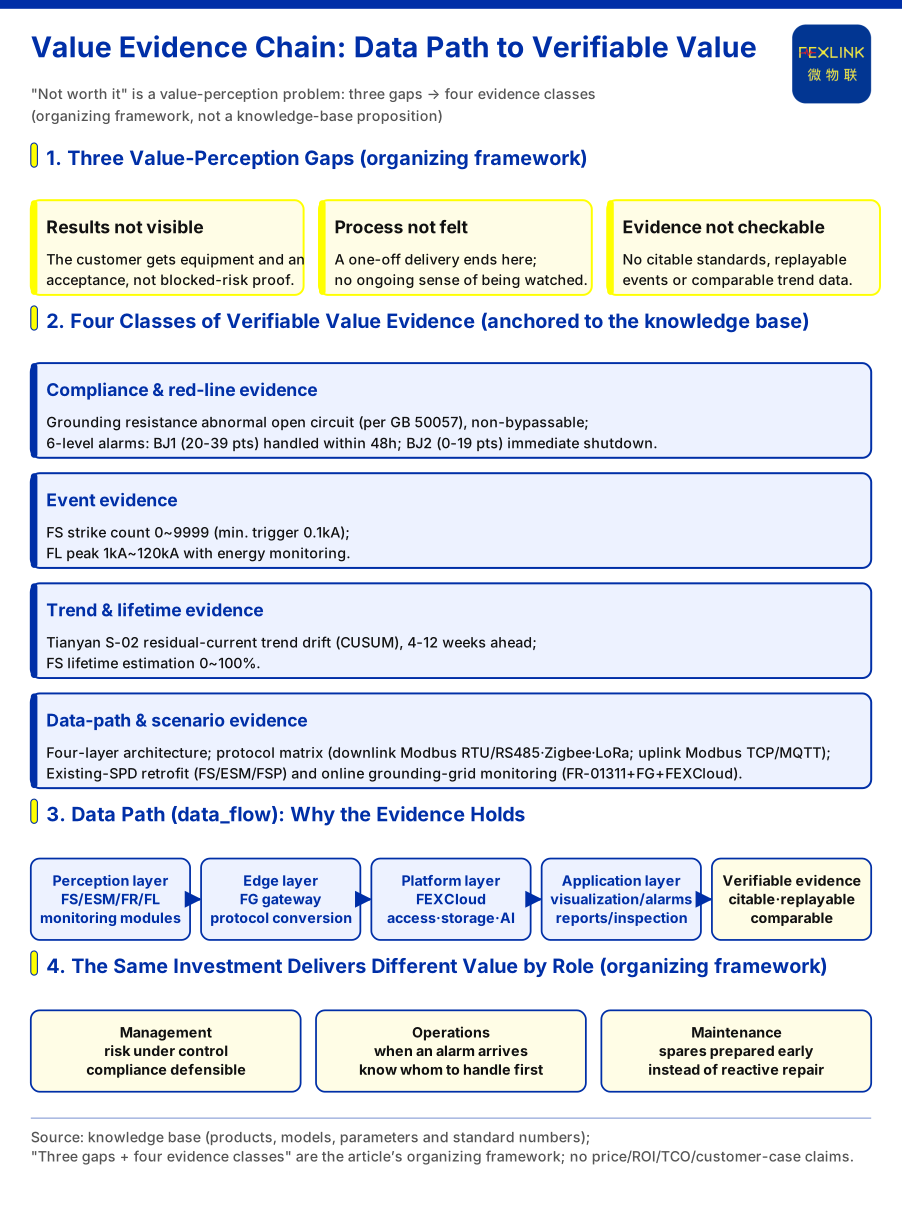
At acceptance, a thought often crosses a customer's mind: the equipment is installed, but was it worth the money? Our position is that "not worth it" is first a problem of value perception, not necessarily of price. Lightning protection's output usually shows up as "things that did not happen" — the strike did not get through, the equipment did not fail — and "nothing went wrong" is easily read as "nothing would have gone wrong anyway." To make value visible, cutting the price or piling on features is not the answer; the protection must be delivered as verifiable evidence: standard red lines and compliance credentials, event evidence, trends and lifetime, and the data path that lets that evidence stand.
"Not Worth It" Is Mostly a Perception Gap, Not Necessarily a Price Gap
Lightning protection has three "naturally thankless" traits, and understanding them is where diagnosis begins. First, invisible results: when protection works, the ideal state is nothing happens; the customer sees "no failure" but can hardly attribute it to protection rather than luck. Second, low frequency: strikes and surges are low-frequency, high-consequence events, and in the long calm between them the investment is silent and its value dormant. Third, no counterfactual: most sites have only one state, with no "protected" versus "unprotected" comparison, so the effect cannot be compared anywhere. Stack the three, and the customer easily concludes: "isn't this just a few components and a box?" That does not mean the quote is high; more often the value was not delivered in a form the customer can confirm.
Translating the Perception Gap into Three Gaps
Put into operational terms, the gap above can be reduced to three.
The first gap is results not visible. What the customer receives is a pile of equipment and one acceptance, not evidence that "the risk was blocked." In purchasing psychology, "it never went wrong" often reads as "it never would have gone wrong."
The second gap is process not felt. A one-off delivery ends at the moment of acceptance; over the following years the customer never keeps sensing that "someone is watching for me." Without process there is no felt sense that service is happening, and value is easily compressed into a purchase unit price.
The third gap is evidence not checkable. When the customer must explain internally, to audit or to management that "this money was well spent," they usually hold only a contract and invoices, lacking citable standard grounds, replayable event records and comparable trend data.
Turning "Nothing Went Wrong" into "Visible Value Evidence"
After diagnosis comes prescription: the point is not to convince customers that "lightning protection matters," but to deliver protection as a verifiable chain of evidence. The four classes below anchor to real the knowledge base capabilities, each mapping to a lever a customer can use to articulate value.
First, compliance and red-line evidence. The knowledge base lists "abnormal open circuit of the grounding resistance" as the non-bypassable red line, per standard GB 50057; in the same six-level alarm scheme, BJ1 (20-39 points) requires handling within 48 hours and BJ2 (0-19 points) requires immediate shutdown. This connects protection to standards and accountability: once the red line is recorded and citable, the customer gains a lever in compliance checks and internal accountability, turning the spend from "cuttable expense" into "indispensable baseline."
Second, event evidence. Lightning is low-frequency, high-consequence; customers want to know both "were we struck" and "how hard." The FS lightning-strike count (0~9999, minimum trigger 0.1 kA) and the FL peak and energy monitoring (1 kA~120 kA range, energy monitoring supported) answer exactly these. When an event occurs, a record with time, amplitude and energy shows protection was truly on duty better than any after-the-fact promotion.
Third, trend and lifetime evidence. The knowledge base records that the Tianyan engine's S-02 residual-current trend drift (CUSUM) model detects a weak mean shift while leakage is still within the safe range, warning 4-12 weeks in advance; FS leakage current, temperature and lifetime estimation (0~100%) provide continuous device-side observations. Trend evidence shifts value from "did it fail afterwards" to "how early did we know beforehand" — the part where customers most feel the money was not wasted.
Fourth, data-path and scenario evidence. Whether the above becomes evidence depends on whether it is actually captured, transmitted and stored. The knowledge base defines the monitoring system as a four-layer architecture — perception, edge, platform and application; gives the protocol matrix for device downlinks (Modbus RTU/RS485, Zigbee, LoRa) and uplinks (Modbus TCP/MQTT, with IEC 61850 optionally at gateway level). In concrete scenarios, the row "surge-protector condition monitoring (retrofit of existing SPDs)" recommends the FS monitor, ESM full-element SPD monitoring and the FSP base; "online monitoring of substation/traction-substation grounding grids" recommends FR-01311 plus an FG gateway plus FEXCloud. Connect the data and the evidence stands; without it, even good protection can only be explained verbally.
The Same Investment Must Mean Different "Value" to Different Roles
Value perception is a function of role. For management, "value" is controllable risk and defensible compliance; for operations, knowing whom to handle first when an alarm arrives; for maintenance, preparing spares in advance rather than reacting to failures. Every alarm in the knowledge base carries a standard-clause citation, four-dimensional impact tags and a confidence level; the Taiyi intelligent-control hub described in runs a seven-stage pipeline (L1 ingest → L2 cleansing → L3 red-line pre-check → L4 Qianzhi analysis → L5 Wanxiang assessment → L6 fusion decision → L7 persistence) end to end in under 2 seconds. Only by translating the same investment into evidence each role can confirm does perception point to "worth it." This is about how value is confirmed — adjacent to, but distinct from, the visibility question of who sees which data.
Boundaries: What This Article Does Not Claim
Second, this article offers no price, quote, ROI, payback-period or margin calculation, and does not discuss total cost of ownership (TCO) or contract/service-package design — these are out of scope.
Third, the quantitative value indicators in the knowledge base (electrical-hazard identification rate 95%+, alarm compression ratio 80%, 4-12 weeks' warning lead time, fault-localisation from days to 2 hours, MTTR reduced by 60%, energy-saving potential 8-20%) are vendor self-reports. They may be cited only as vendor capability claims, never as value commitments or performance guarantees.
Fourth, this article does not reuse the landing points of registered business articles: it does not cover the existing-SPD intelligent-upgrade path, engineering-firm organisation and service transformation, data-visibility design, the inspection firm's new business combining online monitoring, the relationship between hardware price and data value, project profit structure, contracts and business models, or the shift from annual inspection to continuous risk service; it answers only why customers feel it is not worth the money and how value can be made confirmable.
Fifth, this article fabricates no model, parameter, certification, case or industry statistic absent from the knowledge base. Application information recorded internally in the knowledge base (such as the railway traction-substation grounding grid and the Jinzhou Port tank farm) is cited only as background, not as grounds for conclusions.
Conclusion
When customers feel lightning protection is "not worth the money," the core is usually not price but three perception gaps: results are naturally invisible, delivery is one-off, and value evidence is missing. To make value visible, the path is not to cut price or add features but to deliver "nothing went wrong" as four classes of verifiable evidence — compliance red lines, event evidence (FS strike count, FL peak and energy), trends and lifetime (S-02 4-12 weeks ahead, FS lifetime estimation), and the data path that lets evidence stand (four-layer architecture, protocol matrix, scenario combinations) — and to translate the same investment by role into the value each can confirm. The method can be borrowed, but the specific way value is proven must still be confirmed against project, standard and compliance requirements.