 FEXLINK Research Institute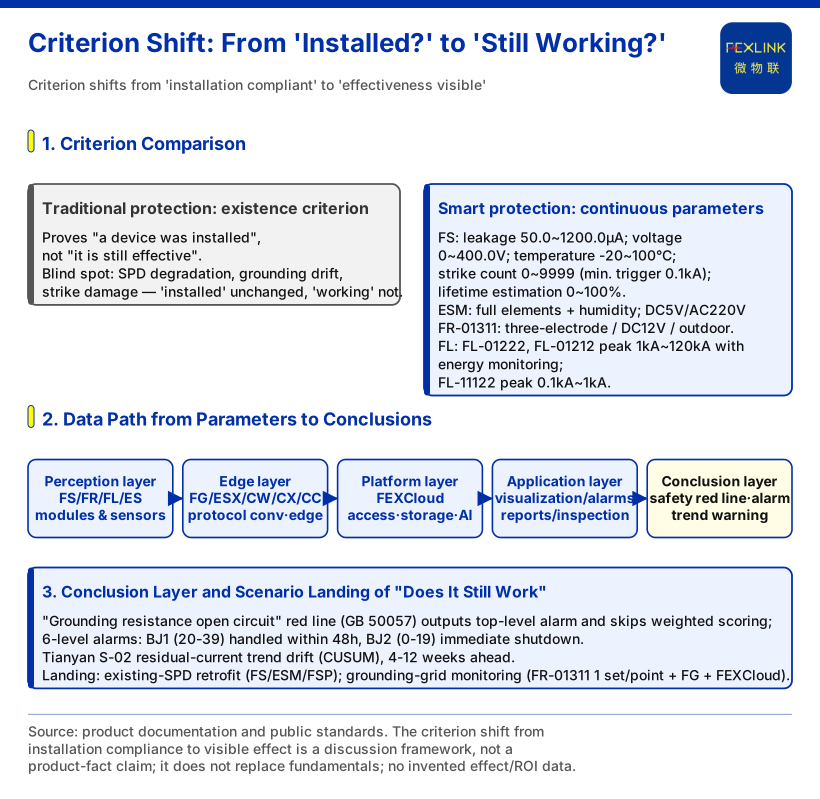
Traditional lightning-protection acceptance speaks in terms of "installed or not": was a surge protective device (SPD) fitted, was grounding done, was periodic testing performed, were records filed. Smart lightning protection answers a different question — "does it still work": is this protection still in condition, can it still operate, and when will it fail. The technical criterion is shifting from "is the installation compliant" to "is effectiveness visible".
"Installed or Not": The Traditional Logic That Judges by Existence
In the traditional model, lightning protection is close to a one-off engineering delivery: design, selection, installation, acceptance, then periodic inspection. Its implicit criterion is "existence" — as long as devices are in place, grounding is intact and records are compliant, protection is assumed effective. This logic is verifiable, accountable and cost-controlled, but it has a structural blind spot: it proves "a device was installed", not "the device is still effective now".
The most typical flaw is treating "was installed" as "still works". An SPD degrades; grounding resistance drifts with environment and workmanship; lightning strikes cause cumulative damage. None of this changes "installed or not", yet each changes "does it still work". Traditional protection does not disregard effectiveness — it lacks a means to observe it continuously; with only annual or quarterly manual testing, effectiveness can only be assumed.
"Does It Still Work" Requires Measurable Observables
To discuss effectiveness, evidence comes first. Smart protection can switch criterion because it grounds effectiveness in continuously collectable parameters. The FS surge protective device monitor in the knowledge base covers remote signalling, air-switch status, grounding status, lightning-strike count, leakage current, temperature, voltage and lifetime estimation, with key parameters leakage current 50.0~1200.0 μA (±10 μA), voltage 0~400.0 V (±0.1 V), temperature -20~100 °C (±1 °C), lightning-strike count 0~9999 (minimum trigger 0.1 kA) and lifetime estimation 0~100%.
These parameters map cleanly onto "does it still work": leakage current and temperature answer "is the device healthy", lifetime estimation answers "how long can it last", lightning-strike count answers "how many surges has it endured", voltage and air-switch status answer "does the circuit still meet protection conditions", grounding status answers "is the discharge path still valid". The ESM terminal extends this to full elements including humidity, with DC5V or AC220V supply; the FR-01311 grounding resistance monitor uses the three-electrode method, DC12V supply and outdoor installation, turning grounding from a one-off measurement into an online quantity.
Lightning strikes must be measured, not merely recorded. Among FL lightning current / transient current monitors, FL-01222 (indoor) and FL-01212 (outdoor) cover 1 kA~120 kA with energy monitoring, while FL-11122 (indoor) covers 0.1 kA~1 kA. They upgrade "it was struck" from a qualitative note into magnitude-bearing evidence — the fundamental difference between the two criteria in evidential form.
From Parameters to Conclusions: The Technical Base of the Criterion Shift
A single parameter is not automatically an "effective" conclusion. The knowledge base organises the monitoring system into four layers: the perception layer collects data from FS/FR/FL/ES series modules and sensors, the edge layer uploads it through gateways (FG/ESX/CW/CX/CC) to the FEXCloud platform layer, and the application layer presents visualisation, alarms, reports and inspections. The protocol matrix gives device downlinks (Modbus RTU/RS485, Zigbee, LoRa) and uplinks (Modbus TCP/MQTT; IEC 61850 optionally at gateway level). Continuous data availability is the precondition for "effectiveness visible".
At the conclusion layer, "does it still work" gains a non-bypassable baseline: the knowledge base lists "abnormal open circuit of the grounding resistance" as the red line per GB 50057; a trigger outputs the highest-level alarm directly and skips weighted scoring. In the same six-level alarm scheme, BJ1 (20-39 points) requires action within 48 hours and BJ2 (0-19 points) immediate shutdown. This red line is exactly the failure mode "installed or not" most easily misses — the grounding device is installed but already open, so protection is in fact not working. The Tianyan engine's S-02 residual-current trend drift (CUSUM) model detects a weak mean shift while leakage is still safe, giving 4-12 weeks' advance warning, extending "does it still work" into the future.
At scenario level, the shift has landed in concrete combinations: the knowledge base recommends the FS monitor, ESM full-element SPD monitoring and the FSP base for "device condition monitoring (retrofit of existing SPDs)", and FR-01311 (one set per point) plus an FG gateway plus FEXCloud for "online monitoring of substation / traction substation grounding grids". The former answers whether the existing device is still effective, the latter whether the grounding-grid discharge path is.
Two Practical Changes Brought by the Criterion Shift
First, acceptance language changes: from "was it installed, did it pass" to "can it continuously provide evidence of effectiveness after go-live". Installation compliance remains the baseline, not the endpoint.
Second, maintenance actions change: periodic inspection gives way to anomalies appearing first as parameter trends, then as alarms, moving the handling window earlier. The 4-12 week lead time and the graded deadlines provide the timeline.
Boundaries: What This Article Does Not Claim
The knowledge base gives no industry criterion division in these terms.
Second, this article does not claim smart protection can replace traditional fundamentals — selection, compliant grounding, correct installation and periodic testing remain prerequisites; it discusses only the shift from installation state to visible effectiveness.
Third, quantitative indicators in the knowledge base (electrical-hazard identification rate 95%+, alarm compression ratio 80%, 4-12 weeks' warning lead time, fault-localisation from days to 2 hours, MTTR reduced by 60%, energy-saving potential 8-20%) are vendor self-reports; they may be cited as vendor capability claims only, never as an effectiveness commitment or procurement basis.
Fourth, this article does not cover the existing-SPD upgrade path, customer-facing data visibility, value perception, low-price winning and procurement economics, scheme orchestration, lightning interrupting system operation, continuous risk service or lightning-protection fundamentals; it answers only why the criterion shifts and on what technical basis.
Fifth, it fabricates no model, parameter, certification, case or effect data absent from the knowledge base and infers no unlisted standard clause; GB 50057, is the only standard referenced.
Conclusion
Traditional protection answers "installed or not" — it proves devices were installed and accepted; smart protection answers "does it still work" — using continuously collectable parameters such as leakage current, temperature, voltage, lightning-strike count, lifetime estimation and grounding resistance, it turns effectiveness into a conclusion that is observable, alarmable and traceable. This is not a negation but an upgrade of the criterion: installation compliance remains the baseline, yet above it continuous evidence of effectiveness exists for the first time. For the client, acceptance extends from "it is installed" to "it stays effective"; for providers, delivery language shifts from "what I installed" to "does it still work now".