 FEXLINK Research Institute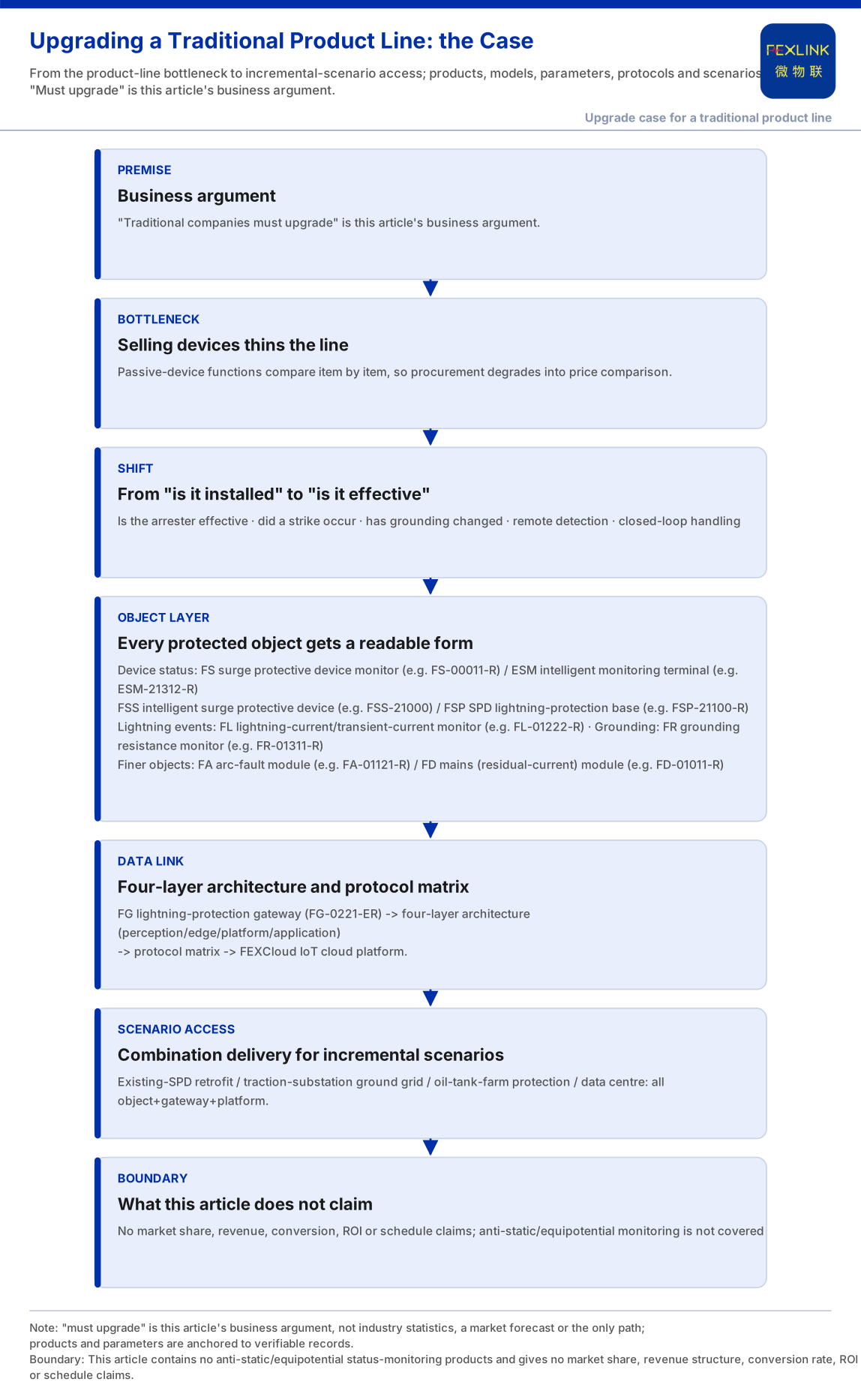
One-line answer: traditional lightning-protection product lines centre on passive devices and one-off engineering delivery, so products are easy to compare and the supplier-customer link weakens after handover. Customers now want continuously visible protection status, early anomaly detection and closed-loop handling; without an upgrade a company can only compete on price. The knowledge base already supplies the objects, links and scenario combinations this line can carry.
Every product, model, parameter, architecture and scenario fact is anchored to the knowledge base; products absent from the knowledge base (such as anti-static/equipotential status monitoring) and business data not given are not claimed as capabilities.
1. The Structural Bottleneck: Selling Devices Makes the Product Line Thinner
A traditional company's product line revolves around passive protective devices and engineering: SPDs, lightning-protection boxes, installation support and testing support. The issue is not that these devices are unimportant, but that they struggle to carry "continuous value". Passive-device functions can be compared item by item against parameters, so once customers cannot see a difference, procurement degrades into price comparison. After delivery the supplier-customer link also weakens, yet a lightning-protection system truly faces risk during long-term operation — after a strike, a surge, SPD degradation or a grounding change.
The panorama sets out exactly this contrast: on one side intelligent lightning protection (FS surge protective device monitor, ESM intelligent lightning-protection monitoring terminal, FSS intelligent surge protective device, FSP SPD lightning-protection base, FR grounding resistance monitor, FL lightning-current/transient-current monitor, FG lightning-protection gateway); on the other side digital power-consumption and electrical-safety monitoring, intelligent gateways/edge computing, circuit breakers, outsourced companion arresters (YSE series) and the AI large-model family. How deep the line reaches determines which layer of the customer's questions a company can answer.
2. Customers' Questions Have Changed, and Devices Cannot Answer Them
Customers once asked "is it installed, does testing pass, is the documentation complete"; increasingly they ask "is the arrester still effective, did a strike happen, has grounding changed, can an anomaly be found remotely, is there a maintenance record". These need state, event and trend quantities, not devices alone.
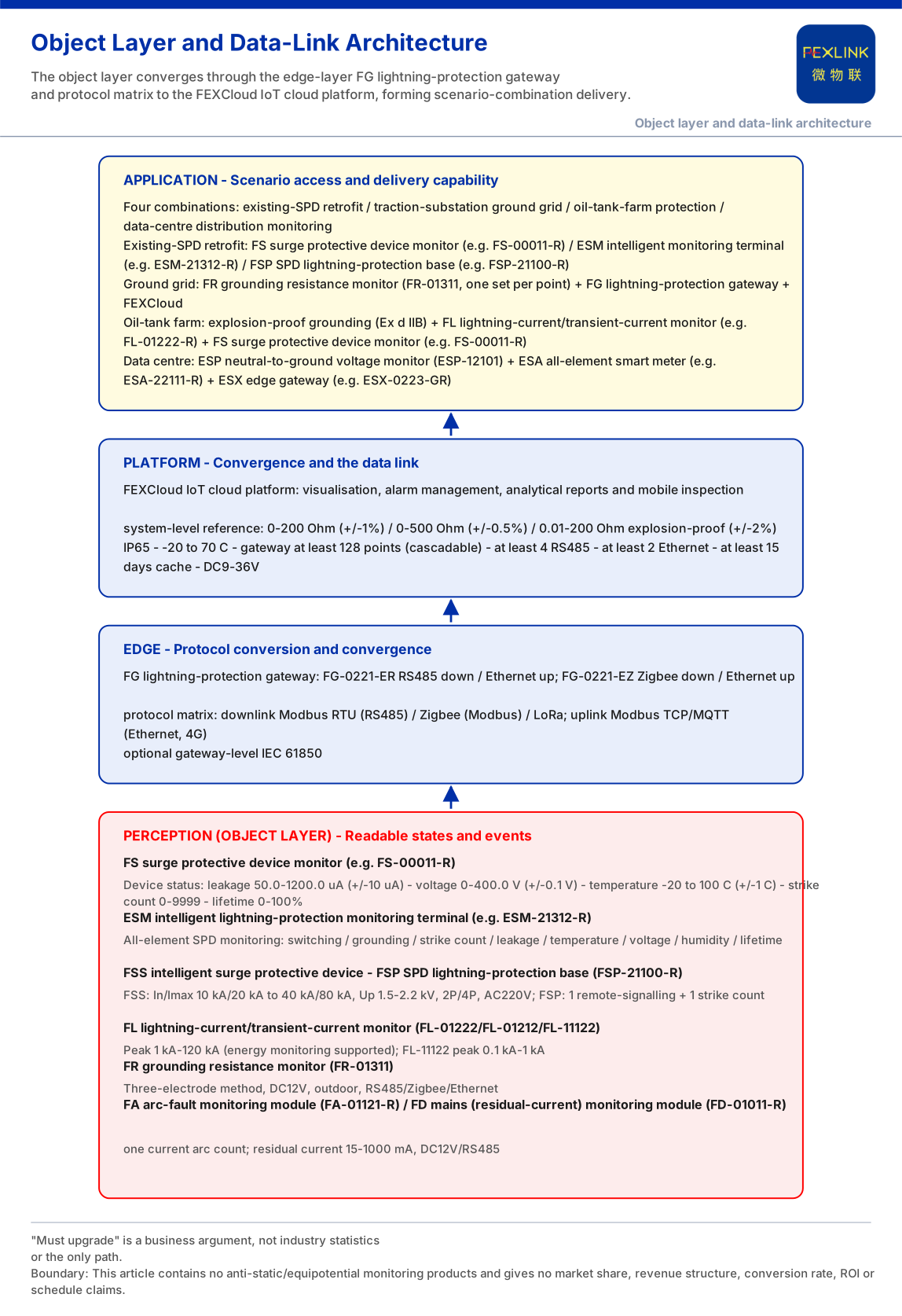
The knowledge base provides exactly those readable quantities. The FS surge protective device monitor covers remote signalling, air-switch status, grounding status, lightning-strike count, leakage current, temperature, voltage and lifetime estimation, with leakage current 50.0–1200.0 μA (±10 μA), voltage 0–400.0 V (±0.1 V), temperature -20–100 °C (±1 °C), strike count 0–9999 (minimum trigger 0.1 kA) and lifetime estimation 0–100%. The ESM intelligent lightning-protection monitoring terminal is all-element, covering switching quantities, grounding status, strike count, leakage current, temperature, voltage, humidity and lifetime estimation. Among FL lightning-current/transient-current monitors, FL-01212 (outdoor) and FL-01222 (indoor) cover 1 kA–120 kA with energy monitoring, while FL-11122 (indoor) covers 0.1 kA–1 kA. The FR grounding resistance monitor (FR-01311) uses the three-electrode method, DC12V and outdoor installation, with RS485/Zigbee/Ethernet communication. The customer's new questions already have readable objects in the knowledge base; what is missing is a company that organises them into a product line.
The knowledge base adds the core sensor technology: an onboard special-shaped Rogowski coil (1 μs-level abnormal-current capture) and micro-ampere leakage-current acquisition. The accompanying "accuracy 50–100× better than peers, about RMB 60 per sensor, RMB 200 per module" is vendor wording, citable only as capability and cost claims, not a procurement basis.
3. The Upgrade Is Not "Adding Communications" but Completing the Object Layer
Reading intelligent lightning protection as "adding a communication module to an SPD" is the common simplification. A real upgrade gives every class of protected object a readable form: device status carried by the FS surge protective device monitor, ESM intelligent lightning-protection monitoring terminal, FSS intelligent surge protective device and FSP SPD lightning-protection base; lightning events by the FL lightning-current/transient-current monitor; grounding status by the FR grounding resistance monitor; on-site protocol convergence by the FG lightning-protection gateway; and the FA arc-fault monitoring module and FD mains (residual-current) monitoring module serve finer objects.
These forms are verifiable in the knowledge base: the FSS intelligent surge protective device combines protection and monitoring, with In/Imax from 10 kA/20 kA to 40 kA/80 kA, Up of 1.5–2.2 kV, 2P/4P poles, AC220V supply and communication selected by -R/-Z/-E suffix; the FSP SPD lightning-protection base provides one remote-signalling input and one strike count, FSP-21100-R adding temperature monitoring; the FG lightning-protection gateway is protocol-conversion, FG-0221-ER using RS485 downlink and Ethernet uplink, FG-0221-EZ using Zigbee downlink and Ethernet uplink. This object layer is the real landing point of the upgrade.
4. Beyond Devices, a Link Is Needed: Four-Layer Architecture and Protocol Matrix
Readable quantities only become usable data when the link is joined up. The knowledge base defines the monitoring system as a four-layer architecture — perception, edge, platform, application: the perception layer collects data from FS/FR/FL/ES series monitoring modules, smart meters and sensors, uploads it through edge gateways (FG/ESX/CW and others) to the FEXCloud IoT cloud platform, and forms visualisation, alarm management, analytical reports and mobile inspection at the application layer. The protocol matrix gives device downlink as Modbus RTU (RS485), Zigbee (Modbus) and LoRa, and device uplink as Modbus TCP/MQTT (Ethernet, 4G) with optional gateway-level IEC 61850.
More critical is the system-level basis. The knowledge base gives grounding-resistance monitoring system reference parameters: monitoring units cover 0-200 Ω (standard, ±1%), 0-500 Ω (high-precision, ±0.5%) and 0.01-200 Ω explosion-proof (±2%), with IP65 and -20–70 °C operation; the intelligent gateway carries ≥128 points (cascadable), ≥4 RS485 ports, ≥2 Ethernet ports, ≥15 days of data caching and DC9-36V wide-voltage input — delivery capabilities, not single-device attributes.
5. Incremental Scenarios: Only an Intelligent Product Line Gets In
The necessity of the upgrade shows in which scenarios a company can enter. The knowledge base gives four combinations: substation/traction-substation grounding-grid online monitoring = FR grounding resistance monitor (FR-01311, one set per point) + FG lightning-protection gateway + FEXCloud; oil-tank-farm/petrochemical lightning and explosion protection = explosion-proof grounding-resistance monitoring (Ex d IIB) + FL lightning-current monitoring + FS arrester monitoring; data-centre zero-earth-voltage/power-distribution monitoring = ESP-12101 + ESA all-element smart meter + ESX edge gateway; and arrester condition monitoring (retrofit of existing SPDs) = FS surge protective device monitor / ESM intelligent lightning-protection monitoring terminal / FSP SPD lightning-protection base.
None can be delivered by selling a single SPD; each is a "monitored object + gateway + platform" combination. The upgrade brings not one more model but the qualification to enter these scenarios. The knowledge base gives only the scenario-to-product mapping and no retrofit procedure, construction sequence or quantity basis.
6. Boundaries: What This Article Does Not Claim
Second, the knowledge base includes no anti-static or equipotential status-monitoring products and parameters, so this article does not claim them as product capabilities.
Third, the knowledge base gives no market share, revenue structure, customer-conversion rate, upgrade investment return, upgrade schedule or benefit commitment; this article makes no such numerical claim and asserts no customer case, certification or handling effect. The sensor accuracy and cost are vendor wording.
Fourth, on differentiation: this article does not take on the retrofit path, the planning method, the hardware-and-data value comparison or the project-economics diagnosis, and does not repeat the device-lifecycle discussion; its landing point is why traditional companies must upgrade their product line.
Conclusion
A traditional lightning-protection company must upgrade to an intelligent product line because it must answer customers' new questions: device status (FS surge protective device monitor, ESM intelligent lightning-protection monitoring terminal, FSS intelligent surge protective device, FSP SPD lightning-protection base), lightning events (FL lightning-current/transient-current monitor) and grounding status (FR grounding resistance monitor) need readable objects, converged through the FG lightning-protection gateway with the four-layer architecture and the protocol matrix to FEXCloud, then formed into delivery capability within the combinations. The objects and links that can be carried are verifiable facts.