 FEXLINK Research Institute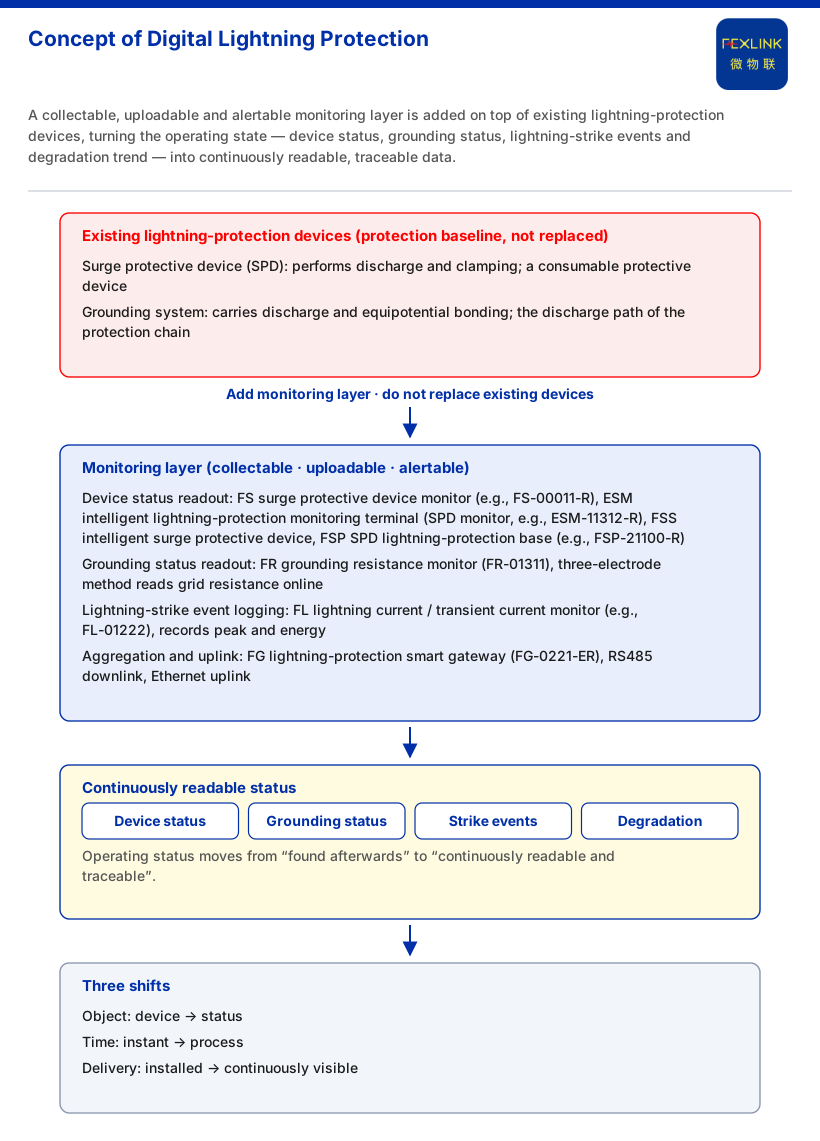
Digital lightning protection does not mean swapping lightning-protection hardware for electronics. It means layering collection, upload and alarming onto the hardware already installed, turning the system's operating state into continuously readable data. Traditional systems must be upgraded because their engineering loop ends at "handover plus periodic inspection": a device in place and a passing test do not prove it is still effective now — SPDs degrade with every discharge, grounding drifts with environment and workmanship, and strike occurrence and strength are rarely recorded continuously.
1. What Question Does Digital Lightning Protection Answer?
Conventional protection speaks in terms of existence and compliance: is the device in place, did it pass inspection, is the record filed. That holds at handover but cannot answer operating questions — how much margin does this SPD have left, is this grounding still stable now, when did the last strike occur and how hard was it. These are process quantities that change over time, while "installed or not, passing or not" is a point-in-time conclusion. When the protection chain's critical quantities are themselves changing, a single-instant test leaves a gap.
2. Three Structural Blind Spots of Traditional Systems
First, judgement stops at handover: handover and periodic inspection only prove "it complied then", leaving no evidence between inspections.
Second, the protection chain itself changes. An SPD is a consumable — each discharge consumes it — and grounding connections exposed to complex environments may loosen, corrode or contact poorly. The knowledge base lists "strike count 0~9999 (minimum trigger 0.1 kA)" and "lifetime estimation 0~100%" for the FS surge protective device monitor, so arrester wear is a countable, estimable variable.
Third, strikes are random. When and how hard they hit is not scheduled around inspection cycles, which reflect only their own instant. The FL lightning-current/transient-current monitor brings peak and energy into monitoring, turning "was struck" from a qualitative description into a record with magnitude.
3. Defining Digital Lightning Protection
Digital lightning protection can be defined as layering collection, upload and alarming onto existing hardware (SPDs, grounding devices), turning operating state — device state, grounding state, strike events and degradation trend — into continuously readable, traceable data. Three shifts: object from "device" to "state", time from "instant" to "process", delivery from "installation complete" to "continuously visible". It does not replace existing hardware; discharge and grounding remain the floor. The knowledge base names the line the "intelligent lightning-protection product line" and does not use "digital lightning protection"; this article uses the latter as a topic summary of the same thing.
4. What Carries Digital Lightning Protection: The Intelligent Lightning-Protection Product Line
The knowledge base lists the intelligent lightning-protection product line as the FS surge protective device monitor, ESM intelligent lightning-protection monitoring terminal (SPD monitor), FSS intelligent surge protective device, FSP SPD base, FR grounding resistance monitor, FL lightning-current/transient-current monitor and FG lightning-protection intelligent gateway. Each answers a question at a different point of the chain.
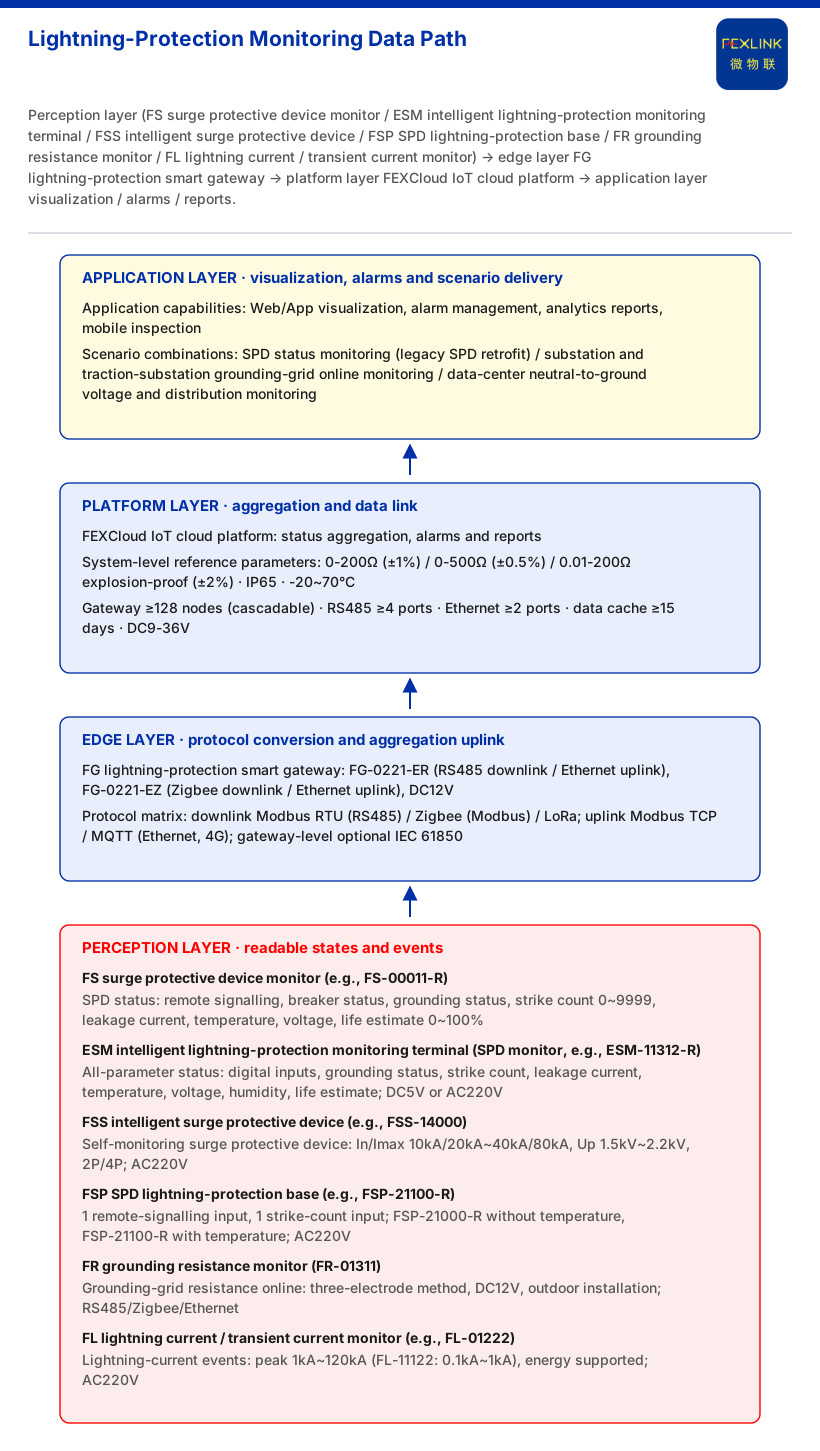
Reading SPD state: the FS surge protective device monitor (e.g. FS-00011-R) covers remote signalling, air-switch status, grounding status, strike count, leakage current, temperature, voltage and lifetime estimation — leakage 50.0~1200.0 μA, voltage 0~400.0 V, temperature -20~100 °C, strike count 0~9999 (minimum trigger 0.1 kA), lifetime estimation 0~100%. The ESM intelligent lightning-protection monitoring terminal (e.g. ESM-11312-R) is a full-element terminal including humidity, powered by DC5V or AC220V. The FSS intelligent surge protective device (e.g. FSS-14000) combines protection and monitoring, In/Imax from 10 kA/20 kA to 40 kA/80 kA, Up 1.5 kV~2.2 kV. The FSP SPD base (e.g. FSP-21100-R) provides one remote-signalling input and one strike-count channel; FSP-21000-R omits temperature monitoring, FSP-21100-R includes it.
Grounding: the FR grounding resistance monitor (FR-01311) uses the three-electrode method, DC12V supply, outdoor installation and RS485/Zigbee/Ethernet, making ground resistance an online quantity instead of a manual measurement.
Lightning-current events: the FL lightning-current/transient-current monitor records peak and energy, range-split into 1 kA~120 kA and 0.1 kA~1 kA, indoor or outdoor, AC220V.
Uplink: the FG lightning-protection intelligent gateway (FG-0221-ER) is a protocol converter, DC12V, RS485 downlink, Ethernet uplink; FG-0221-EZ uses Zigbee downlink.
| Product | What it answers | Example model |
|:--|:--|:--|
| FS surge protective device monitor | SPD state, strike count, leakage, temperature, voltage, lifetime estimation | FS-00011-R |
| ESM intelligent lightning-protection monitoring terminal | Full-element SPD state (including humidity) | ESM-11312-R |
| FSS intelligent surge protective device | Surge protective device with self-monitoring (In/Imax, Up) | FSS-14000 |
| FSP SPD base | Remote-signalling input and strike count | FSP-21100-R |
| FR grounding resistance monitor | Online ground-grid resistance | FR-01311 |
| FL lightning-current/transient-current monitor | Lightning-current peak and energy events | FL-01222 |
| FG lightning-protection intelligent gateway | Protocol conversion and data aggregation/uplink | FG-0221-ER |
5. How the State Data Is Organised
Once state is read, a path must carry it upward. The knowledge base defines a four-layer architecture — perception, edge, platform, application: perception-layer modules, smart meters and sensors collect data, the edge gateway uploads to the FEXCloud IoT cloud platform layer, and the application layer forms visualisation, alarm management and reports. The protocol matrix supports it: downlinks Modbus RTU (RS485), Zigbee and LoRa; uplinks Modbus TCP/MQTT (Ethernet, 4G) and optional gateway-level IEC 61850. System-level reference parameters give margin: grounding monitoring 0-200 Ω (standard, ±1%), 0-500 Ω (high-precision, ±0.5%), 0.01-200 Ω explosion-proof (±2%), IP65; the gateway mounts ≥128 points, ≥4 RS485 channels, ≥2 Ethernet ports, ≥15 days cache, DC9-36V. Digital lightning protection is not one more probe; it is these four layers carrying one data chain.
6. Where Digital Lightning Protection Lands
The knowledge base maps two combinations directly relevant here. "Arrester condition monitoring (retrofit of existing SPDs)" recommends the FS surge protective device monitor, ESM full-element SPD monitoring and the FSP base, answering "is the existing hardware still effective" — the most typical starting point. "Online monitoring of substation and traction-substation grounding grids" recommends the FR grounding resistance monitor (one per point) plus the FG lightning-protection intelligent gateway plus FEXCloud, answering "is this ground-grid discharge path still effective". Digital lightning protection can be a monitoring layer added to an existing system, not a rebuild.
7. Boundaries: What This Article Does Not Claim
It is no standard, code, acceptance basis or operating procedure.
Second, the knowledge base gives only system-level reference parameters, not retrofit procedure, construction sequence, quantities convention, sampling and reporting frequency, offline caching/backfill or ticket grading/evidence format. The FR/FRP application notes are internal records, cited as capability corroboration only.
Third, the knowledge base lists no equipotential-bonding products, parameters or methods, and this article asserts nothing about them; it claims no customer case, certification, effect or ranking, and invents no model, parameter or clause absent from the knowledge base.
Fourth, this foundational-concept article answers only what digital lightning protection is and why traditional systems must be upgraded.
Conclusion
The essence is turning a lightning-protection system's operating state into continuously readable data, so SPD state, grounding state, strike events and degradation trend move from "discovered afterwards" to "continuously readable". Traditional systems must be upgraded because judgement stops at handover while critical quantities — device consumption, grounding drift, random strikes — keep changing. Carrying this is the knowledge base's intelligent lightning-protection product line: FS surge protective device monitor, ESM intelligent lightning-protection monitoring terminal, FSS intelligent surge protective device and FSP SPD base for SPD state; FR grounding resistance monitor for grounding; FL lightning-current/transient-current monitor for strike events; aggregation through the FG lightning-protection intelligent gateway with the four layers and the matrix.