 FEXLINK Research Institute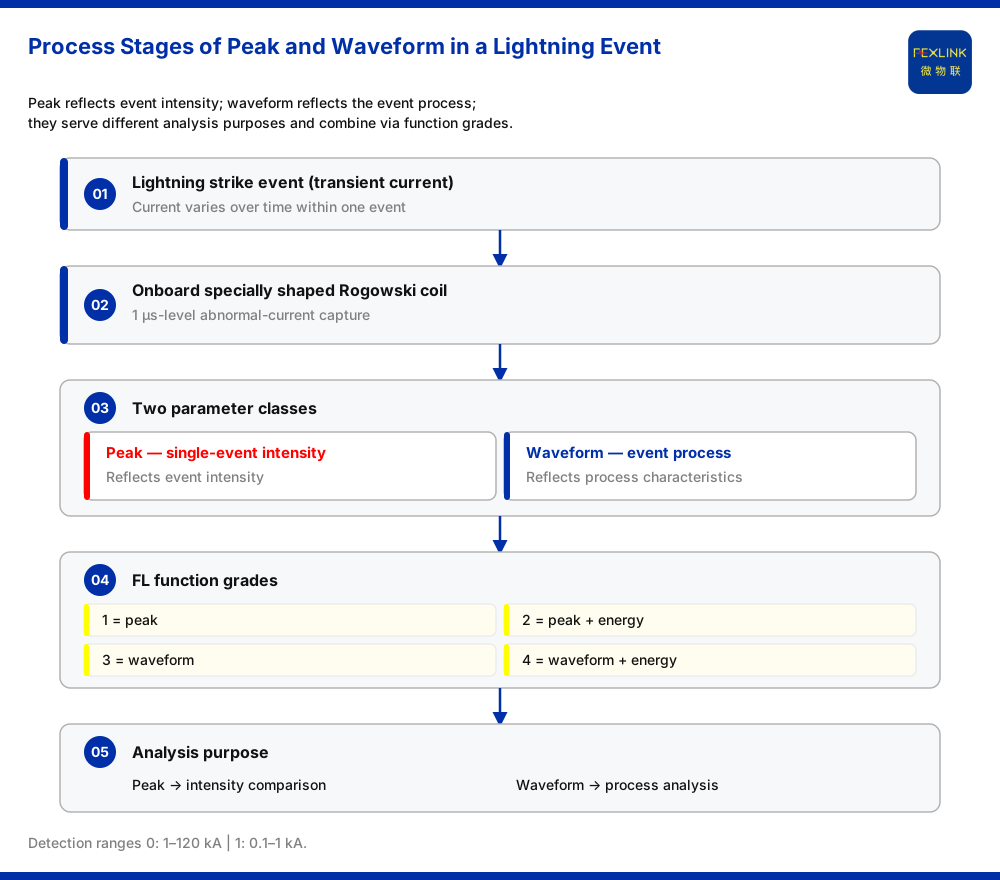
Direct answer
The peak value of a lightning current states "how strong this strike was"; the waveform states "what the course of this strike looked like." The peak is an amplitude quantity: it answers what magnitude the event reached. The waveform is a curve that varies with time: it answers how the event occurred and how it evolved. The two are not substitutes on the same dimension but serve different analytical purposes. Intensity discrimination, grading and statistics call for the peak; understanding the process characteristics of an event calls for the waveform. The FL lightning current / transient current monitor organises these two parameter classes into one model rule through function grades 1, 2, 3 and 4. "Record the peak or record the waveform" is therefore a configuration choice at the function-grade position, not a trade-off between mutually exclusive products.
1. The peak states the intensity magnitude of an event
The peak is the maximum amplitude a lightning current reaches in one event; it compresses the whole transient process into a single number. The value of that number lies in being comparable, gradable and thresholdable. Comparing a single event against a given magnitude, ranking events over a period by amplitude, or building a statistical distribution all require only the peak. For monitoring that asks whether the current exceeded a certain intensity and how many strong events occurred, the peak is often the most direct and economical object to record.
The peak also corresponds to a division of detection ranges. Under the model rule, the detection ranges fall into two classes: range 0 covers 1 kA–120 kA, for lightning current events of larger amplitude; range 1 covers 0.1 kA–1 kA, for transient current events of smaller amplitude. The range code is written at the head of the model, so the question of what magnitude of peak to record is settled at the product-selection stage; the required magnitude determines the range and is not adjusted arbitrarily in software afterwards.
The peak, however, is single-point information: it locates the highest point of the event but says nothing about how energy is distributed in time, nor how fast the rise and decay proceed. Once the purpose goes beyond "how strong was it," the peak is insufficient.
2. The waveform states the process characteristics of an event
The waveform records how the lightning current changes over time. What it preserves is the temporal shape of the event, not a compressed extreme value. Where the peak gives one number, the waveform gives the whole course; it therefore carries more process information and a markedly larger volume of data. It answers questions of the kind "how did this event happen," and suits scenarios that need to observe event shape and distinguish processes.
The division of labour between the two can be understood as follows: the peak cares about the "highest point," the waveform about the "entire trajectory." For the same event, two processes with the same peak need not share the same waveform; conversely, two processes with similar waveforms need not have peaks of the same magnitude. Because they describe different facets, the function grades keep them as two main lines instead of merging them into one indicator.
3. The organising logic of function grades 1, 2, 3 and 4
Under the model rule, the function codes are defined as follows:
| Function code | Recorded content | Main line |
|:--|:--|:--|
| 1 | Peak | Intensity |
| 2 | Peak + energy | Intensity + energy |
| 3 | Waveform | Process |
| 4 | Waveform + energy | Process + energy |
Two layers of relationship are visible in this table. The first is the division between the peak line and the waveform line: functions 1 and 2 belong to the peak line, functions 3 and 4 to the waveform line. The second is energy as a third parameter class that can be superimposed: energy never forms a grade on its own but is added, respectively, on top of the peak line and the waveform line. Choosing a function grade therefore means first deciding whether intensity or process is wanted, then whether energy must also be retained.
This is why "peak or waveform" is not a simple either/or: function 2 shows the peak can coexist with energy, function 4 shows the waveform can. Both can be extended, and the direction of extension is energy in both cases.
4. Where the two parameter classes sit in the model rule
The model rule for the monitor is FL–[detection range][channels][function][installation][supply]–[communication]. The function grade is an independent field within the model, meaning "record the peak or record the waveform" is fixed at the product-numbering level: determined during selection, it corresponds to one recording capability after delivery. The detection range is likewise a model field and maps directly to the peak magnitude. The two key peak-related choices — what magnitude to record and whether to record energy — are thus both embodied in the same model code.
5. Where the two parameter classes land, seen from existing models
Under the current model parameters, the peak line already has clear landing points:
| Model | Installation environment | Supply | Peak range | Energy | Communication |
|:--|:--|:--|:--|:--|:--|
| FL-01222 | Indoor | AC220V | 1 kA–120 kA | Supported | R/Z/E |
| FL-01212 | Outdoor | AC220V | 1 kA–120 kA | Supported | R/Z/E |
| FL-11122 | Indoor | AC220V | 0.1 kA–1 kA | — | R/Z/E |
Three points can be read from this table. First, for the same peak recording, indoor and outdoor are two installation environments with different models; they are not interchangeable, and selection must distinguish them by on-site installation conditions. Second, the two 1 kA–120 kA variants support energy while the 0.1 kA–1 kA variant does not; energy support is therefore tied to the detection-range class and cannot be assumed across classes. Third, the communication suffixes R/Z/E correspond to different communication methods; they belong to the model rule's communication field and are independent of the peak, waveform and energy choices.
Parameters of different variants must not be applied to one another: indoor and outdoor variants must not be conflated, and the 1 kA–120 kA and 0.1 kA–1 kA classes must not be inferred from each other. Each model's peak range, energy support and installation environment are governed by its own parameters.
6. The shared acquisition basis of peak and waveform
Whether extracting the peak or reconstructing the waveform, the data come from the same acquisition chain. The core sensor of the monitor is an onboard, specially shaped Rogowski coil with 1 μs-level abnormal-current capture capability. The peak is the result of extracting the amplitude of the acquired signal; the waveform is the result of reconstructing its time sequence. The two share one front-end channel. The sensor's time-response capability is thus the common basis of both parameter classes: the capture capability determines how much process detail can be preserved and the raw-signal quality on which both the peak and the waveform depend.
The two share one source and one channel; only their output form differs.
7. Recording the peak or the waveform: decide by analytical purpose
The foregoing can be condensed into a single decision path:
- If the purpose is intensity discrimination, grading, event counting and statistics, choose function 1 (peak).
- If energy information is needed in addition to intensity, choose function 2 (peak + energy).
- If the purpose is to observe the process characteristics of an event, choose function 3 (waveform).
- If energy information is needed in addition to process, choose function 4 (waveform + energy).
- Also fix the detection-range class: larger-amplitude events fall in the 1 kA–120 kA class, smaller-amplitude events in the 0.1 kA–1 kA class.
The essence of this path is to clarify first "what question is to be answered," and then to return to the two model fields — the function grade and the detection range — to complete the configuration.
Applicability and limits
This article explains only what the peak and waveform parameter classes respectively reflect and where they sit in the function grades and the model rule. It is limited to the model rule, function-grade definitions, detection ranges and core-sensor entries of the lightning current / transient current monitor in the knowledge base. The peak ranges and function grades listed here are capability divisions at the model-code level, not measurement conclusions about any specific on-site event. It does not address standards-compliance determination, does not include sampling rate, accuracy or other parameters not listed in the model rule, and does not infer specific selected models for the waveform grades. For on-site configuration, the installation environment, detection range, function grade and communication field should be checked variant by variant; parameters must not be interchanged between indoor/outdoor variants or detection-range classes.