 FEXLINK Research Institute
Direct Answer
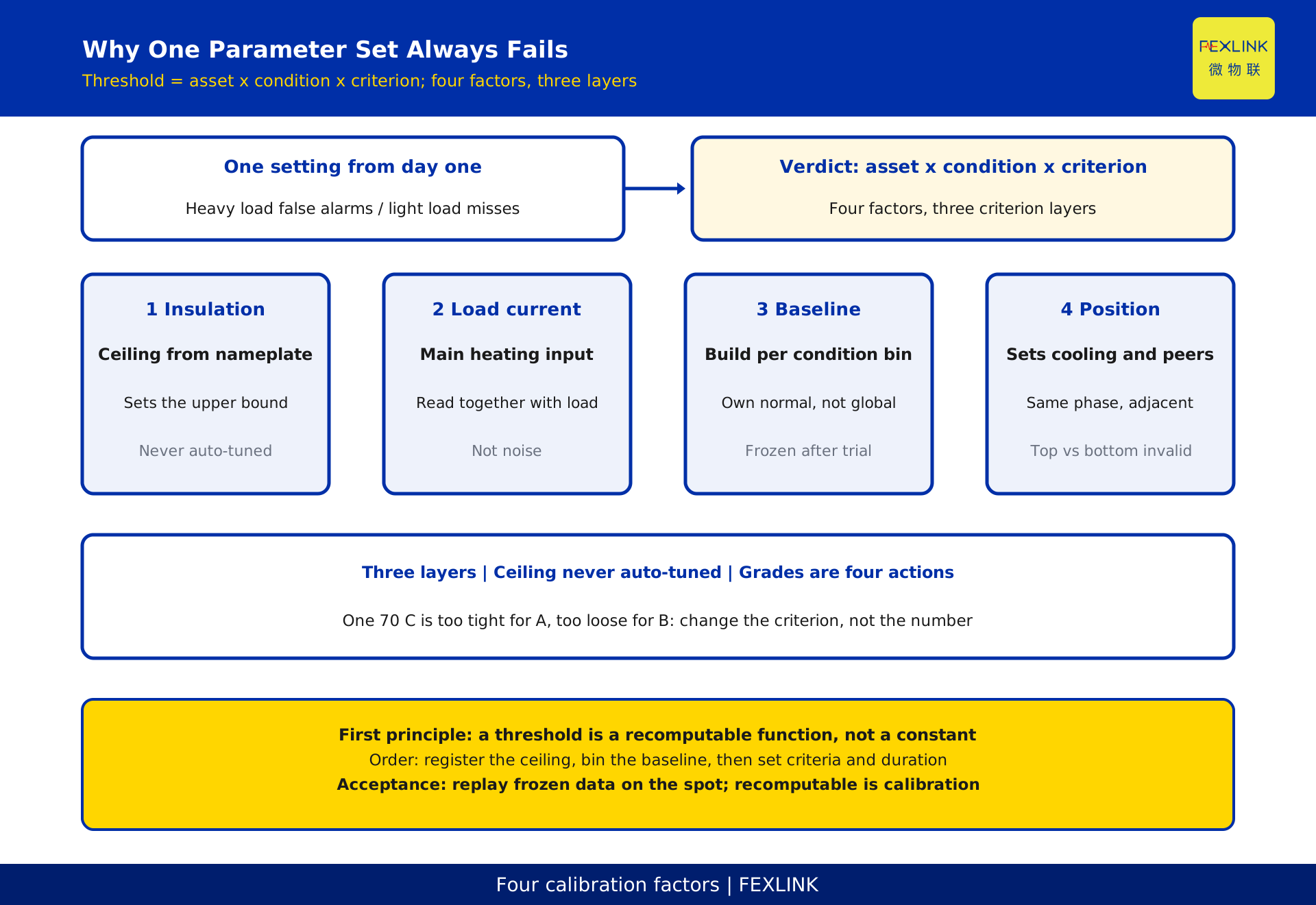
One setting from day one is not too high or too low; it is wrong in kind. A threshold is not a constant belonging to an asset but the joint product of asset × operating condition × criterion: the same busbar under heavy and light load, in summer and winter, near a cabinet top and near an air inlet, has different reasonable limits. Set it tight and heavily loaded assets hug the line, training operators to silence the alarm. Set it loose and a lightly loaded asset drifts far from its own baseline without crossing the line. Both failures share one root: absolute temperature is the only criterion, while trouble shows in rise, peer deviation and baseline drift.
The fix splits a threshold into three layers: an absolute ceiling that cannot be auto-tuned (from nameplate and documentation), relative criteria normalised to conditions (temperature rise, phase difference, deviation from a binned baseline), and duration and rate conditions rejecting jitter. Alarm grades are four different actions, not one line cut into four; baseline learning may adjust only the relative margin, never cross the ceiling. This article gives principles and reuses no specific temperature values; the numeric reading of a colour scale belongs to KD-0042.
1. One Setting Buys Both False Alarms and Missed Alarms
The first is line-hugging false alarms. A heavily loaded circuit with poor cooling sits close to the limit during ordinary fluctuation, crossing and retreating many times a day. Alarm counts rise, credibility falls, and the operator's action shifts from handling to silencing.
The second is silent missed alarms. A lightly loaded circuit with a low normal temperature can sit far above its own history and still stay below the common limit. The system shows zero alarms, calmer than a flood and more dangerous: calm means the criterion did not cover it.
Neither failure is solved by moving the whole limit: up reduces false alarms and deepens missed ones, down does the reverse. The remedy is a different criterion structure, not a different number. This fixes the division with KD-0984: closing an alarm flood is a process question; threshold trust is this article's.
2. A Threshold Is Not an Asset Property
Treating a threshold as this device's alarm line leads to setting it once forever. Better: one alarm decision = asset ceiling and own baseline × current load and ambient conditions × comparison rule and duration. If any term changes, the equivalent threshold should change.
That is why copying a mature parameter set from another project fails: only the criterion term travels, not the asset and condition terms. Two units of the same model in different positions should not share one either.
The sturdier statement is that a threshold is a recomputable function, not a distributable constant. A function is auditable: every alarm answers relative to which baseline, by how much, and for how long. A constant offers only configuration convenience and, at acceptance, only the claim that this was how it was set.
3. Four Factors: Insulation Class, Load Current, Baseline, Position
| Factor | What it sets | If missing |
|---|---|---|
| Insulation heat class | Allowable ceiling | Borrowed ceiling too strict or too loose |
| Load current | Main heating variable | Heavy normal looks abnormal; light abnormal looks normal |
| Historical baseline | Normal for this asset | Only a global mean; unit differences vanish |
| Mounting position | Cooling and valid peers | Stack gradients and phase differences misread |
Load current is most often mistaken for noise, yet it is the main explanation: temperature must be read together with load. Position decides which points may be compared — same phase, same circuit, adjacent points, not cabinet top against bottom.
4. Three Layers of Criteria
| Layer | Question | Tunable | Authority |
|---|---|---|---|
| Absolute ceiling | Insulation or joint damage | No | Nameplate and documentation |
| Relative criteria | Deviation from own normal or peers | Yes, by load and ambient bins | Logged, reversible |
| Duration and rate | Trend or jitter | Yes | Log-only in trial, live after freeze |
The three layers must be written into the configuration, or they displace one another. Keep only the ceiling and early detection disappears; keep only relative criteria and there is no hard boundary; omit duration and one sampling spike generates an alarm.
An executable criterion reads: under load bin X, deviation above that bin's baseline exceeds Y, persists longer than T, and has not crossed the ceiling, then trigger grade Z. It can be recomputed, replayed and attached to an acceptance annex; alarm when temperature exceeds a value cannot.
5. Grading Is Not Cutting One Line Into Four
Colouring one line four ways is not grading. Grading means four different handling actions. Each grade states its trigger, action, owner, deadline, exit condition and whether it opens a work order. The first may only add inspections and an observation record; the last may require load reduction, an on-site check and escalation. The difference lies in actions, not colour.
If all four grades go to one duty group without closing rules, four grades are one message repeated four times; two grades work if observe and dispatch close differently.
A graded reference value must answer three questions: relative to which baseline, by how much, for how long. The numeric values on an example colour scale belong to KD-0042 and are not reused; a change of asset, insulation class or mounting condition requires recomputation, not a copied table.
6. A Cross-Asset Checklist, Not a Parameter Table
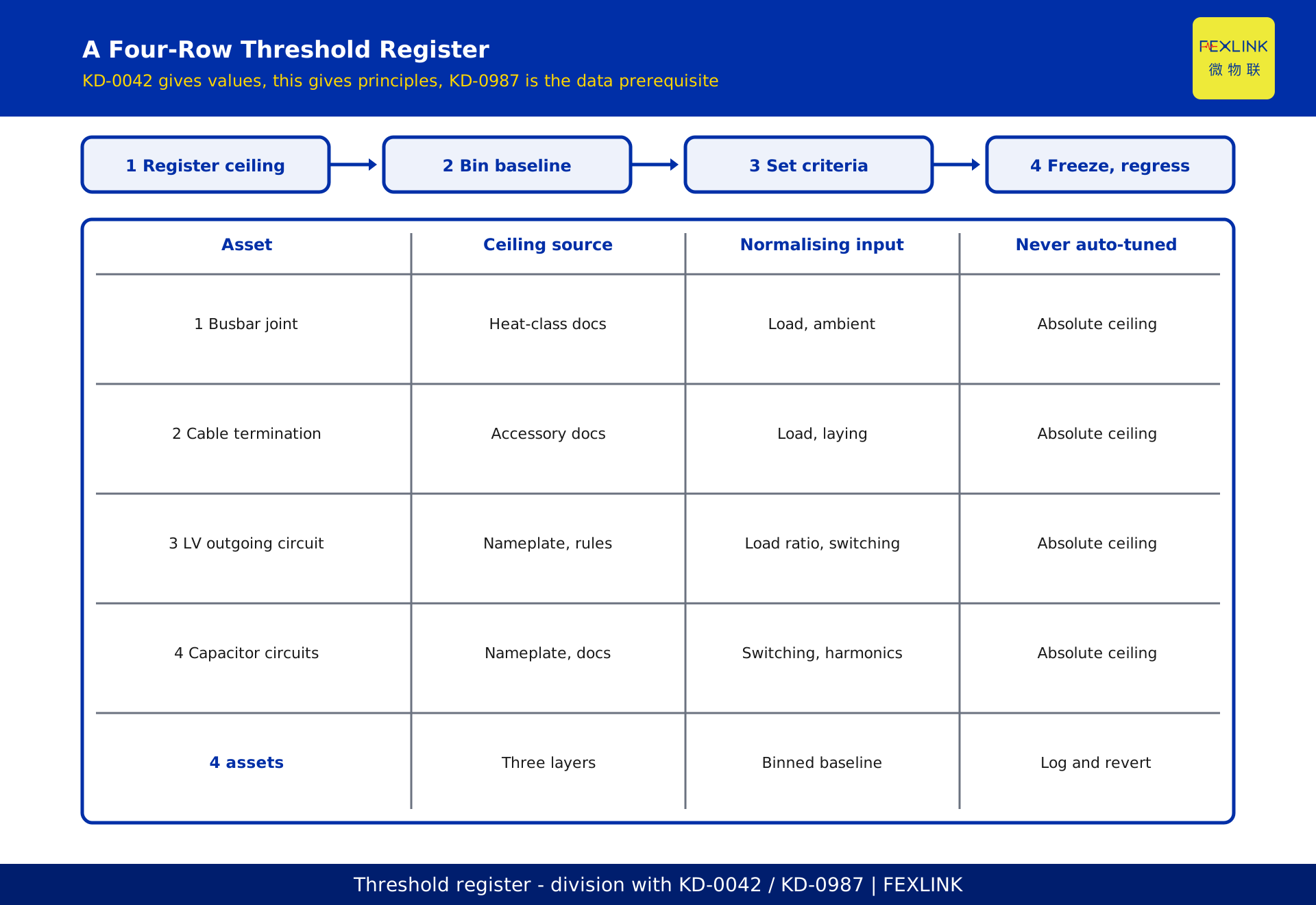
| Asset | Ceiling source | Normalising variable | Preferred relative criterion | Never auto-tuned |
|---|---|---|---|---|
| Busbar joint | Conductor and heat-class documentation | Load, ambient | Adjacent same-phase difference, rise | Absolute ceiling |
| Cable termination | Accessory documentation | Load, laying | Own-baseline deviation, phase difference | Absolute ceiling |
| LV outgoing circuit | Nameplate and operating rules | Load ratio, switching | Binned-baseline deviation, rise rate | Absolute ceiling |
| Capacitor circuits | Nameplate and documentation | Switching count, harmonics | Peer-circuit difference | Absolute ceiling |
Fill cells one by one, not with one number. Any blank is marked to be confirmed during the trial run and logged without dispatch; filling it from elsewhere disguises the unknown as known.
7. A De-Identified Example: Why One 70 °C Fails Twice
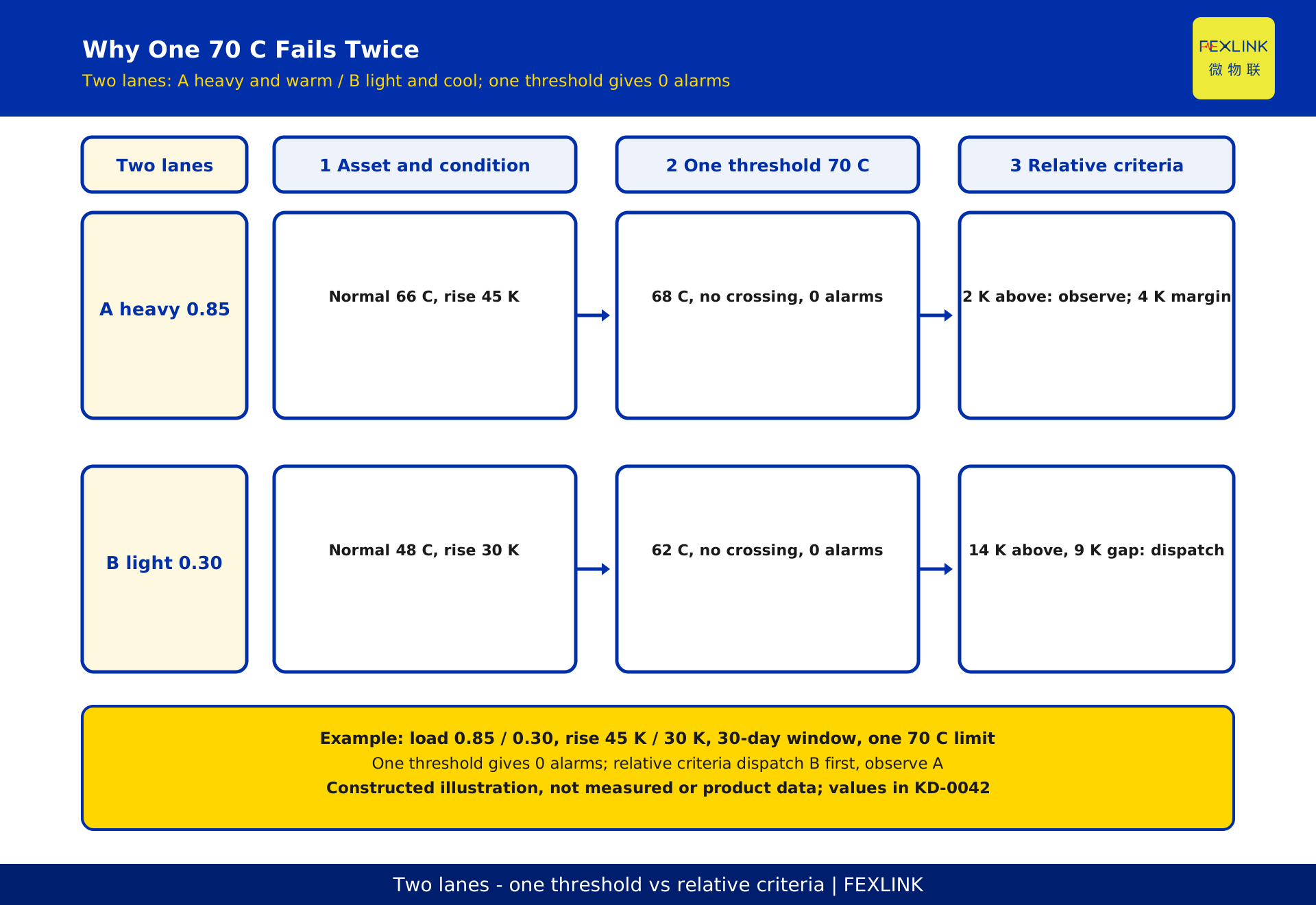
Constructed, de-identified illustration; not measured data or any product parameter. In one cabinet, assets A and B have load ratios of 0.85 and 0.30, and manufacturer documentation gives allowable temperature rises of 45 K and 30 K. The site uses one absolute threshold of 70 °C over a 30-day window.
In steady state A sits at 66 °C and B at 48 °C. On one day A rises to 68 °C and B to 62 °C. Under the common threshold neither crosses 70 °C, so the system produces 0 alarms. Read with relative criteria, B is 14 K above its own baseline with a 9 K phase difference and should trigger observation or dispatch first; A is only 2 K above, inside normal fluctuation, and can be marked for observation. Yet A's normal value sits just 4 K below the threshold, so small fluctuations create line-hugging false alarms.
The same 70 °C does two wrong things: too tight for A, too loose for B. Raise it and A goes quiet while B stays invisible; lower it and B is caught while A generates more false alarms. The example proves no value reasonable, only that one absolute quantity cannot fit two conditions.
8. Baseline Learning: Direction, Boundaries, Freeze
The right direction is binned modelling with margin-only tuning: build stable segments for load and ambient bins, and learn what this asset usually reads under this condition, not one global mean. Auto-tuning may touch only the relative margin and duration conditions rejecting jitter.
Three boundaries are fixed. Tuning must not cross the absolute ceiling, which comes from the nameplate and is outside learning. New commissioning, post-maintenance, point changes and seasonal shifts require a freeze period where the baseline accumulates but is not applied; an old baseline must not be inherited. Every adjustment is logged, reversible and traceable to its triggering data.
At acceptance, remove the claim that the algorithm keeps learning: ask for a replay on frozen data stating the bin used, the margin, and why the hard boundary was not crossed. Recomputable on the spot is calibration; a verbal guarantee is a promise. This mirrors frozen replay in KD-0986 applied to a threshold criterion.
9. A Five-Step Calibration Process and Three Prohibitions
Five steps, each leaving a record: one, register each circuit's absolute ceiling from nameplate and documentation with the source file; two, collect stable segments binned by load and ambient and build binned baselines; three, configure relative criteria and duration, fixing each grade's action, owner, deadline and exit condition; four, during the trial run log only, using a 30-day window to check false and missed alarms; five, freeze the baseline, sign it, and run one change regression after any change.
Three prohibitions: do not copy values across assets, do not use a global mean as the baseline, do not let auto-tuning cross the absolute ceiling. They correspond to copying, flattening and raising the ceiling.
The output is not a parameter sheet but a threshold register: asset, source file, condition bin, last change and rollback point.
10. Common Mistakes and Division of Labour
Four mistakes: treating uniform is easier to manage as a technical conclusion; treating the tighter the safer as common sense; choosing between temperature rise and absolute temperature; and treating commissioning values as valid for life. Over-strict settings also weaken response, while assets, loads and seasons change.
The boundaries are fixed. KD-0042 covers the numeric values of the four busbar grades, so no specific temperature is reused here. KD-0984 covers consolidating and closing an alarm flood on the process side. KD-0986 covers selecting predictive-maintenance capability. KD-0987 covers the technical self-check of data being accurate, complete, timely and processable, the prerequisite for trustworthy thresholds. KD-0990 covers multi-protocol gateway selection. This article adds calibration to asset and condition, the three-layer criterion structure and binned baselines.
On product roles: FEXLINK's publicly disclosed multi-channel temperature controllers and electrical fire monitoring units sit at the sensing layer, while the busbar scheme organises points into a comparable circuit view. Thresholds, graded actions and closing rules remain set by nameplates, documentation and operating rules. This only illustrates layers; it rates no model.
Frequently Asked Questions (FAQ)
Q: Is a uniform threshold not easier to manage?
A: What is easier to manage is the process, fields and register, not the value. A uniform register with per-asset values works; a uniform value buys two amplified risks.
Q: With automatic baseline learning, is manual calibration still needed?
A: Yes. Learning adjusts only the relative margin; the absolute ceiling comes from the nameplate and documentation and is outside learning. Commissioning, maintenance and seasonal shifts also need a freeze period, or history decides the ceiling.
Q: Should the threshold use absolute temperature or temperature rise?
A: They divide the work. The ceiling protects insulation; rise, phase difference and baseline deviation give early detection. Only the first reports late; only the second has no hard boundary.
Q: After an asset swap or maintenance, can the old threshold carry over?
A: No. Both the asset and condition terms changed, so the old baseline is not comparable. Collect new stable segments, rerun change regression and log it; carrying the old value over makes a new unit hug the limit.
Q: Is grading just cutting one line into four segments?
A: No. Four grades mean four actions, owners and exit conditions. If all four push one message with no closing rule, more grades only add colour; two grades work if observe and dispatch close differently.
Scope and Limitations
This is a calibration methodology for circuits where temperature and current acquisition already exists; it is not a setting sheet for any project. The four factors, three criterion layers, cross-asset table and five-step process are generic examples. In the worked example, assets A and B, load ratios of 0.85 and 0.30, allowable rises of 45 K and 30 K, the threshold of 70 °C, normal values of 66 °C and 48 °C, readings of 68 °C and 62 °C on one day, deviations of 14 K and 2 K, a 9 K phase difference, a 4 K margin, a 30-day window and 0 alarms are constructed, de-identified illustrations — not measured data, product parameters, or evidence that any value is reasonable.
The registry field related_standards is empty. No standard number, clause or pass limit is cited; no uniform compliance line, specific setting value, product model parameters, prices, point counts, or performance figures such as accuracy, false-alarm reduction, advance-warning days, incident reduction or payback period. Actual values and graded actions follow the nameplate, documentation, project operating rules and local requirements, confirmed by the responsible party. Public web material only confirmed the engineering consensus that thresholds are jointly constrained by insulation heat class, load, ambient temperature, mounting structure and baseline; it is not cited as a clause.
Product links are qualitative descriptions of public information: no model rated, no field performance inferred, no procurement promise. The division with KD-0042, KD-0984, KD-0986, KD-0987 and KD-0990 is fixed in section 10.
Frequently Asked Questions
Why One Size Never Fits All
One setting from day one is not too high or too low; it is wrong in kind