 FEXLINK Research Institute
The short answer
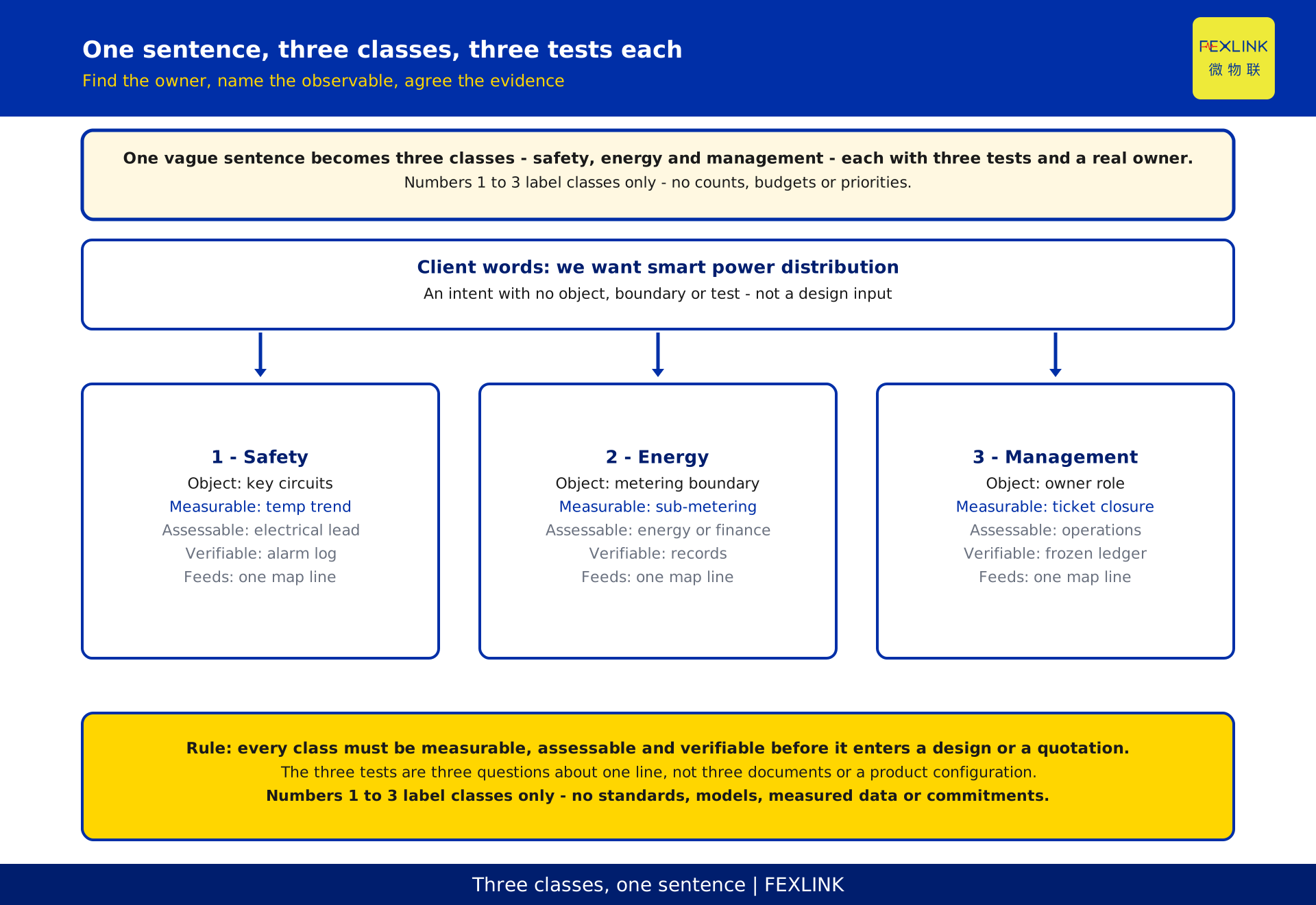
"We want smart power distribution" is a phrasing, not a requirement. The first step is not choosing a platform or quoting a price, but translating that sentence into three classes of quantifiable requirements - safety, energy and management - each passing three tests: measurable, assessable and verifiable. If any test fails, design, budget and acceptance will not line up. The deliverable is a requirement-metric-budget-acceptance map plus a list of open items, not a rendering.
Why this sentence cannot go straight into a design
"Smart power distribution" is a statement of intent with no object, no boundary and no test. It means three different things: an electrical lead worries about joint temperature rise and insulation deterioration; an energy manager wants sub-metered consumption and load structure; operations wants alarms to reach an owner and work orders to close. All three share one slogan, yet there is one budget and one set of acceptance terms. Feeding it into a design compresses three definitions of success into one list, causing repeated redesign, a budget that no longer matches scope, and an argument at acceptance.
A simple test: ask the design, commercial and delivery teams to write down independently what they would deliver. If the three answers differ, the requirement is not yet decomposed.
Level one of the breakdown tree: sort the request into three classes
The tree has two levels; level one is classification. Safety asks whether something can fail and be detected early. Energy asks where electricity goes and whether the structure leaves room for improvement. Management asks who owns the response, how quickly a loop closes, and whether the record is traceable. Classification finds a real client-side owner for each class: the electrical lead owns safety, energy or finance owns energy, operations or the user department owns management. A request with no owner should not enter the metric table, because nobody will sign for it at acceptance.
A single sentence often contains all three classes. Split the wording into lines and mark each; anything unclassifiable is background context. Presentation-only requests such as a wall display belong under a management presentation sub-item, marked as not forming their own acceptance conclusion. Ask the client to confirm the classification line by line in writing; only written confirmation freezes it. The three classes are a working method here, not the dimensions or layers of any official framework.
Level two: four steps from a request to a metric
Level two takes each classified line through four steps: state the object (which bus section, circuit family or department); name the observable (a collectable quantity such as a temperature trend, sub-metered consumption or an alarm handling record); state the form of the test (a trend, a band, a count, a duration or a closure record - form only, never a value); state the evidence (which record, whose signature, which revision). Miss one step and a third party cannot reproduce the result.
The common mistake is skipping the object: "we want temperature monitoring" leaves the section, locations and reader undefined, so neither budget nor acceptance has a footing. The other is treating "the system has data" as "this can be accepted"; what can be accepted is a record with a revision, an owner and a reproducible path. Only lines completing all four steps enter the map; the rest stay as open items, not guessed values to make the table look complete.
The three tests: measurable, assessable, verifiable
The three tests are three questions about the same line. Measurable asks whether a stable collection definition and record exist; if the only description is an impression, stop and fix the definition. Assessable asks who judges it, on what cycle and against which record; without an owner and a cycle, a metric is just a curve on a screen. Verifiable asks what evidence reproduces the result at handover and which revision both parties sign against. A line whose definition and revision are not frozen cannot go into a contract annex.
The order is fixed: collection definition first, assessment responsibility next, acceptance evidence last. Reverse it and an unstable quantity ends up in an acceptance clause. A line passing all three is a metric; one passing the first two is an observation item; one passing only the first is a data point. This article gives no limits, thresholds, rates or pass/fail conclusions. Test forms and definitions follow the agreed revision, current standards and measured site conditions.
Worked examples for the three classes
| No. | Class | Measurable | Assessable | Verifiable |
|---|---|---|---|---|
| 1 | Safety | Temperature trend and alarm log | Electrical lead reviews on a cycle | Alarm and handling records with a revision are recomputed |
| 2 | Energy | Sub-metered consumption and load curve | Energy or finance reconciles on a cycle | Sub-metering records are recomputed under the agreed definition |
| 3 | Management | Work order status and closure log | Operations checks on a cycle | The frozen work order ledger is recomputed |
Every cell holds a name and a form of test only - no values, ratios, thresholds or pass/fail conclusions. These are structural examples, not a configuration or project measurements. A real project adds the object to every cell: a circuit or joint location for safety, a metering boundary for energy, a responsible role for management. Without the object, the three tests are fine words.
Five common phrasings and the real question behind each
| No. | What the client says | The real question | Class |
|---|---|---|---|
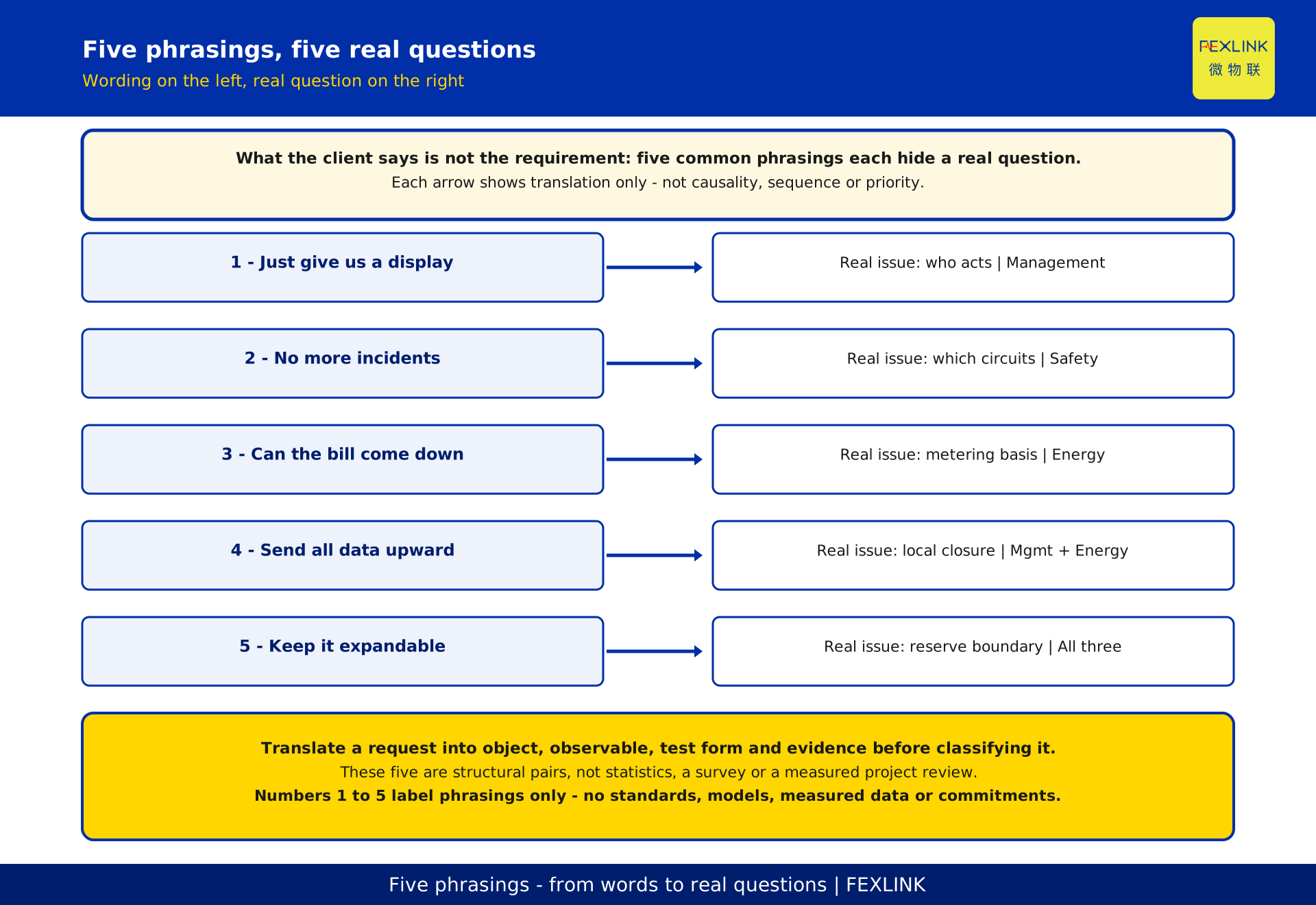
| 1 | Just give us a big display | Who reads it, and who acts afterwards | Management |
| 2 | No more electrical incidents | Which circuits enter early warning first | Safety |
| 3 | Can the electricity bill come down | Are metering boundaries and the baseline definition aligned | Energy |
| 4 | Send all data to the platform | Which quantities must close locally and which deserve upload | Management and energy |
| 5 | Keep it easy to expand later | Where is the boundary for reserved points and channels | A constraint across all three |
This is an interview translation tool, not a script to use on the client. One takes presentation as the goal; the issue is the responsibility chain. Two takes an outcome as a requirement; the issue is scope and priority. Three takes a financial goal as a technical metric; the issue is the definition. Four takes a technical action as the goal; the issue is data layering. Five is a constraint, logged as an open item rather than a metric. All five are structural generalisations with no statistical source, not survey results or a basis for budgeting.
Interview script, must-ask list and open items
The script runs through object, current practice, test, owner and evidence, following the owner: the electrical lead answers safety, energy or finance answers energy, operations answers management. Record only the client's own words and visible evidence; do not infer on their behalf or turn presales understanding into a client commitment.
| No. | The one question to ask | What not to write |
|---|---|---|
| 1 | Which section or family of objects does this refer to | Only "the whole plant" |
| 2 | How is this done today, and by whom | "Not done at present" and stop |
| 3 | Which record decides whether it was achieved | "Look at the system" |
| 4 | Who signs, and on what review cycle | A presales-filled owner |
| 5 | Who replies in writing for anything unavailable | An experience-based estimate |
Anything unavailable is marked "to verify", listed as an open item, filled in after a written client reply, and kept in two revisions when changed. A blank reads as confirmed; "to verify" enters the tracking list. The record is frozen by design, commercial and delivery on one shared sheet, and only that revision enters the design and quotation
How to fill the requirement-metric-budget-acceptance map
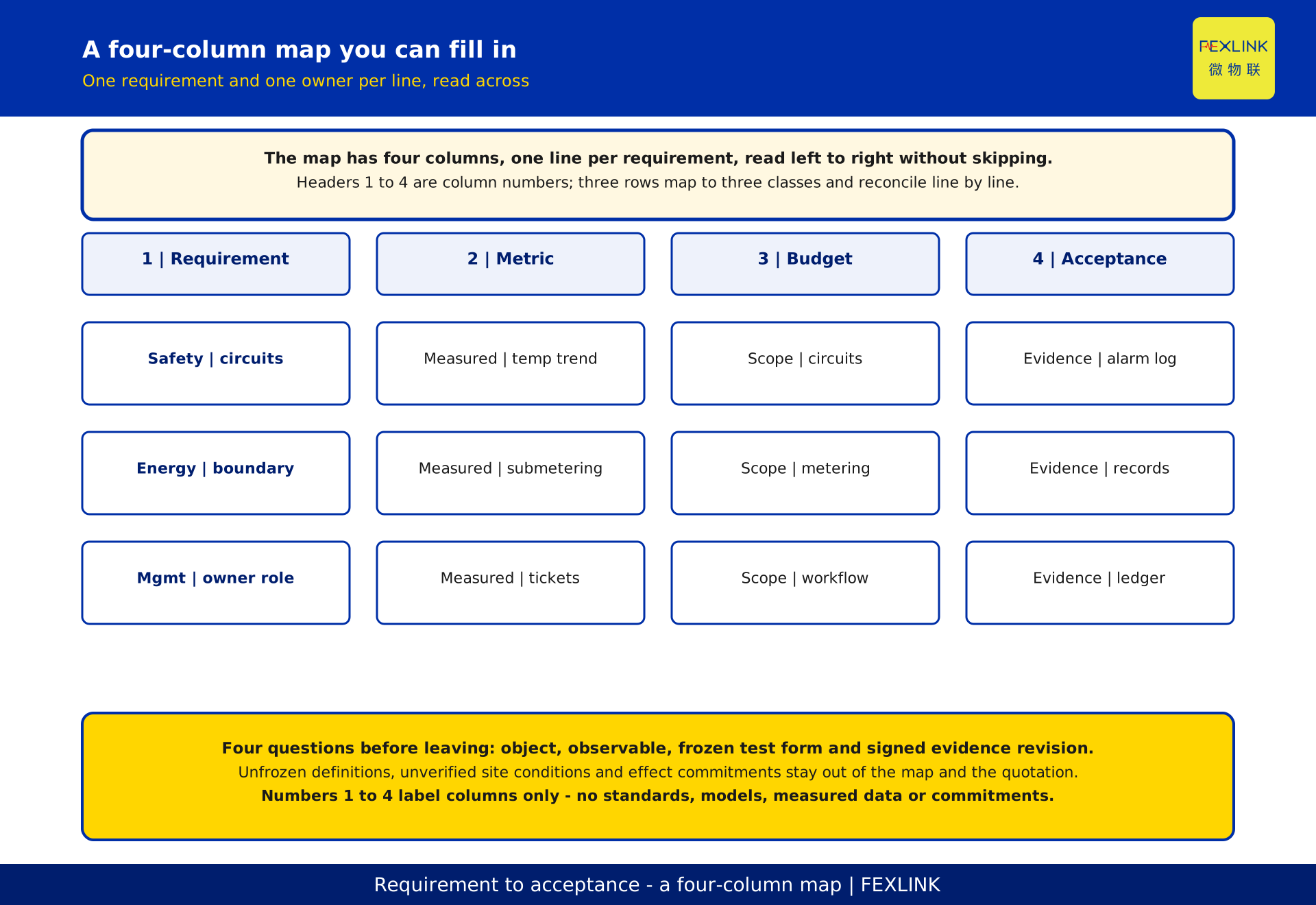
The map has four columns, one line per requirement, read left to right without skipping. Requirements hold the classified wording and object. Metrics hold the observable and the three tests from the four steps. Budget holds only work scope and pricing basis for that line - boundaries such as points, connections, implementation work and services - without unit prices, amounts or shares. Acceptance holds the evidence source, recomputation method and revision. Columns must reconcile line by line.
Three rules: one line has one owner, so split cross-department lines in two; the budget column carries no numbers and the quotation is issued separately by the commercial team; acceptance evidence must be reproducible by a third party against the same revision. The easiest thing to miss is what must never be a commitment: unfrozen definitions, unverified site conditions, ratios with no statistical source, effect adjectives and any concrete pass value. None belong in the map, the design text or the quotation annex.
A scenario: turning one sentence into a sheet
At one factory the client said only that distribution should be made smarter. The interview split the sentence into three lines: the electrical lead wanted a temperature trend at key circuit joints detected early; the energy function wanted sub-metered consumption reconciled by workshop; operations wanted alarms to have an owner who accepts the ticket. The lines were marked safety, energy and management, each with an object, a test form and an evidence revision. "Expansion later" became an open item, and "a display" a management presentation sub-item that forms no acceptance conclusion of its own. The scenario is illustrative, with no client name, location, scale, result data, measured values or effect commitments.
Where this article stops and neighbouring articles begin
This article answers one question in discovery: how to turn a vague sentence into a handover-ready metric list. What to look at, measure and photograph on a site survey, why installed points end up unused, whether a budget belongs to safety retrofit or energy retrofit, how metric definitions are written, which documents acceptance checks against, and which numbers may appear in a proposal are all separate articles. What is provided is the breakdown tree, the three tests, the interview script and the map, with interfaces left open for downstream steps.
How the associated solutions and official frameworks are referenced
The digital electrical intelligent supervision system and the SLCIE capability model registered here are company solution or framework names, appearing as names only. Their dimensions, layers and elements follow official documentation and the knowledge base. This article does not expand, decode or redefine them, and does not use a framework name as a classification rule; presenting the three classes as solution layers, or the three tests as model elements, would invent an official framework. The registered related products and related standards fields are empty, so the text contains no product models, parameters, standard numbers, year designations, clause numbers, limits or compliance determinations; cleanliness statements are phrased only in the negative.
Frequently asked questions (FAQ)
Q: What if the client gives only a slogan and will not sit through an interview?
Hand over a sheet containing only what is known and the open items, treating "to verify" as a formal deliverable. Ask for written confirmation of classification and owners; confirming even one line beats presales inferring on the client's behalf.
Q: Does smart power distribution have to include a platform and a display?
Not necessarily. Presentation depends on whether the management request contains an explicit responsibility chain and closure record requirement. Without one, a display is a presentation sub-item forming no acceptance conclusion of its own. Taking presentation as the goal is the line most often cut and most likely to cause an argument.
Q: Should the three tests carry concrete values?
This article gives the form of a test only, with no limits, thresholds, ratios or pass/fail conclusions. Concrete definitions and values are agreed by both parties after the definition is frozen, against current standards, measured site conditions and the contract annex. Writing them into a design earlier turns an unverified condition into a promise.
Q: Can the map be used directly as a quotation or a contract annex?
No. It aligns requirements with evidence. The budget column carries scope boundaries rather than amounts, and acceptance carries a recomputation method and a revision. The quotation and contract annex are issued separately.
Q: Are the three classes an official framework classification?
No. They are a working classification used here to decompose a vague sentence, find owners, name observables and align acceptance evidence. They are not the dimensions, layers or elements of any official framework, and do not replace the client's existing management definitions.
Scope and limitations
This article applies to presales engineers, project managers and client-side electrical leads turning a vague request into a handover-ready, reproducible metric list before project approval. It does not apply to work judgements during construction, equipment selection or contractual acceptance clauses, and does not replace site work procedures, product configuration or a formal quotation. The three tests, five phrasings, interview script and map are structural method, not statistical results, an industry survey or a measured project review; the text contains no limits, thresholds, ratios, amounts, point counts or effect commitments. Test forms and definitions follow the agreed revision, current standards and measured site conditions. All deliverables remain drafts pending review; independent QA and owner acceptance are not complete, and nothing is published.
Frequently Asked Questions
When the Client Says "We Want Smart Power Distribution"
"We want smart power distribution" is a phrasing, not a requirement