 FEXLINK Research Institute
Direct Answer
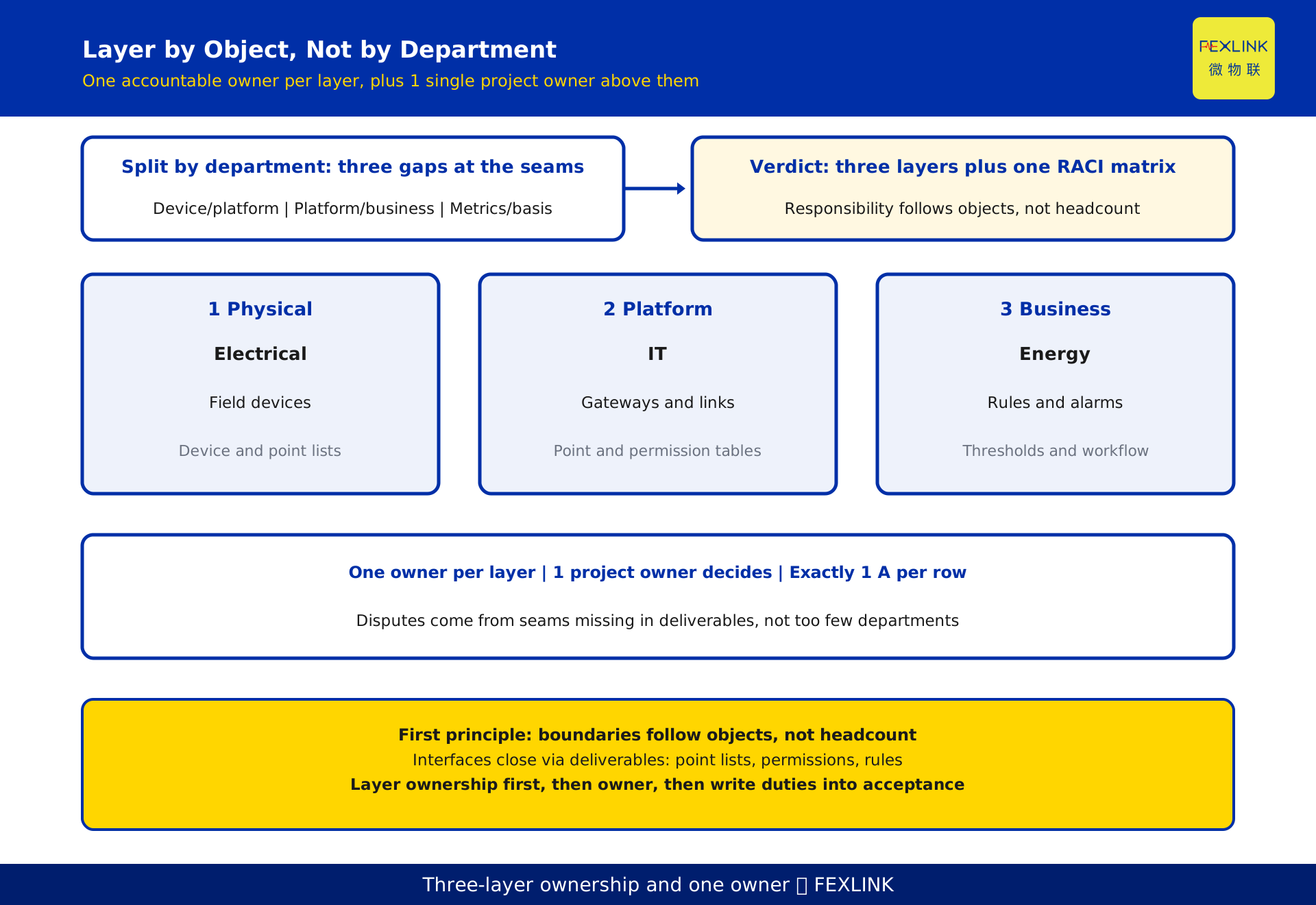
A monitoring project stalls when it lands across the electrical, IT and energy departments. The cause is rarely technical: work is split by department instead of by object, so nobody owns the seams. The answer is to split the project into three layers — physical, platform and business. Electrical owns field terminals and devices. IT owns gateways, networks, platform accounts and permissions. Energy or the consuming department owns business rules and the alarm-to-closure loop. Above those three layers, appoint a single project owner who arbitrates cross-layer issues and signs off on acceptance. Then fix every work item in a RACI matrix so disputes become a table lookup rather than a search for a person. This article covers the owner's internal division of responsibility only.
1. Why Three Departments Stall on One Project
A monitoring project spans three asset classes: field devices, gateway and network links, and platform rules. These map onto three departments: devices to electrical, platform to IT, energy indicators to the energy or consuming department. Each owns one segment, but three gaps are left behind.
Gap one, between devices and platform: meters are installed and wired, yet the platform reads nothing. Electrical says the devices are healthy; IT says the point list was never handed over. Gap two, between platform and business: alarms are pushed and nobody acts. IT says delivery completes its duty; energy says it never defined the rules. Gap three, between indicators and the reporting basis: monthly energy figures do not reconcile. Energy says the data is wrong, electrical says the CT ratio was never synced, IT says the raw data was never altered.
All three gaps fall on departmental boundaries, and none is written into any deliverable. Once a problem appears, discussion slides from "how do we fix it" to "whose job is it". The starting point is not carving three blocks out of the org chart; it is acknowledging that cross-layer interfaces exist and naming one accountable owner for each.
2. First Principle: Layer by Object, Not by Department
Responsibility boundaries follow objects, not headcount. Objects divide into three layers. The physical layer covers terminals, sensors, instrument transformers, breakers, field power and cabling. The platform layer covers gateways, communication links, point lists and protocol adaptation, platform accounts and permissions, data storage and external interfaces. The business layer covers thresholds and business rules, alarm grading and dispatch, closure of the handling loop, energy accounting basis and reports.
A department carries layer responsibility; it is not the layer itself. One department may cover several layers, and one layer may be shared, but "who is finally accountable" must be unique per layer. This mirrors an end-edge-cloud architecture: layers connect through interface contracts, not reporting lines.
The working test: for any dispute, fix the layer and object, name that layer's accountable owner, then ask which department assists. Reverse the order and discussion collapses into turf arguments.
3. Unpacking the Three Layer Boundaries
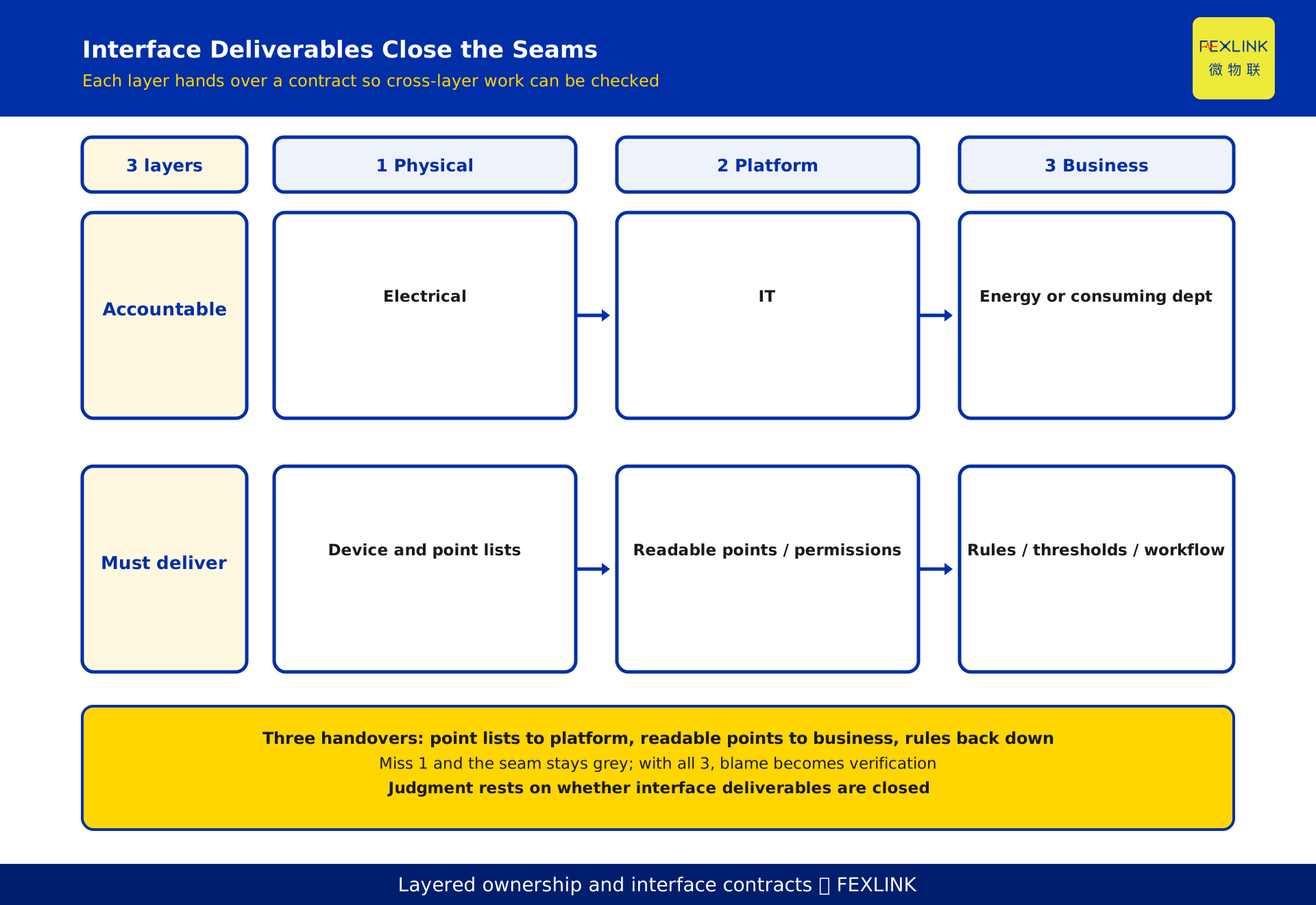
The three boundaries compress into one table: what each layer owns, must deliver, and explicitly does not own. Listing what a layer does not own stops disputes faster than listing what it does.
| Layer | Accountable dept | Main objects | Must deliver | Explicitly out of scope |
|---|---|---|---|---|
| Physical | Electrical | Terminals, sensors, instrument transformers, breakers, field power, cabling | Device list and point list, wiring records, field integrity confirmation | Platform accounts, data ingestion, alarm rules |
| Platform | IT | Gateways, links, point lists and protocol adaptation, account permissions, interfaces | Readable point list, permission table, ingestion and interface notes | Device selection, threshold setting, alarm handling |
| Business | Energy or consuming dept | Thresholds and rules, alarm grading and dispatch, closure loop, accounting basis and reports | Rule and threshold table, grading table, handling workflow and receipts | Device and link troubleshooting, permission configuration |
The easiest column to overlook is "must deliver". The device and point lists are the physical layer's contract to the platform layer; the readable point list is the platform layer's contract to the business layer; the rule and threshold table is the business layer's configuration basis handed back down. With all three, cross-layer work has something to check against; miss one and the boundary stays grey.
4. Why a Single Project Owner Comes First
Layering resolves who is accountable vertically, not who decides horizontally. New points requiring field power changes, how far permissions open, and who confirms a threshold all cut across three layers; no single layer can decide alone.
So appoint one project owner at kickoff with three powers: prioritizing cross-layer work, arbitrating interface disputes, and signing overall acceptance. It need not be a new position — an existing project manager or lead department head can carry it, provided the mandate is written into the project charter.
A common mistake is treating the owner as the person who does everything; it does not replace the three layers' execution duties, only makes trade-offs and closes open threads. Without an owner, disputes escalate to senior management. One signal tells you whether governance has gelled: when a cross-layer issue appears, is there one authorized person who can decide?
5. Three Risks of Unclear Ownership
Unclear ownership converts into three risks whose repair cost rises in order.
Coverage risk: a task nobody claims. Point mapping and alarm closure straddle two layers, so both sides assume the other owns them — a stalled schedule during delivery, unattended alarms during operations.
Overlap risk: the same task done twice with different bases. A threshold configured on the platform and recorded in a business ledger, drifting out of sync, makes alarms appear and disappear. It is more hidden than coverage risk — on the surface "someone is handling it" — and surfaces only when data conflicts.
Traceability risk: no unique accountable owner after an incident. Once coverage and overlap compound, a review turns into competing accounts rather than corrective action; fixes never land and the problem recurs. The mitigations: coverage by an interface deliverables list, overlap by a single source of configuration, traceability by one accountable owner per work item.
6. Filling in a RACI Matrix
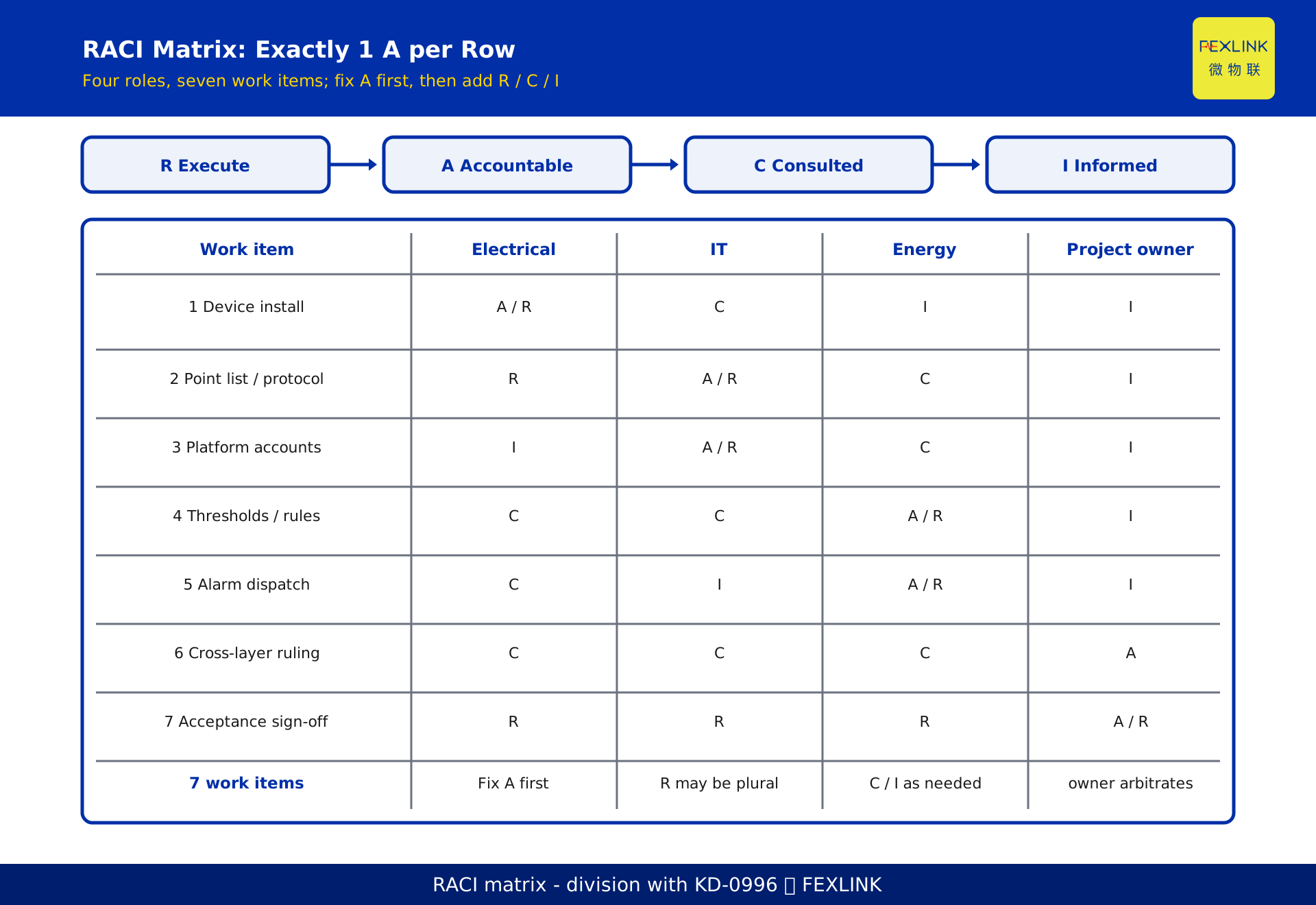
RACI brings layering down to work items. R is the executor, A the accountable party who owns the outcome and can veto, C is consulted before the decision, I informed after it. One hard rule: every item has exactly one A; R may be plural; C and I as needed.
Rows are typical work items; columns are the three departments plus the project owner. Adapt the skeleton by adding or removing rows.
| Work item | Electrical | IT | Energy | Project owner |
|---|---|---|---|---|
| Device selection, install and wiring | A / R | C | I | I |
| Point list and protocol adaptation | R | A / R | C | I |
| Platform accounts and permissions | I | A / R | C | I |
| Threshold and alarm rule setting | C | C | A / R | I |
| Alarm dispatch and closure loop | C | I | A / R | I |
| Cross-layer interface arbitration | C | C | C | A |
| Overall acceptance sign-off | R | R | R | A / R |
Fill it in this order: list items, fix the single A, then add R, C and I. Fixing A first forces "which layer does this belong to" and prevents an even split by department. Two A's in a row means the item can be split; split and refill. A matrix must be referenced by the project charter to carry authority.
7. Writing Responsibility into Deliverables and Acceptance
Responsibility tends to stay on paper: a matrix can look polished while acceptance dissolves into conflicting accounts. Make it real by translating responsibility into checkable deliverables attached to acceptance criteria.
The physical layer delivers the device list and point list; acceptance checks that field devices and points correspond one to one. The platform layer delivers the readable point list and the account permission table; acceptance checks that every point is readable and every account sits within its authorization. The business layer delivers the rule and threshold table, the alarm grading table and the handling workflow; acceptance traces one alarm end to end, from trigger to closure. Each layer's acceptance items are signed by that layer's accountable owner, and cross-layer items by the project owner.
After that, "the platform cannot read the data" becomes a check on which deliverable is missing: no point list means the physical interface is unclosed; a delivered but unconfigured point list means platform adaptation is incomplete. Ownership shifts from blame to verification.
8. Judging Three Typical Dispute Scenarios
Read the three scenarios back through the layers and the matrix, and judgment becomes direct.
Scenario one: devices installed but the platform reads nothing. Check whether the point list was delivered and adaptation completed. A missing point list belongs to the physical layer, incomplete adaptation to the platform layer; if both are in place, it is a cross-layer dispute the owner arbitrates, naming a retest owner.
Scenario two: alarms pushed but nobody acts. The platform owns delivery; the business layer owns the closure loop. If delivered but dispatch rules or the receiving role were never defined, responsibility sits with the business layer; if never sent, with the platform layer. Evidence: whether the alarm grading table and handling workflow exist.
Scenario three: monthly energy figures do not reconcile. The business layer owns the accounting basis and reports, the physical layer owns field parameters such as CT ratios, the platform layer owns raw data integrity. Compare the three deliverables and you can tell whether the basis, a field parameter or the data path changed. Across all three, judgment depends not on who argues loudest but on whether the interface deliverables are closed.
9. Division with KD-0996: Internal Ownership vs External Due Diligence
This article and KD-0996 both belong to the early project phase but point in different directions. This one answers an internal question: which department is accountable for which layer, who arbitrates, and how to fill the matrix. Its outputs are a layered responsibility table, a RACI matrix and an interface deliverables list. KD-0996 answers the owner's question to suppliers: what to ask during tendering or technical clarification, and how to verify responses. Its outputs are a clarification question list and a response evaluation basis.
Sequence matters: internal ownership must be settled before consistent external questions can be asked. If the departments have not aligned, clarification demands will contradict one another and suppliers cannot answer coherently. Settle internally first, then ask outward; writing clarification questions belongs to KD-0996.
Frequently Asked Questions (FAQ)
Q: Beyond the three departments, do we need a new department or position for the project?
A: No. Layering assigns responsibility, it is not an organizational redesign. An existing project manager or lead department head can be the owner; what matters is writing the three mandates into the project charter. Departments keep their structure.
Q: For a small project led by one department, does three-layer ownership still apply?
A: Yes, and even more so. Layers divide objects, independent of department count. When one department covers several layers, still list deliverables and name an owner per layer; otherwise "it is all our own people" lets interface contracts go missing, and coverage risk surfaces when points are added or staff change.
Q: Can A and R be the same person in RACI?
A: Yes. On small items executor and accountable party are often one role. The hard rule is not separating A and R, but one A per row. On cross-department items A sits with the lead layer while R is distributed, so the two separate naturally.
Q: Should suppliers appear in this RACI matrix?
A: Use two tables. The internal matrix lists only internal departments and the project owner, for ownership and arbitration; supplier responsibility belongs in the contract's work-interface and deliverables schedule. Mixing the supplier in blurs two duties — being accountable and performing to contract — and makes acceptance harder.
Q: Will the matrix change after it is set?
A: Yes, but changes must leave a trace. Moving from commissioning into operations shifts the item list and owners; the A for alarm handling may transfer from the project team to the consuming department. Keep the matrix as a controlled charter document and record the reason, date and approver for every change, so ownership never drifts back to guesswork.
Scope and Limitations
This article applies to electrical safety, energy and intelligent monitoring projects where several owner departments collaborate, especially those fixing roles, interfaces and acceptance criteria at kickoff. For a small retrofit owned by one department, a layered deliverables list may suffice. It does not apply to how a supplier organizes its own team, nor is it a tender or contract template.
Department names, layer definitions and the matrix skeleton are generic examples and do not represent any enterprise's org chart, staffing or performance measures. No product model, parameter, price or quantity is given, and no standard number or clause is cited. Scenarios are de-identified composites, not any particular customer or project. The layering analogy draws on the general architecture of end-edge-cloud collaboration and digital electrical intelligent supervision systems; it is not a selection, procurement or compliance commitment. Actual ownership should be confirmed by the project owner with all departments against the project charter, contract terms and local management requirements.
Frequently Asked Questions
One Project, Three Departments
to split the project into three layers — physical, platform and business. Electrical owns field terminals and devices