 FEXLINK Research Institute
The short answer
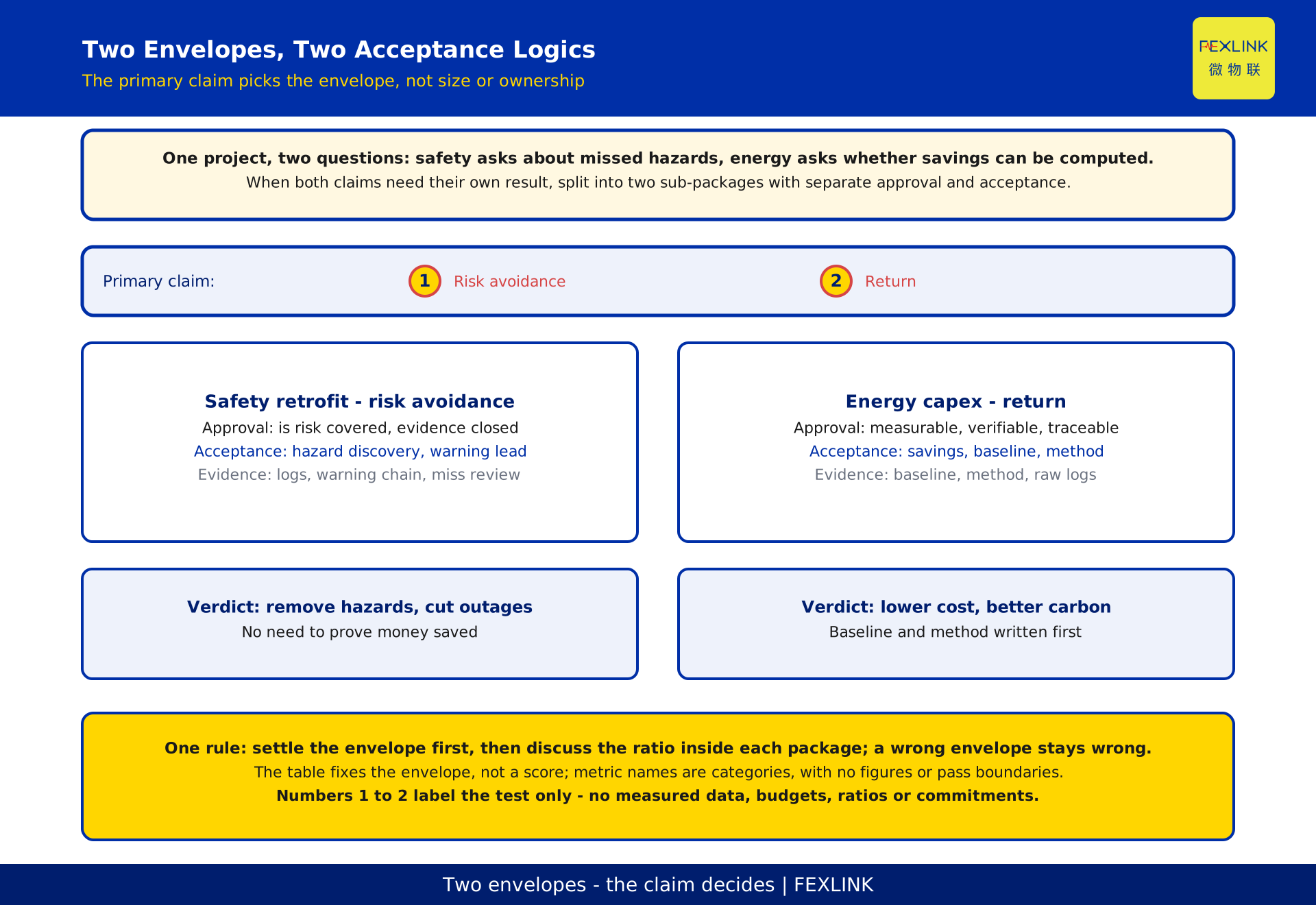
One monitoring project, two envelopes: "safety retrofit" or "energy-saving capex". This is an ownership decision settled before approval, not a filing-time bookkeeping choice. One rule decides it: the primary claim picks the envelope. To remove electrical hazards and cut unplanned outages, use the safety envelope, where acceptance asks whether hazards were found early and warnings left a usable window. For lower cost and better carbon performance, use the energy envelope, where acceptance must compute savings, with the baseline and calculation method written at approval time. When both claims are real and both need their own result, split into two sub-packages with separate approval and acceptance logic.
A wrong envelope costs at both ends: at approval the proposal follows the wrong review logic and stalls; at acceptance you must prove something the project never did - a safety-only job asked for a saving rate. This article gives no budgets, ratios, saving rates, payback, acceptance limits or commitments, and does not replace finance, audit or qualified parties. The table, checklist and split method are structural tools. Numbers 1 to 6 label items only; GB/T 23331 and ISO 50001 are standard names, not measured data.
Two different questions: which envelope, and how to split
Two things are easily conflated: which budget envelope the money comes from (primary claim, approval logic, acceptance metrics), and how safety and energy spending is split inside one project (risk exposure versus waste exposure). The second has its own article here and is not repeated.
Mixing them shows up as discussing the ratio first and back-solving the envelope: easy-to-quantify savings push the whole project into energy capex, or an untradable safety floor pushes every line into the safety envelope. Both reverse the order. Settle the envelope first, then discuss the ratio inside each package; once the envelope is wrong, no fine ratio work repairs the mismatch.
How the two approval logics differ
A safety retrofit is reviewed as risk avoidance: explain the hazard, severity, why existing means miss it, and how the retrofit turns passive discovery into early warning. Reviewers care about coverage, a closed evidence chain and no new safety gap; they do not ask you to prove money saved.
An energy capex project is reviewed as a return: explain where waste sits, which energy link the measure acts on, how savings are computed, how the baseline is set, and who reviews the method. Reviewers care that results are measurable, verifiable, traceable and lasting; they do not ask how many hazards were removed.
The same sensing base is asked two questions: the safety envelope asks "did we miss anything?", the energy envelope asks "can you compute it?". A proposal blending both answers satisfies neither.
What a safety retrofit is audited against
The registry groups acceptance here into two metric classes: hazard discovery and warning lead. As reviewable items, at least three things are needed.
First, discovery evidence: how the hazard surfaced before, where it was missed, which points became visible afterwards, and whether records trace to time, location and actor. Second, lead evidence: whether a usable window exists between warning and action, whether the chain is recorded, and why one "alarm raised" line is not enough. Third, missed-alarm review: sample known hazards for identification, treating a miss as a veto item needing explanation rather than substituting alarm counts for coverage.
No discovery-rate, lead-time figures or limits appear here. Metric names are categories; definitions, sampling and pass boundaries belong to project documents and contracts.
What an energy-saving capex project is audited against
Acceptance here revolves around "energy savings", but savings is not a number read off afterwards. Three things must be concrete at approval time; if one is missing, this envelope is not the right home.
First, the energy baseline: which boundary, convention and period describe pre-retrofit use, how output, shifts and weather are stripped out, and who confirms it. Second, the calculation method: how before and after are compared, what verifies the result, who reviews it, where raw records are exported. Third, the savings figure: a result that can be computed and reconciles with baseline and method - not a conclusion documented afterwards.
ISO 50001 and GB/T 23331, which adopts it identically, give a management-system method framework: energy review, energy baseline, energy performance indicators, continual improvement. They prescribe no saving rate and set no acceptance limits. Other articles here cover baseline definition, indicator selection and certification data; this article only explains why baseline and method come first, repeats none of that, and quotes no clause numbers, limits or conformity judgements. Versions follow the currently effective texts and must be rechecked after revision.
One comparison table that settles the envelope
| Item | Safety retrofit | Energy-saving capex |
|---|---|---|
| Primary claim | Remove hazards, cut unplanned outages | Lower cost, improve carbon performance |
| Approval logic | Risk avoidance: is the risk covered | Return: can the result be measured |
| Material focus | Hazard list, gaps in current means, warning chain | Baseline, calculation method, affected energy link |
| Acceptance metric classes | Hazard discovery, warning lead | Energy savings, baseline, calculation method |
| Veto risks | Missed alarms, incomplete coverage, no action window | Invalid baseline, unreviewable method, no computable result |
| Typical evidence | Discovery records, warning-to-action chain, missed-alarm review | Baseline confirmation, calculation trail, raw record export |
The table settles the envelope only; it is not a scoring sheet or an official approval checklist, and contains no figures or pass boundaries.
A four-step test driven by the primary claim
The test looks neither at budget size, equipment ownership, nor which department leads - all three are unstable cuts. Ask four questions in order.
Step one: write the pain as one decidable sentence naming the thing changed, for example "a class of joint overheating stays invisible until it becomes a fault". Step two: risk avoidance or return - consequence severity, or quantifiable waste. Step three: who supplies evidence at acceptance, and which class. Step four: if both hold, move to splitting.
Skip the first three and you pick the envelope easiest to write, not the one matching the claim.
Why mixed projects need two sub-packages
A real plant often wants hazard control and energy visibility on one shared sensing and data base. Force one envelope and half the work cannot be explained inside that envelope's acceptance. Splitting is not shrinking the project: it writes two approval logics and two acceptance criteria separately, so every line of spend answers its own question.
Three disciplines apply. Write claims separately: one sub-package, one claim. Set criteria separately: each carries its own baseline, metric class or evidence chain, and neither borrows the other's metrics. Keep the base shared but make ownership explicit: collection and platform capabilities state what they serve in each document and are never counted twice. The owner and finance still confirm accounts, contracts and acceptance arrangements.
A de-identified split example
A manufacturing plant planned distribution-side monitoring and also wanted workshop energy visibility. The first draft put everything in one package claiming "improve distribution safety and energy efficiency"; both reviewers asked for the other side's material.
The rewrite split by primary claim. Sub-package one claims hazard discovery and warning lead, uses the safety envelope, builds on the hazard list, gaps and warning-to-action record chain, and is audited only on coverage and lead evidence. Sub-package two claims energy visibility and computability, uses the energy envelope, writes the baseline and method first, and is audited only on savings reconciling with both. The shared base states its purpose in each document and is not counted twice.
This is a de-identified method illustration, with no client, place, project name, budget or result data; it is not a real project and commits to no configuration, budget or schedule.
Three consequences of a wrong envelope
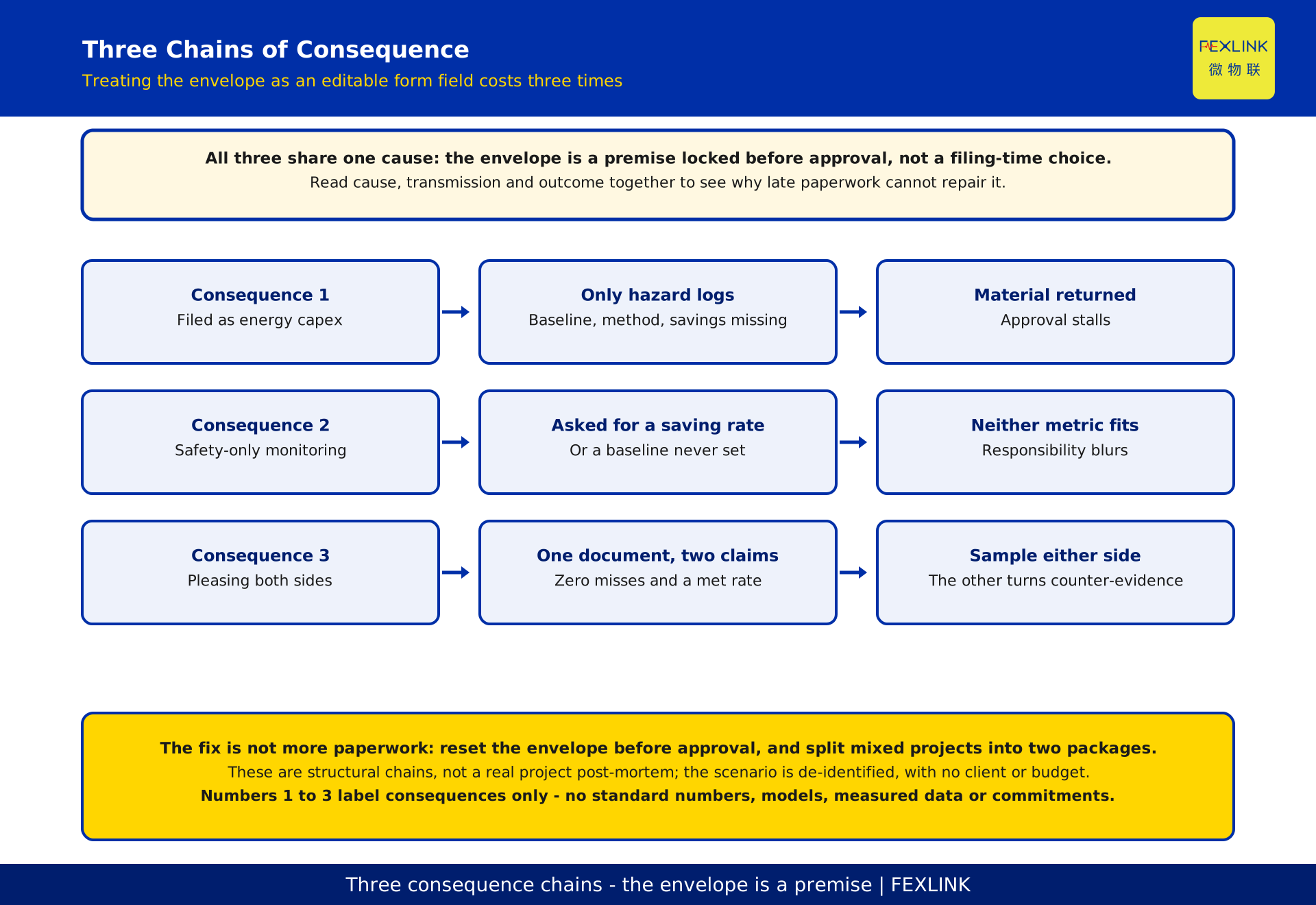
First, approval stalls on logic: filed as energy capex but backed only by hazard records, the baseline, method and savings figure cannot be produced.
Second, acceptance gets mismatched metrics: a safety-only job filed as energy capex is asked to prove a saving rate; an energy promise tucked into a safety retrofit is chased for a baseline never established.
Third, two evidence chains contradict: one document claims both zero missed alarms and a met saving rate. Once either side is sampled, the other's record convention becomes counter-evidence.
All three share one cause: treating the envelope as a form field adjustable later, rather than a premise locked before approval.
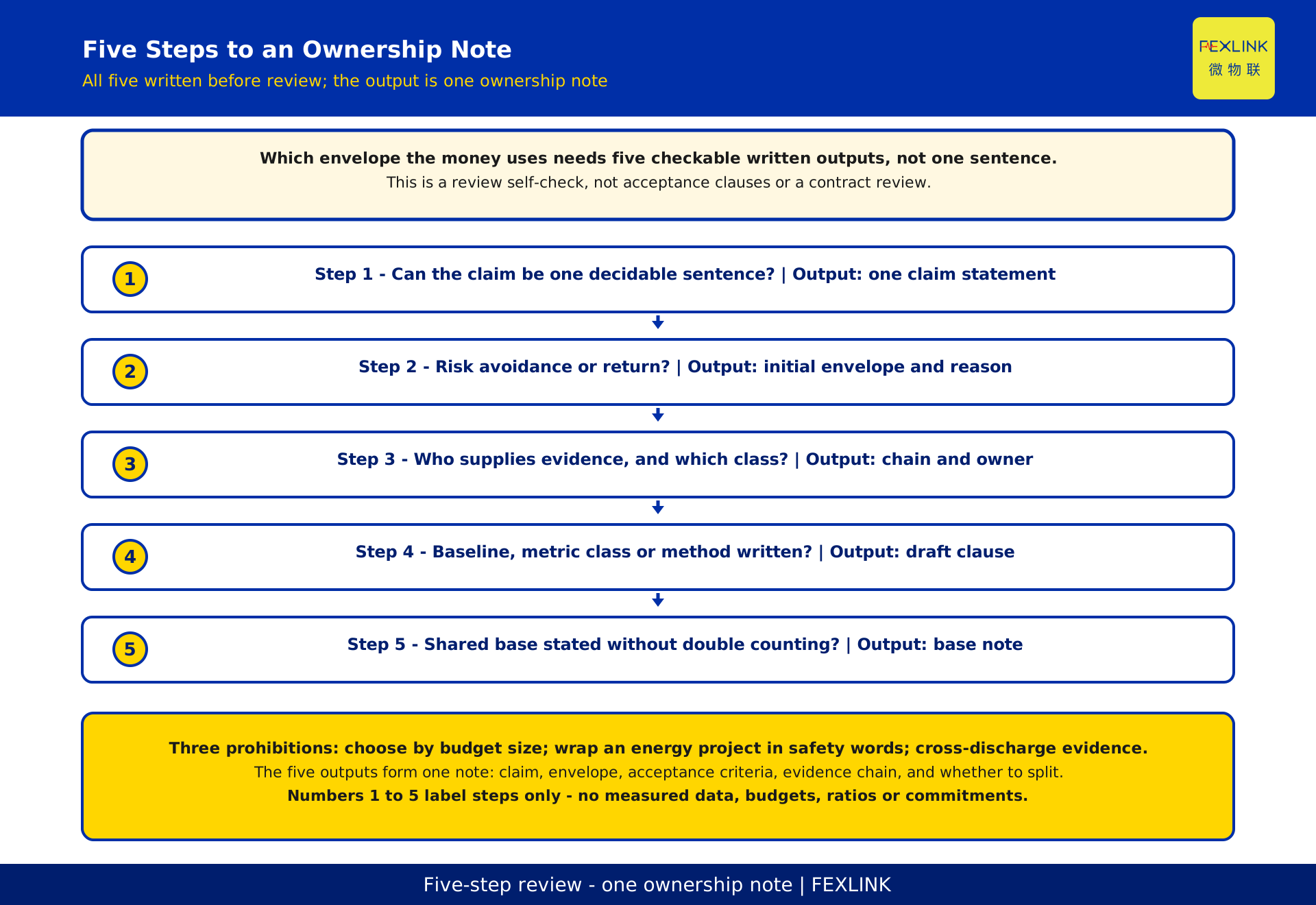
A five-step pre-approval review checklist
| Step | One question to ask | Written output | If it fails |
|---|---|---|---|
| 1 | Can the claim be one decidable sentence with an object | One claim statement | Rewrite; do not choose an envelope |
| 2 | Does it land on risk avoidance or on return | Initial envelope and rationale | If both hold, move to splitting |
| 3 | Who supplies evidence at acceptance, and which class | Evidence chain and owner | No owner, no submission |
| 4 | Are baseline, metric class or method written concretely | Draft acceptance clause | Write them first, then file |
| 5 | Is the shared base stated in each package without double counting | Base ownership note | Merge or separate if counted twice |
The output is a one-page ownership note: claim, envelope, acceptance criteria, evidence chain, and whether to split - all five written before review. Numbers 1 to 5 label steps only.
Common misjudgments and prohibited moves
| Misjudgment | Why it is wrong | Prohibited move |
|---|---|---|
| Choosing by budget size | Budget size has nothing to do with approval logic | Do not use the safety envelope to simplify a small project's paperwork |
| Wrapping an energy project in safety language | Acceptance will ask for savings and the material will not match | Do not mix uncommitted metrics into the primary claim |
| Offering a saving rate to win approval | With no baseline or method written, the promise cannot be verified | Do not write any unverified saving-rate figure |
| Borrowing metrics across split packages | The two acceptance criteria merge again | Do not let one sub-package discharge the other's obligation |
| Treating a standard as an acceptance limit | A management-system standard gives a method framework, not project limits | Do not quote clause numbers or make conformity judgements |
Frequently asked questions (FAQ)
Q: The primary claim is vague. Can we file as energy capex and adjust later? No. The envelope is a premise, not an adjustable form field. If the claim cannot be a decidable sentence with an object, step 1 has not passed and any choice carries the mismatch into acceptance. Write the pain down first.
Q: Should a safety retrofit also compute savings to ease approval? No. Every extra metric adds an acceptance obligation, and the safety envelope does not ask for savings. If an energy benefit exists, split it off as its own claim rather than mixing it into safety criteria.
Q: Does splitting count as duplicate investment? Splitting is not double counting. Whether it is judged duplicate depends on whether the shared base states its purpose in each document and is counted separately - exactly the third discipline. The owner and finance decide under their accounts and contracts.
Q: Must we hold ISO 50001 certification before using the energy envelope? No. ISO 50001 and GB/T 23331, which adopts it identically, give a method framework of energy baseline, energy performance indicators and continual improvement, useful for writing the baseline and method. Certification is not a precondition, and no conformity judgement is made here. Versions follow the currently effective texts.
Q: Why no budgets, ratios, saving rates or acceptance limits? Ownership settles logic and evidence, not numbers. Budgets, ratios, saving rates, payback and pass boundaries belong to project documents, contracts and qualified parties. This article has no measured data, limits or commitments; numbers 1 to 6 label items only, and GB/T 23331 and ISO 50001 are standard names.
Scope and limitations
This is a method note on budget ownership during approval, for owner-side project managers, finance and energy leads, and presales teams before the proposal is fixed. It does not apply to how safety and energy spending is proportioned inside a project, to baseline definition, indicator selection, certification data, account determination, audit convention, contract acceptance clauses, or any conformity judgement - those belong to other articles here or to qualified parties.
Factual boundaries: the related-products field is empty, so no model numbers, series names, parameters or selection advice appear. The related-standards field registers GB/T 23331 and ISO 50001; only names and numbers are cited, with no year, clause number, limit or conformity judgement; versions follow the currently effective texts and must be rechecked after revision. Related solutions are registered by name only; under the handbook rule against self-inventing official frameworks, their dimensions, layers and elements are not expanded or decoded, and the official definition rests with official documents. The official source folder is empty.
No measured data, budget, ratio, saving rate, payback, deadline, acceptance limit or commitment appears here. The number pool is only structural labels 1 to 6 plus two standard identifiers. The example is a de-identified plant with no client, place, project name or result data. The article and figures are not the decision authority; final ownership is confirmed by the owner, finance, audit and qualified parties in project documents. All deliverables are pending review, owner review is required, the generator does not self-approve, and nothing is published.
Frequently Asked Questions
Should This Budget Come From Safety Retrofit or
One monitoring project, two envelopes: "safety retrofit" or "energy-saving capex"