 FEXLINK Research Institute
The short answer
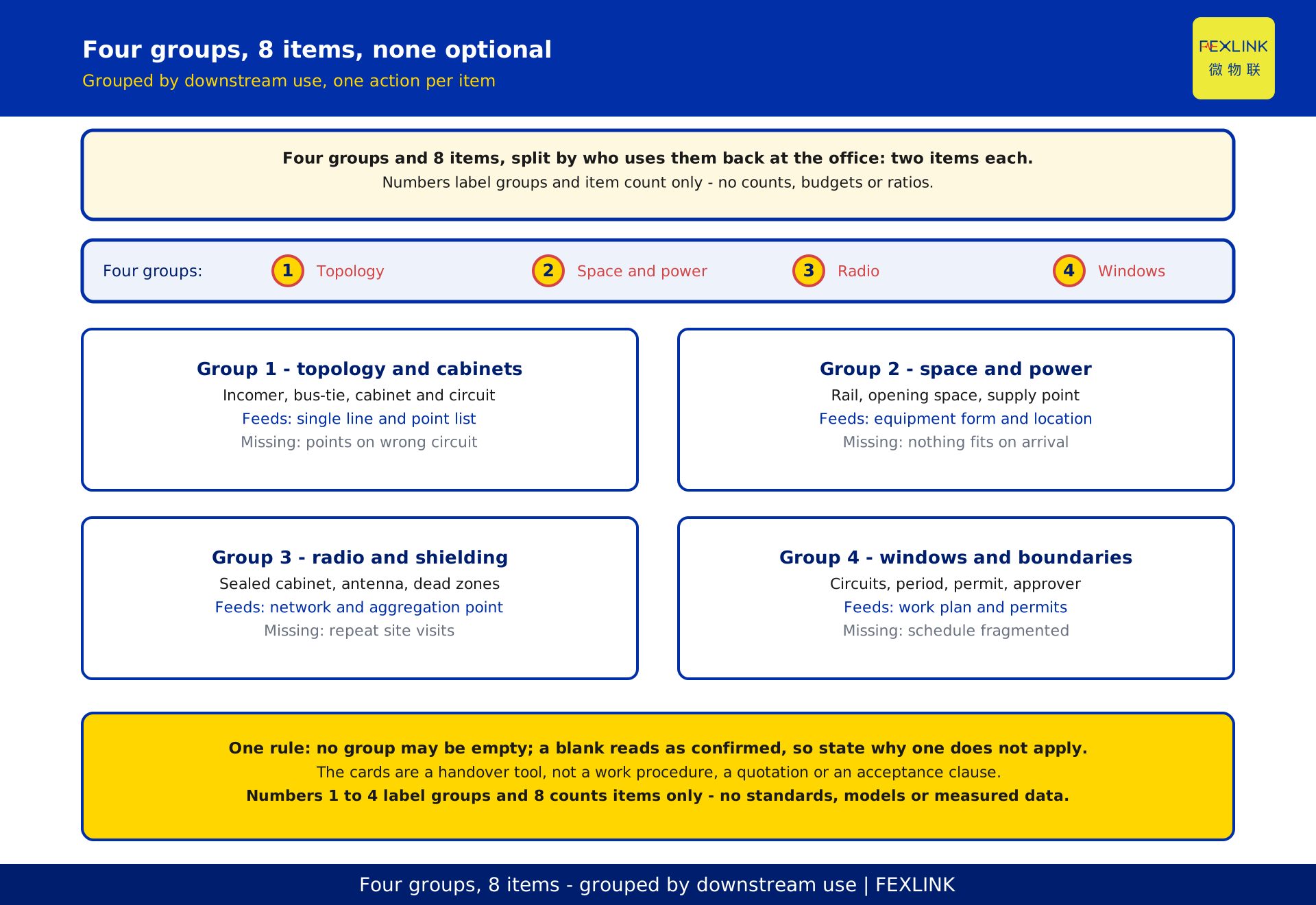
A competent survey is not measured by photographs taken, but by whether the design can be written without another round of calls. Bring back four groups covering 8 items: distribution topology and cabinet positions; installable space and power supply; communications conditions and shielding; outage windows and work boundaries. Take three kinds of photographs on site: overview, close-up and nameplate. Miss one group and placement, power, communications or schedule are reworked; at worst the selection is scrapped. What follows is a handover list and record, not a work procedure.
What a wasted visit actually means
"Being on site" and "bringing back information someone else can use" are different things. Three failures recur: photographs without dimensions, cabinet numbers without circuit ownership, verbal assurances without a written boundary. None can be reused by someone absent — review, selection, quotation and scheduling all happen in an office using only those pages.
The test is blunt: can someone who never visited draw the layout, fix the gateway location and decide on an outage without asking? If not, the visit repeats; the real cost is not travel but finding the mismatch after the design is frozen.
Scope comes first. This article covers only what a survey brings back; live-work boundaries, window scheduling and the new-build versus retrofit architecture each have their own treatment. None is expanded here, but the record must leave an interface each can fill in.
Four groups, eight items: turning "what to look at" into a handover list
Groups are split by who uses them back at the office: topology feeds the single-line drawing, space and power feed placement, communications feed the network, windows feed the plan. Each holds two items, so 8 in total; every item must carry one downstream action or it is padding.
| Group | Group name | Two information items | Downstream action |
|---|---|---|---|
| 1 | Topology and cabinet positions | Incoming feed and bus-tie relationship; cabinet numbers and circuit ownership | Draw the single line; fix the point list |
| 2 | Installable space and power | Remaining DIN rail and CT opening space; supply point and power conditions | Fix equipment form and location |
| 3 | Communications and shielding | Cabinet shielding and antenna routing; signal and dead-zone checks | Fix network topology and aggregation point |
| 4 | Outage windows and boundaries | Available windows and circuits; tasks needing an outage and permit interface | Plan work and permits |
Grouping also lets handover be claimed by group, so gaps are chased by the owner of that column. Numbers are identifiers only, not quantities or budgets.
Group one: topology and cabinet positions, drawn on site
A single-line diagram is not copied from the drawing set; it checks that drawings and site agree: incoming direction, bus-tie position, which bus section carries critical circuits, and any added drawers or temporary feeders. The cabinet list pairs number, type, circuit and load; the same cabinet written differently across revisions is a common source of rework visible only on site.
Sketch it on the spot and ask the owner's electrician to sign it. Photographs show a door, not circuit ownership. Methods that leave the primary circuit untouched depend most on this group — which section a CT clips to, where secondary wiring runs, which cabinet holds the gateway — so asking later rebuilds the list.
Group two: installable space and power, deciding whether anything fits
Look at three things: remaining DIN rail, module depth and clearance, and the working space a CT needs to open. Retrofit doors carry old cut-outs, buttons and nameplates while trunking is full; there looks to be room when nothing fits. Measure, do not eyeball; if it cannot be measured, write "to verify".
Power means two questions: is there a usable low-voltage supply point, and how far is it from the device. A common 220 V single-phase supply is one condition to verify, not a specification; method, voltage and capacity follow site measurement and the latest selection manual. Ranges, channel counts, supply and interfaces are configurable, not fixed specifications.
Associated devices are placement objects: a gateway takes rail and an uplink path, a CT takes workable length on the busbar or cable. Recording where it goes and where power comes from beats naming models early; the model is the last step.
Group three: communications and shielding, deciding whether data returns
A metal cabinet acts roughly as a shielding cavity, so nodes inside often lose contact on go-live; this is a blocked path, not weak signal. Record whether the cabinet is sealed, whether the antenna can be brought outside or raised, distances across cabinets and walls, and any reusable wired path. A link working with the door open and failing shut is a classic trap, so test again closed.
Test signal and dead zones on site, not from experience; note bus routing, usable terminals and end positions. This group sets the aggregation point, network grouping and which critical points need a wired fallback. Missing it surfaces only during commissioning as repeated visits, when cabinets are closed and changes cost far more than one question on the day.
Group four: outage windows and work boundaries, deciding whether the schedule holds
A window is not "we can switch off". Record which circuits, what period, how long, who approves and what permit is required. Boundaries separate tasks not touching energised conductors from those needing isolation, verification, earthing and tagging. The survey establishes what the site allows and leaves a written interface; judgement and sign-off belong to qualified personnel and the permit process. This article gives no work steps or safety determination.
Read windows with topology and cabinet positions to see which cabinets can be finished inside a window and which move to a phased list. Chopped-up schedules are rarely slow work; the survey never asked which circuit a cabinet belongs to or whether it can be shut, leaving planning to guess.
Three kinds of photographs, each answering a different question
More photographs are not better; each should answer a question the office cannot. An overview answers how the row is arranged and where aggregation goes; a close-up answers whether there is room, how trunking runs and where the old cut-out sits; a nameplate answers whether model and drawings agree.
| Kind | Question it answers | What to capture | If missing |
|---|---|---|---|
| Overview | Row, aisle and mounting face | Include cabinet numbers and a reference | Aggregation cannot be located |
| Close-up | Room available and wiring route | Aim at rail, cut-outs and trunking | Wrong equipment form |
| Nameplate | Model versus drawings | Legible text, filed by cabinet number | Ratio misconfigured |
Include a cabinet number or reference so the set is not a pile of indistinguishable doors; a blurred nameplate is none taken. Where rules forbid photography, use a sketch plus hand-copied fields endorsed by the owner's electrician. Photographs are a method, not a mandatory action.
How one missing item propagates into rework
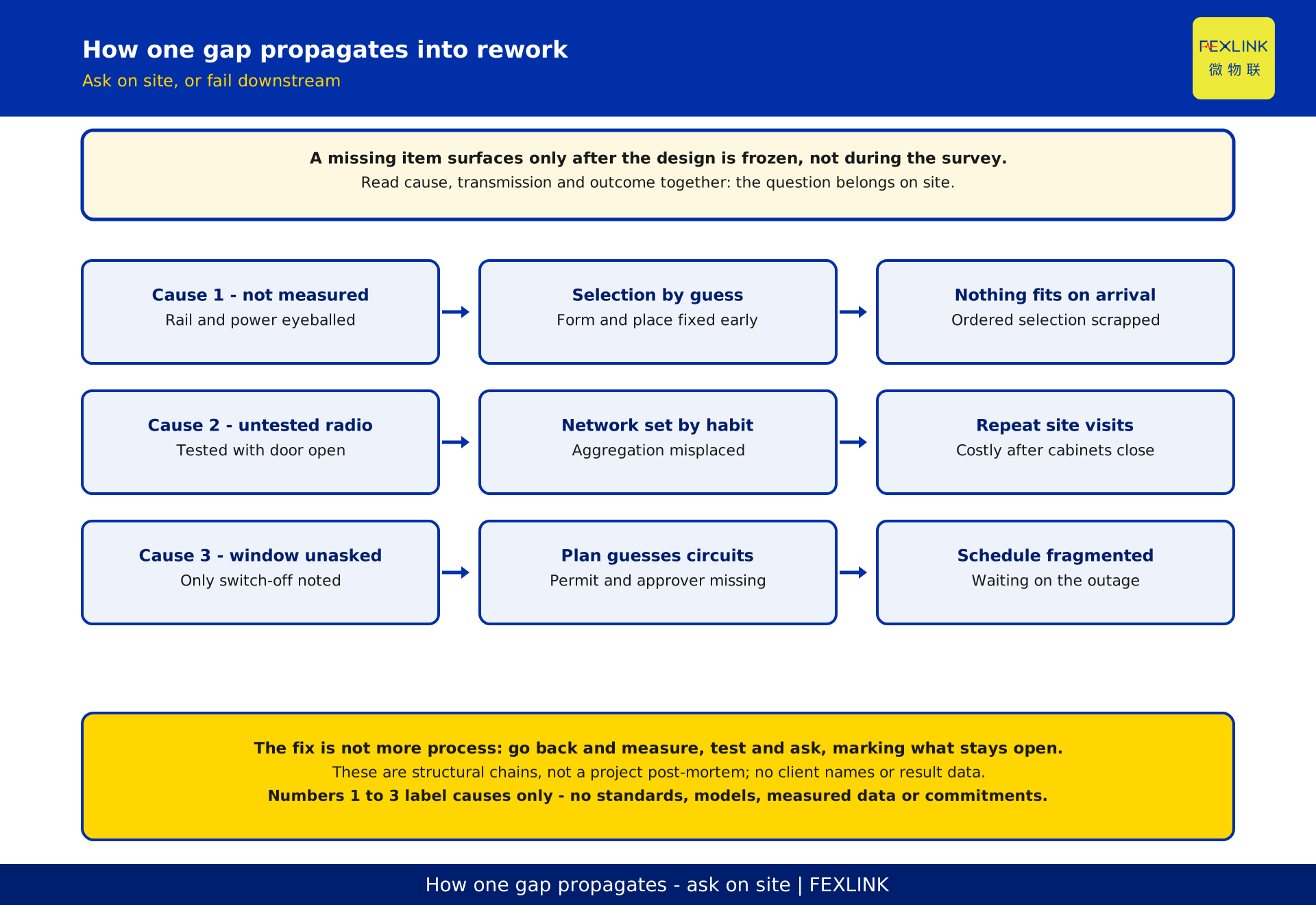
Read the groups as a chain: every consequence arrives after leaving the site. Unclear topology hangs points on the wrong circuit, so CT and gateway quantities are computed for the wrong object. Unclear space and power means equipment cannot be installed, scrapping the selection. Unclear communications puts aggregation wrong and draws repeat commissioning visits. Unclear windows schedule work on circuits that cannot be shut.
All four surface downstream but could have been asked on site. The value of a list is therefore not completeness; each item carries an action and an owner, so gaps show immediately. This is why "to verify" beats a blank — a blank reads as confirmed.
A site record you can fill in on the spot
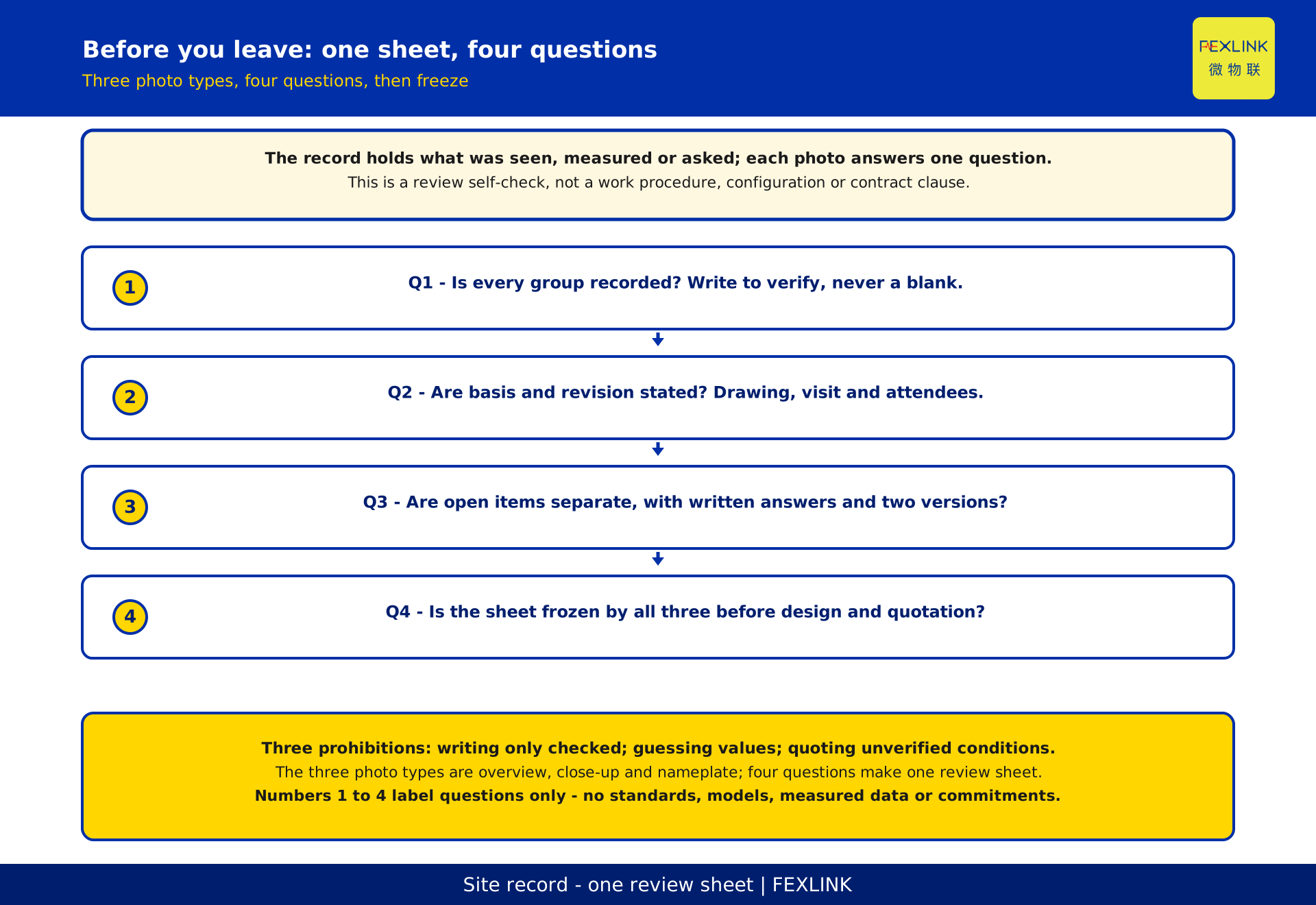
Lay the record out in columns — item, site observation, basis and revision, open items, sign-off — one row per group or cabinet. Observation holds only what was seen, measured or asked; otherwise write "to verify", not a blank or a guess. Basis and revision state the drawing revision, visit and attendees; open items are answered in writing and changes keep both versions.
| Column | What to enter | What is forbidden |
|---|---|---|
| Item | Which of the 8 items applies | Only "checked" or "no problem" |
| Site observation | Seen, measured, photograph IDs | Values guessed from experience |
| Basis and revision | Drawing revision, attendees | Unversioned verbal statements |
| Open items | Conditions not obtainable | Guessed values |
| Sign-off | Owner's electrician and attendees | Presales signing on their behalf |
The record is signed and frozen by design, commercial and construction on one sheet; only the frozen revision enters design and quotation. It is a presales deliverable, not a quotation: no prices, amounts or "first-time pass" promises. One shared sheet keeps every later question on the same record instead of three contradictory copies.
Where the associated products sit in the list
The associated products are the FEXLINK ESX/CW/CX series edge computing gateways and split-core CT current transformers. In the record they correspond not to "which model" but to four measurable placement conditions: rail and uplink for the gateway, workable length and secondary-wiring route for the CT, a shared supply point, and whether cabinet sealing forces the antenna outside. Models appear only as candidates under open items; formal selection follows the latest selection manual and product knowledge base. Configuration, ranges, channel counts and interfaces are configurable; this article gives no parameters, selection or purchasing advice.
The associated solution, the digital electrical intelligent supervision system, is registered by name only. Its dimensions, tiers and elements follow official documentation and the knowledge base; this article does not expand them, define a framework, or present the four groups as solution tiers. Packaging a survey list as an official framework is the easiest red line to cross.
Common misjudgements and how to correct them on site
Photographs instead of dimensions: write "to verify" when rail cannot be measured. Copying drawings instead of checking topology: check each cabinet for added circuits. Treating "there is signal" as "it will communicate": test with the door closed and note antenna routing. Treating "we can switch off" as "there is a window": circuits, period, permit and approver are all required. Leaving details for later: one question on site can cost several departments. Using the record as a quotation basis: it holds conditions, not promises. Quietest of all is treating "not recorded" as "not applicable" — state the reason, or silence becomes a default assumption.
Frequently asked questions (FAQ)
Q: The owner gives only a short access window and the 8 items cannot all be collected. What then?
Take the three that cannot be recovered remotely: the topology sketch, measured space and power figures, and the three kinds of photographs. Dead zones and window conditions become open items for written follow-up. An honest "to verify" beats guessed values; open items are a deliverable because they assign who must answer.
Q: What if photography is not allowed on site?
Use a sketch plus hand-copied fields — cabinet numbers, relative positions, visible dimensions and readable nameplate text — endorsed by the owner's electrician. Compliance takes priority; photographs are a method, not a mandatory action, and an endorsed written record is equally handable.
Q: Must all 8 items be collected on every project?
The four groups are general, weighted differently in new-build and retrofit: new-build favours reserved routes and verification alongside progress, retrofit favours cabinet space, dead zones and window boundaries. No group may be empty; one that does not apply must say "not applicable" with a reason.
Q: How does the site record relate to design and quotation?
It records conditions. Design uses it to fix points and network topology; the commercial team produces the quotation separately against the formal list and contract. Open items must be answered in writing before freezing, and only the frozen revision enters design and quotation. Using the record as a quotation basis turns unverified conditions into commitments.
Q: The title says "without these 8 things you wasted the trip". Is that not absolute?
It stresses handover cost, not a statistical finding or acceptance clause. The only test is whether someone who never visited can carry on without asking. If not, ask or go again, regardless of whether 8 items were ticked; the list is a means, a handable record the goal.
Scope and limitations
This article covers organising and handing over information from a first survey on electrical monitoring projects, for presales and field engineers and integrator project managers. It addresses cabinet positions, mounting space, communications and work windows in low-voltage rooms; not high-voltage work, live-working methods, safety procedures or product selection. The four groups, 8 items, three kinds of photographs and record columns are a structured checklist, not a standard clause, acceptance limit or conformity judgement. Site conditions, supply methods and configurable options follow the latest design documents, selection manual and product knowledge base; live working, isolation, verification and permits are determined by qualified personnel under site rules. The related-standards field is empty, so no standard numbers, years, clauses or limits are cited. Scenarios are de-identified examples (a park, a factory) with no real client, measured data, amounts, ratios or performance claims. Associated products and the solution are registered by name only, with no selection, purchasing or safety recommendation.
Frequently Asked Questions
What to Bring Back From Site Surveys on Electrical
A competent survey is not measured by photographs taken, but by whether the design can be written without another round of calls