 FEXLINK Research Institute
The short answer
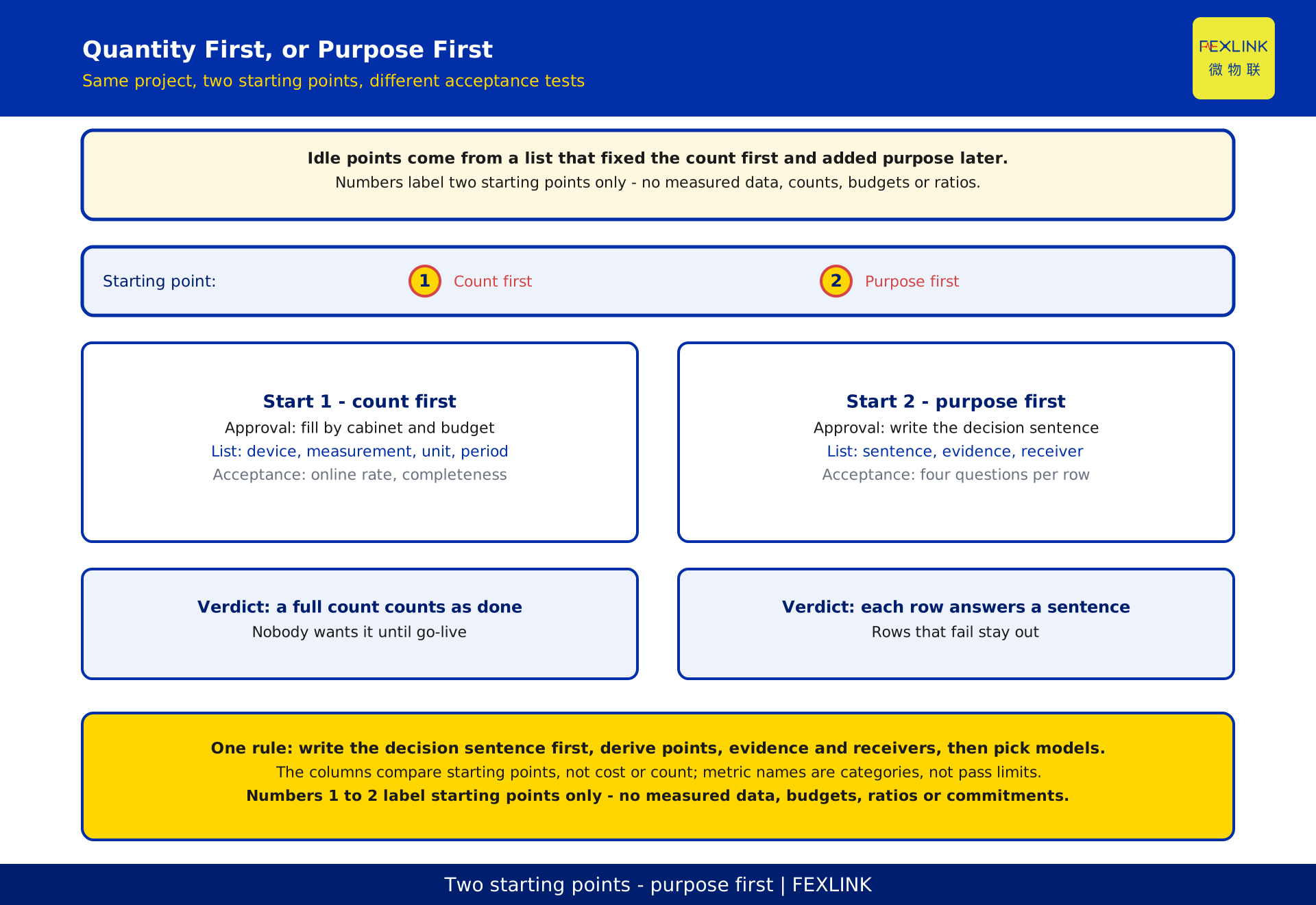
Points go idle not because hardware failed, but because the count was fixed before the purpose was defined. Reverse the order: write the decision the project must answer, derive mandatory points, evidence and receivers, then let risk grading set the installation sequence. Fewer points used often beat many points merely installed. The 60% in the title is rhetorical, not a measured statistic; this article neither verifies nor extrapolates it.
Point-level idleness is not system-level idleness
Separate two failure modes. System-level idleness appears after go-live: dashboards stay unopened, reports miss the routine meeting, alarms never become work orders. The remedy is attaching outputs to existing workflows - an operational mechanism covered elsewhere here. Point-level idleness is planted earlier, during scoping: a point has no question to answer from the day it is fitted. Data still arrives, yet no role changes an action because of it.
Symptoms look alike - low logins, unattended alarms - but treatments differ. System-level idleness is repaired with process; point-level idleness cannot be, because that point should never have been installed. Pick a point and ask which decision it supports; no answer means idle, regardless of online rate. This article covers only the second mode, not idle storage assets.
Three causes: no purpose, no owner, wrong threshold
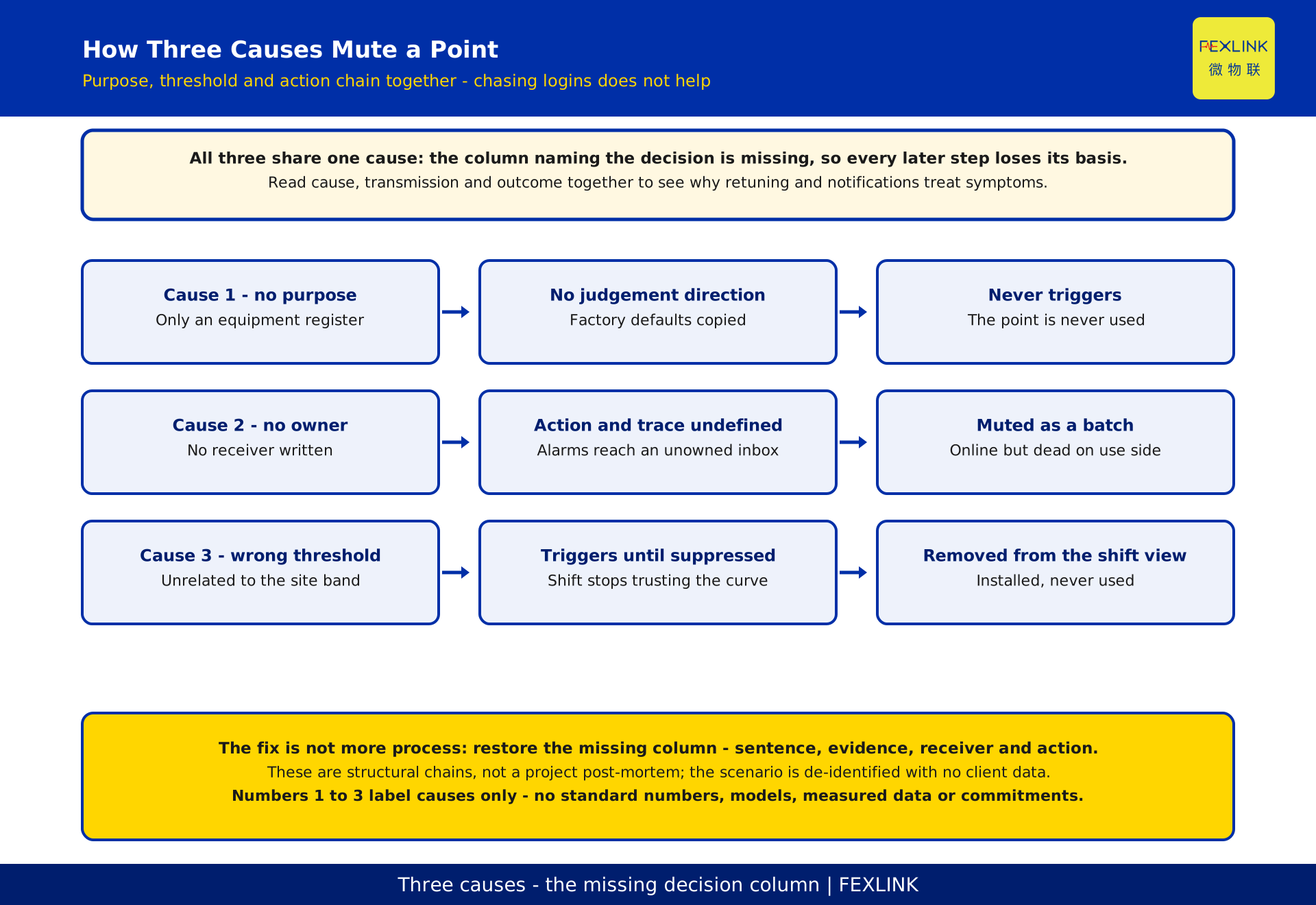
First, no purpose. A point list usually has device, measurement, unit and sampling period, but omits the column that matters: which decision the point answers. Without it, reviewers cannot tell which row to delete.
Second, no owner. Thresholds fire, but the list records neither who receives the alarm nor what action and record follow. Alarms land in an unowned inbox and are muted as a batch: online on the data side, dead on the use side.
Third, wrong threshold: copying factory defaults unrelated to the site's operating band, or treating data as a conclusion. Detached from the decision, a threshold never triggers or triggers until suppressed.
The three chain together: no purpose leaves no basis for a threshold, no basis leaves no action, no action gets the alarm muted, and the point leaves the shift view. Retuning, notifications and chasing logins treat symptoms; the root is the missing column.
The wrong order: quantity first, purpose later
The usual sequence fixes the count from budget or cabinet positions, builds the equipment list, installs, then asks at go-live what the data is for. Each step locks the error in.
Removing a row needs a change order; changing the configuration means repricing; moving one point may need another outage window. When the project discovers nobody wants those curves, the only move left is asking the shift team to look more often. Quantity has become a premise.
The boundary matters: retrofit reductions for short windows and the density-investment relation are covered elsewhere. This article covers neither count nor price, only the ordering error. Even a small list goes idle without a decision per row.
Reverse planning, step one: write a decidable question
The start is one decision sentence, not the topology drawing. It needs an object (circuit, joint class or settlement boundary), a judgement (rising under comparable load, or leaving the established operating band) and a destination (the role that takes the result).
"Understand how the main circuit is running" is not a decision sentence: no judgement, no destination, any point fits. "Is joint temperature rising under comparable load, and who arranges a recheck?" supplies all three, and whether one temperature node can answer becomes checkable.
This differs from breaking a vague request into measurable, assessable and acceptable indicators during discovery: that answers what the owner wants, this answers why each point exists. A decomposed requirement still needs translating into point-level sentences or it stays at reporting level. The sentence becomes a fixed column; an empty cell means the row was never reverse-planned.
Reverse planning, step two: derive points and evidence
Only with a decision sentence does selection begin: the sentence fixes the evidence, the evidence fixes the quantity, the quantity fixes the position, and only then does the work reach a purchasable device.
| Decision sentence (example) | Position of mandatory point | Evidence form | Receiver |
|---|---|---|---|
| Is joint temperature on the main circuit rising? | Main busbar joints and critical connections | Trend records under comparable load and recheck records | Electrical lead |
| Does a residual-current anomaly call for investigation? | Distribution circuits needing early warning | Alarm, notification and disposition records | Shift operator |
| Can a settlement boundary be reconciled on its own? | Assessment and settlement boundary | Raw records and reconciliation records | Energy lead |
The table gives no figures, limits or sampling periods; those come from comparable site data and current documentation. Every row stays contestable: can the evidence support the sentence, and is the receiver a real role?
Against the existing practice of listing points in layers - assessment objects, main energy units, key equipment - the difference is the deletion rule: a layered list says which objects exist, reverse planning says objects without a sentence wait. With no question this round, the object moves to open items until survey or review supplies one.
Risk grading only sets the installation order
Grading by risk and graded list review are established elsewhere here; this article adds only how the result becomes an executable sequence.
Installation batches: main-circuit and critical-joint points are installed and verified first, so a full rollout does not bury receiver definitions. Release conditions: receivers and actions are written before installation, and the next batch depends on the previous acceptance result. Verification order: spot checks start at the highest-risk points.
Grading becomes three columns - batch, release condition, check order. It does not create points; the decision sentence does.
Uniform coverage versus risk-weighted placement
Two list styles look alike on the drawing; the difference is the basis, not density.
| Comparison | Uniform coverage | Risk-weighted placement |
|---|---|---|
| List basis | Cabinet positions and drawing cells | Decision sentences and risk grade |
| Distribution | One per object of the same class | Dense on critical objects, none without a sentence |
| Data purpose | Decided after go-live | Written into the list at approval |
| Acceptance question | Online rate and data completeness | Which sentence does each row support |
| Typical outcome | Complete data, no role changes an action | Fewer rows, each with an owner |
This is not a cost comparison: no amount, ratio or point count, and no claim that fewer points preserve the same safety level. Coverage as the goal leaves acceptance without a criterion; the decision sentence as the goal makes every row questionable.
Give alarms an owner and tie thresholds to decisions
Two causes live on the same row. Every alarm-generating point must carry three fields before installation: receiver, action and record. If one is missing, the row does not enter the installation list.
Initial thresholds follow the judgement the sentence needs, not a factory default: a comparable trend for sustained rise, or an operating band written from comparable site history. Setting the band and reviewing thresholds is joint work between site and product configuration; this article gives no figures and makes no conformity judgement. The review owner goes into the same row.
Related solutions are recorded by name only: predictive maintenance and the digital electrical intelligent supervision system, whose dimensions, layers and elements belong to official documentation and are not expanded here.
Four acceptance questions for each point
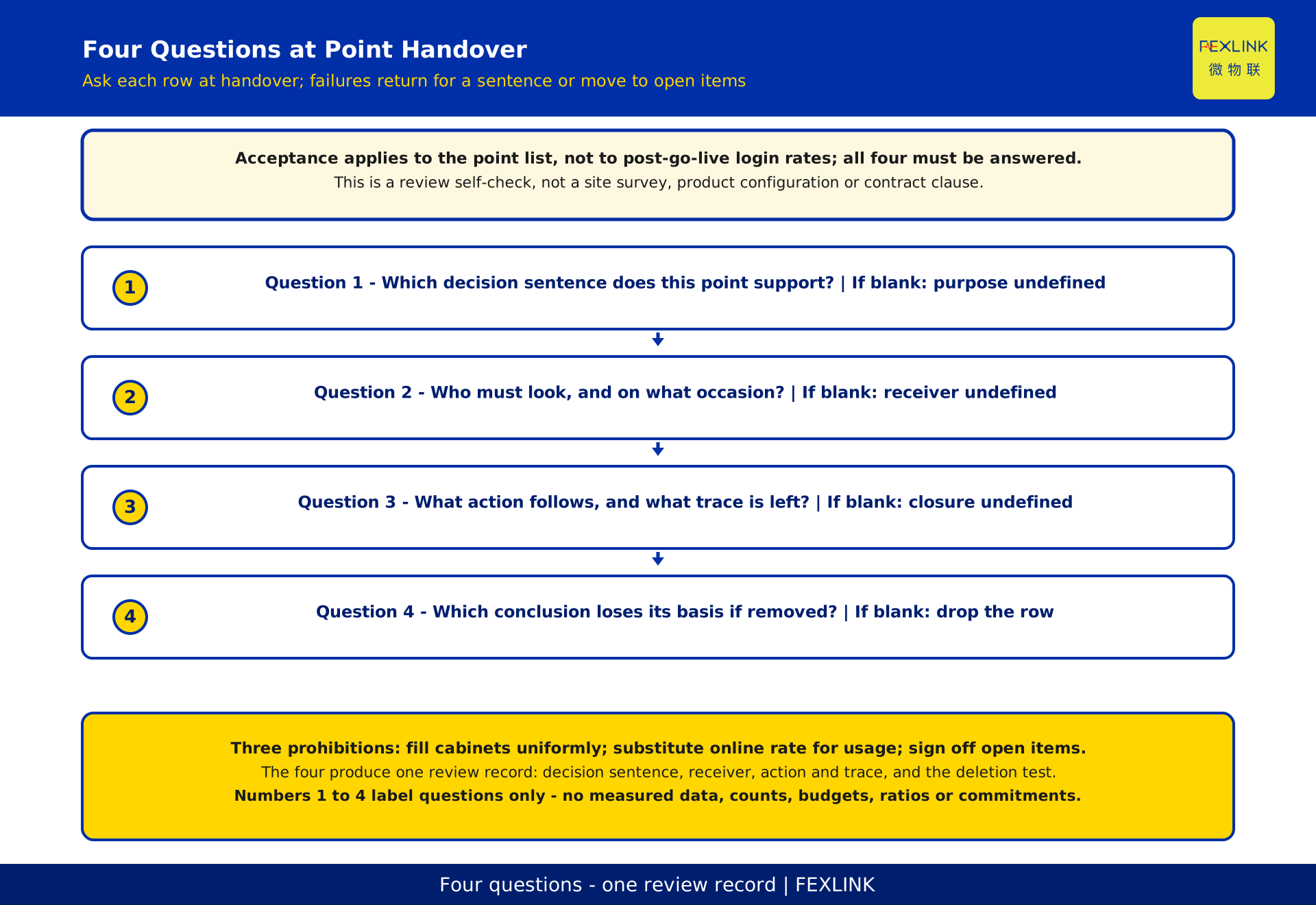
Acceptance belongs at the handover of the point list, not in login statistics after go-live:
| No. | Question | If unanswered |
|---|---|---|
| 1 | Which decision sentence does this point support? | Purpose undefined |
| 2 | Who must look, and on what occasion, when the data changes? | Receiver undefined |
| 3 | What action follows, and what trace is left? | Closure undefined |
| 4 | Which conclusion loses its basis if this point is removed? | The row can leave the list |
The fourth question is a deletion test: not a real deletion, but a demand that the row show why it cannot be replaced. If no conclusion is affected, the point was installed, never used.
Only rows answering all four are accepted; others return for a sentence or move to open items. The object here is the point list, not the functional verification, simulated injection and threshold drills of a later stage, nor the handover and meeting routines that keep outputs in use.
Where the linked products sit in the point list
When mandatory points become purchasable objects, the two registry products each occupy one class of row. Temperature nodes paired with the FEXLINK-BMS busbar monitoring system cover main busbar joints and critical connections, serving sentences such as whether temperature keeps rising. The ESF-22110-R electrical fire monitoring controller covers circuits needing early warning, serving sentences such as whether an anomaly calls for investigation - hence receiver and action in full.
The model performs only the last mapping: sentence first, mandatory point second, model last; working backwards from a model list returns to uniform coverage. This article states no range, channel count, power supply, interface or parameter; these are configurable, and configurations follow the current selection manual and product knowledge base. Nothing here is a selection or purchasing recommendation. The digital electrical intelligent supervision system is recorded by name only.
A de-identified scenario and common mistakes
In one plant retrofit, the first list filled cabinet positions uniformly; row-by-row questioning left most cells without a sentence and the receiver column nearly empty. Rewritten, the list narrowed to the main circuit, critical joints and objects needing settlement or warning, each row carrying a sentence, evidence form, receiver and action. Undefined rows went to open items until the survey returned topology, mounting space and outage windows.
Four mistakes recur: online rate as usage, point count as design depth, factory defaults as acceptance thresholds, and "might be useful later" as a reason to approve now, which quietly promotes open items into the signed list. All bypass the sentence.
Neighbour boundaries hold: discovery decomposition, survey information, density versus investment, and post-go-live workflows each have their own article. This one adds only why points go idle at planning stage and how the list is rewritten.
Frequently asked questions (FAQ)
Q: The points are already installed and have no purpose. Can this be repaired?
Only the use side can be repaired: add a sentence, receiver and action to installed points, and move incomplete rows to open items. Cost already spent is not recovered by adding process - hence the reversed order.
Q: Is fewer always better?
No. The criterion is whether each row answers the four questions. High-risk objects deserve dense coverage; one without a sentence is one too many. No optimal count is given, and no claim that fewer points leave safety unchanged.
Q: Can "might be useful later" justify keeping a point?
Not for this round, though it may enter open items, which must state the missing sentence and who supplies it at which milestone so it is not approved by default.
Q: Who should set alarm thresholds?
Use side and site together: the use side supplies the judgement direction, the site writes the band from comparable history, the product side implements it. A default set by one party alone detaches the threshold from its purpose.
Q: Is the 60% in the title backed by statistics?
No. It is rhetorical, not a measured statistic or survey result. This article does not verify it, extrapolate it, cite a source, or use it for acceptance, budgeting or effect claims.
Scope and limitations
This is a method note for reviewing point lists in new-build and retrofit projects, during proposal design and point-by-point acceptance. It does not replace site surveys, selection, configuration or the mechanisms that keep a system in use after go-live. The scenario is de-identified.
The 60% in the title is rhetorical, not measured. The article gives no count, amount, ratio, threshold value, sampling period, payback period or effect commitment, makes no conformity judgement, and the registry field for related standards is empty. Models and parameters follow the current selection manual and product knowledge base; nothing here is a selection recommendation. Deployment requires qualified engineers working from survey and drawings. Solution names are recorded only; their dimensions and elements belong to official documentation.
Frequently Asked Questions
Why 60% of Installed Monitoring Points End Up Idle
Points go idle not because hardware failed, but because the count was fixed before the purpose was defined