 微物联研究院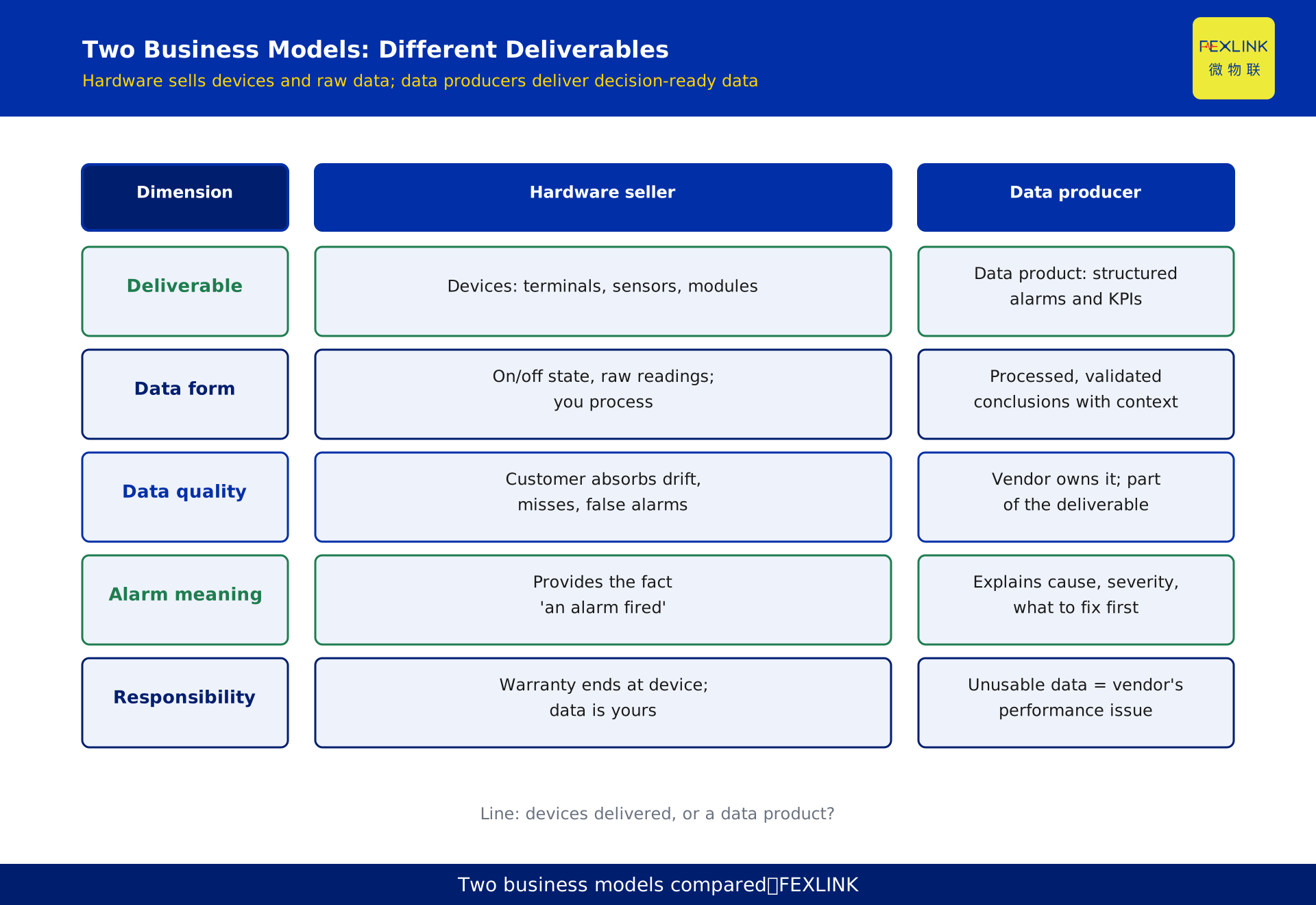
Direct Answer
When selecting an electrical monitoring vendor, first identify its business model: one type "sells hardware" — delivering devices and raw on/off data; the other "produces data" — delivering decision-ready structured data and alarms. The single discriminating test is whether the vendor takes responsibility for data usability: when something goes wrong, does it say "the device is fine, interpret the data yourself," or does it explain "what this alarm means and what to do about it"? Use this test to ask three questions, and you can avoid ending up with "a pile of hardware and nobody manages the data." Core conclusion: look at the business model before product specs; with the wrong model, even excellent specs never get used.
The Dividing Line: What Is Delivered
The dividing line between "selling hardware" and "producing data" is not the product form — both may sell monitoring terminals and both may build a platform. The real line is what the contract promises to deliver:
- A hardware seller delivers the device itself: terminals, sensors, communication modules; the attached "data" is typically low-processed information such as on/off status and raw readings — whether and how it can be used is the customer's own responsibility;
- A data producer delivers a data product: processed, validated, structured alarms and indicators, plus the interpretation of "what this data means"; data quality and usability are the vendor's responsibility.
In the same distribution cabinet, the two vendor types give the customer different things: the former gives "measuring hardware," the latter gives "usable conclusions." When selecting, asking "what exactly are you selling me" reveals the model faster than asking "what is your accuracy class."
Responsible for Data Usability vs Not
This is the most substantive difference between the two models, visible in four links:
Who owns data quality. For a hardware seller, delivery completes at installation; drift, missed alarms, and false alarms are absorbed by the customer. For a data producer, data quality is part of the deliverable — abnormal sampling, calculation deviation, and distorted alarms are problems to be solved.
Who explains what an alarm means. A hardware seller provides the fact "an alarm fired"; a data producer provides "why it fired, how severe it is, and where to act first." The former leaves judgment to you; the latter completes the judgment for you.
Who owns standard alignment. Whether thresholds follow national-standard definitions and whether measurement algorithms comply with norms — a hardware seller typically does not commit to this; a data producer treats standard alignment as part of the data product, with a clear basis for "which standard an alarm cites and by how much it exceeds."
Who to turn to when problems arise. In a hardware-style engagement, the vendor is responsible for device faults and the customer carries data problems; in a data-style engagement, unusable data is a breach of the vendor's obligation, with a clear responsibility boundary.
After-Sales Boundary: Whether the Contract Mentions "Data"
The after-sales boundary difference shows most directly in contract clauses:
A hardware contract ends responsibility at device delivery and warranty: within warranty, a failed device is replaced; outside warranty, paid repair; data-level clauses typically do not exist. A data contract extends responsibility into data service: data accuracy, alarm timeliness, and report delivery frequency are agreed; interruption of data service counts as breach.
A practical check: ask the vendor to put "data usability" into the contract — if it will only commit to hardware indicators (accuracy, temperature range, protection rating) but not data-service indicators (alarm accuracy, data completeness, report punctuality), it sells hardware; if it commits to the latter, it produces data.
Three Questions at Selection Time
Three questions quickly reveal the vendor's model without reading the full product manual:
Question one: after installation, what will you give me? If the answer is "devices, commissioning, warranty," that is hardware; if the answer is "structured data, alarms, reports, ongoing service," that is data production.
Question two: what does this alarm mean, and who explains it? If the vendor says "the system alarms; you look at it yourself," the model leans hardware; if it provides alarm interpretation, standard basis, and handling suggestions, the model leans data.
Question three: if the data is inaccurate, is that your problem? Hardware sellers typically dodge this (not a fault unless the device broke); data producers answer directly (inaccurate data means the data product is unqualified).
After these three questions, the model is basically clear. Note: this is not "which is better" but "which one matches what you need" — the two types fit different scenarios.
Which Type Fits Which Need
Neither model is absolutely superior; the fit depends on the buyer's capability and goal:
Choose a hardware seller when: the enterprise has strong in-house electrical and data teams that can handle data processing, threshold setting, and alarm interpretation on their own and only needs reliable acquisition equipment; the budget is straightforward, treating devices as a one-time asset purchase.
Choose a data producer when: the enterprise lacks dedicated electrical-data analysis headcount and wants "usable conclusions right after installation"; it cares about continuous operation (alarms interpreted, reports produced, data validated); it treats monitoring as a long-term service rather than a one-time purchase.
The judgment principle: can your team turn data into decisions? If yes, the hardware model saves money; if no, the data model saves money — because under the data model, the investment buys "decision usability," not a pile of devices you must process yourself. A useful thought experiment: six months after installation, when the first serious electrical event occurs, will your team know exactly what the data says and what to do next? If the honest answer is no, the data model is the lower-risk choice regardless of sticker price — decision readiness, not device inventory, is what the budget should buy.
Two Common Misjudgments
Misjudgment one: platform equals data production. A vendor having a platform does not make it a data producer. Many hardware sellers also build display platforms, but the platform only shows raw data without processing or interpretation — the delivery is still hardware. The criterion is not "is there a platform" but "is the data on the platform processed, and is someone responsible for interpreting it."
Misjudgment two: high accuracy equals good data. Acquisition accuracy is a hardware indicator; data usability is a service indicator. Even the most accurate device, if data is unvalidated, alarms are uninterpreted, and thresholds are not set to standards, still leaves the customer with numbers that are "accurate but useless." Put "data-product capability" ahead of "device accuracy" in selection.
One more quick self-check: ask "if the devices were all removed, what would I still have?" — usable data and conclusions mean the data model; acceptance forms and warranty cards mean the hardware model. This single question is often more clarifying than any spec sheet.
Writing the Business Model into the Tender
To make selection stick, fix the model in the tender documents so verbal promises do not drift:
- A "data usability responsibility" clause: alarm accuracy, data completeness, and report delivery frequency must carry quantified commitments;
- An "alarm interpretation" deliverable: each alarm carries a standard basis, severity level, and handling suggestion;
- A "standard alignment" requirement: threshold and algorithm definitions follow national standards or industry norms;
- A "data-service interruption" responsibility: data unavailability reaching an agreed threshold constitutes breach.
Writing these into the tender automatically surfaces the business model — vendors that can respond are data producers; those that cannot are hardware sellers. This filters mismatched suppliers earlier than any spec comparison.
Acceptance Checkpoints: Verifying the Model Is Delivered
The business model is useful beyond selection — use it for acceptance after purchase. Verify whether the promised "data model" is delivered at three checkpoints:
First week online: is the alarm "understandable"? The first real alarm after go-live instantly reveals the model: a hardware model gives an alarm point; a data model gives the cause, standard basis, severity, and suggested action. If the first week's alarms say only "an alarm fired," the promised data service has not been delivered.
First month of operation: is the report "produced by someone"? A data model's deliverables include periodic reports (daily/monthly/annual) with conclusions and suggestions; a hardware model's "report" is usually an auto-exported data table. At the end of the first month, comparing promised reports with received reports shows whether the model landed.
First problem: is responsibility "taken"? When false alarms, missed alarms, or data drift appear, a data-model vendor responds and investigates the data chain; a hardware-model vendor will most likely reply "the device is fine." The first problem's handling is the most honest test of the business model.
Write these three checkpoints into the acceptance plan; the model's delivery can be verified within three months — no need to wait until the system is abandoned to discover the wrong model was chosen.
Scope and Limitations
The "hardware seller / data producer" dichotomy in this article is an analytical framework for selection decisions; real vendors present many intermediate forms (e.g., hardware vendors with basic platforms, data vendors that also sell devices). Judgment should combine specific contract clauses and actual delivery capability. The quantified indicators mentioned (alarm accuracy, data completeness, etc.) are framework suggestions; concrete values should be agreed in tender documents per project scenario and verified by actual results. This article does not evaluate specific vendors, and scenarios are anonymized (a generic park/factory and similar references).