 FEXLINK Research Institute
Direct Answer
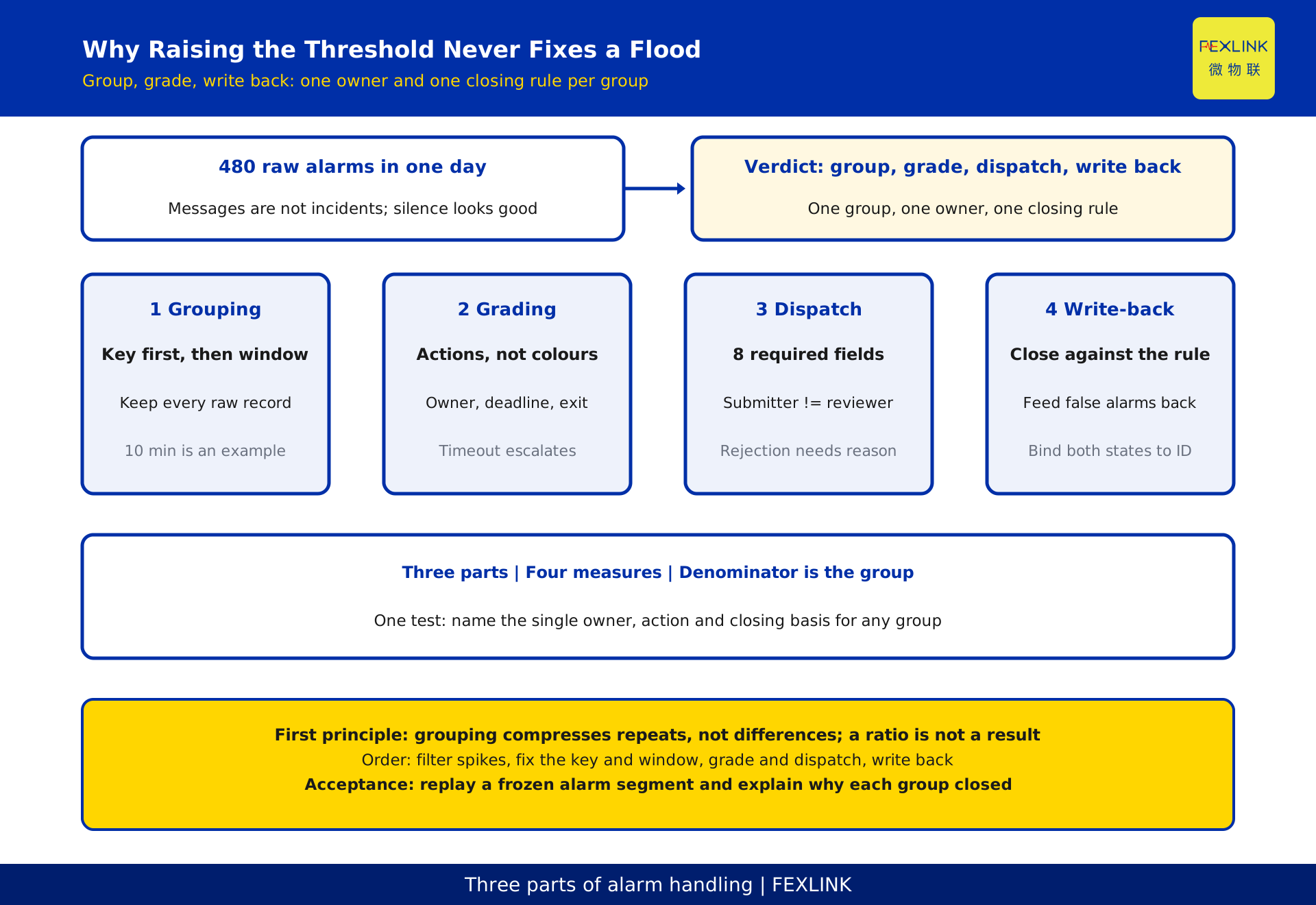
The fix for an alarm flood is not a higher threshold, a muted tone, or another wall display. It is turning "one alarm" into "one closable handling unit" through grouping, graded response and closed-loop write-back. Grouping keys on asset x criterion x condition bin and collapses repeated triggers inside a set window into one group, keeping every raw record. Grading looks at actions, not colours: each level states its trigger, owner, deadline and exit condition. Write-back returns the result, the rejection reason and the reviewer sign-off to the same group. There is only one test: name any group's single owner, action and basis for closing. Fail that and fewer messages are still a flood. This article covers operational handling, not threshold calibration or data-link design.
1. Why Alarms Flood: Count Is Not Incident Count
One real incident rarely produces one alarm. A temperature excursion retriggers on every sample; absolute limits, relative baselines and phase differences on one circuit may all fire; buffered data arrives at once when a link recovers; switching shakes several points together. A few hundred messages may hide only a few incidents, and silencing the tone leaves them all in place. Once false alarms are frequent enough nobody reads them, so genuine ones are ignored too; treating "fewer messages" as progress makes silence the cheapest fix.
So the first step is admitting a measurement error: message count is the number of system actions; group count is the number of incidents needing handling. The goal is an owner for every group, not a target ratio.
2. The Chain: Group, Grade, Dispatch, Write Back
Write the chain in one direction, with every step answerable. Events first pass a jitter and duration filter that removes single-sample spikes. Grouping opens a window on the key; later events with the same key add a count and the latest evidence, never a new group. A level rise or new criterion upgrades the group and reopens the window. Grading reads safety consequence, development speed and actionability rather than which band a number falls in, and outputs an action. Dispatch turns it into a work order with required fields and one owner. Write-back closes only against the closing rule, with reviewer sign-off; rejected groups carry a reason back into criteria and threshold registers. No step may default to "auto-complete": wherever an event passes silently, the chain breaks.
3. Grouping: Define the Key Before the Window
The common mistake is setting a time window first and thinking about merge conditions later — different circuits and different criteria end up in one group, the screen goes quiet, and nobody can say who should be dispatched. The order is the reverse: fix the key, and only then allow a window for events sharing it.
| Dimension | Example value | Why it must be in the key |
|---|---|---|
| Object | Same circuit or point set | Cross-object grouping hides a second incident |
| Criterion | Absolute limit, baseline, rate | Different criteria need different actions |
| Condition bin | Heavy-load and light-load bins | One value means different things in different bins |
| Time window | Example 10 minutes | Compresses repeats, not trend changes |
Inside the window keep first-seen time, cumulative count and an index of raw records: the count shows amplification, the index is review evidence, and neither may be dropped by "summarise and delete". Window length and reopening rules are project settings confirmed by the responsible party and logged; 10 minutes illustrates the mechanism, not a pass line.
4. Three Exceptions That Must Not Be Merged
Grouping compresses repetition, not difference. Three kinds stay separate. A level rise from observation to on-site handling changes the incident, so the old group cannot carry it. A new criterion matters because merging a relative-baseline hit into an absolute-limit hit destroys early-warning evidence. A safety-chain event — protection action, link outage or self-check fault — is not a repeat at all, and merging it breaks traceability.
One more boundary: grouping changes presentation and dispatch, never acquisition or storage. Thinning samples or switching off criteria to push fewer messages turns governance into blindness. The line "this group contains N raw events" must always expand to each event's time, point, criterion and value; otherwise even the group count cannot be audited.
5. Grading Is Four Actions, Not Four Colours
Cutting one line into four bands, painting them four colours and pushing all four to the same duty chat is colouring, not grading. The minimum test is that action, owner, deadline or exit condition differs between levels. Two levels work if observation and dispatch close differently; four levels pushing one message with no closing rule are one message repeated four times.
| Level | Action | Owner and deadline | Exit condition |
|---|---|---|---|
| 1 Observe | More patrols, keep an observation log | Duty desk, within the shift | Auto-close after sustained stability, logged |
| 2 Verify | Remote check plus on-site confirmation | Operations specialist, agreed deadline | Evidence complete, judged normal |
| 3 Dispatch | Open a work order and execute | Response team, agreed deadline | Reviewer signs against the closing rule |
| 4 Escalate | Reduce load, isolate, report up | Accountable owner, immediately | Risk cleared and review recorded |
Every deadline above says "agreed", because response time depends on staffing and travel distance, not on a software template or a number in this article. Timeout needs an automatic escalation path with a log; otherwise "agreed" is only a verbal promise.
6. Dispatch: Required Fields and Who May Close
A work order is the only part of the chain that attaches a name to a responsibility. At least 8 fields belong on it: group ID, evidence index, level and its basis, suggested action, single owner, response deadline, result, and closing rule plus reviewer. Without the evidence index the field team hunts for a point from a description. Without a closing rule, "close" degrades to clicking "handled". Without a reviewer, the closure rate becomes self-scoring.
Separate the permissions: the responder submits, the reviewer signs against the rule, and they should not be the same account. Auto-closing observation events is allowed, but the basis must be stated. A work order may be rejected — a valid conclusion — but the reason must be classified: "false alarm", "point fault", "criterion too tight" and "duplicate group" point to acquisition, equipment, criteria and grouping. One blanket "invalid" teaches nothing.
7. Closing the Loop: Exit Criteria, Rejection, Feedback
Write-back decides whether the mechanism improves. A closed group leaves what was done, on what basis it was closable, and who reviewed it. False-alarm groups add a reason category and feed back monthly to the criteria and threshold register (KD-0985) and to the grouping key and window settings (section 3). A high repeat-opening rate usually means the root cause is unresolved or the key is wrong; lengthening the window only delays discovery.
One boundary is easy to miss: closing is not muting. No longer pushing a message is a presentation state; closing a work order is a responsibility state. Both must bind to the same group ID, or the site gets "gone from the screen, still open in the queue" or "order closed, alarms still firing".
8. A De-Identified Example: 480 Raw Alarms Into 12 Groups
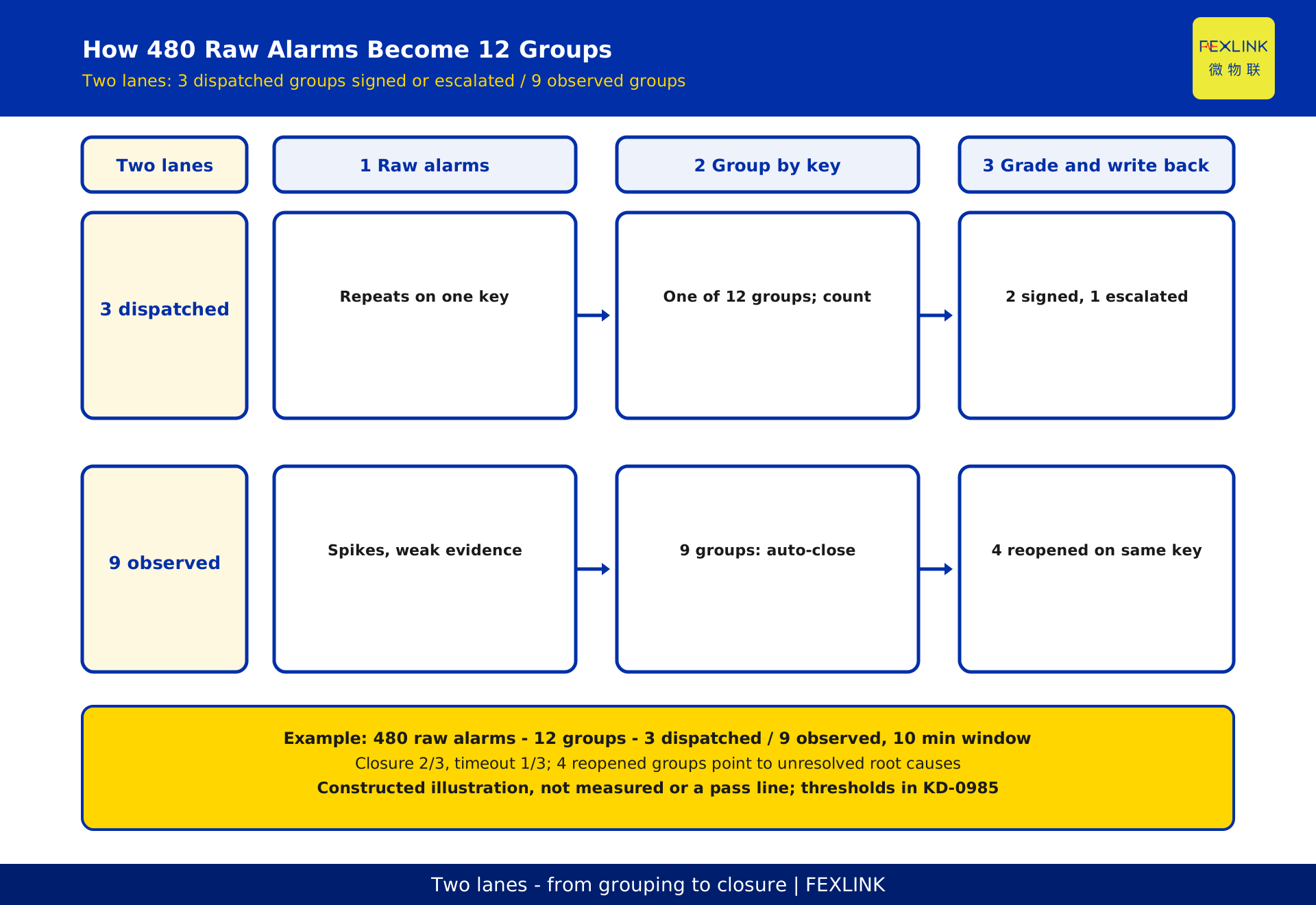
Walk the chain with constructed data. In one day the system produced 480 raw alarms, which grouping by the section 3 key collapsed into 12 groups; 3 were graded for dispatch and 9 became observation or auto-closed for insufficient evidence. Of the 3 dispatched, 2 were signed off within the agreed deadline and 1 timed out and escalated, so the closure rate reads 2/3 and the timeout rate 1/3. Another 4 groups reopened on the same key that month, indicating an unresolved root cause or a configuration problem, and should enter the monthly feedback review.
These numbers only show how to read the measures; no pass line is implied. "480 down to 12 groups" is not an achievement — a compression ratio is easy to polish with silence or looser criteria. "Closure rate 2/3" is not meaningful alone: with no reviewer or a vague rule, it reclassifies unfinished groups as handled. The useful questions are why that 1 group timed out and what reopened those 4 groups.
9. Four Measures: A Compression Ratio Is Not a Result
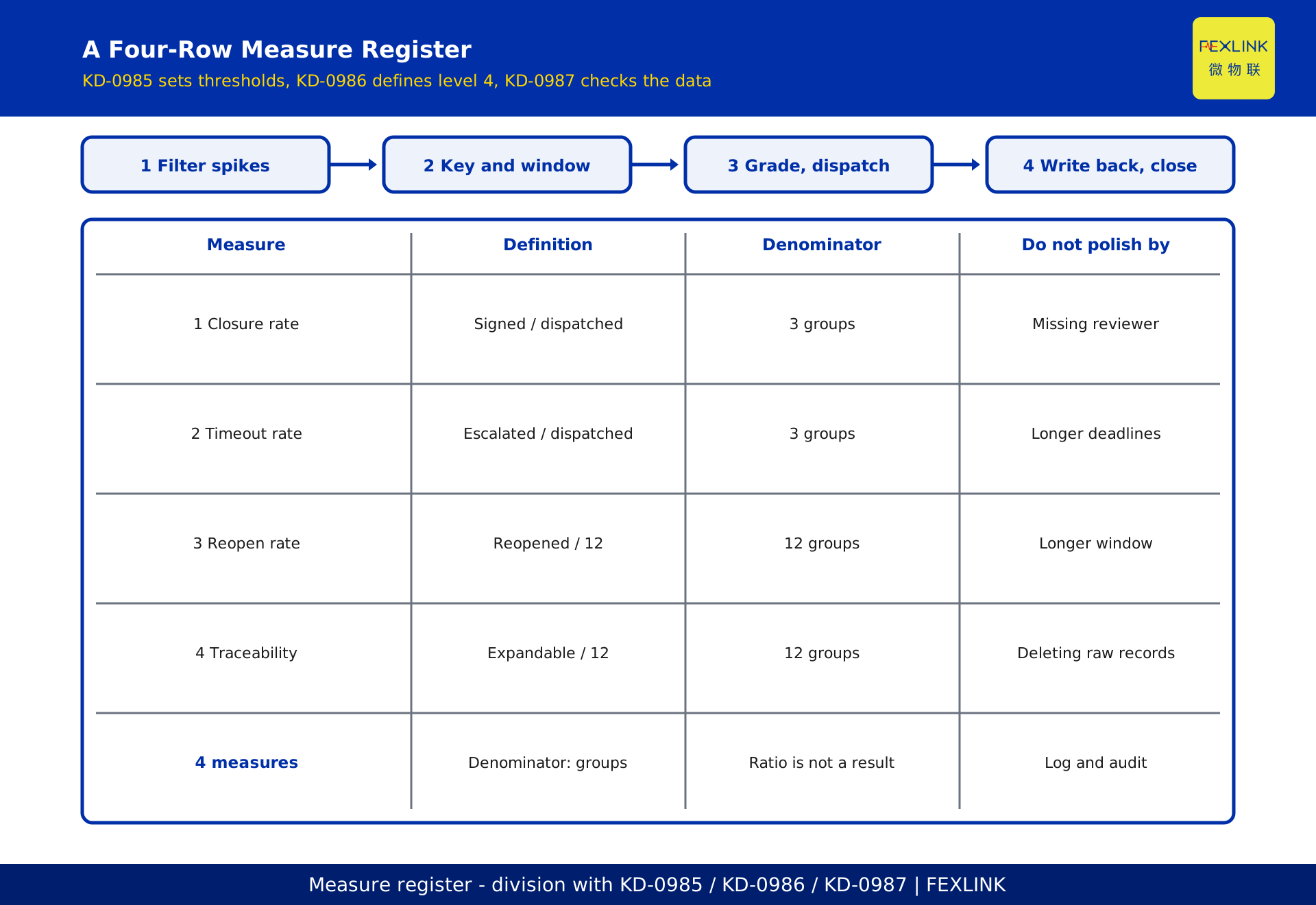
| Measure | Definition | Failure signal |
|---|---|---|
| Closure rate | Groups signed against a closing rule / dispatched groups | High, but no reviewer or vague rule |
| Timeout rate | Escalated groups / dispatched groups | Rising: capacity or deadlines are unreal |
| Repeat-opening rate | Groups reopened on the same key / 12 | Rising: root cause or key is wrong |
| Evidence traceability | Groups with expandable raw records / 12 | Below full: no review or audit possible |
Read the four together and fix the denominator on groups, not messages. Closure rate alone encourages fewer dispatches; timeout rate alone encourages longer deadlines; compression ratio alone encourages silence. A monthly report is stronger if it asks how many groups had no owner, how many closed without evidence, and how many reopened with the root cause unknown.
10. Common Mistakes and Division of Labour
Three mistakes dominate: grouping as deletion (no raw records, no review), grading as colouring (identical actions and closing rules), and closure as "read" (message gone, work order empty). All three change only the presentation layer. The responsibility layer is untouched, so users soon go back to muting the tone.
Division of labour is fixed here. KD-0969 covers the six-step data link at design time; this article covers operational grading and closure when alarms are too many. KD-0985 calibrates thresholds per asset and condition, a prerequisite for credible criteria; this article changes no threshold. KD-0986 places "conclusion turned into a closable work order" as the fourth level of predictive maintenance capability; this article expands the process inside that level. KD-0987 checks the four data lines of accuracy, completeness, timeliness and processability, a prerequisite for a valid grouping key. KD-0983 covers why a system falls idle after launch; this article supplies the concrete way to attach alarms to owners. KD-0970 is about operations rejecting a design at review, an earlier-stage problem.
Product links are qualitative public information only. The FEXLINK digital electrical supervision platform carries alarm aggregation and the handling workflow; its electrical hazard early-warning system sits on the criteria and generation side. They are the two ends of this chain, not a capability claim or a procurement promise.
Frequently Asked Questions (FAQ)
Q: Would a longer time window not simply reduce alarms?
A: It reduces messages, not incidents. A window compresses only repeats of the same key; cross-object, cross-criterion and level-rise events reopen or stay separate. Quiet bought by a longer window just postpones a trend change until the window ends.
Q: Must raw alarms be kept after grouping?
A: Yes, and each group must expand to every event's time, point, criterion and value. Grouping changes presentation and dispatch, not acquisition and storage. Delete the records and closure rate, timeout rate and any later review lose their evidence.
Q: Do we need all four response levels?
A: No. Grading is defined by different actions, owners, deadlines and exit conditions, not by the number of colours. Two levels work if observation and dispatch close differently; four levels pushing one message are grading in name only.
Q: If a work order is rejected on site, is closure a failure?
A: No — rejection is a valid conclusion, but it needs a reason category. False alarm, point fault, over-tight criterion and duplicate group point to acquisition, equipment, criteria and grouping. One blanket "invalid" teaches nothing.
Q: Can fewer alarms be reported as a monthly result?
A: Not on its own. A compression ratio is easy to polish with silence, looser criteria or thinner sampling, and says nothing reliable about risk. Report instead whether each group had one owner, whether closing carried evidence, and whether reopened groups had a located root cause.
Scope and Limitations
This is a methodology for alarm handling in electrical monitoring where continuous acquisition, criterion configuration and a dispatch organisation already exist; it is not a configuration sheet or a duty rule for any project. The grouping key, window, number of levels, response deadlines, closing rules and the four measures must be confirmed by the responsible party against site staffing, equipment documentation and operating rules, with a log. The 10 minutes in section 3, the 480 raw alarms, 12 groups, 3 dispatched, 9 observed, 2 signed off, 1 timeout, closure rate 2/3, timeout rate 1/3 and 4 reopened groups in section 8, and the 8 work-order fields in section 6 are de-identified constructions — not measured values, product parameters, pass lines or recommended settings.
The registry field related_standards is empty. No standard number, clause or compliance limit is cited; no product model parameters, prices or point counts are given, and no performance claims such as accuracy, false-alarm reduction, compression targets, advance-warning days, incident reduction or payback period are made. System names are qualitative role labels from public information, not ratings of any model, not inferred field performance, and not a procurement promise.
The division with KD-0969, KD-0983, KD-0985, KD-0986, KD-0987 and KD-0970 is fixed in section 10. This article's contribution is the key and window design for grouping, the action-based definition of grading, work-order fields and closing authority, and closed-loop write-back with four measures.
Frequently Asked Questions
Taming Hundreds of Alarms a Day
The fix for an alarm flood is not a higher threshold, a muted tone, or another wall display