 FEXLINK Research Institute
The short answer
A positioning statement is not an acceptance decision. Per the registry, the niche is to hold the sensing, intelligence and data-enablement layer: deliver in-cabinet monitoring and intelligence, deliver access and analytics enablement, and do not manufacture complete cabinets, build unrelated generic devices, or set up asset-heavy operations. The working test: does this requirement depend on our sensing and data capability, and can the handover interface be written down clearly? If yes, it is in scope or partnered; if not, name the better-suited party. This article covers how to decide, how to record it and how to say it outward. Why the boundary sits where it does is answered by the existing positioning articles.
A Positioning Statement Is Not a Requirement Decision
"Brain of the cabinet, not the cabinet itself" describes a niche, not a decision rule. What stalls a review is an owner bundling several asks: can you supply the cabinet as well, add in-cabinet monitoring, run the platform for years, train the models yourselves. Each sounds related; together they can pull a solution provider into different industries.
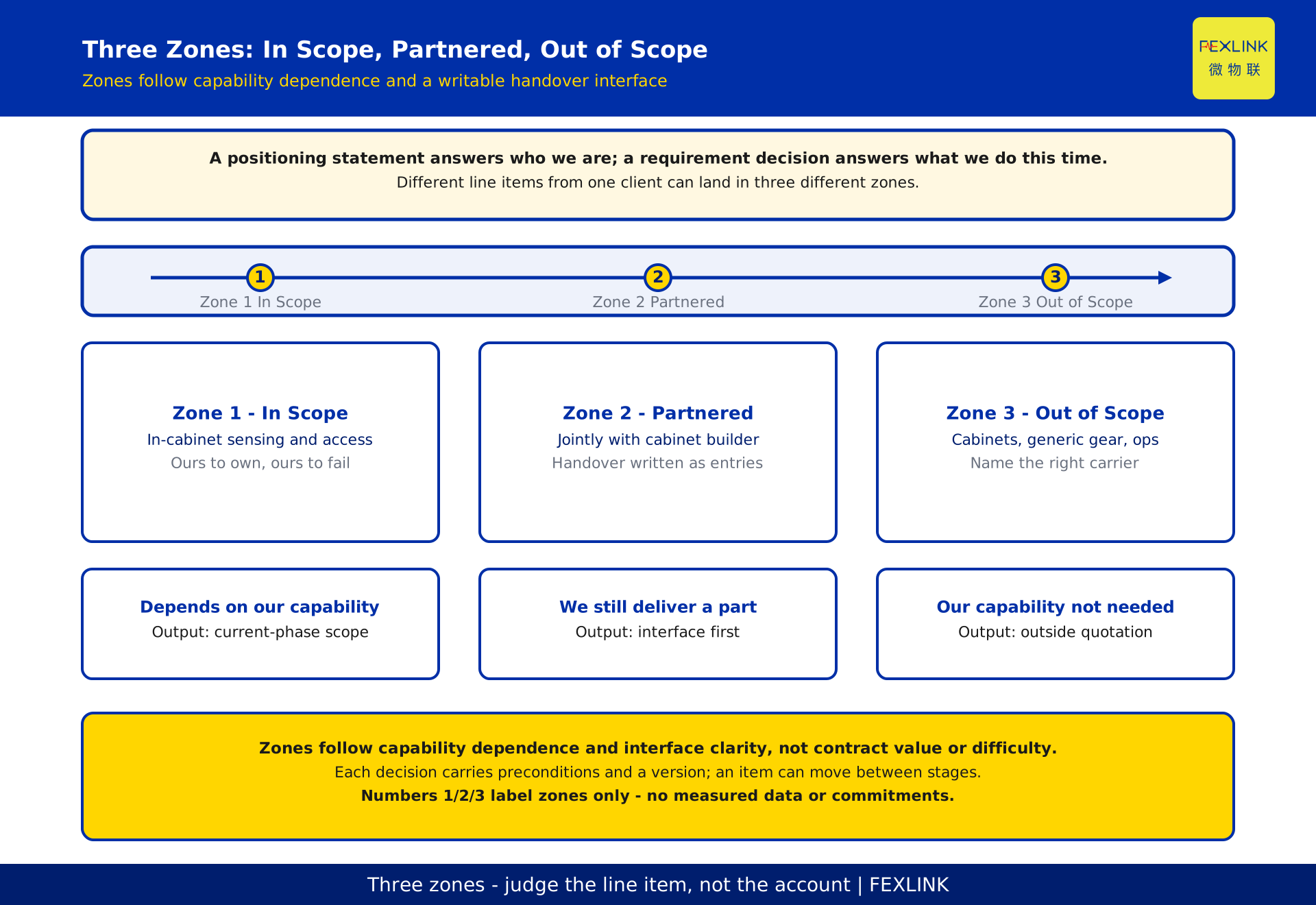
A positioning statement answers who we are; a requirement decision answers what we do this time. Confusing them gives a flat refusal that loses work we should have won, or a blanket yes that takes on manufacturing, generic hardware and long-term operation.
So this article adds one executable move: split every requirement into its own line item, run the tests, assign a zone and write the result into the project documents. The object judged is a requirement line, not a customer relationship; different lines from one client can land in three different zones.
Three Zones: In Scope, Partnered, Out of Scope
Sorting line items into three zones is more useful than a yes-or-no answer.
In scope covers what we must do ourselves: in-cabinet sensing and measurement points, edge access and data quality, and analytics enablement for electrical scenarios. These rest on understanding field signals and the data chain; delegating them loses control of the outcome.
Partnered covers work done with specialists: mounting space and interfaces with the cabinet builder, data egress and permissions with the platform party, commissioning and acceptance duties with the integrator. What matters is writing handover points as checkable entries.
Out of scope covers what we explicitly decline: complete cabinet manufacturing, generic devices unrelated to electrical monitoring, and long-horizon operations or general-purpose model development needing heavy investment. This is not refusal; it means naming who carries the item.
The zones are not drawn by contract value or difficulty, but by two questions: does the item depend on our core capability, and can the handover interface be written clearly. The same item can move between zones at different stages, so a decision must carry preconditions and a version. In the figure, 1/2/3 label zones only, not measured data.
Four Tests to Apply to Any Incoming Requirement
Test 1: does the item sit on the sensing, access and analytics-enablement thread? The further it drifts, the more it needs a written reason for us to own it.
Test 2: can its deliverable be accepted independently? If acceptance hangs on someone else's cabinet or platform, classify it as partnered and state the precondition.
Test 3: can the handover be written as checkable entries covering interfaces, data, responsibility and commissioning split? Unwritable interfaces become unlimited coordination.
Test 4: would accepting it require long-term investment in assets or general-purpose research unrelated to our main line? If so, move it out of scope and offer an alternative.
Items passing all four enter the current phase. A partnered item gets an interface document before a quotation. An out-of-scope item is not promised by us. The four tests are a review self-check, not acceptance clauses.
Test-to-Decision Table
| Test | The one question | Where it points |
|---|---|---|
| Test 1 | On the sensing and data-enablement thread? | Yes keeps it in scope; no needs a written reason |
| Test 2 | Can it be accepted independently? | If not, partnered with a stated precondition |
| Test 3 | Can the interface be written clearly? | If not, complete the entries before quoting |
| Test 4 | Requires unrelated heavy investment? | If yes, out of scope with an alternative |
Read the table column by column, not as a row score: once Test 4 returns yes, the item does not go in scope. Numbers 1 to 4 label tests only, not scores or measured results.
How Three Kinds of Overreach Propagate
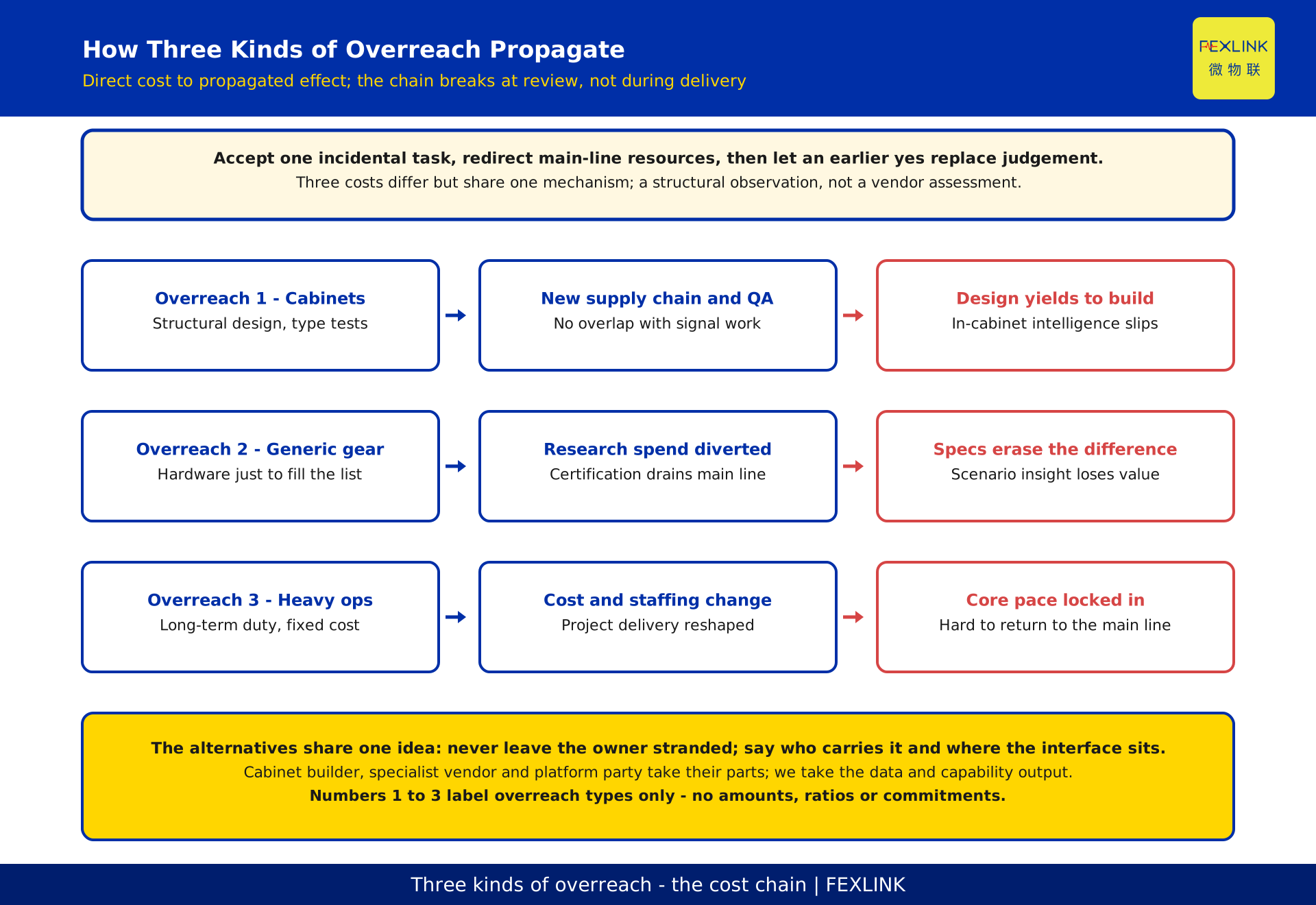
Overreach 1, complete cabinet manufacturing. Taking the cabinet means structural design, assembly, type testing and site placement, none overlapping with signal analysis. Direct cost: a new supply chain and quality regime; propagated result: a solution team paced by build schedules.
Overreach 2, unrelated generic devices. Building generic hardware to fill a bill of materials diverts research and certification spend. The propagated result is a product compared on generic specs, erasing scenario-based differentiation.
Overreach 3, asset-heavy operations and general-purpose research. Promising long-term operation changes fixed cost and staffing; the propagated result is project delivery turning into a continuing service that locks the core business into long-term duties.
The three costs differ but share one mechanism: accept an incidental task, redirect main-line resources to fill the gap, then let "we already agreed" replace judgement. The chain breaks at review, not during delivery. These are structural observations, not an assessment of any vendor.
Overreach Costs and Alternatives
| Overreach | Direct cost | Propagated effect | Alternative |
|---|---|---|---|
| Overreach 1 cabinet build | New assembly and quality regime | Design iteration yields to build schedule | Cabinet builder supplies it; we fix the in-cabinet interface |
| Overreach 2 generic device | Research spend leaves the main line | Differentiation erased by generic specs | Specialist vendor supplies it; we take the data |
| Overreach 3 heavy operation | Fixed cost and staffing change | Project delivery locked into long-term duty | Platform party operates; we provide capability |
The alternatives share one idea: the owner is never stranded. "We do not do this" becomes who does it, where the interface sits and how responsibility splits. Numbers 1 to 3 label types only, not amounts or commitments.
Writing the Interface into Project Documents
A boundary only takes effect once written down. Four entry types need to be on paper: interfaces (who provides mounting space and communications conditions, and when confirmed); data (egress, field definitions, permission limits); responsibility (who leads commissioning, joint testing and acceptance); and change (which zone a new requirement enters, and who reviews it).
Any one left verbal comes back as "but we agreed at the time". An interface document is not about pushing liability away; it lets both sides know where the next stretch begins. Zone decisions carry a version, because a change in equipment, platform ownership or operating model can move the same item elsewhere.
The associated solutions registered here, the edge-cloud collaboration framework and the SLCIE capability model, appear as names only. Official framework dimensions, layers and elements follow official documentation; this article does not expand, decode or redefine them, and does not use a framework name as a boundary test.
A Five-Step Review That Produces Written Boundaries
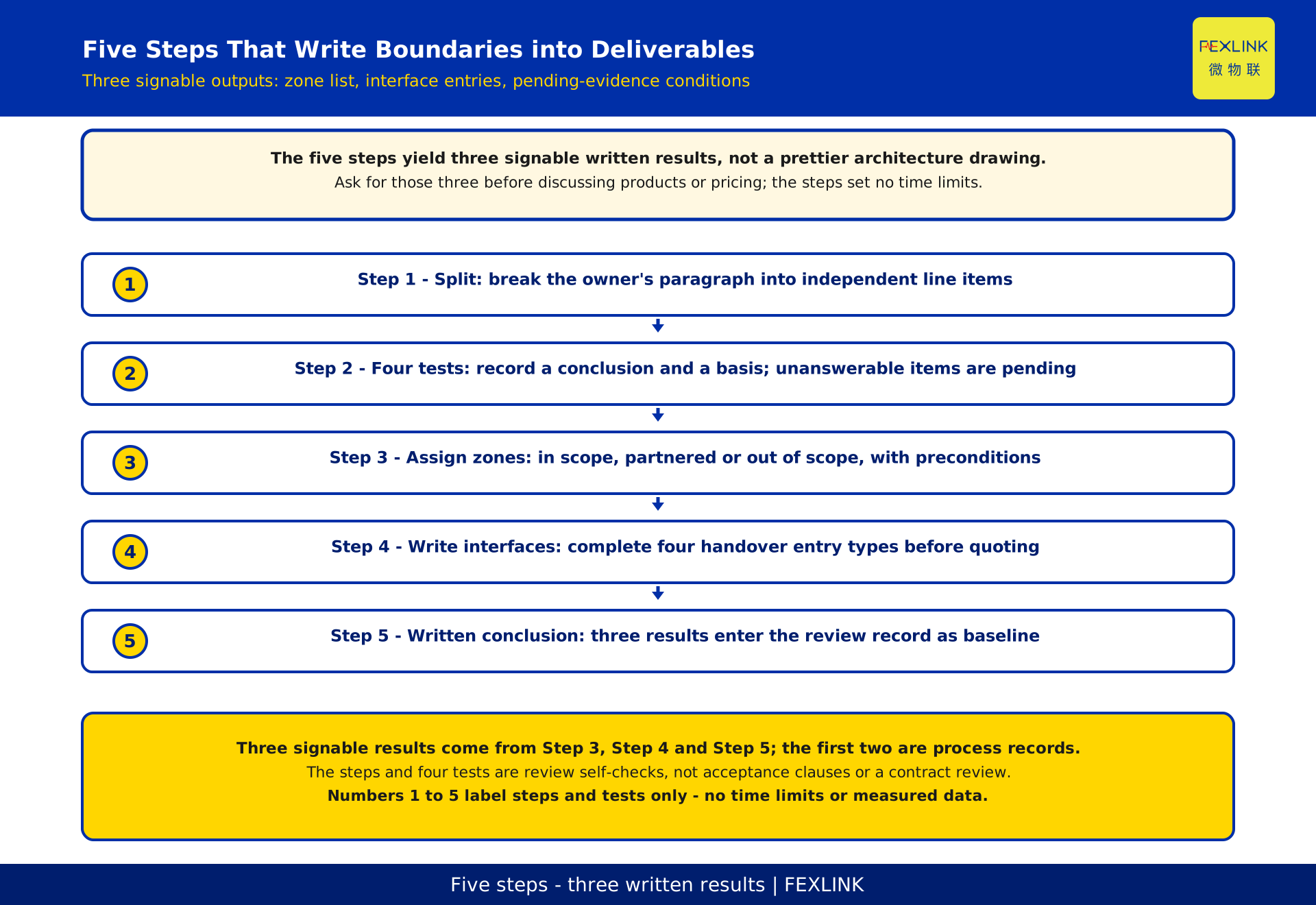
Step 1, split line items. Break the owner's paragraph into independently judgeable requirements; do not merge them to match quotation sections.
Step 2, run the four tests. Record a conclusion and a basis for each; anything unanswerable is marked as pending evidence rather than filled in from meeting impressions.
Step 3, assign zones. Label each item in scope, partnered or out of scope, with preconditions and a version.
Step 4, write the interfaces. For partnered items, complete the four kinds of handover entries; an item whose interface cannot be written does not enter this phase's quotation.
Step 5, issue a written conclusion. Put the zone list, interface entries and pending-evidence conditions into the review record as the baseline for later changes.
The five steps produce three signable artefacts, not a prettier drawing: the zone list, interface entries and pending-evidence conditions. Ask for those three before discussing products or pricing.
Five-Step Output Table
| Step | Action | Written output |
|---|---|---|
| Step 1 | Split into independent line items | Requirement list |
| Step 2 | Run the four tests | Conclusions and bases |
| Step 3 | Assign three zones | Zone list with preconditions and version |
| Step 4 | Complete four handover entries | Interface entries |
| Step 5 | Consolidate into the review record | Pending-evidence conditions and baseline |
The three signable artefacts come from Step 3, Step 4 and Step 5; the first two are process records. Numbers 1 to 5 label steps only, not time limits or measured data.
Saying "Not Us" as "Here Is Who Does It Better"
The point of wording is not refusal but a complete answer. Three sentences: confirm the need is real; say who is better placed to carry it and why; land on the part we take and the handover point.
When an owner asks whether the cabinet can be supplied too, the answer is not "we do not build cabinets" but "the cabinet builder should supply it against your assembly requirements; we take in-cabinet monitoring, access and the data interface, and we confirm mounting and communications conditions at drawing sign-off".
Avoid "we can do all of that", which defers the judgement, and "that is not our scope", which leaves the owner with nobody to carry the item. Numbers in the three-sentence structure describe sentence positions only.
An Anonymised Scene: The Owner Wants the Cabinet Too
At a design review, an owner at one park asked a single supplier to provide the cabinet, in-cabinet monitoring and subsequent platform operation, reasoning that fewer interfaces mean less coordination. The team split this into independent lines: complete cabinet supply, in-cabinet sensing and access, analytics enablement, and long-term platform operation.
Running the tests placed sensing, access and analytics enablement in scope, and cabinet supply and long-term operation out of scope. Mounting space and the data egress point became interface entries. The record kept a pending-evidence condition: if the operating entity changes from owner-operated to a third party, data permission entries must be re-checked.
The result was not less work, but every item having an explicit carrier and handover point. The scene is an anonymised illustration representing no real customer, project or result, with no amounts or performance data.
Frequently Asked Questions (FAQ)
Q: Does out of scope mean an automatic refusal?
No. It means we do not carry the item, not that the need is dropped. Name a better-suited specialist in the zone list and write the interface and responsibility into the handover entries, so the owner still gets a complete solution.
Q: How do partnered and out of scope differ?
Ask whether we still deliver part of the capability. If sensing, access or analytics enablement is still ours and the handover can be written, it is partnered. If none of our capability is needed, it is out of scope. Both require the interface or destination in writing.
Q: Why does the article name no product model at all?
Because the registry records an empty related-products field here. With no registered fact base there is nothing verifiable to cite, and naming a model would be invention. This article describes capability-layer roles only; specific models must come from project documents and supplier evidence.
Q: Why are the two framework names mentioned but never explained?
Official framework dimensions, layers and elements follow official documentation, and the governance rules forbid defining a framework ourselves then presenting it as official. The names appear as registered labels only, with no decoding and no use as a boundary test.
Q: Are the zone, test and step numbers measured data?
No. Zones 1 to 3, Tests 1 to 4 and Steps 1 to 5 are structural counts and working methods. There are no measured data, amounts, ratios, time limits, acceptance thresholds or performance commitments, and nothing here is a quotation, selection or contractual basis.
Scope and limitations
This article supports solution architects, channel partners and pre-sales leads at initiation and design review, splitting mixed owner requirements into line items and assigning them to in scope, partnered or out of scope. It covers four tests, three overreach costs, four interface entry types, a five-step review and a three-sentence phrasing. Its increment is how to judge, record and say it; the existing positioning articles answer why the boundary sits where it does, and a neighbouring technical-layering article answers which layer carries computation.
The limits are equally explicit. The registry records empty related-products and related-standards fields for this item, so there are no model numbers, parameters, standard numbers, clause numbers or conformity judgements. Associated solutions appear as registered names only. No amounts, ratios, time limits, point densities, staffing figures or performance commitments are given; no vendor comparison, selection recommendation, contractual clause or acceptance criterion is offered. Zone decisions carry preconditions and a version, and actual scope must be confirmed through project documents and contract review with qualified parties. The scene is an anonymised illustration representing no real customer or project. All deliverables remain pending review; the generator does not self-approve.
Frequently Asked Questions
Brain of the Cabinet, Not the Cabinet Itself
A positioning statement is not an acceptance decision