 FEXLINK Research Institute
Direct Answer
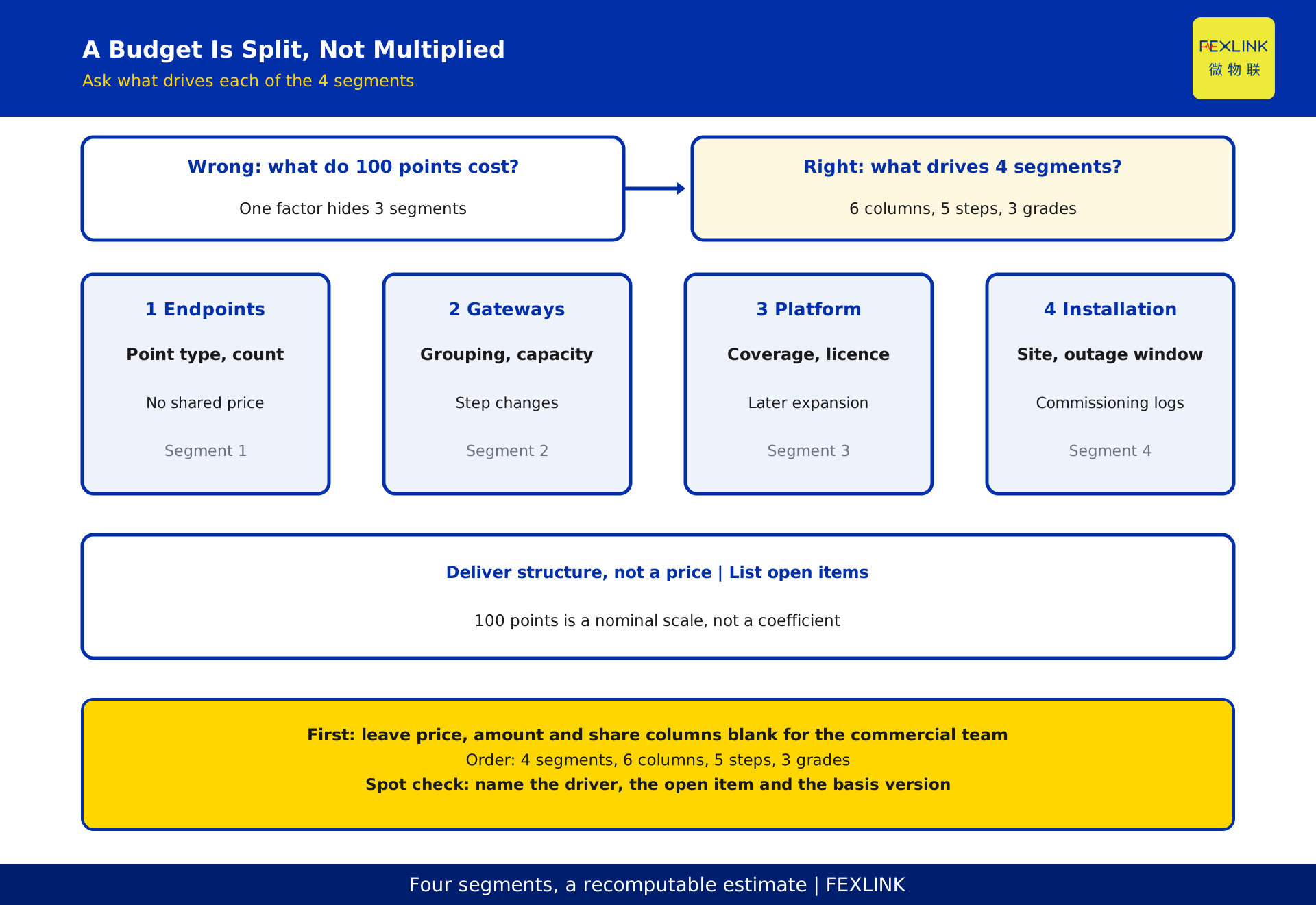
When an owner asks for a rough number, the pre-sales deliverable is not a figure but an estimate that someone else can recompute. Split the investment into 4 segments — endpoint points, gateway access, platform software, and installation plus commissioning — and state what drives each. Fill a 6-column sheet in 5 steps, recheck the point list against 3 risk grades, and list every open item separately. 100 monitoring points is a nominal scale, not a coefficient that produces a total. This article gives no unit price, no amount, no percentage split and no payback period, and it does not promise that fewer points preserve the same safety level. What it gives is a structure the owner and the commercial team can keep working on. A scale estimate and a formal quotation are different things: pre-sales owns the first, with boundaries and open items stated; commercial owns the second, against a formal list and contract terms. The handover between them must be written.
1. Why "It Depends" Is Not an Answer
"That depends" confuses two questions. At the approval stage an owner needs an order of magnitude and its variables, not a signable price. A wild number and a vague evasion both remove the project from the budget discussion. Three things should be answered instead: how many parts the cost has, what drives each part, and which conditions force a recalc. The deliverable is therefore structure, boundaries and open items — not a lonely number. Writing the structure down has a second benefit: when scope is added later, the team can point to which condition in which segment changed instead of arguing from memory. Two failures are common: quoting only a point price times the count and swallowing the other 3 segments; or giving a range without the assumptions that make it valid, so any change looks like an error.
2. Four Segments, Four Different Drivers
| Segment | What drives it | Usually missed |
|---|---|---|
| 1 Endpoints | Point type, count, mounting conditions | Different types cannot share one price |
| 2 Gateway access | Grouping, capacity, comms and power | Unit count jumps in steps, not linearly |
| 3 Platform software | Coverage, functions, licence form | Later expansion and licence form |
| 4 Installation | Site conditions, outage window, interfaces | Circuit verification and commissioning records |
The point of splitting is that the drivers differ, so one "price per point" cannot cover all four. Segment 1 follows point types, 2 follows grouping and capacity, 3 follows coverage and licence form, and 4 follows site conditions. Collapsing them into a single factor assumes all four scale linearly with point count, which is exactly what fails. Each segment gets its own open-items column so the handover has something to discuss.
3. Why Unit Price Times Point Count Breaks Down
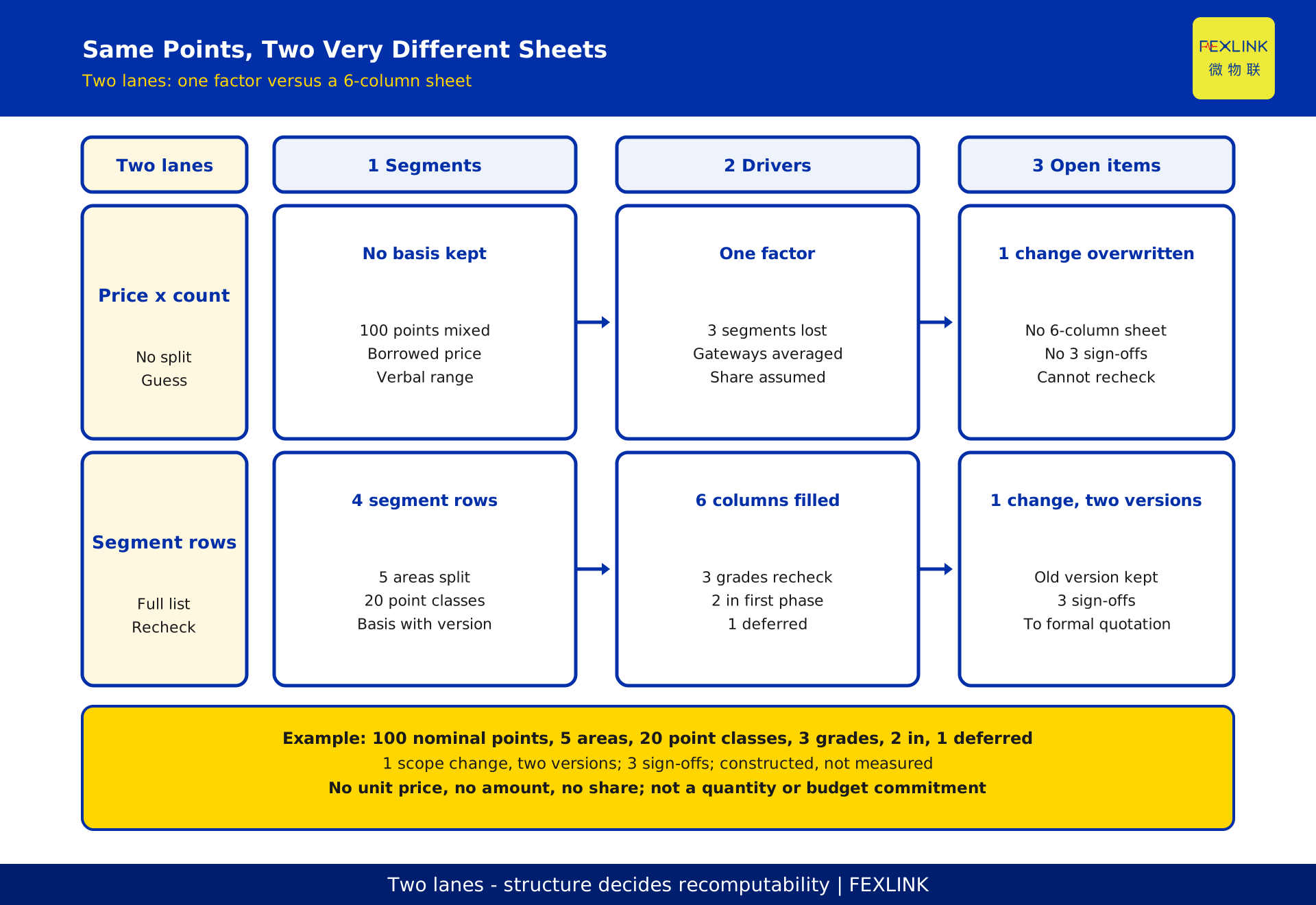
Four sources of nonlinearity: gateways are grouped by access capacity, so crossing a threshold changes the unit count in a step; the platform is scoped by coverage and licence form, so doubling points need not double it; installation is constrained by site conditions, outage windows and interfacing trades, and correlates weakly with point count at all; and points come in types, so merging different objects into one price discards the differences before the total is computed. Four typical mistakes: reusing another project's price, averaging gateways across points, folding commissioning into the point price, and keeping no version of the estimate so a changed condition simply overwrites the old one. The fix is not a finer factor. It is listing these four places separately, each with its driver and the specific item still undecided.
4. Density Is Not "The More the Better"
Repeating points on the same risk object yields diminishing new information, while the burden of collection, access, platform handling and later verification keeps growing. This is a qualitative relationship, not a curve for computing an optimal density: no curve values, no thresholds and no recommended density appear here. The key point is that density is an output of a coverage decision, not a knob on the budget. Deleting points to cut cost is using money to change a risk judgement, which reverses the order. The correct sequence is to fix coverage requirements from design documents and a risk assessment, then discuss the form that satisfies them; the budget conversation comes after. Pre-sales should make that sequence explicit in the meeting and write it into the boundary column of the sheet.
5. Risk Grading in Three Steps, and One Claim to Correct
Three steps: list the monitoring targets by risk object; assign 3 grades by consequence and importance; then choose coverage form and whether each item enters the first phase. Grading should consider whether an alternative information source exists, whether an abnormal outcome is reversible, and whether current inspections already cover the object. One claim needs correcting here: the registry states that risk-graded placement can cut investment without lowering the safety level. This article does not adopt it. Grading is a risk judgement, not a licence to delete points. Any coverage change and any claim about the safety level must be confirmed in writing by the owner and the designer against a risk assessment. No "same safety level" promise and no savings ratio are made here. Pre-sales may identify which points are open to grading discussion, but cannot sign that conclusion for the owner.
6. A Six-Column Estimate in Five Steps
| Column | Name | What to fill |
|---|---|---|
| 1 | Segment | Which of the 4 segments |
| 2 | Driver | What this segment depends on |
| 3 | Quantity basis | Units for points, groups, scope or trades |
| 4 | Open items | Conditions not yet fixed |
| 5 | Basis and version | Survey record and design-file version |
| 6 | Verdict and route | First phase, deferred, or specialist review |
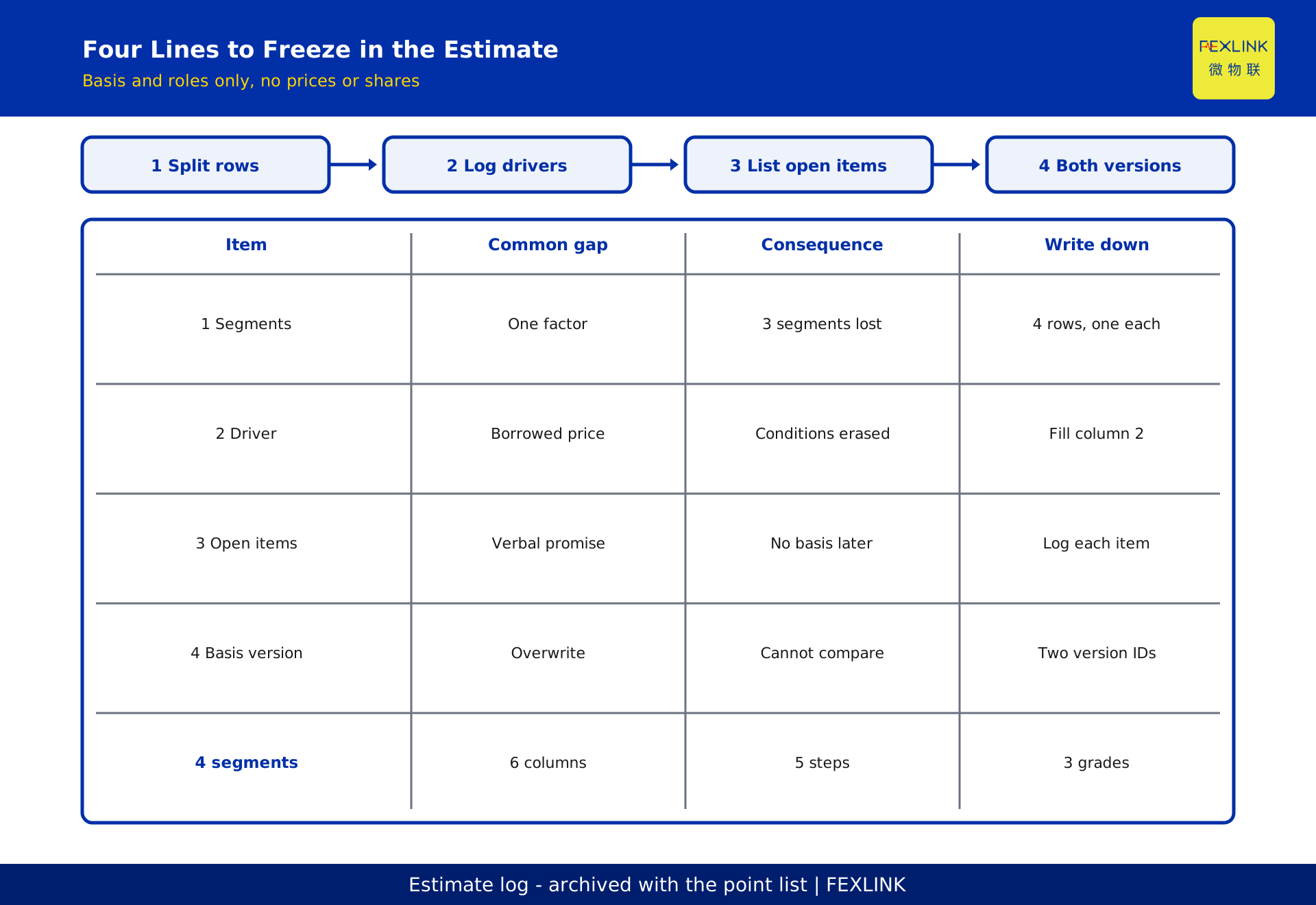
5 steps: create one row per segment; fill the driver and quantity basis; write undecided conditions into open items; record the basis and version; then freeze the sheet after 3 parties confirm it in writing, keeping both versions on change. Price, amount and percentage columns stay blank for the commercial team to complete during formal quotation against contract terms. If pre-sales fills them, the sheet becomes a quotation and the boundary is lost.
7. A De-identified Example: 100 Nominal Points
The following is a de-identified constructed illustration, not a real project, not measured data, not a recommended configuration, and not a quantity or budget commitment. A retrofit with 100 nominal monitoring points is split across 5 areas and consolidated into 20 point classes. Rechecked against 3 risk grades, 2 grades enter the first phase and 1 grade is deferred. 1 change of scope is kept in two versions, with the old one preserved. Finally 3 parties — pre-sales, the owner's facilities or energy lead, and design plus commercial — confirm the estimate boundary in writing. Note that no unit price, amount or percentage appears anywhere; the sheet carries only segment, driver, quantity basis, open items, basis version and route. Whether a number can be computed depends on who fills those open items, and against which document.
| Item | Consolidation | Route |
|---|---|---|
| 5 areas | 20 point classes | Register row by row in 6 columns |
| 3 risk grades | 2 grades in first phase | 1 grade deferred, pending confirmation |
| 1 scope change | Two versions kept | Old version preserved |
| 3 written confirmations | Boundary frozen | Hand over to formal quotation |
8. What Drives Each Share (No Percentages)
The registry lists the share logic of the four segments as a key point, so the scope here must be narrowed: a share is an outcome, not an input. No percentages, ranges or rule-of-thumb coefficients are given. What can be explained is what determines it. Segment 1 depends on the mix of point types and mounting conditions; 2 on grouping and spare access capacity; 3 on coverage, functions and licence form; 4 on site conditions, outage windows and interfacing trades. The same 100-point project can produce entirely different shares under different building conditions or coverage requirements. Anyone asking for an industry-average share to apply directly is erasing the project's differences. Shares only mean something after a formal quotation exists, and the commercial team should explain them.
9. Five Misreadings and Four Prohibited Actions
Five misreadings: treating a scale estimate as a quotation, treating point count as the only variable, reusing another project's price, reading risk grading as permission to delete points, and replacing written confirmation with a verbal promise. All share one structure: something unrelated to this project stands in for an open item. Four prohibited actions: reporting a number before boundaries and open items are written; keeping no version of the sheet and overwriting the old one; letting pre-sales decide risk grades alone; and writing points removed by grading straight into a savings conclusion. Once any of these occurs the sheet can no longer be recomputed, and later additions lose their basis.
| Misreading | What is wrong | Return to |
|---|---|---|
| Estimate as quotation | Skips segmentation and handover | Column 6, verdict and route |
| Count as sole variable | Swallows the other 3 segments | Column 2, driver |
| Borrowed price | Erases condition differences | Column 4, open items |
| Grading as deletion | Budget changes a risk judgement | Column 5, basis and version |
10. Handover to a Formal Quotation
Four items move across: the versioned point list, the 4 segment definitions with open items row by row, written confirmation of the risk grading, and both version identifiers of the estimate sheet. Responsibility splits 3 ways: pre-sales supplies structure and boundaries, sets no price and decides no risk grade; the owner's facilities or energy lead confirms coverage requirements and grading, and records differences in writing; design and commercial produce the price from a formal list, contract terms and current market practice. Product models and the linked solution named in the registry are registered only; no model, parameter or capability claim appears in the text, none enters the conclusion or acceptance basis, and the 4 segment definitions do not point to any specific product configuration. Neither an article nor an estimate sits in the deciding seat: whether a figure enters a contract is decided by the formal quotation process.
Frequently Asked Questions (FAQ)
Q: Can you just give a total for 100 points?
No. This is a method for a pre-sales scale estimate; the deliverable is a 4-segment split, a 6-column sheet and open items, not a price. A total requires a fixed point list, coverage requirements, contract terms and a commercial basis, and comes from the formal quotation process. Quoting before then signs off on conditions nobody has fixed.
Q: Which segment disappears from the sheet most often?
Segment 4, installation and commissioning. It follows site conditions, outage windows and interfacing trades rather than scaling with point count, so it is easily folded into a "price per point". Giving it a row of its own, with its driver and open items, is more useful than explaining additions later.
Q: Does risk grading mean fewer points and immediate savings?
That inference is not available. Grading is a risk judgement, not a licence to delete points; coverage changes and any claim about the safety level need written confirmation from the owner and designer. No same-safety-level promise and no savings ratio are made here, and the registry's affirmative claim has been corrected.
Q: What share does each segment take? Even a rough range would help.
No range is given. A share is an outcome of a formal quotation, not an input to an estimate; it moves with the mix of point types, spare capacity, coverage requirements and site conditions. Applying a rule-of-thumb coefficient erases those differences. Section 8 only explains what determines each segment.
Q: Who has to sign the estimate sheet?
Pre-sales, the owner's facilities or energy lead, and design plus commercial — 3 parties confirm the boundary in writing before it is frozen, with both versions kept on change. Pre-sales deciding grades alone, verbal promises about coverage, or overwriting the previous sheet all destroy recomputability.
Scope and Limitations
This is a method note on pre-sales scale estimating, not a quotation, not a bid basis and not a contract annex. It contains no unit price, amount, percentage share, payback period, savings rate or performance promise; no product parameters, configuration quantities, gateway capacity values or density thresholds. The registry lists no associated standard, so the text carries no standard number, year, clause number or conformity table. The example in Section 7 is a de-identified constructed illustration: not a real project, not measured data, not a recommended configuration, and not a quantity, budget or schedule commitment. Risk grading and coverage changes require written confirmation from the owner and designer; no promise of an unchanged safety level or of any savings ratio is made. Companion articles cover payback arithmetic for busbar monitoring, ROI reporting for management, and the split between safety and energy spending; this piece addresses only how to estimate point-based investment quickly and how density relates to cost, without repeating those methods. The linked solution and product models are registered only.
Frequently Asked Questions
What Does 100 Monitoring Points Really Cost
When an owner asks for a rough number, the pre-sales deliverable is not a figure but an estimate that someone else can recompute