 FEXLINK Research Institute
Direct Answer
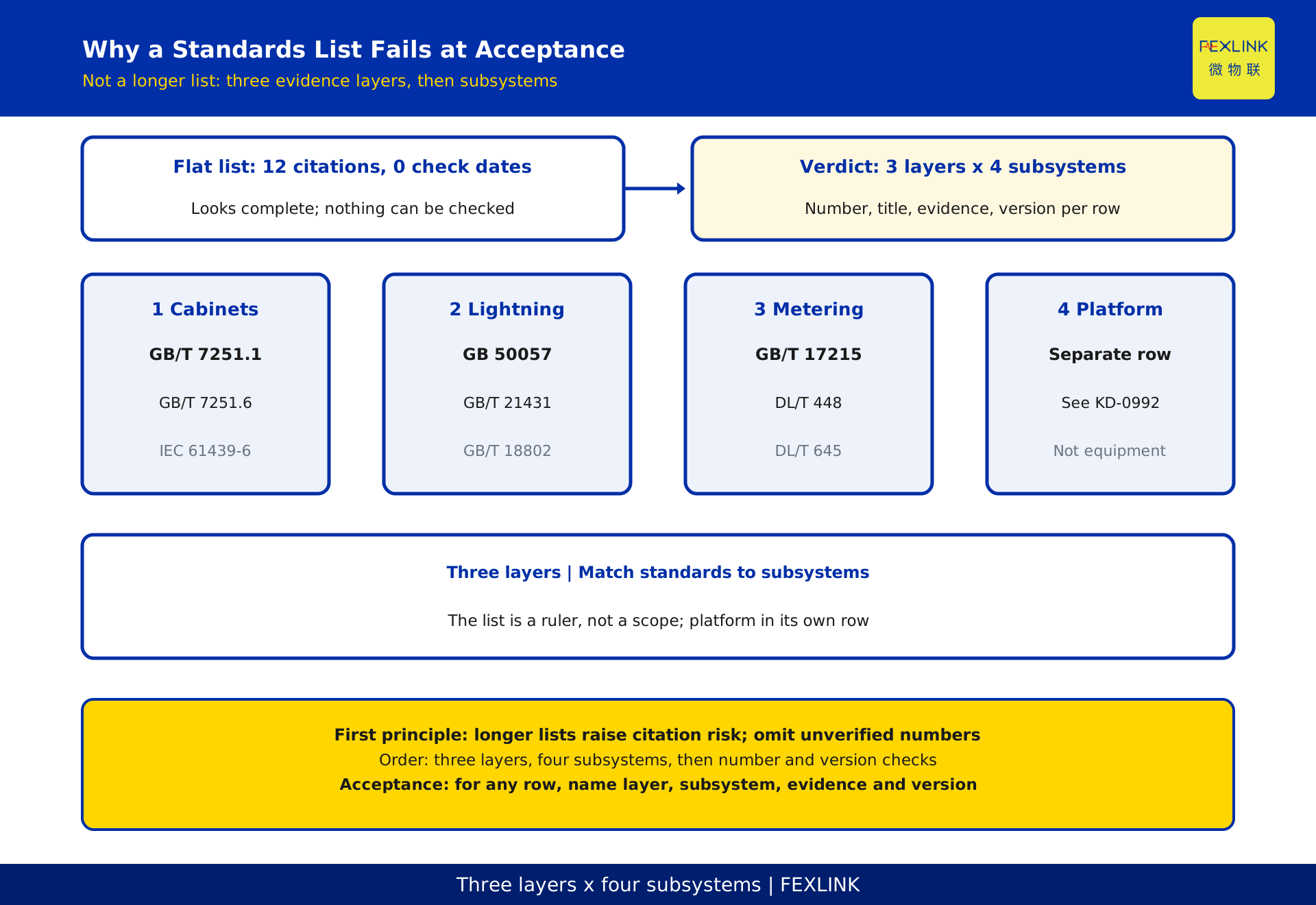
There is no universal standards list for accepting a monitoring system. What works is a subsystem register: cabinets and busways follow low-voltage assembly standards, lightning protection follows separate design, inspection and surge-device standards, and metering follows accuracy, device-configuration and protocol standards. Platform cybersecurity is a different line. More important is three layers of evidence: design and construction codes answer "was it built as designed", product standards answer "is the device compliant", and in-service inspection codes answer "does it stay compliant". None replaces the others. Write only the number, title and a qualitative scope; do not quote clause numbers, limits or conformity tables. Check versions against the effective text, and omit any number you cannot verify. This covers the equipment, electrical and metering matrix, not the metering reconciliation rules in KD-0998, platform classified protection in KD-0992, false-alarm measurement in KD-0981 or early-warning acceptance design in KD-0980.
1. Three Layers, Not One Flat List
Laying a dozen standards in one flat table usually means "everything is cited, yet nothing can be checked on site", because the documents answer different questions. Sort the acceptance basis into three layers first, each with its own evidence.
| Layer | Question | Evidence | Cannot replace |
|---|---|---|---|
| Design and construction | Was it built as designed | Drawings, as-built records, acceptance notes | Product compliance |
| Product compliance | Is the device itself compliant | Type tests, factory checks, certificates | Installation and integration |
| In-service inspection | Does it stay compliant | Inspection reports, periodic checks, logs | As-built conformity |
The middle layer is most often dropped: drawings and screens are reviewed, but type-test reports for cabinets, surge devices and meters never match nameplates. The reverse is common too: one type-test report is offered as proof the whole system is accepted, treating product compliance as engineering conformity. Label each document with its layer before arguing about completeness.
2. Four Subsystems, Each With Its Own Standards
Grouping by subsystem rather than by bookshelf is the cheapest way to avoid gaps and wrong citations. Cabinets and busways, lightning protection and earthing, metering, and platform and network each form one group. Their issuing bodies, legal status and acceptance timing differ; ticking them all in one table compresses unlike questions into "complies".
Which subsystems exist is fixed by the design documents and contract scope, not inferred from the list. The list is a ruler, not a scope statement: a missing subsystem is not exempt from inspection, and a device absent from the project needs no inapplicable standard cited for completeness.
3. Cabinets and Busways: Product Standards Only Cover the Product
Within the low-voltage assembly family, GB/T 7251.1 is the general rules for assemblies, while GB/T 7251.6 covers one specific product, busbar trunking systems (busways), and is identical to IEC 61439-6. Treating GB/T 7251.6 as "the acceptance standard for the whole cabinet" is a classic mismatch: it does not cover assembly structures or component selection beyond the busway.
Wiring systems sit on another line. GB/T 16895.6 addresses selection and erection of wiring systems in low-voltage installations; it is a design document, not a product standard for monitoring devices. One trap: the same number was once issued as mandatory and later wholly replaced by a recommended edition. Drop the "/T" and the citation changes legal nature. Rather than writing numbers from memory, state a verifiable scope such as "general rules for low-voltage assemblies and applicable parts", then let the responsible party confirm the number.
The registry list is a starting point, not text to paste into an acceptance file. Verify the title, the version and the applicability. If any cannot be confirmed, leave the number blank and mark it pending.
4. Lightning Protection: Design, Inspection and Product Are Three Different Things
This group is often reduced to a string of numbers, but the roles are distinct: GB 50057 is the design code for lightning protection of buildings; GB/T 21431 is the inspection code for lightning protection systems; GB/T 18802 is the series for low-voltage surge protective devices, covering performance requirements and selection. Design compliance is not inspection compliance, and a type-test report does not prove the device was installed in the right place at the right stage.
If electronic information equipment is connected, GB 50343 on lightning protection for building electronic information systems applies. It concerns lightning electromagnetic impulse protection, not external lightning protection. Online data on lightning currents or earthing condition are operational evidence, not a substitute for a qualified body's inspection conclusion.
Remember: design codes point to drawings, inspection codes to reports, product standards to nameplates. Cross-references are not coverage.
5. Metering: Accuracy, Device Configuration and Protocols
This group is often shortened to "per GB/T 17215 and DL/T 448", yet the first is a family. The GB/T 17215 series covers general requirements, particular requirements and acceptance inspection for metering equipment, and answers whether one meter is accurate. DL/T 448 is the technical management code for metering installations, covering metering points, transformer and meter combinations and secondary circuits. Automatic readings also need protocol standards such as DL/T 645 and DL/T 698.
Settlement and management metering must be separated: circuits for trade settlement or cost allocation demand more, while monitoring-only circuits can use lower configurations, but standards must not be mixed. Writing only "per GB/T 17215" without a part number leaves both sides pointing at different documents in a dispute.
6. Four Common Number-Writing Errors
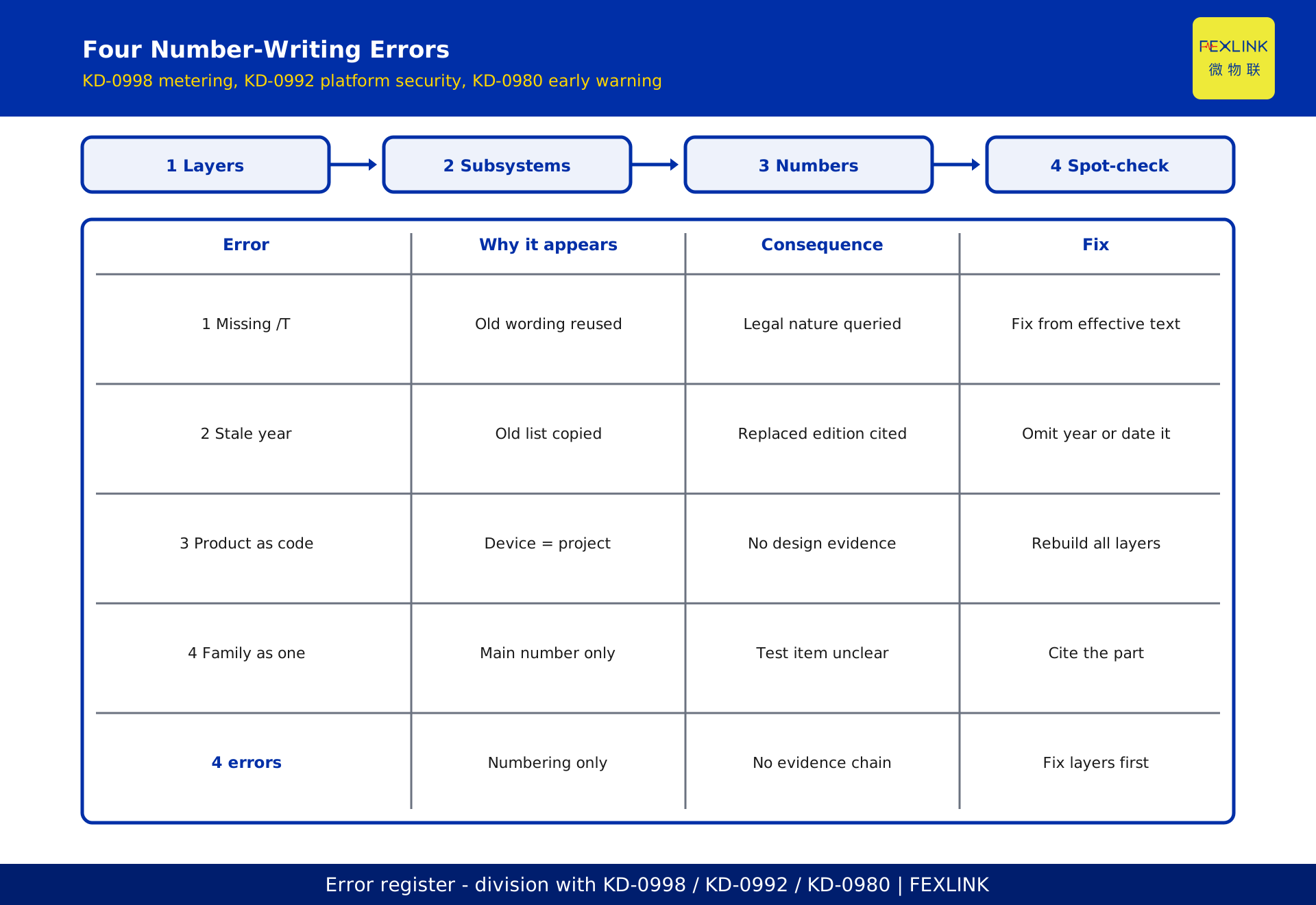
Four errors account for most challenges to an acceptance file. They share one cause: the number looks familiar, but version and applicability were never checked.
| Error | Why it appears | Consequence | Fix |
|---|---|---|---|
| Missing or wrong "/T" | Copied from old mandatory wording | Legal nature questioned | Correct against the effective text |
| Year refers to a withdrawn edition | Old list copied without update | Cites a wholly replaced edition | Omit the year or state a check date |
| Product standard used as acceptance code | Device compliance read as project compliance | No design or integration evidence | Rebuild evidence for all three layers |
| A family written as one document | Only the main number recorded | Cannot locate a test item in a dispute | Cite the part or describe the scope |
The fourth is concentrated in GB/T 17215 and GB/T 18802: both are series, and a main number alone says little. The second is subtle: the more a list is copied from an earlier proposal, the more likely a replaced edition travels into the new project.
7. A De-Identified Example: One Wrong Number Undermines the Whole File
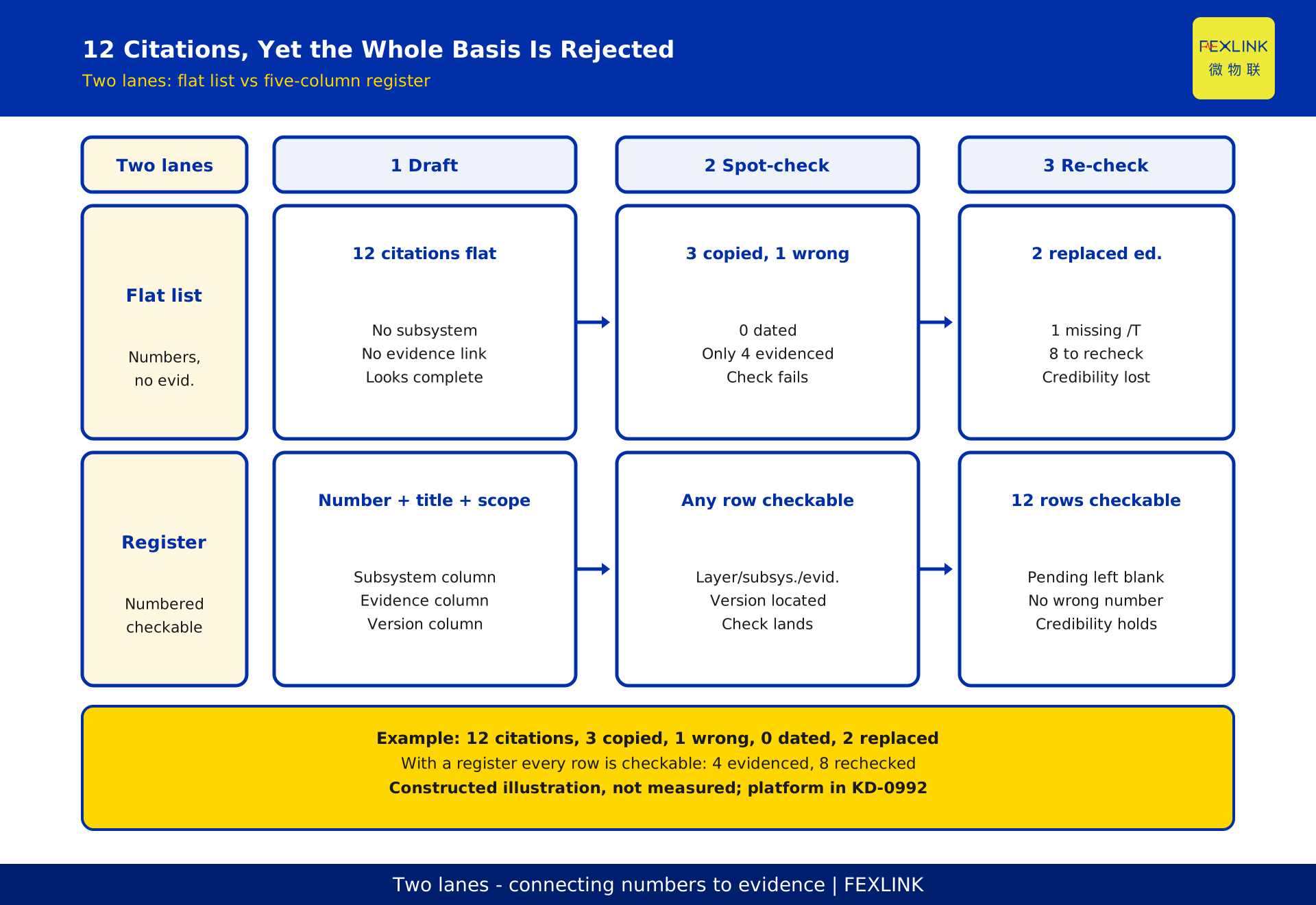
Take a constructed case. An acceptance basis lists 12 citations; 3 were copied from an earlier proposal, 1 wrongly marks a recommended standard as mandatory, and 0 carry a check date. Spot-check whether each can be traced to an effective text, a subsystem and evidence: of the 3 copied entries, 2 point to wholly replaced editions, the 1 wrong "/T" is challenged, and only 4 of the 12 produce evidence on the spot.
The result is not "too few standards cited" but a collapse of credibility: the remaining 8 must be re-verified even if correct. Turn the list into a five-column register covering number, title and scope, applicable subsystem, evidence and version-check conclusion; write "to be confirmed" and leave the number blank where verification fails. All figures are de-identified constructions, not measurements or recommended ratios.
8. Platform Security Is a Separate Line
Platform networking, cross-organisation data exchange, account permissions and audit trails belong to information security, not equipment or electrical standards. Whether classified protection applies and what acceptance must check is the scope of KD-0992. This article only asks for a separate platform row: do not cover platform security with a cabinet product standard, or treat equipment compliance as an assessment conclusion.
The field-side and platform-side boundary also needs stating: device access authentication, permission tiers, the encryption scope for transport and storage, and traceable operations each have different evidence. Grading and assessment conclusions follow the competent authority and the assessment body.
9. How to Write the Acceptance Basis: A Five-Column Register
The result is a register that can be used directly. Omit "applicable subsystem" and you get gaps; omit "evidence" and nothing can be checked; omit "version-check conclusion" and old editions travel into new projects.
| Column | What to write | Common omission |
|---|---|---|
| Number | Verified standard number; cite the part for a family | Main number only, missing "/T", stale year |
| Title and scope | Full title and what it covers here | Vague "complies with national standards" |
| Applicable subsystem | Cabinets or busways / lightning and earthing / metering / platform | No subsystem, one row for all |
| Evidence | Drawings, type tests, inspection reports, calibration records | Numbers with no evidence |
| Version-check conclusion | Check date, source of effective text, pending items | No check date, earlier proposal reused |
Spot-check any row: can you say which layer it belongs to, which subsystem it covers and which document can be produced? If not, the row is not yet an acceptance basis. "To be confirmed" is allowed in the version column, but an unexplained blank is not; a blank number with a note survives review better than a familiar-looking wrong one.
10. Common Mistakes and Division of Labour
Three recurring mistakes: treating a longer list as more rigorous when citation risk grows with each row; treating "the device has a certificate" as "the system passed acceptance", skipping design and integration evidence; and copying technical requirements into a conclusion without a test method. All share one feature: numbers without an evidence chain.
The boundaries are fixed. KD-0998 covers metering reconciliation rules, KD-0992 platform classified protection and its three mandatory checks, KD-0981 on-site false-alarm measurement, KD-0980 early-warning acceptance design, KD-0990 protocol-family integration, and KD-0983 post-launch usage mechanisms. This article adds the three-layer split, the subsystem-to-standard register and the number-writing corrections.
The registry has an empty related_products field; related_solutions lists the digital electrical intelligent supervision system and intelligent online lightning-protection monitoring. Only a qualitative role split is made: the former carries monitoring data and acceptance evidence, the latter supplies lightning-side data. Neither replaces design documents, type-test reports or conclusions from qualified bodies; neither implies model capability or measured performance, and no procurement commitment is made.
Frequently Asked Questions (FAQ)
Q: Can the registry's standards list be copied straight into an acceptance file?
No. It is a starting point; verify every title, version and applicability. This article identifies three problems in it: a missing "/T", a busway standard read as a whole-cabinet standard, and a family written as one document. Leave uncertain numbers blank with a note.
Q: Should the year be written at all?
Either omit it or state a check date, but never add one from memory. A year identifies a specific edition, and a wrong one cites a wholly replaced version. Let the responsible party confirm and correct it against the effective text.
Q: If all type-test reports are present, is design conformity still needed?
Yes. A type test only proves the device, which is the product layer. Whether it was built as designed and integrated correctly still needs as-built records and acceptance notes; periodic inspection has its own evidence.
Q: Can the lightning-protection numbers be merged into one line?
Not recommended. The design code, the inspection code and the surge-device series answer three different questions. Merging them removes the links to drawings, inspection reports and nameplates.
Q: If the platform already passed a classified-protection assessment, do equipment standards still apply?
Yes. They are separate lines. An assessment conclusion covers platform security and cannot replace product compliance or engineering conformity evidence for cabinets, lightning protection and metering. Keep its own row.
Scope and Limitations
This applies to monitoring and early-warning projects whose scope is fixed and whose acceptance basis is being drafted or reviewed, written for owner-side acceptance leads, supervisors and bid technicians. It does not replace sector-specific design codes, operating rules or contract terms, and makes no determination of any standard's applicability or conformity.
Only standard numbers, titles and qualitative scope descriptions appear here; no clause numbers, requirement tables, limits, conformity tables or penalty amounts are quoted, and no standard is claimed current or indefinitely valid. Numbers and versions come from the effective texts of the standards disclosure system, the design documents and the competent authority. The 12 citations, 3 copied entries, 1 wrong classification, 0 check dates, 2 replaced editions, 4 with evidence and 8 to be re-verified, plus the three layers, four subsystems, four error types and five columns, are constructed illustrations or structural counts, not measured or recommended values.
No product models, parameters, prices or point counts appear, nor claims about pass rates, acceptance rates, false-alarm rates or payback periods. The two system names come from related_solutions and only mark a qualitative split between the evidence-carrying and lightning-monitoring sides; they imply nothing about model capability or field performance. This register is a drafting tool, not a substitute for KD-0998 metering reconciliation, KD-0992 platform checks or KD-0980 early-warning acceptance design. The D10 score still requires independent QA review.
Frequently Asked Questions
Which National and Industry Standards Should an Electrical Monitoring System Be Accepted Against?
There is no universal standards list for accepting a monitoring system. What works is a subsystem register: cabinets and busways follow low-voltage assembly standards, lightning protection follows separate design, inspection and surge-device standards, and metering follows accuracy, device-configuration and protocol standards. Platform cybersecurity is a different line