 FEXLINK Research Institute
Direct Answer
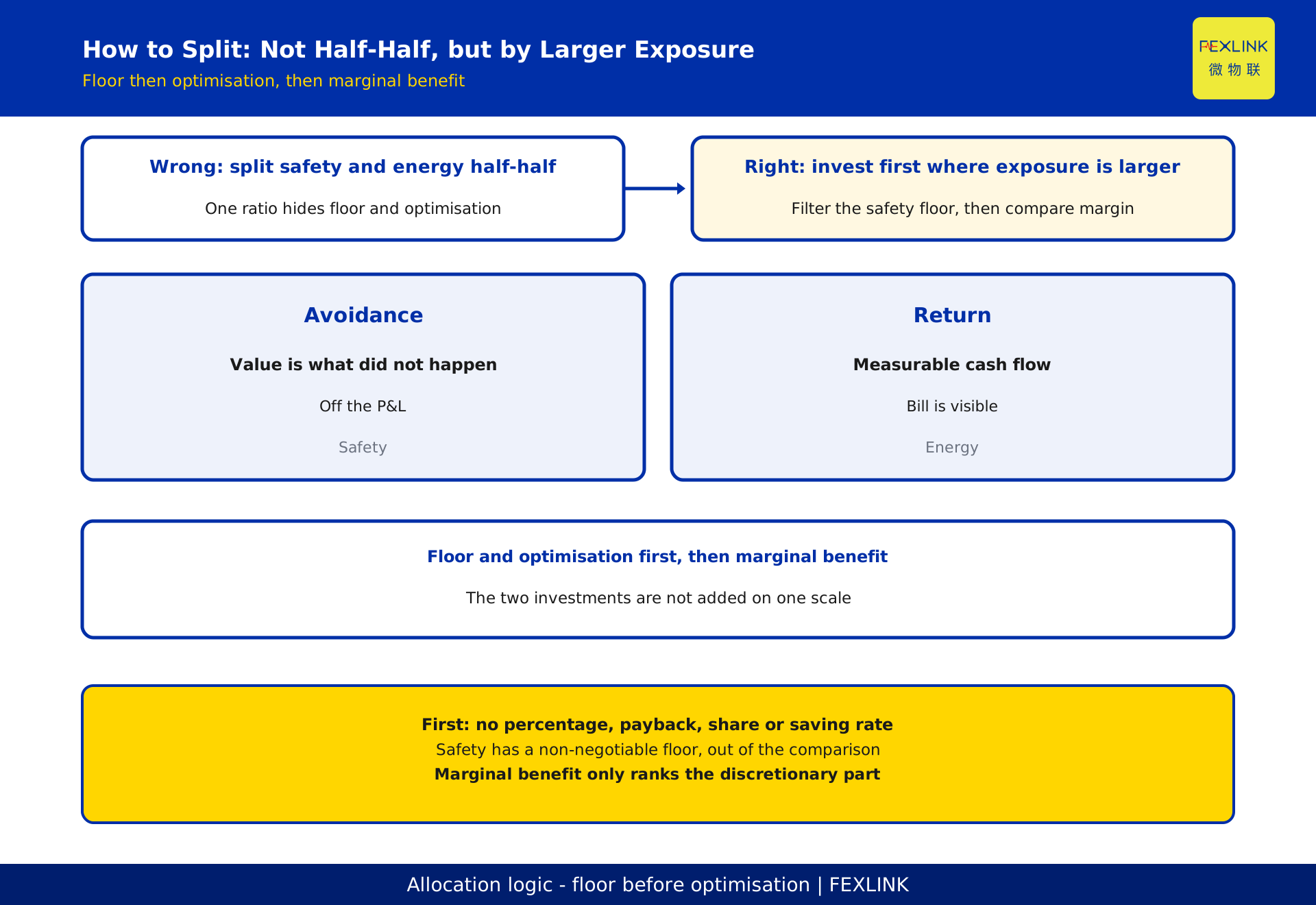
In an integrated project that must cover both electrical safety and energy efficiency, the budget between safety monitoring and energy-cost management should neither be split down the middle nor ranked by "which one is easier to quantify." The only workable allocation logic is this: first separate the non-negotiable safety floor from the discretionary optimisation space; then, within the discretionary space, compare the risk exposure built from the severity and likelihood of electrical hazards against the waste exposure built from the recoverable amount of energy waste, and invest first in whichever yields the higher marginal benefit and can actually be delivered within the constraints. This article gives no percentages, payback periods, savings rates or allocation shares, and does not promise that "investing in energy first guarantees a return." Allocation is a conditional decision method, not a financial model; the final ratio must be confirmed by the owner against the budget envelope and compliance requirements.
1. Why splitting evenly is a trap
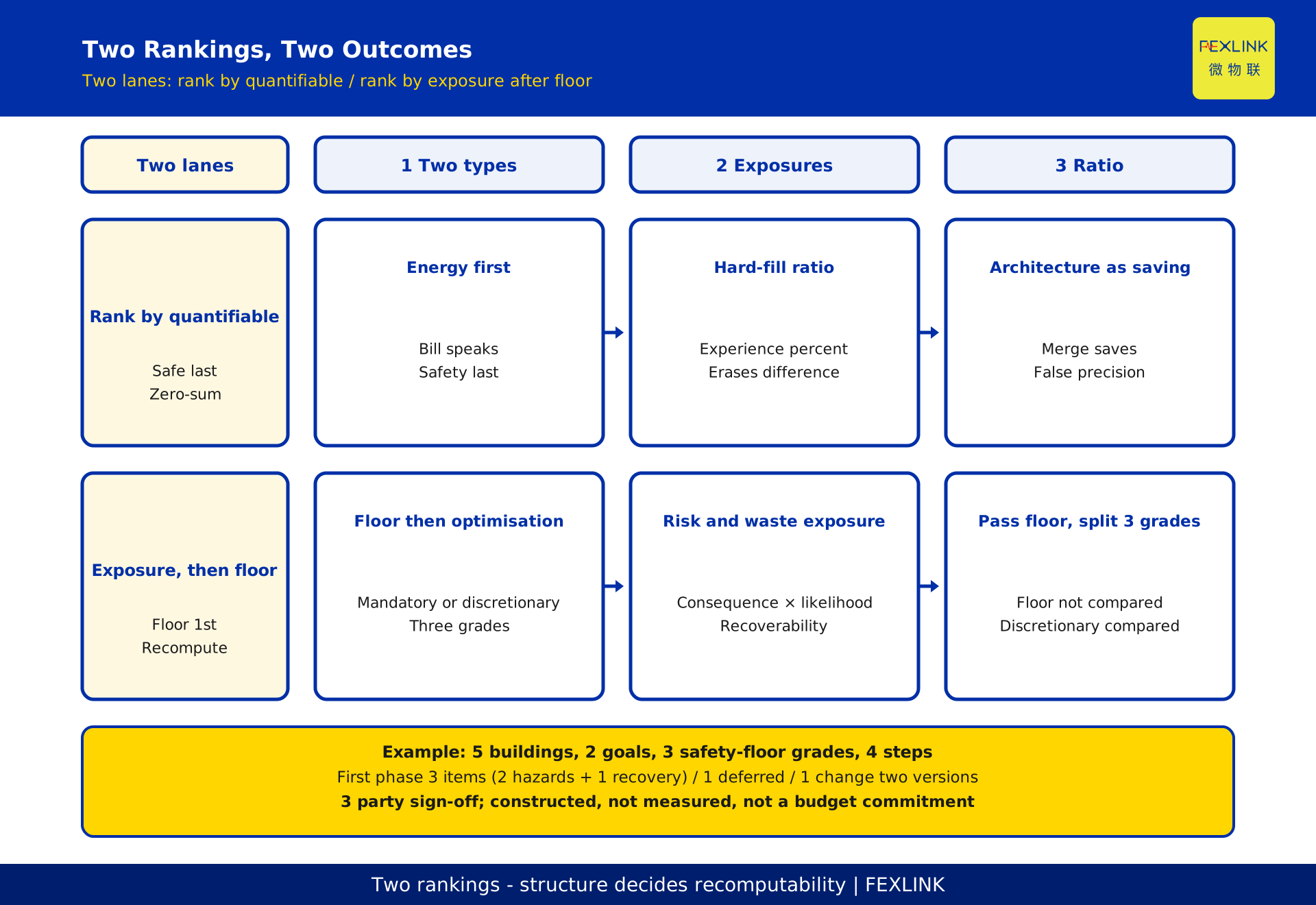
Splitting the two budgets evenly usually leaves both underdone: the safety side cuts key monitoring points to fit the budget while hazards remain, and the energy side saves money with superficial metering while waste is never truly closed. A more subtle trap is ranking by quantifiability — energy savings speak through the electricity bill, while the safety benefit is the negative of "no incident happened" and gets pushed back. There is also the zero-sum illusion that the budget is fixed, so more for safety means less for energy. In practice, separating floor from optimisation often delivers both goals without raising the budget. All three errors come from not separating floor and optimisation first, not from how the ratio is cut.
2. The value nature of the two investments: avoidance vs return
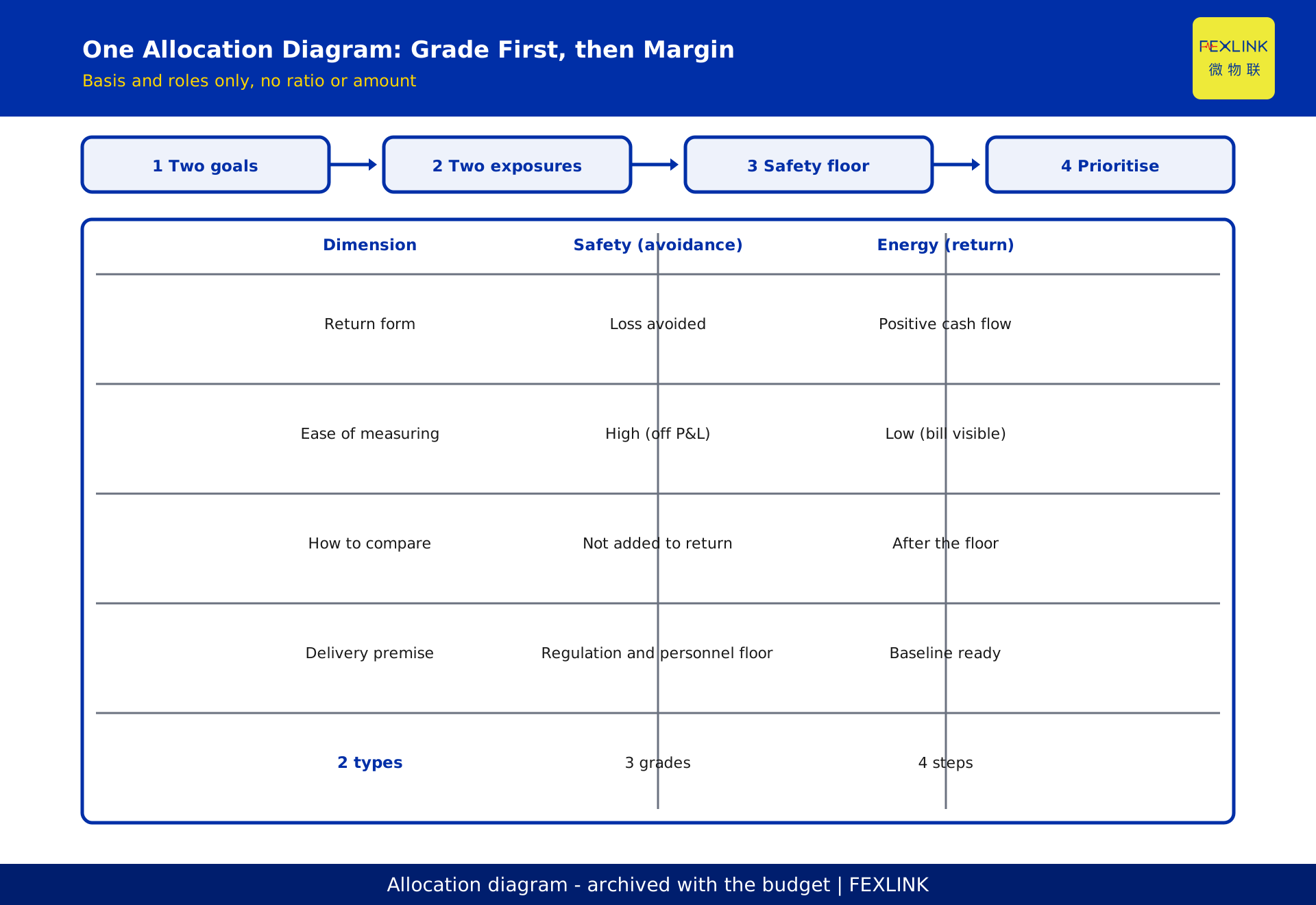
Electrical safety investment is essentially risk avoidance: its value shows in what did not happen — no trip, no fire, no injury, no regulator penalty. The return is a loss avoided, which does not appear on the profit-and-loss statement and is hard to price in money. Energy-cost management is essentially return: its value shows in the energy cost not spent or the waste recovered, a measurable positive cash flow. The two cannot be added on the same scale, which is exactly why ranking purely by "marginal benefit" pushes safety back and why a floor filter must come first.
| Dimension | Safety (avoidance) | Energy (return) |
|---|---|---|
| Return form | Loss avoided (did not happen) | Measurable positive cash flow |
| Ease of measuring | High (off the P&L) | Low (bill is visible) |
| How to compare | Not added to return directly | Compare only after the safety floor |
3. How to estimate risk exposure
Exposure is not a precise number but a qualitative frame: place each electrical hazard on a matrix of consequence severity (three grades: personnel, production, compliance) times occurrence likelihood (three grades: exposed defects, historical peers, design blind spots), and mark which are high-consequence, high-likelihood and must be treated, and which can be observed. This step produces no amount, only a list of "which hazards cannot wait." The exact thresholds are set by design documents and risk assessment; this article gives no quantification template. The point is to think of consequence and likelihood separately and avoid judging safety "good enough" just because nothing has failed yet.
4. How to estimate waste exposure
Waste exposure is also qualitative: first identify the main energy flows and known waste points (no-load, harmonics, three-phase imbalance, standby loss), judge which are recoverable and which are structurally fixed; then see whether the recovery action must share the same retrofit window with hazard treatment. This step also produces no amount, only a list of "which waste is worth acting on." Whether it truly yields benefit depends on the energy baseline, accounting method and contract terms being ready, judged by the energy lead; forcing a payback number at the estimate stage only manufactures false precision.
5. What "marginal benefit first" really means
"Invest first where marginal benefit is highest" is only a decision prompt, not a command, and must not be read as "invest in what pays back, push safety back." Here marginal benefit means the risk drop or waste recovery from the next unit of investment within the discretionary space, not book ROI. The correct use is: after the safety floor, compare the marginal effect of candidate actions within the remaining budget, and fill first the one with high marginal benefit that can be delivered. It answers "how to rank the discretionary optimisation," not "whether the floor is kept." Keeping those two sentences apart is what stops the one-liner from misleading.
6. The safety floor is non-negotiable: only the discretionary part is tradeable
What can be traded is always the part above the safety floor. Mandated monitoring and protection, links directly to personnel and major-accident risk, and owner-recognised non-downgradeable items do not enter the marginal-benefit comparison; they are either mandatory or handled on a compliance path. Applying "marginal benefit first" to the safety floor equals changing a risk judgement with money, and that is exactly the action this article corrects. The registry's umbrella phrasing "invest first where marginal benefit is highest" is kept here only as a decision prompt after the boundary correction above; it makes no promise of cost saving or of not lowering the safety level.
7. How one sensing base serves both goals
The two goals need not build two collection layers. The same batch of data measured on electrical circuits (voltage, current, leakage current, temperature, harmonics) feeds both hazard early-warning (threshold, trend, imbalance) upward and energy statistics (sub-metering, efficiency benchmarking). One layout, two analysis layers — a fact of architecture, not a marketing line. But this article promises no "how much was saved by merging": whether it saves depends on whether the existing circuits were due for retrofit anyway and whether the platform was due anyway; the architectural convergence must not be booked directly as investment saving. Reading architecture as saving is one of the common misjudgements.
8. One safety and energy allocation decision diagram
Compress the previous sections into one executable diagram, done in four steps: list the two goal types and candidate actions; pass the safety floor and split into three grades; within the discretionary grade estimate the two exposures; rank by marginal benefit and match the remaining budget. The output is not a number but a decision list of "which items enter the first phase, which are deferred, which await specialist assessment," plus the basis and open conditions behind each item.
| Step | Action | Output |
|---|---|---|
| 1 | List two goal types and candidate actions | Candidate list |
| 2 | Pass safety floor, split into 3 grades | Mandatory or specialist or discretionary |
| 3 | Within discretionary, estimate two exposures | Cannot-wait or worth-acting list |
| 4 | Rank by marginal benefit | First-phase or deferred or to-assess |
9. De-identified constructed example
A campus retrofit, nominally 5 buildings, 2 goal types (safety and energy), filtered through 3 safety-floor grades, yields by the 4-step decision: 3 items in the first phase (2 hazard treatments plus 1 high-recovery waste treatment), 1 item deferred (low recovery and not on the floor), 1 scope change kept in two versions with the old not overwritten; finally the owner's energy lead, design and construction confirm the boundary in writing with 3 parties. No amount, share or payback appears throughout; whether a number can be computed depends on who fills the open items and against which document. All figures are structural illustrations, not a real project, not measured values, not a recommended configuration.
10. Common misjudgements and forbidden actions
Five misjudgements: treating allocation as zero-sum cutting, ranking by quantifiability, reading the safety benefit as the negative "out of sight, out of mind," booking architectural convergence as saving, and treating the decision diagram as a quotation. Four forbidden actions: forcing the two shares to fit a percentage, using payback numbers to push safety investment down, putting floor items into the marginal-benefit comparison, and letting pre-sales decide the ratio alone. Any of these destroys the recomputability of the diagram and leaves no basis for later additions or audit.
FAQ
Q: Can you just give a ratio like "safety X percent, energy Y percent"?
No. The share is the result after the budget envelope and compliance requirements are fixed, not an input to the allocation method; the two exposures differ so much across projects that applying an experience ratio erases project difference. This article only explains the allocation logic and gives no percentage.
Q: Should we invest in energy first because it pays back, and push safety back?
Absolutely not. Safety has a non-negotiable floor; regulation, personnel and major-accident risk do not enter the marginal-benefit comparison. "Invest in what pays back" applies only to the discretionary optimisation above the floor. Pushing safety back is exactly what this article corrects.
Q: Can one sensing base really manage both safety and energy?
Yes — it is a fact of architecture: the same batch of circuit measurement data feeds both the hazard early-warning and the energy-statistics analysis layers upward. But this article promises no saving from merging; whether it saves depends on whether the existing retrofit and platform were due anyway.
Q: Can risk and waste exposure be converted to money and then compared?
Not recommended at the estimate stage. They differ in unit and in certainty; forcing them together manufactures false precision. This article only ranks qualitatively: consequence severity times likelihood, and waste recoverability, producing a list of "what cannot wait, what is worth acting on"; the money goes to formal accounting.
Q: Who signs off the decision diagram for it to count?
The owner's energy lead confirms the budget envelope and the floor, design and construction confirm the candidate actions and their basis, and 3 parties confirm the allocation boundary in writing and freeze it; changes keep two versions. Pre-sales only produces the structure and logic — no ratio, no pricing, no risk-grade decision.
Scope and Limitations
This article is a methodology note on allocating safety and energy investment in an integrated project; it serves owners' energy leads, project managers and solution architects in the ratio discussion at the initiation stage. It does not apply to budget-attribution decisions (that is decided by the initiation budget line and acceptance criteria; see the related article on this site), does not apply to specific energy-saving quantification (to be done by a specialist under an energy-management-system method), and does not apply to any standard-conformance judgement. The whole text carries zero standard numbers, zero year numbers, zero clause numbers and zero conformance tables; the related solutions "digital electrical intelligent supervision system" and "energy-carbon autonomy system 4×3×2" are registered only, not decoded and not parameterised. The registry's umbrella phrasing "invest first where marginal benefit is highest" is corrected by the boundary "filter the safety floor first" and makes no promise of cost saving or of not lowering the safety level; the example is a de-identified constructed illustration, not a real project, not a measured value, not a recommended configuration, and constitutes no commitment of configuration quantity, budget or schedule. The article and the diagram are not in the adjudication seat; the final ratio is confirmed by the owner against budget and compliance.
Frequently Asked Questions
Can you just give a ratio like "safety X percent, energy Y percent"?
No. The share is the result after the budget envelope and compliance requirements are fixed, not an input to the allocation method; the two exposures differ so much across projects that applying an experience ratio erases project difference. This article only explains the allocation logic and gives no percentage.
Should we invest in energy first because it pays back, and push safety back?
Absolutely not. Safety has a non-negotiable floor; regulation, personnel and major-accident risk do not enter the marginal-benefit comparison. "Invest in what pays back" applies only to the discretionary optimisation above the floor. Pushing safety back is exactly what this article corrects.
Can one sensing base really manage both safety and energy?
Yes — it is a fact of architecture: the same batch of circuit measurement data feeds both the hazard early-warning and the energy-statistics analysis layers upward. But this article promises no saving from merging; whether it saves depends on whether the existing retrofit and platform were due anyway.
Can risk and waste exposure be converted to money and then compared?
Not recommended at the estimate stage. They differ in unit and in certainty; forcing them together manufactures false precision. This article only ranks qualitatively: consequence severity times likelihood, and waste recoverability, producing a list of "what cannot wait, what is worth acting on"; the money goes to formal accounting.
Who signs off the decision diagram for it to count?
The owner's energy lead confirms the budget envelope and the floor, design and construction confirm the candidate actions and their basis, and 3 parties confirm the allocation boundary in writing and freeze it; changes keep two versions. Pre-sales only produces the structure and logic — no ratio, no pricing, no risk-grade decision.