 FEXLINK Research Institute
The short answer
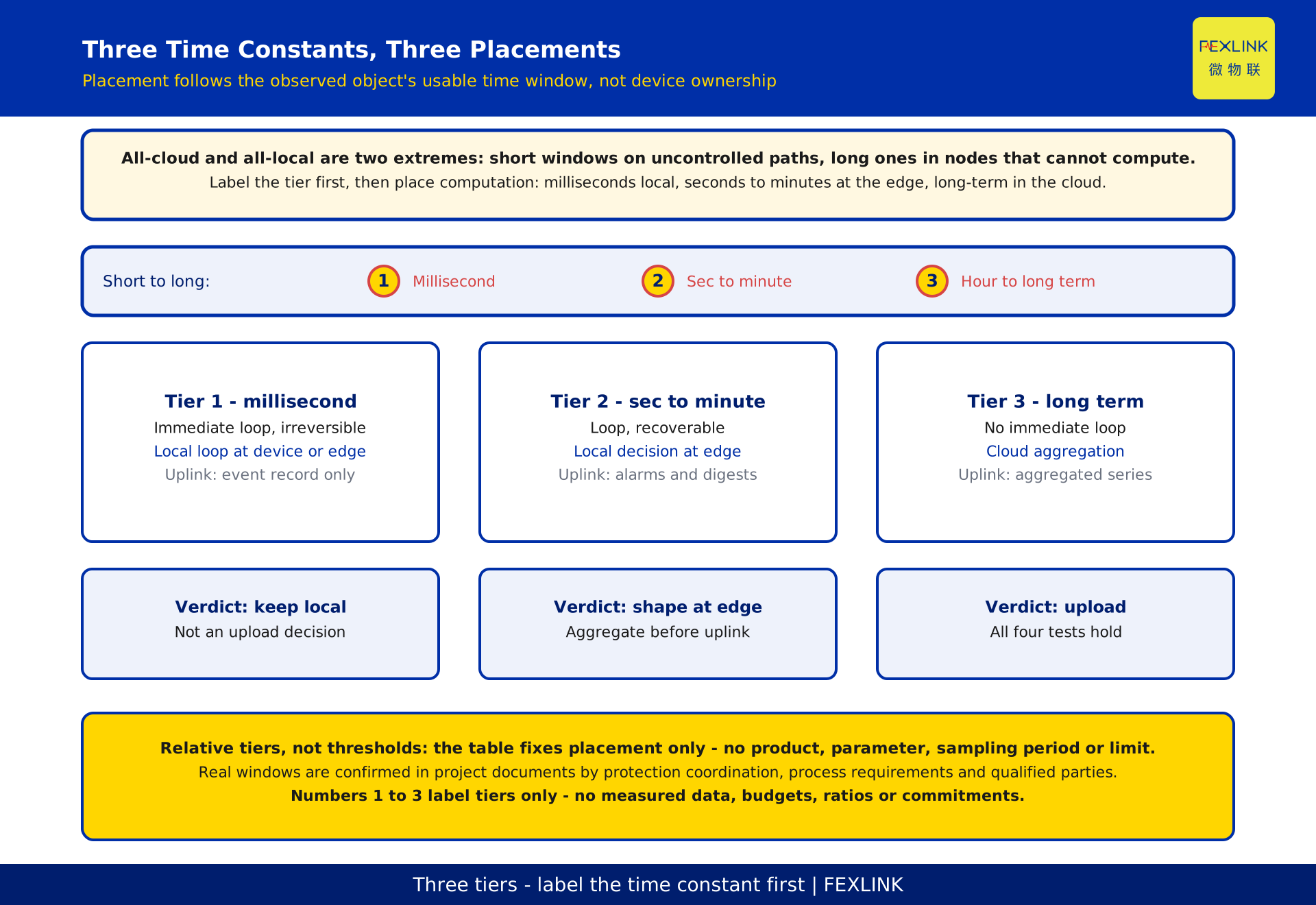
Do not split device, edge and cloud by which box looks more capable, or by data volume. Split them by the time constant of the observed object: protection interlocks on a millisecond scale must close their loop locally at the device or edge; second-to-minute monitoring alarms belong on the edge; hour-to-long-term trends, cross-site benchmarking and carbon accounting are the only candidates for upload. To decide whether a quantity qualifies, ask one question: is the time window its loop can tolerate longer than the worst-case latency bound of the path? If shorter, keep it local. Upload is justified only when retransmission and queuing cannot change the conclusion. Below are the mechanism, four admission tests and a placement table. Numbers 1 to 6 label links, tiers, tests, chains and steps only - no measured data, deadlines, limits or commitments.
The yardstick is the observed time constant
Three common splits are unstable: by device ownership, data volume and function name. Each treats placement as a box or feature property, so one quantity gets different answers across projects.
A time constant is the usable window between an object starting to deviate and an action or conclusion still being valid. It belongs to the object, not to the system (control-systems engineering consensus; the registered core conclusion also allocates placement by time constant). One winding temperature has a short window for immediate tripping and a long one for a monthly cooling-degradation trend: one quantity, two placements. Label each item's tier first, then decide where its computation lands; do not draw three boxes and fill them afterwards.
"All-cloud is too slow, all-local becomes an island" is not a dilemma but two extremes: the first hands a short-window decision to an uncontrolled path, the second pushes long-window analysis into a node that cannot compute it. Both skip the time constant.
Latency is a chain of six links
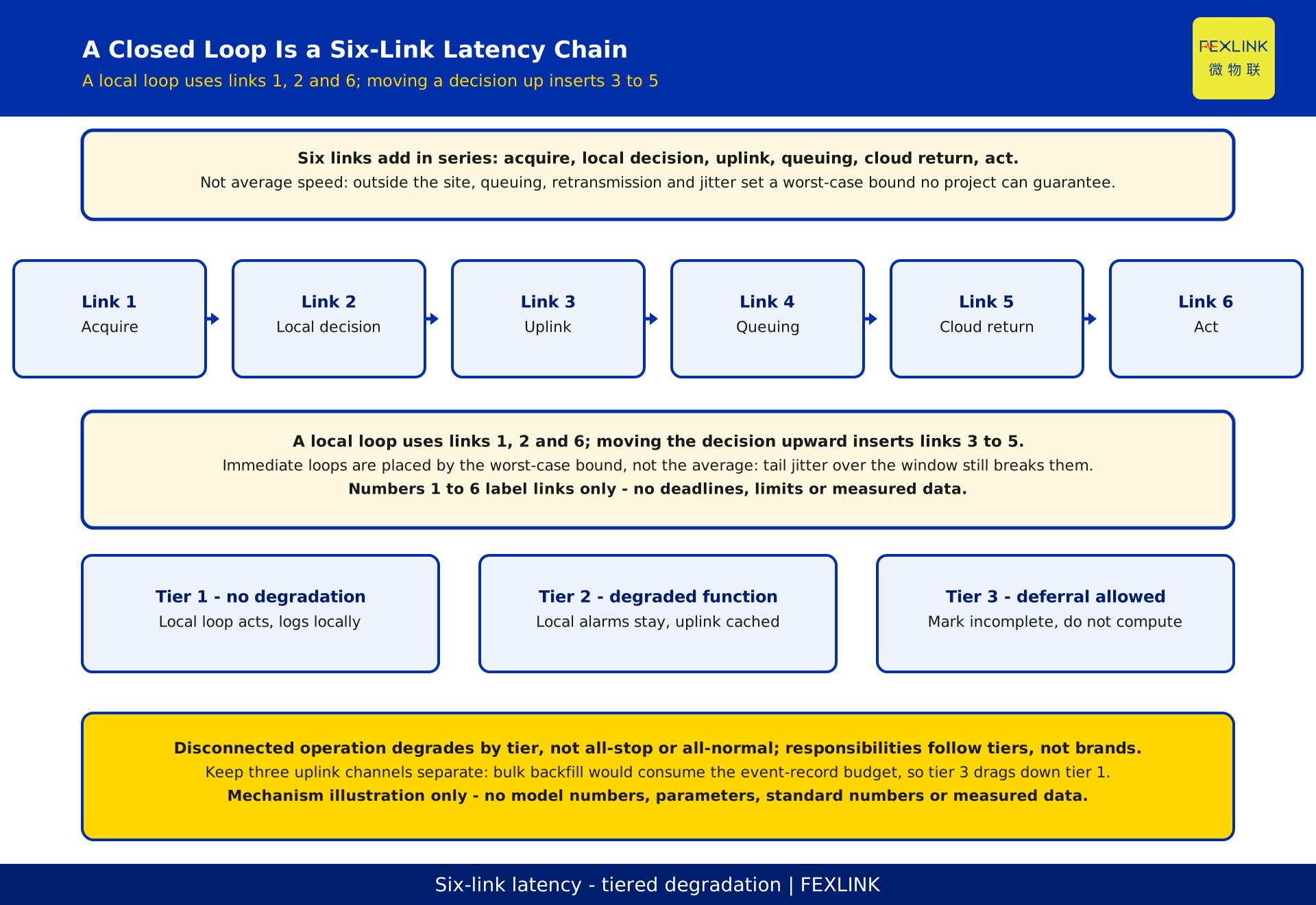
From event to action, latency adds six links in series: link 1 acquisition, link 2 local decision and output, link 3 upstream transport, link 4 queuing and scheduling, link 5 cloud computation and downstream return, link 6 execution. A local loop uses links 1, 2 and 6; moving the decision upward inserts links 3 to 5 into the chain.
The issue is not average speed. Once a decision leaves the site, queuing, retransmission, congestion and scheduling jitter are not guaranteed unilaterally by the project, and their worst-case latency bound cannot be compressed (public consensus on network real-time behaviour; an accepted article in this library lists latency among its four constraints). An average that passes while tail jitter exceeds the window still breaks the loop. Immediate closed-loop decisions are therefore placed by the worst-case bound, not the average. "We measured it once and it responded quickly" is not a reason to upload.
A scenario: a manufacturing plant centralised all anomaly decisions in the cloud. During one upstream congestion, a short-window limit-exceedance trip waited for a return path and acted outside its window. Review found average latency within target; the tail was not. Anonymised illustration, with no client, location, scale or result data.
Three tiers of placement
| Tier | Time constant | Immediate loop | Computation lands | Uplink form |
|---|---|---|---|---|
| 1 | Millisecond scale | Yes, irreversible | Device or edge, local loop | Event record and result only |
| 2 | Second-to-minute | Yes, recoverable | Edge, local decision | Alarms and aggregated digests |
| 3 | Hour-to-long-term | No | Cloud | Aggregated series on shared definitions |
These are relative tiers, not calibrated thresholds: a tier 1 action cannot be recovered, a late tier 2 conclusion can be filled in, a tier 3 conclusion holds only across periods and objects. The table fixes placement only - no product, parameter, sampling period, accuracy class or limit. Real windows are confirmed in project documents by protection coordination, process requirements and qualified parties.
Signals that must close the loop locally
| Signal class | Why it stays local | Behaviour when disconnected |
|---|---|---|
| Protection interlocks and fast tripping | Irreversible; waiting for a return path overruns the window | No degradation, acts as normal |
| Hard-wired interlocks and emergency stop | No queuing or scheduling link may enter the path | No degradation, independent of communication |
| Local fast decisions and loop self-checks | Valid only now; replay is meaningless | No degradation, edge stays autonomous |
| Transient discrimination needing raw waveforms | Compression destroys the granularity needed | Store the conclusion and features locally |
An accepted article on interlock timing sets out the execution tiers and argues why hard wiring cannot be replaced. This article does not repeat its timing values or implementation detail; it adds one principle: these four classes cannot move upward because their time constant is shorter than the latency bound introduced by links 3 to 5, independent of device performance.
Four admission tests before anything is uploaded
Test 1 - no immediate loop. Losing or delaying the uploaded content cannot disable a site action. Test 2 - replayable. A failed upload can be cached and retried; the cloud can backfill from original timestamps leaving no permanent gap. Test 3 - conclusion, not raw granularity. The edge compresses and aggregates first; the uplink carries a checkable digest, not the full raw stream. Test 4 - cross-domain value only. Only conclusions a single site cannot reach - cross-site benchmarking, long-term baselines, consolidated carbon accounting - justify the cloud.
All four must hold; if any fails, reshape the data locally rather than forcing it upward. These are admission tests, not a product list or a performance promise. Trend prediction, efficiency benchmarking and carbon accounting are called "cloud suited" because all four hold, not because they are functionally superior.
Three things the edge must finish first
Aggregate the raw stream into a checkable digest on shared definitions; object identifiers must mean the same at edge and cloud, or the cloud invents its own naming. Timestamp every uplink record with both capture time and send time, never conflated; after backfill, place by capture time, not arrival time. Fingerprint each batch with a verifiable integrity tag so the cloud can de-duplicate overlapping resends.
All three finish at the edge; the cloud receives only formed data. An ESX intelligent edge computing gateway carries this stage - protocol access, local decisions, caching and uplink shaping - while CW series industrial gateways handle multi-channel field access and concentration. Both are topology roles here, not a selection conclusion; interfaces, power supply and link combinations follow the latest selection manual, and customisable items must not be judged against a fixed specification.
Three failure chains from a mismatched time constant
Chain 1 - too slow where it must be fast: a short-window decision moves up, the path bound exceeds the window, and the action is late and irreversible. Normal tests hide it; disconnection or congestion exposes it. Chain 2 - too fast where it should be slow: long-window analysis sits at the edge, rules and history grow with point count, one node cannot compute, a rule change visits every site, and each site evolves its own definitions into silos that cannot be benchmarked. Chain 3 - one quantity, two definitions: the same indicator is computed at the edge and again differently in the cloud, two numbers disagree, and ownership cannot be assigned. The defence is a single source of definitions: the edge produces the conclusion, the cloud only aggregates and correlates, never recomputes.
The accepted division-of-labour article covers structural mistakes such as a missing or overreaching layer; these chains describe what propagates after one quantity is mismatched to its tier. The views complement each other.
Disconnected operation: degrade by tier, not uniformly
Neither "everything stops" nor "everything continues" is right; degrade by tier:
- Tier 1, no degradation: local loops and hard wiring do not depend on communication; they act normally and log locally.
- Tier 2, degraded function, intact conclusion: the edge keeps local decisions and alarms, uplink becomes cache-and-retry, and operator visibility moves from remote to local.
- Tier 3, deferral allowed: trends, benchmarking and accounting pause, are marked "incomplete data", and are not computed from a broken window.
Responsibilities follow the same tiers: edge nodes own local caching and degradation switching, the cloud owns post-recovery backfill. No brand boundary is drawn.
After recovery: time alignment and de-duplication
Backfill is placed by capture timestamp; until the cloud marks a window "complete", no summary spanning the disconnected interval is published. De-duplication keys on object identifier plus capture timestamp plus batch fingerprint, so one event is not alarmed locally and then turned into a second work order after resend. Backfill priority follows the time constant: closed-loop event records first, then alarms and digests, then long-term series.
A recovery drill passes not when "all data is back" but on three statements: no extra alarm, no missing event, no second number. The accepted data-chain article covers the sensing-to-work-order path; this article sets only the alignment rules at recovery.
The data-flow topology
The device tier acquires signals and performs irreversible actions; the edge tier handles access, local closed-loop decisions, shaping and caching; the cloud tier aggregates, correlates across domains and runs long-term analysis. Uplinks split by tier: tier 1 event records, tier 2 alarm digests, tier 3 long-term series. Downlink carries definitions and configuration only, never immediate actions.
The three uplink channels must stay separate. On one shared channel, bulk long-term backfill consumes the latency budget of event records - tier 3 would drag down tier 1. This follows directly from splitting by time constant and is the point the topology figure expresses. "Downlink must not carry life-safety actions" agrees with the accepted interlock-timing article; it is cited here, not re-argued.
The two registered solution names - the edge-cloud collaboration framework and the SLCIE capability model - appear as names only. Governance requires dimensions, layers and elements of official schemes to come from official documents; this article does not expand, decode or invent a framework.
A five-step placement review
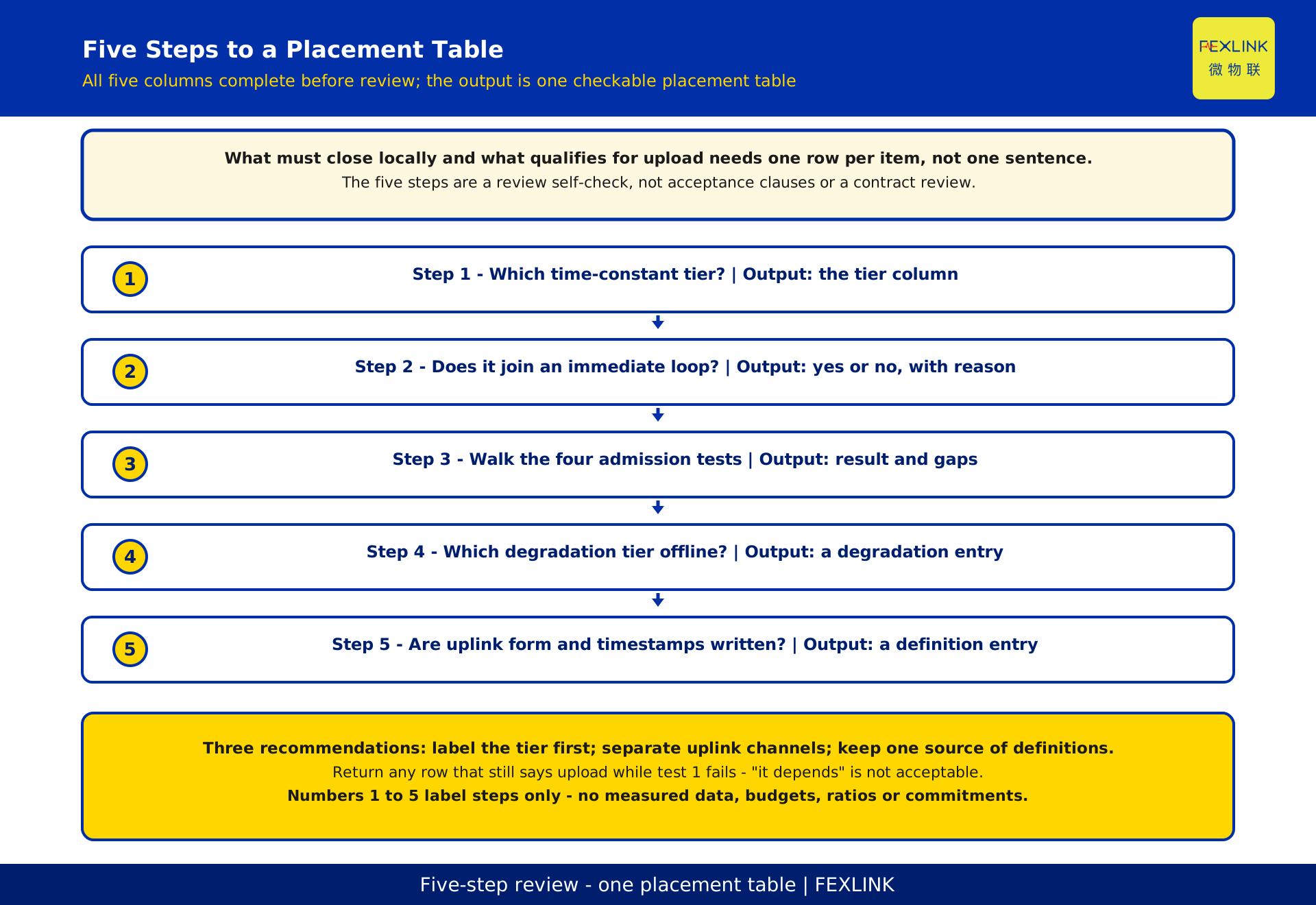
| Step | One question to ask | Written output |
|---|---|---|
| 1 | Which time-constant tier does this quantity belong to? | Tier column of the placement table |
| 2 | Does it take part in an immediate closed loop? | Yes or no, with the reason |
| 3 | Walk the four admission tests one by one | Admission result and gaps |
| 4 | Which degradation tier applies when disconnected? | Degradation entry |
| 5 | Are uplink form and timestamp rules written down? | Definition entry |
The output is one placement table: one row per item, all five columns complete before design review. Three recommendations: label the time constant before drawing the three boxes; keep uplink channels separate by tier; keep one source of definitions so the cloud never recomputes an edge conclusion. If a row says "upload" while test 1 fails, return it - "it depends" is not acceptable.
Frequently asked questions (FAQ)
Q: Is sending everything to the cloud not the simplest option? It saves a box and loses a latency bound. Once a short-window decision moves up, the worst case is no longer controlled by the project; under disconnection or congestion that function effectively fails.
Q: If the edge has enough compute, can trend analysis stay local too? Keep samples, not the only conclusion. Cross-site benchmarking needs multiple sources on one set of definitions; a single-node conclusion cannot be aligned - the chain 2 silo.
Q: How is the time constant fixed - should we measure a value? This article gives relative tiers and tests and requires no specific number. Real windows are confirmed in project documents by protection coordination, process requirements and qualified parties; no limit, sampling period or accuracy class is set here.
Q: The registry lists specific gateway models, so why does the text name only the series? That field lists gateway series able to carry the edge role. The text cites them as topology roles, with no selection advice, model stacking or specification comparison; interfaces, power supply and link combinations follow the latest selection manual, and customisable items must not be treated as fixed specifications.
Q: Are numbers 1 to 6 measured data? No. They are structural labels for links, tiers, tests, chains and steps. There is no measured data, amount, ratio, deadline, standard number, clause number or performance commitment. The related-standards field is empty, so no conformity judgement is made.
Scope and limitations
This applies to monitoring-system architecture and design review, helping an architect turn "what must close locally, what qualifies for upload" into a checkable placement table. It does not replace protection setting coordination or contract clauses, gives no sampling period, accuracy, limit or investment figure, and does not enter quotation or scheduling.
It does not repeat four accepted articles in this library: four constraints and three misplacements in the division-of-labour article, irreplaceable tier roles in the direct-to-cloud article, execution tiers and hard-wired timing in the interlock-timing article, and the sensing-to-work-order chain in the data-chain article. Its increment is only the time-constant placement criterion, six-link latency decomposition, four upload tests, three mismatch chains, tiered degradation, recovery alignment and de-duplication, and the five-step review. The related-standards field is empty, so no standard number or conformity judgement appears; solution names are registered only, with official definitions left to official documents; products are topology roles, not selection advice. The scenario is a generic "manufacturing plant" as an anonymised illustration, with no client, location, inferable scale or result data. All deliverables await independent QA; the generator does not self-approve, and nothing is published.
Frequently Asked Questions
Where to Draw the Line Between Edge and Cloud
Do not split device, edge and cloud by which box looks more capable, or by data volume