 FEXLINK Research Institute
Direct Answer
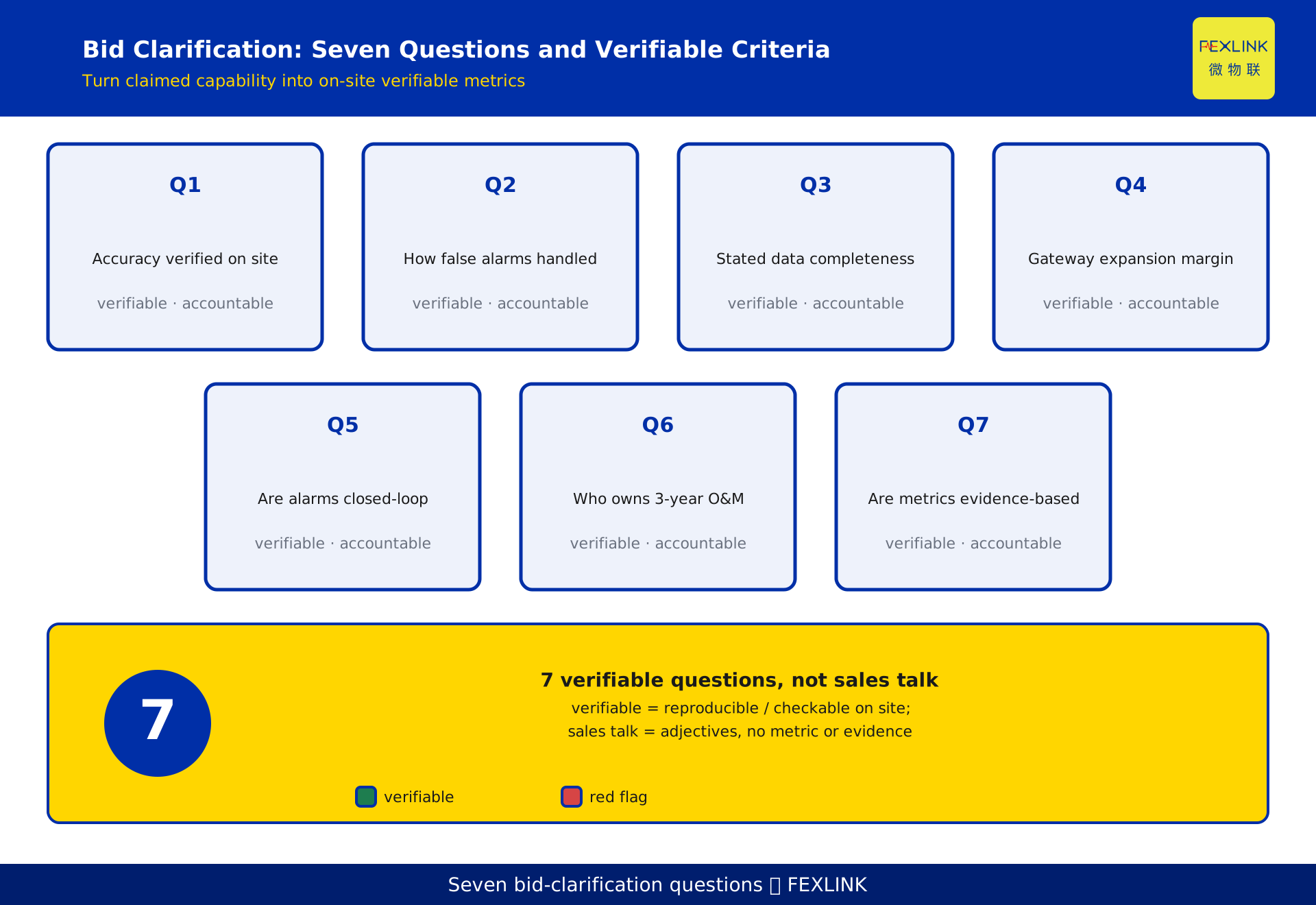
A bid clarification meeting is not a repeat of the sales presentation. It is the moment to use seven verifiable, accountable questions to surface the real capability - and the latent risks - that a polished demo hides. The whole point can be stated in one sentence: turn "claimed capability" into "metrics I can reproduce or verify on my own site", and write those metrics into a contract annex. Below are the seven questions, the answers you should listen for, a method to spot sales-talk red flags, and a one-page checklist you can bring into the evaluation room.
1. Why bid demonstrations fail to prove real capability
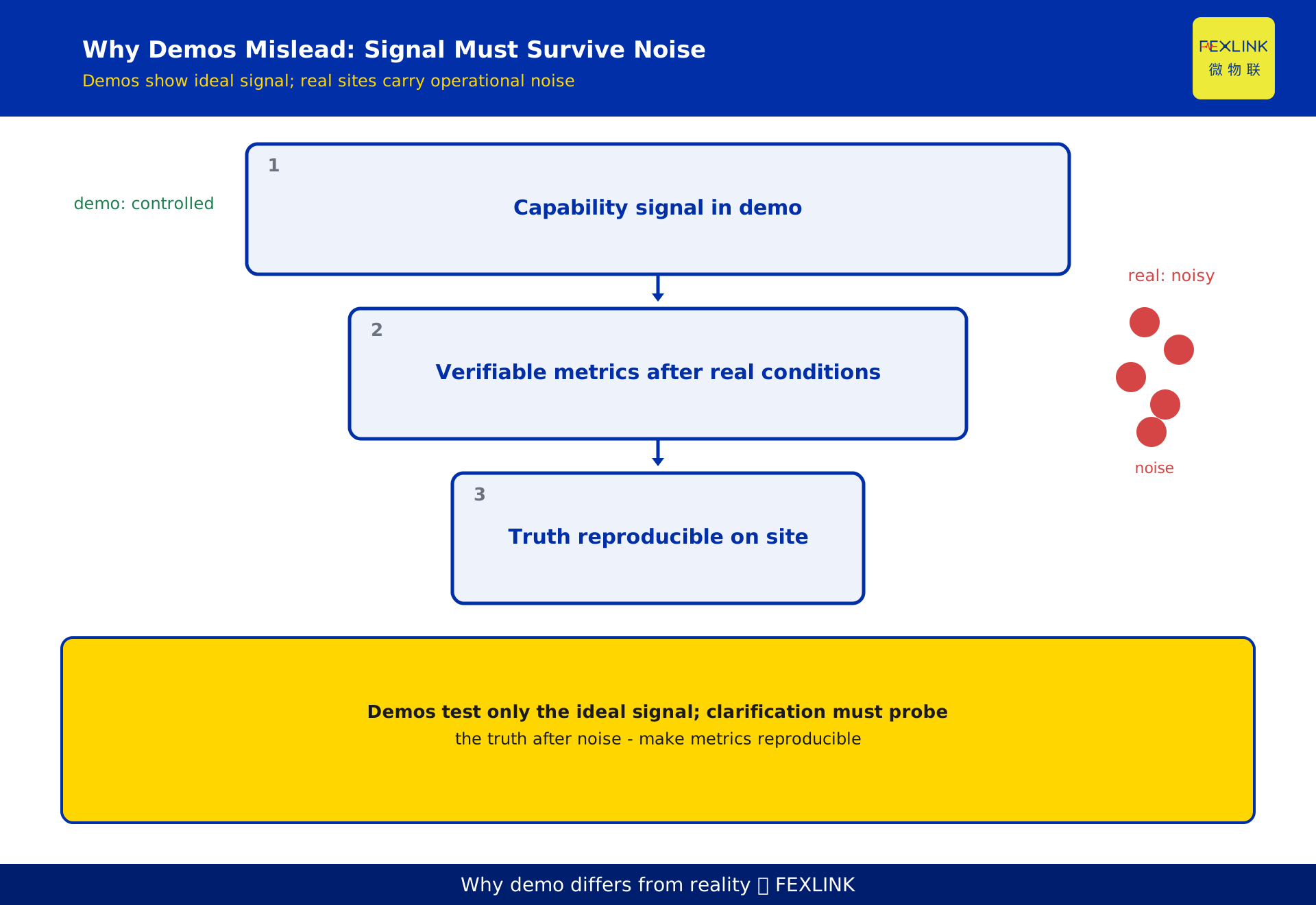
During evaluation, vendor demos usually look excellent: smooth curves on a large screen, alarms flashing, one-click reports. But the demo environment is controlled - the data is clean, the operating conditions are ideal, the network is unconstrained, and the metering points are hand-picked. The real site is different: legacy circuits, historical debt, interference sources, seasonal load swings, and network jitter all discount or even invalidate the "capability shown in the demo" under real operating conditions.
A demo only proves that something can be done under ideal conditions; it does not prove that it will be done stably and continuously at your site. The gap between those two statements is exactly where later disputes and hidden risks come from. The purpose of the clarification meeting is to expose that gap in advance with verifiable questions, rather than discovering it only after the contract is awarded.
FEXLINK, positioning itself as a company that produces data, builds an edge-cloud three-tier architecture whose goal is to turn field signals into usable data reliably. But any vendor's "capability" - once it lands on your site - must survive the question "can I reproduce it?". The linked solutions, such as the digital electrical supervision system and the predictive maintenance solution, only hold value once expressed in verifiable terms.
2. Seven questions to ask and what answers to expect
The seven questions below follow the principle of "verifiable and accountable", covering technical capability, data quality, scalability, and accountability. For each, the "answer to listen for" is given - if the vendor cannot answer, or answers vaguely, that is itself a red flag.
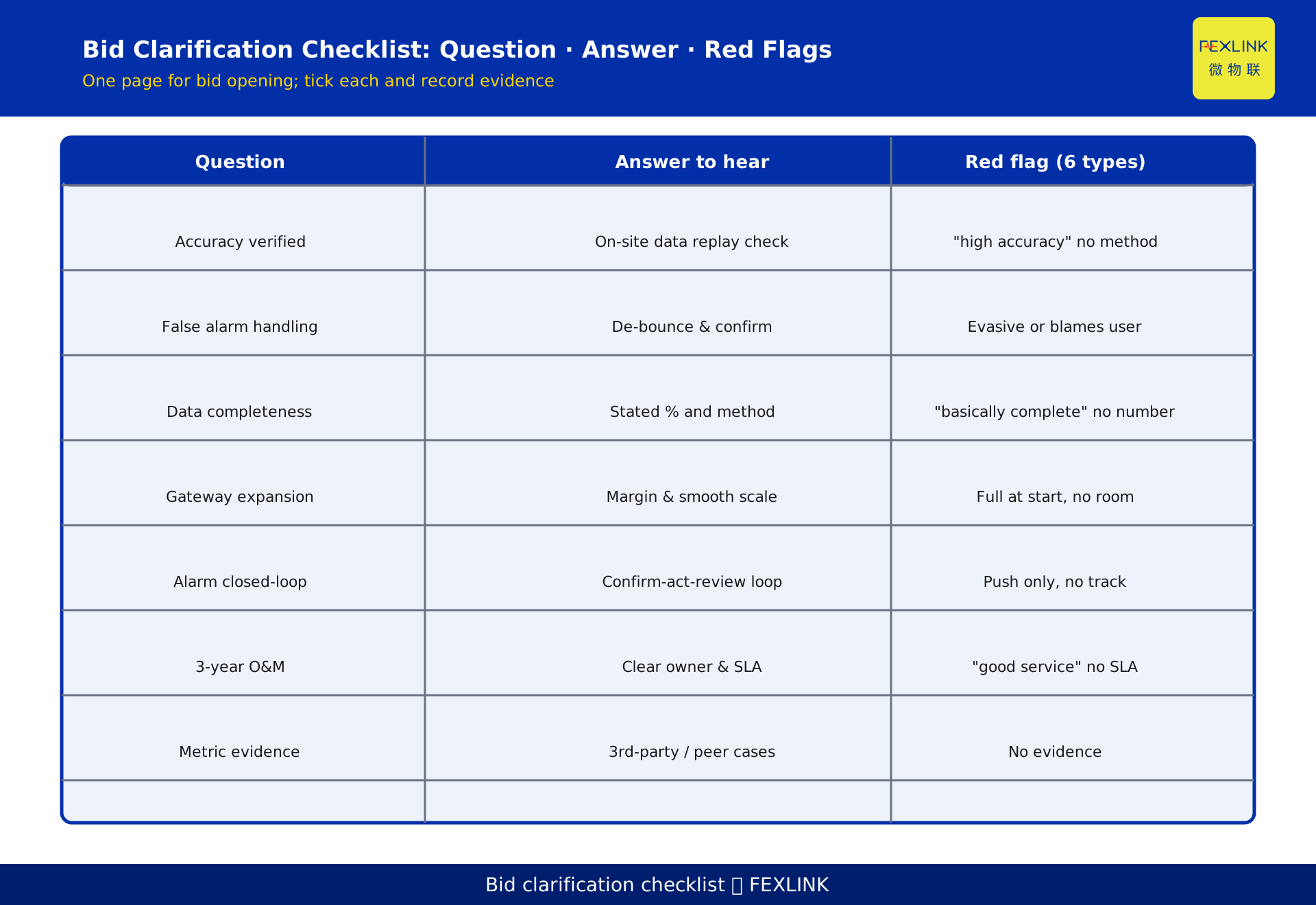
Q1. How can prediction accuracy be verified on my site? Listen for: a verification method that is reproducible at your site - for example, replaying historical data, or benchmarking against a real time window you provide - together with a defined way to compute precision and recall, rather than a bare claim that "accuracy is very high".
Q2. How are false alarms handled? Listen for: de-bounce, suppression, confirmation, and grading mechanisms; a stated false-alarm rate and how it is driven down - not a deflection that blames "your complex environment".
Q3. What data completeness do you commit to? Listen for: a concrete percentage with a stated statistical basis (for example, around 99% magnitude, by point or by time window), and a clear trigger level at which missing data initiates investigation - not "basically complete" or "should be fine".
Q4. What expansion margin does the gateway leave? Listen for: designed headroom in the edge gateway that supports smooth scaling (more points, more protocols), with the current capacity and ceiling stated - not a unit shipped already at full capacity with no room to grow.
Q5. Are alarms truly closed-loop? Listen for: a complete loop from generation, push, acknowledgement, handling, to review, with the loop path and the responsible owner named - not a system that merely "pushes" and stops there.
Q6. Who owns the three-year operation and maintenance? Listen for: a clear responsible entity and an SLA (response time, availability commitment, spares and upgrades) captured in writing - not an unsubstantiated promise like "our service has always been good".
Q7. Is there evidence behind the metrics? Listen for: key metrics backed by third-party testing, same-scale case references, or historical operating data - not only an internal marketing narrative.
3. Red-flag answers that signal sales talk
Identifying evasive or empty answers matters more than enjoying polished rhetoric. The common red flags are:
- Adjectives instead of metrics: using words like "industry-leading", "intelligent", "adaptive", or "one-click" in place of concrete numbers and definitions.
- Demo presented as conclusion: stating the "demo result" as if it were the "inevitable result at your site", avoiding any discussion of condition differences.
- Evading the verification method: when asked "how do I verify this on my site", answering "we have a lot of experience" or "it is generally fine" without giving a method.
- Generalized commitments: using vague qualifiers such as "basically", "should", or "usually", and refusing to give a quantifiable commitment.
- Refusing to put it in the contract annex: any statement like "we keep those metrics internally and it is inconvenient to write them into the contract" should be treated with caution.
- No supporting evidence: key metrics backed by neither third parties nor same-scale cases, only internal promotion.
Any single hit among these six red-flag types should be marked and followed up in the evaluation record.
4. Turning commitments into contract annexes
Commitments extracted in the meeting must be hardened into accountable text, or the clarification meeting is wasted. Recommended practice:
- Annex it: list the key metrics (accuracy basis, completeness commitment, false-alarm rate, expansion margin, alarm closed-loop requirement, O&M SLA) as a technical annex to the contract, with the same binding force as commercial terms.
- Quantify it: for every metric, state "value + statistical basis + assessment period + consequence of non-compliance", avoiding words like "good" or "stable".
- Make it verifiable: specify the acceptance or verification method (on-site replay, benchmarking against a time window, third-party sampling) so the commitment can be re-checked.
- Assign accountability: O&M and availability commitments name the responsible entity, response time, and penalties.
- Keep the trail: turn the Q&A into minutes, signed by both parties, as the interpretive basis for the annex.
Note: this article never writes any specific accuracy or energy-saving rate as a commitment of the solution; effect-type data do not enter the conclusion. Values a vendor discloses at the clarification meeting should be recorded as "vendor-disclosed values"; whether to rely on them is decided by the evaluation panel against the evidence.
5. A one-page clarification checklist
Compress the seven questions above into a single page you can bring to the site (see figure 3). Suggested fields: question number, the must-ask content, the vendor's answer summary, the verification method, whether a red flag was hit, the evidence or basis, and the recorder with date. Tick each item and leave space to fill in - do not treat a verbal answer as settled. The value of the checklist is turning "subjective impression" into an "auditable evidence chain".
6. Pre-meeting preparation checklist
What you prepare before the meeting decides how much truth you can extract:
- Compile the site inventory: list your circuits, your points, and your historical problems first.
- Prepare real data samples: pick a representative historical data window and ask the vendor to replay or benchmark against it on the spot.
- Lock the definitions: agree in advance how completeness, accuracy, and false-alarm rate are computed, to prevent the vendor from using a self-serving definition.
- Map the responsible persons: who answers technical, who answers commercial, who answers O&M - match them to people in the room.
- Pre-set red-flag follow-ups: for each possible empty claim, prepare a counter-question: "give me the concrete number or the evidence".
7. How this differs from KD-0991 (cost-based evaluation)
KD-0991 is about "how to evaluate by cost comparison" - when several proposals show a clear price gap, how to compare price, configuration, and hidden costs together. This article is a "due-diligence method for what to ask the vendor at clarification" - it focuses on using seven verifiable questions to make the capability real. The two are complementary: KD-0991 answers "is it worth the money", this article answers "is what the vendor says actually true". The incremental contribution here is the seven verifiable questions and the red-flag identification list.
FAQ
Q: Do we have to ask all seven questions every time?
Not necessarily. Prioritize by your site's pain points, but keep the "verifiable and accountable" principle intact. The three core questions - accuracy verification, completeness commitment, and alarm closed-loop - are recommended as mandatory.
Q: A vendor says accuracy is 99%; can we write that straight into the contract?
Not directly. First ask what that 99% means: what basis, on what sample, and how it is reproduced on your site. A disclosed value without a verified basis is only a reference and does not enter the conclusion.
Q: Does one red flag mean disqualifying the vendor?
Not always. Red flags flag risk and prompt follow-up; if the vendor can produce verifiable evidence, the item can be downgraded. The key is to expose the risk before selection, not after.
Q: What does this have to do with doing a demo?
The demo is the signal the vendor gives; the clarification is the verification you demand. This method puts the demo signal to the test against real-condition noise (see figure 2).
Q: How do I use this together with KD-0991?
First use this article to clarify "is the capability true", then use KD-0991 to compare "price gap and configuration"; only when both gates pass is the evaluation solid.
Scope and Limitations
- This article applies to owner-side bidding and technical clarification for parks, data centers, factories, and office buildings that adopt IoT or edge-cloud architectures for energy, equipment, and environment monitoring. Purely mechanical metering or points without return capability fall outside the automatic verification scope.
- The "seven questions" and "six red-flag types" are evaluation due-diligence methods, not mandatory checklists. Specific metric bases follow the actual system and the selection manual; this article does not constitute a mandatory technical rule or a procurement basis.
- No standard number or standard clause is cited. Any threshold or limit is expressed as "in combination with the actual system", and the conclusions do not serve as engineering acceptance criteria.
- The terms "a certain park / a certain data center / a certain factory / a certain office building / a certain building" are generic scene placeholders that correspond to no real customer, project, or place name; no identifiable customer information is used.
- The references to FEXLINK (a company that produces data, with an edge-cloud three-tier architecture), the digital electrical supervision system, and the predictive maintenance solution are contextual only, described qualitatively without fabricating platform parameters, accuracy figures, or connection counts; relevant capabilities follow the latest product knowledge base and do not enter the conclusion.
- Effect-type data (such as accuracy, energy saving, or ranking) never enter the conclusion. This article is positioned as a "bid-clarification due-diligence methodology", providing an actionable question list and red-flag identification, and does not constitute selection or procurement advice.
Frequently Asked Questions
Do we have to ask all seven questions every time?
Not necessarily. Prioritize by your site's pain points, but keep the "verifiable and accountable" principle intact. The three core questions - accuracy verification, completeness commitment, and alarm closed-loop - are recommended as mandatory.
A vendor says accuracy is 99%; can we write that straight into the contract?
Not directly. First ask what that 99% means: what basis, on what sample, and how it is reproduced on your site. A disclosed value without a verified basis is only a reference and does not enter the conclusion.
Does one red flag mean disqualifying the vendor?
Not always. Red flags flag risk and prompt follow-up; if the vendor can produce verifiable evidence, the item can be downgraded. The key is to expose the risk before selection, not after.
What does this have to do with doing a demo?
The demo is the signal the vendor gives; the clarification is the verification you demand. This method puts the demo signal to the test against real-condition noise (see figure 2).
How do I use this together with KD-0991?
First use this article to clarify "is the capability true", then use KD-0991 to compare "price gap and configuration"; only when both gates pass is the evaluation solid.