 FEXLINK Research Institute
Direct Answer
A site already running three separate systems — electrical safety, lightning protection, and energy — does not need a rip-and-replace. The key is not a fourth system but one unified data ingestion layer that aggregates the edge gateways, meters, and submeters each subsystem already owns into a single platform, enabling unified collection, domain presentation, and correlated analysis. Connect the data model and merge alarms first, then unify the interface: once data and alarms flow together, the split of three accounts and three screens is already more than half solved.
1. The real pain of three coexisting systems: accounts, data, and alarms split apart
Many campuses, data centers, and factories are not short of systems; they have too many in isolation. Early construction is staged, split by discipline and by vendor: one integrator for electrical safety, another for lightning monitoring, a separate rollout for energy metering. By the time the owner wants all three on one panel, they turn out to be islands.
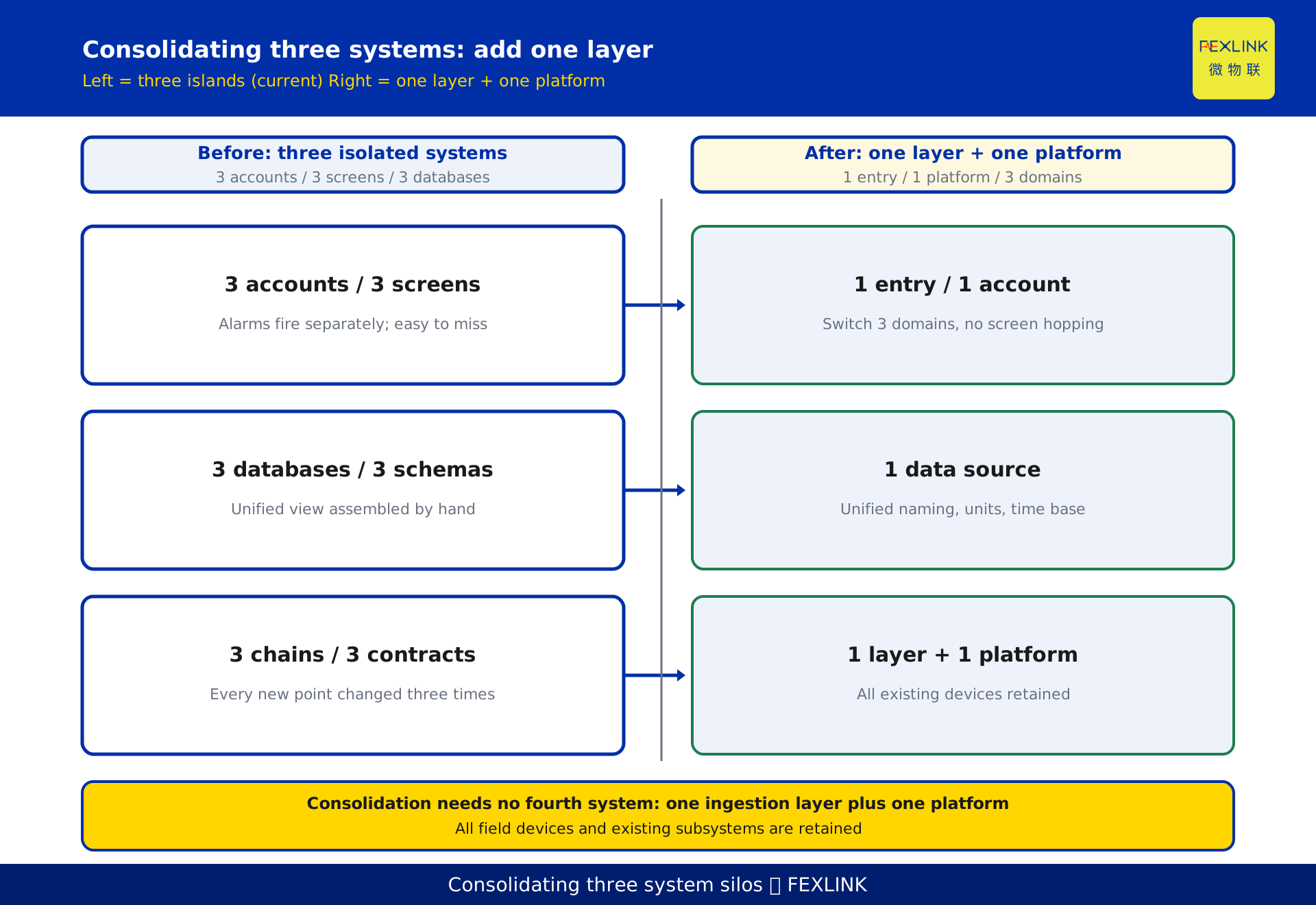
First, accounts and entry points split. Operators hold three accounts, three URLs, and three sets of credentials, switching between three screens all day. Alarms pop on screen A for safety, B for lightning, C for energy; if nobody stands before a given screen, that alarm might as well not have happened. This is a concrete missed-alarm risk, not a usability nuisance.
Second, data splits. The three overlap heavily: the same switchboard is metered for current and voltage by an electrical meter, metered again for current and energy by a submeter, and may carry a surge-protective-device status point from the lightning system. But the data sits in three databases, three table structures, and three protocols, so a unified picture of that switchboard is assembled by hand.
Third, investment splits. Three acquisition chains, storage stacks, maintenance contracts, and training tracks; every new point often changes in all three, and every upgrade or vendor outage ripples across all. The duplicated cost is not only hardware but long-term integration overhead.
The gap is not a lack of systems, but a lack of the layer that twists the existing ones into one rope.
2. Integration mindset: no rip-and-replace, start from a unified data ingestion layer
The tempting proposal is to rebuild one grand unified platform. In brownfield sites this almost never works: devices, gateways, and meters are already running their own business, and tearing them down means production-stopping retrofit, rewiring, and re-integration. The pragmatic path is to keep the brownfield and add the ingestion layer.
The core idea: leave field devices and existing edge nodes untouched, and add only a unified data ingestion layer that aggregates every available stream into one place, then performs collection, presentation, and analysis uniformly. It is downward-compatible with each vendor's gateways and meters, and upward exposes one unified data interface — not a fourth business system but an infrastructure layer for aggregation and translation.
In product terms, FEXLINK FS/ESM/FSS lightning monitoring, SFA/SFB/SFE electrical meters, and ESX/CW edge/industrial gateways are ready-made field-side capabilities. Integration does not replace them: the ESX/CW gateway or existing edge nodes push data to the ingestion layer, which performs protocol normalization, model alignment, and alarm merging. This is the brownfield use of the "Digital Electrical Intelligent Supervision System" and the "End-Edge-Cloud collaboration architecture" — adding a unifying layer above the stack, not overturning it.
3. The unified ingestion layer: connecting edge gateways and meters into one layer
The layer does three things: receive broadly, recognize clearly, manage well.
"Receive broadly" means wide ingestion capability. The field downlink is often RS485, Zigbee, and LoRa; the uplink commonly uses Ethernet, 4G, and MQTT. Wide input voltage DC9-36V and IP65 are what let an edge or industrial gateway stay online long term in harsh environments. The layer must pull from these heterogeneous links rather than demanding the field be rebuilt into one interface. For an ESX/CW class gateway, downlinking over RS485/Zigbee/LoRa and uplinking over Ethernet/4G/MQTT is its native role — the natural forward post of aggregation.
"Recognize clearly" means data-model alignment. Even measuring the same switchboard current, field names, units, timestamp precision, and point-table naming may all differ. The layer builds a unified "point-table to semantics" mapping: "I_A from safety," "IA from energy," and "cabinet current from lightning" all map to one semantic point, "phase current of switchboard X." This is the prerequisite for all later unified presentation and correlation, and the most underestimated yet most decisive step in brownfield consolidation.
"Manage well" means unified cadence and quality. Once collection tasks are consolidated, the layer offers a unified collection policy, resume-after-break, and time-base alignment, avoiding the chaos where safety samples every 15 minutes, energy every 1 minute, and lightning on event trigger — a chaos that makes later analysis impossible to align. Cadence should follow the business use, not the rule that finer is always better.
4. Three tiers: unified collection, domain presentation, and correlated analysis
Once data enters the layer, the business side needs to collect completely, see clearly, and correlate actively.
Unified collection: after normalization the platform interfaces with one data source instead of three; adding or adjusting a point is configured at the ingestion layer, invisible to the business system. Naming, units, and a time base are unified too, so no later analysis pays for "three inconsistent dialects" again.
Domain presentation: "domain" does not mean returning to fragmentation, but partitioned views inside one platform. The safety domain sees electrical-safety measurements and alarms, the lightning domain surge-protector status and lightning events, the energy domain consumption and efficiency. An operator logs into one account, opens one platform, and switches among the three domains instead of jumping between three screens. It preserves each discipline's habit while eliminating the physical split of accounts and screens.
Correlated analysis: once the model is connected, alarms that fired independently can be merged. A lightning strike (lightning domain) that induces a switchboard surge (safety domain) with a short-term consumption anomaly (energy domain) can, under a unified model, be correlated into one event chain instead of three unrelated alarms. Its value is not to replace professional judgment but to weave scattered signals into a net first.
5. Landing sequence: data first, interface later
The easiest pitfall is to start with a unified big screen or interface. It looks intuitive and is easy to report upward, yet it is the topmost layer. If the data model is not connected, it either becomes a fake unification stuffing three old interfaces into one web page, or churns through rework and fizzles out.
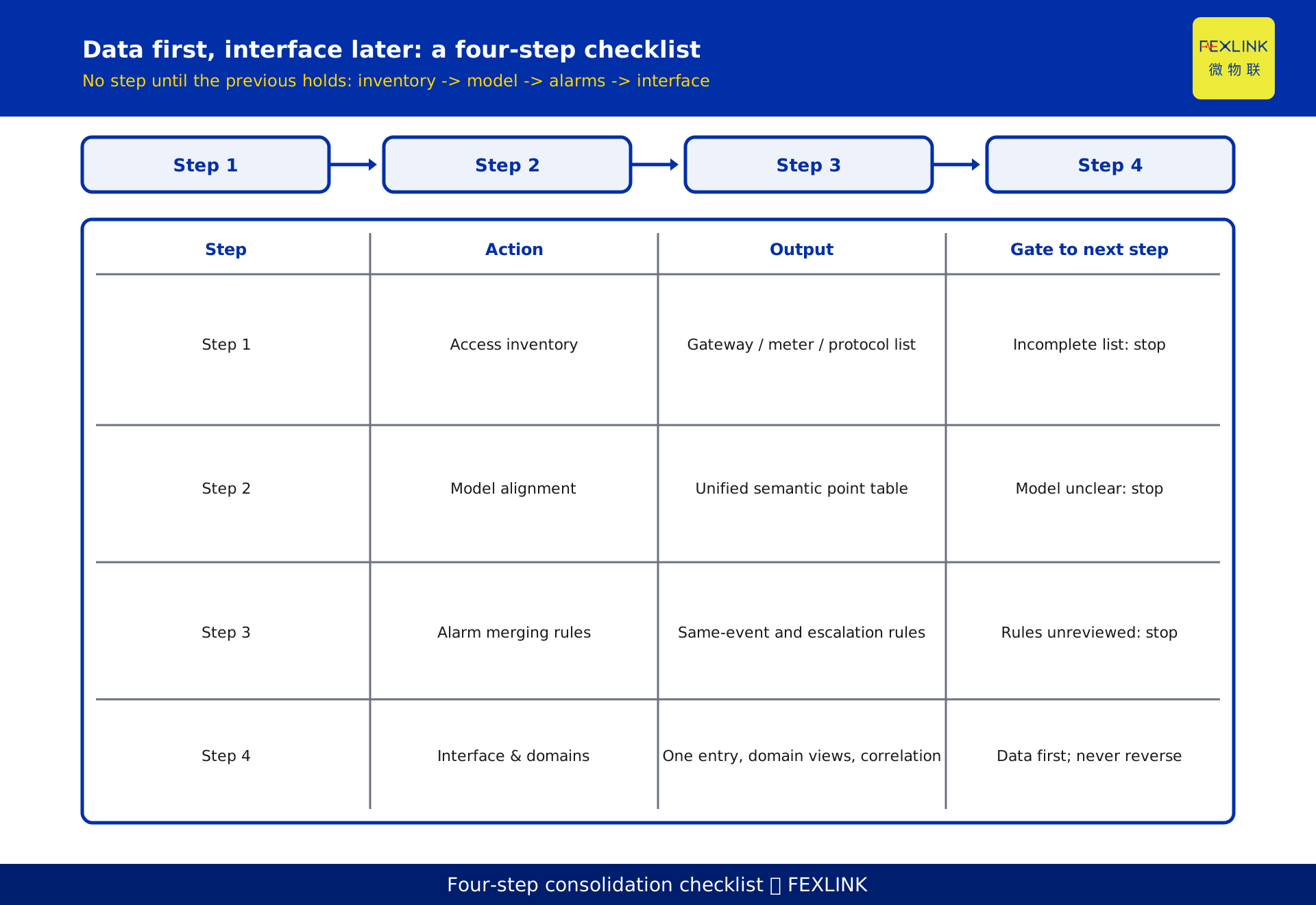
Four steps, and do not advance until the previous one is solid:
- Inventory the data access. List the gateways, meters, protocols, and point tables of each system. No code, just a checklist — yet it decides whether the later connection can hold.
- Align the data model. Build a unified semantic point table mapping same-named-but-different-structured quantities to unified semantics — the hardest bone, most worth doing first.
- Define alarm merging rules. Which alarms belong to one event, which need merging, which need escalation. Rules come from the business, not a guess.
- Unify interface and domains. On that foundation, unifying the entry, account, domain presentation, and correlated view becomes natural.
Do the "data connected" half solidly first; interface unification is the result, not the reverse. Reversing the order is often why projects run half a year and return to square one.
6. Multi-subsystem aggregation topology: one diagram explains the architecture
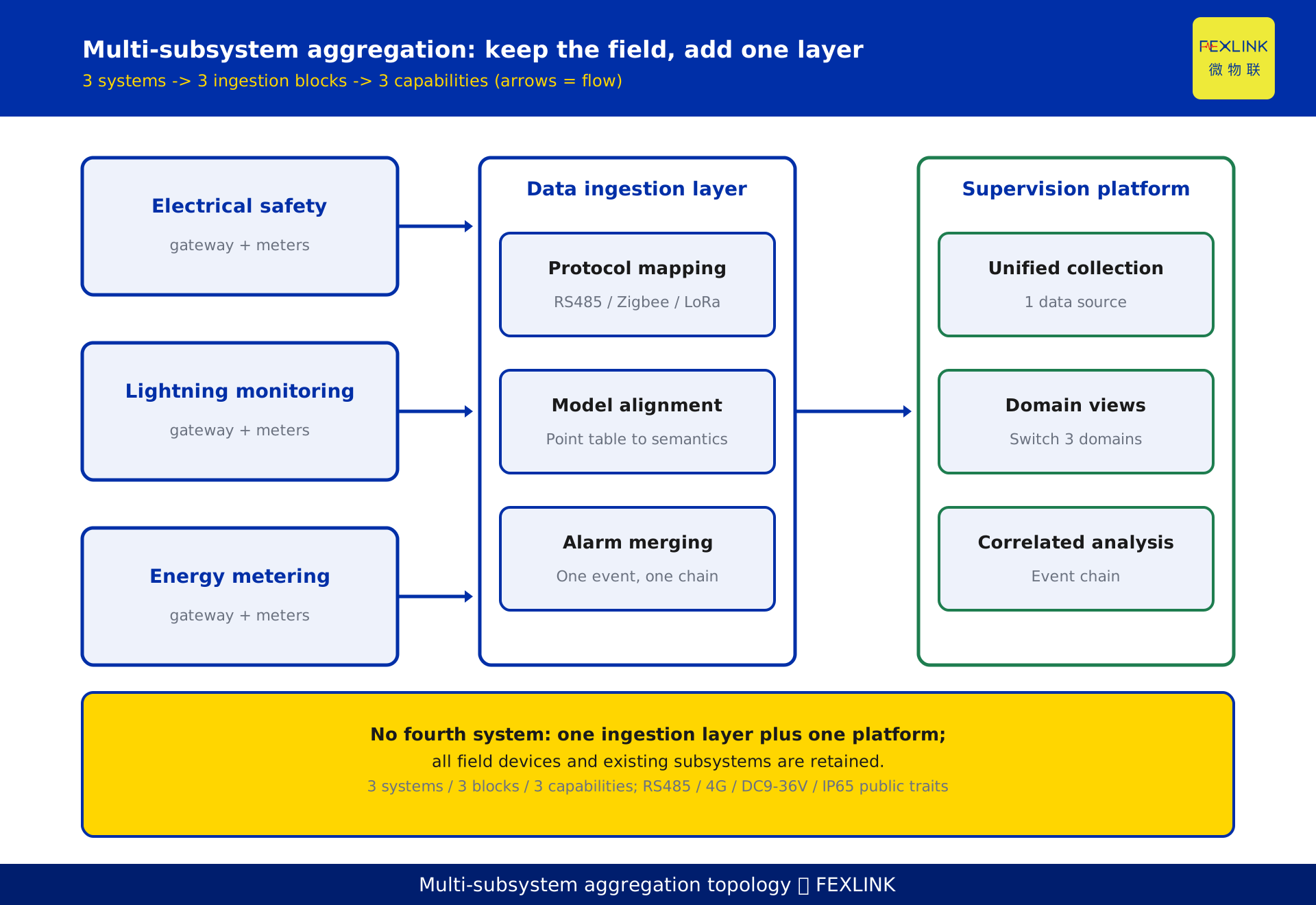
The figure places three existing subsystems on the left, the unified data ingestion layer in the middle, and the unified supervision platform on the right. The three left columns carry their own gateways and meters, flow right into the ingestion layer (protocol normalization, model alignment, alarm merging), then into the platform (unified collection, domain presentation, correlated analysis). Arrows express "field device → edge gateway/meter → ingestion layer → platform." The diagram labels real numbers such as three systems and three tiers; illustrative parameters are marked "illustrative."
The conclusion: consolidation needs no fourth business system, only one ingestion layer plus one platform. Field devices and existing subsystems are all retained; the investment is largely preserved, the production-stop risk largely avoided, yet the fragmented operations experience converges onto one panel.
7. How related products fit the integration path
Placing products inside this path clarifies their roles.
FEXLINK FS/ESM/FSS lightning monitoring handles surge-protector status, lightning strike count, grounding resistance, and related monitoring. During consolidation it remains the professional data source of the lightning domain; it only sends data to the ingestion layer for semantic alignment.
SFA/SFB/SFE are electrical meters with progressive capabilities: SFA basic metering (current, voltage, power), SFB adds phase-related measurement, SFE adds harmonic measurement. They provide measurements shared by both the electrical-safety and energy domains — the same meters serve both, showing that "one device, multi-domain reuse" removes duplicated investment.
ESX/CW are edge/industrial gateways downlinking over RS485/Zigbee/LoRa and uplinking over Ethernet/4G/MQTT; wide input voltage DC9-36V and IP65 let them stay online in switchgear rooms, rooftops, and outdoor enclosures. They are naturally the forward post. But a gateway's job is aggregation and translation; accuracy, range, and price follow the latest selection manual and product knowledge base. This article makes no such commitments.
8. Boundary with the four-layer three-dimensional framework (KD-0966)
KD-0966 discusses landing the four-layer three-dimensional framework, i.e. how a new project enters from a top-level framework. This article is different, and the distinction matters.
KD-0966 faces a blank sheet: no systems yet, so build downward from the top-level design, framework first. This article faces a site with a pile of systems: the three islands exist, and the focus is aggregating upward from the ingestion layer — brownfield consolidation, not new-framework landing. Its increment is the unified ingestion layer and data-model connection: how to twist existing subsystems into one rope at low cost.
The paths are complementary: a new project uses the framework to build the skeleton, a brownfield project uses the ingestion layer to stitch the existing skeleton together; both converge into the "End-Edge-Cloud collaboration architecture." For a new project read KD-0966 first; for three running legacy systems, "data first, interface later" here is more to the point.
FAQ
Q: Does consolidating three systems mean tearing down and rebuilding the originals?
No. Keep the brownfield and add the ingestion layer. Field devices, gateways, and meters are essentially untouched; only a unified data ingestion layer is added. Rip-and-replace is costly and carries production-stop risk.
Q: Will the unified ingestion layer become a new single point of failure?
It needs focused availability protection, reducible through redundant deployment, resume-after-break, and local caching. It only aggregates and translates, not replacing each subsystem's local control and protection; even if briefly abnormal, field safety is still backed by the subsystems.
Q: The three systems' data models differ a lot; how long does alignment take?
It depends on point-table scale and standardization; there is no uniform schedule. Do the access inventory and semantic point table solidly first, rather than rushing to write integration code.
Q: Will alarm merging drown important alarms?
The goal is weaving multiple alarms of one event into an event chain, not eliminating them. Business defines which belong together, which escalate, which stay independent. Improper merging can mask signals, so rules must be reviewed and reversible.
Q: Which article should I read, this one or KD-0966?
For a new project with no systems yet, KD-0966; for multiple running legacy systems, this article's ingestion layer and "data first, interface later." Complementary, not mutually exclusive.
Scope and Limitations
- Applies to brownfield sites — campuses, data centers, factories, buildings — already running separate electrical-safety, lightning, and energy subsystems that wish to supervise them uniformly without rip-and-replace. Purely manual metering or points with no return-channel capability are outside automatic aggregation.
- Terms such as "unified data ingestion layer," "unified collection," "domain presentation," "correlated analysis," and "data first, interface later" are methodological, involving no mandatory standard or acceptance clause. The related standards field is empty; no standard number or clause is cited.
- FS/ESM/FSS lightning monitoring, SFA/SFB/SFE electrical meters, and ESX/CW edge/industrial gateways are described only qualitatively and by role: the progression of SFA basic metering, SFB adding phase, SFE adding harmonic, and the public-range traits of ESX/CW downlink RS485/Zigbee/LoRa, uplink Ethernet/4G/MQTT, wide input voltage DC9-36V, and IP65. Accuracy, range, and price follow the latest selection manual and product knowledge base; this article makes no commitments and constitutes no selection or procurement advice.
- "Campus / data center / factory / building" are generic placeholders for no real customer, project, or place; all cases are desensitized. The "Digital Electrical Intelligent Supervision System" and "End-Edge-Cloud collaboration architecture" are referenced in solution context only; no platform parameters or device counts are fabricated.
- Effect-type data such as energy-saving rate, accuracy rate, ranking, or payback period never enter the conclusions. This article is a methodological path with an actionable sequence and architectural rationale, and constitutes no effect commitment.
Frequently Asked Questions
Does consolidating three systems mean tearing down and rebuilding the originals?
No. Keep the brownfield and add the ingestion layer. Field devices, gateways, and meters are essentially untouched; only a unified data ingestion layer is added. Rip-and-replace is costly and carries production-stop risk.
Will the unified ingestion layer become a new single point of failure?
It needs focused availability protection, reducible through redundant deployment, resume-after-break, and local caching. It only aggregates and translates, not replacing each subsystem's local control and protection; even if briefly abnormal, field safety is still backed by the subsystems.
The three systems' data models differ a lot; how long does alignment take?
It depends on point-table scale and standardization; there is no uniform schedule. Do the access inventory and semantic point table solidly first, rather than rushing to write integration code.
Will alarm merging drown important alarms?
The goal is weaving multiple alarms of one event into an event chain, not eliminating them. Business defines which belong together, which escalate, which stay independent. Improper merging can mask signals, so rules must be reviewed and reversible.
Which article should I read, this one or KD-0966?
For a new project with no systems yet, KD-0966; for multiple running legacy systems, this article's ingestion layer and "data first, interface later." Complementary, not mutually exclusive.