 FEXLINK Research Institute
The short answer
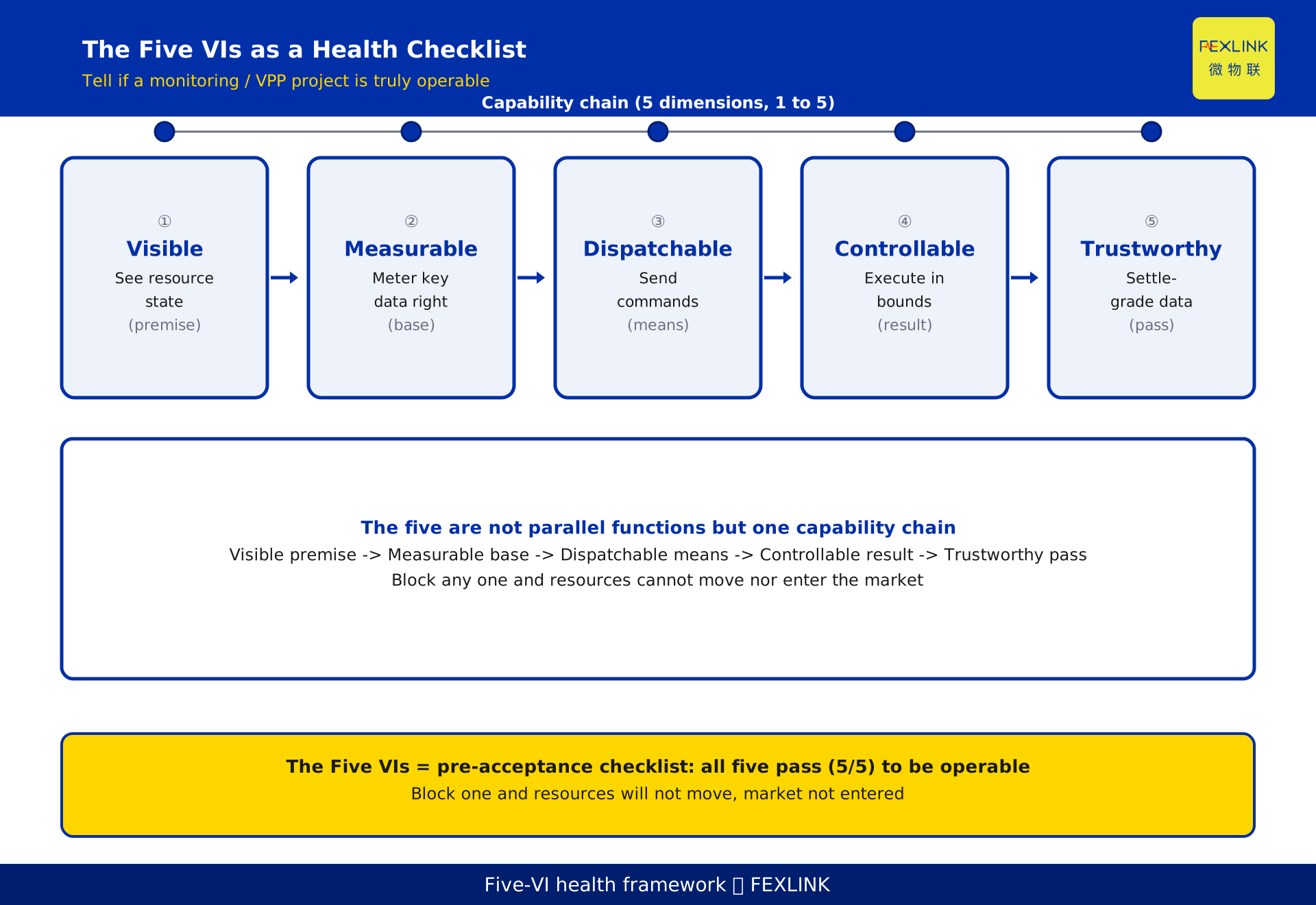
To tell whether a monitoring or virtual-power-plant (VPP) project is truly operable or merely "built and demonstrable", use the "Five VIs" as a health checklist: Visible (you can see resource state), Measurable (data is accurate), Dispatchable (commands reach the assets), Controllable (commands actually execute within safe bounds), and Trustworthy (data is accepted for settlement). Only when all five pass can you call it operable; if any one is blocked, the resources cannot be dispatched and the market cannot be entered. Below, each of the five is broken into checkable criteria.
1. Why "passed acceptance, yet cannot be operated"
Many owners have seen the same scene: at acceptance the dashboards look good and the demo runs smoothly, so the review passes and the project is declared "done". But when it is time to join demand response, do peak-valley arbitrage, or aggregate distributed resources for market regulation, the system simply will not move — commands are sent but devices do not respond, data never returns, and the books do not reconcile at settlement.
The problem is not that the engineering "was not done", but whether what was built can be operated long term. Between "built and usable" and "operable" lies a capability gap: acceptance checks whether functions exist and the demo works; operation checks whether resources can be continuously sensed, metered, dispatched, controlled and trusted. The "Five VIs" checklist in this article turns that gap into five items you can tick one by one, so you find the gaps before acceptance instead of after.
FEXLINK positions itself as a company that produces data; its edge-cloud three-tier architecture aims to keep these five things — Visible, Measurable, Dispatchable, Controllable, Trustworthy — stable and controllable. But as a health-check method it applies to any platform.
2. What each of the Five VIs means
- Visible: can you see, in real time and in full, the operating state of dispersed resources and the aggregated overall picture? Where the resource is, whether it is online or offline, how much it is generating or storing right now — the operator should tell at a glance on the dashboard.
- Measurable: can the key quantities of a resource be metered accurately? Power, energy, voltage, frequency, response volume — only if these are measured correctly does everything else stand on solid ground; if they are wrong, both dispatch and settlement rest on a shaky base.
- Dispatchable: can regulation commands be sent down to the resource side? Ramp-up points, ramp-down points, start/stop, power setpoints — is the command channel open and does it reach every resource it should?
- Controllable: after the command is sent, does the resource actually move as instructed, and always within safe bounds? Controllable stresses "executed correctly + never exceeds bounds" — it looks at both response and protection.
- Trustworthy: does the data carry settlement-grade credibility — consistent metering scope, aligned timestamps, traceability and auditability, so it is accepted by the market operator or settlement party?
The five are not five parallel functions but a capability chain: Visible is the premise, Measurable is the foundation, Dispatchable is the means, Controllable is the result, and Trustworthy is the pass.
3. The field capability gap behind each VI
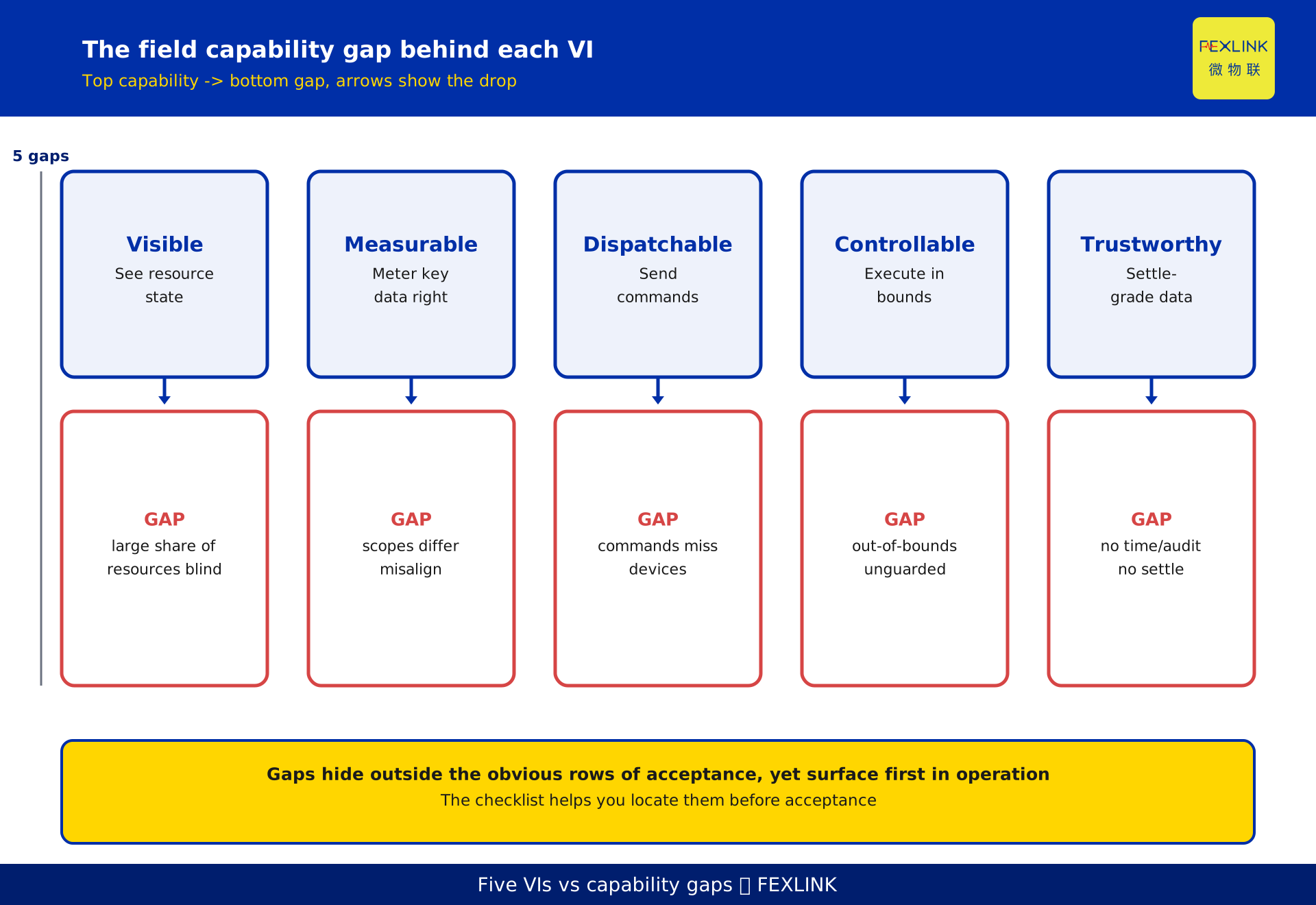
When acceptance passes yet operation fails, it is usually because one of the VIs has a gap in the field. The mapping:
- Visible gap: incomplete resource inventory, inflated point online-rate, dashboards showing only totals without per-resource detail. It looks "visible" on the surface while a large share of resources sits in a blind spot.
- Measurable gap: metering devices lack accuracy, different resources use different scopes, edge-side alignment is missing. Once volumes are aggregated the data no longer lines up, and nobody can say where the "one kWh ramped up" actually came from.
- Dispatchable gap: commands only reach the gateway, not the device; or only manual dispatch is supported, not automatic. For minute-level continuous regulation, manual operation simply cannot keep up.
- Controllable gap: the device receives the command but does not execute, or executes beyond a safe bound with nobody to intercept. The typical case is missing over-limit protection and missing interlocking logic, turning "controllable" into "dare to dispatch but dare not trust".
- Trustworthy gap: no aligned timestamps, no audit trail, metering scope inconsistent with settlement. The data "works" but "cannot settle", and is bounced back the moment it enters the market.
These gaps rarely sit in the obvious rows of an acceptance checklist, yet they are the first things to surface during operation and market participation.
4. Why "Trustworthy" decides whether you can settle
For a VPP to join the electricity market, demand response or ancillary services is essentially a "trade data for revenue" business: the regulation capacity you declare and the response you actually deliver are both settled, reconciled and scrutinised on the strength of data.
Even if a project passes Visible, Measurable, Dispatchable and Controllable, as long as "Trustworthy" fails it remains an internal showcase and cannot enter settlement. The reasons are direct:
- The settlement party wants traceable, auditable, scope-consistent data, not "roughly the same".
- Misaligned timestamps mean the "same response" recorded front and back no longer matches; inconsistent metering scope produces systematic deviation between declared and settled volume.
- Without an audit trail, when a dispute arises there is no way to reconstruct "how much was actually dispatched, and why".
So Trustworthy is not a nice-to-have among the five, but the final kick that converts the first four capabilities into market revenue. NDRC and NEA document [2025] No. 357 promotes virtual power plants as independent market entities participating in electricity markets and demand response; its policy direction is precisely to give VPPs a capability base that is metered, tradable and settleable. This article discusses it only as qualitative policy context, and the specific clauses are subject to the currently published text.
5. Checking your project item by item with the Five VIs
Turn the five into an acceptance-time checklist and tick each item:
- Visible: pick a resource at random — can you see its real-time state and its last-24-hour curve on the dashboard? Does the online-rate statistic exclude "fake online" points?
- Measurable: does the key-quantity metering meet accuracy? Is the metering scope unified across resources? Can aggregated data be traced back to source item by item?
- Dispatchable: can regulation commands be sent to target resources automatically? Does the command channel cover all resources that should be dispatched?
- Controllable: after execution, does the resource actually move as commanded? Is there over-limit protection and interlocking logic as a backstop?
- Trustworthy: does the data carry aligned timestamps, traceability and auditability? Is the metering scope consistent with the market settlement scope?
Only when all five pass does the project have the groundwork for sustained operation and market regulation; if any one fails, fix that one first before talking about go-live or aggregation.
6. A Five-VI health scoring table
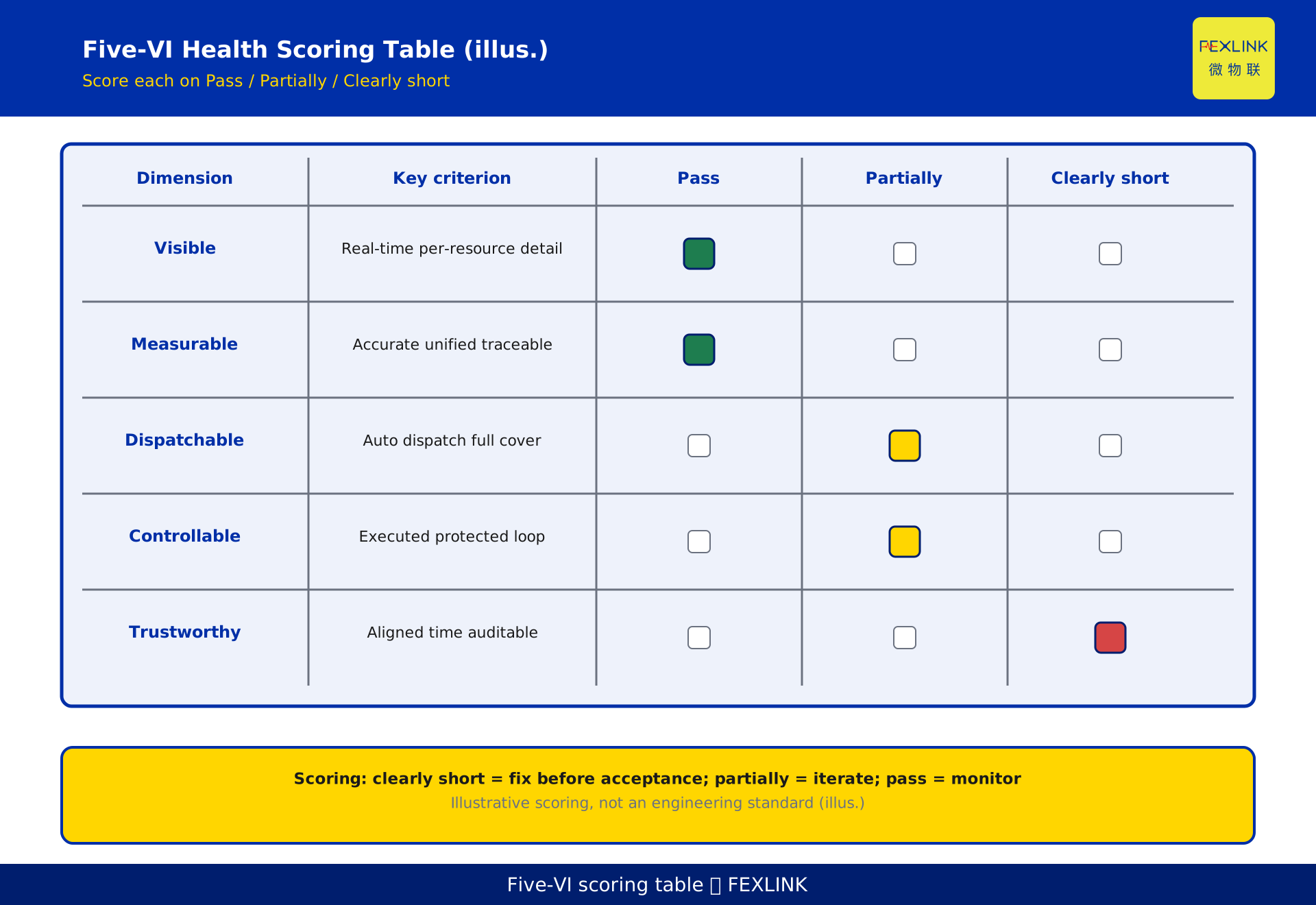
Score each item on three bands — Pass / Partially / Clearly short (illustrative scoring, not an engineering standard) — to locate the weak links fast:
| Dimension | Key criterion | Pass | Partially | Clearly short |
|---|---|---|---|---|
| Visible | Real-time, per-resource detail | Full coverage | Totals only | Large blind spot |
| Measurable | Accurate, unified scope, traceable | All met | Scope mismatch | Cannot align |
| Dispatchable | Auto dispatch, full coverage | Full coverage | Partly manual | Cannot reach device |
| Controllable | Executed, protected loop | Protected | Weak protection | No interlock |
| Trustworthy | Aligned time, auditable, consistent | All present | Partly missing | Cannot settle |
Scoring conclusion: a "clearly short" item must be fixed before acceptance; a "partially" item should be prioritised for iteration after go-live; a "pass" item should be maintained and put under daily monitoring. The illustrative scores are method demonstration only; a real health check should follow the actual capability of your system.
FAQ
Q: Which of the five VIs matters most?
None alone. The five form a capability chain; Trustworthy is the "pass", but without the first four, Trustworthy has nothing to build on. If any one is blocked, the resources cannot be dispatched.
Q: Does passing acceptance mean it is operable?
Not necessarily. Acceptance looks at functions and demo; operation looks at continuous sensing, metering, dispatch, control and settlement. This checklist fills exactly that gap, and is best used before acceptance.
Q: Does Trustworthy require blockchain?
Not necessarily. The core of Trustworthy is aligned timestamps, consistent scope, traceability and auditability; the technical means can vary and need not be tied to any particular solution.
Q: Do the Five VIs apply only to virtual power plants?
No. They apply to any monitoring system that needs "long-term operation + resource regulation + data settlement", such as campus energy aggregation or distributed-PV clusters.
Q: How does this differ from KD-0988 (which indicators management should watch)?
KD-0988 is the post-go-live operations KPI (what management watches); this article is the Five-VI health framework for judging, before acceptance, whether a project is truly operable. The increment is using the five VIs as a pre-acceptance health checklist.
Scope and limitations
- The "Five VIs" health framework in this article applies to monitoring and VPP-type projects that use IoT collection and an edge-cloud architecture, require sustained operation and may join market regulation — such as campuses, data centres, offices and distributed-resource aggregation. Pure display-type points with no dispatch command and no settlement need are only for reference and fall outside the mandatory health scope.
- The "NDRC and NEA document [2025] No. 357" is cited only as qualitative policy context, indicating its direction of promoting VPPs as independent market entities in electricity markets and demand response. This article quotes no specific clause number, ratio or timeline from it; all policy content is subject to the currently published text, and this article is not a policy interpretation or engineering basis.
- The scores and bands (Pass / Partially / Clearly short) are illustrative constructs to explain the method, not mandatory standards; a real health check should follow the actual capability of your system and its selection manual.
- The terms "a campus / a VPP pilot / a data centre / an office" are generic scene placeholders, not tied to any real customer, project or place, and no identifiable customer information is used; specific VPP project names are never written.
- The virtual-power-plant service, edge-cloud coordination architecture and "Five VIs" framework mentioned are cited as solution context only, described qualitatively without fabricated platform parameters or device counts, and are not a selection or procurement recommendation.
- Effect-class data such as saving rate, accuracy rate or ranking never enter the conclusions of this article; its positioning is a "operability health framework" methodology, providing the meaning of the five VIs, capability gaps, the Trustworthy-settlement relation, the item-by-item health method and the scoring table.
Frequently Asked Questions
Which of the five VIs matters most?
None alone. The five form a capability chain; Trustworthy is the "pass", but without the first four, Trustworthy has nothing to build on. If any one is blocked, the resources cannot be dispatched.
Does passing acceptance mean it is operable?
Not necessarily. Acceptance looks at functions and demo; operation looks at continuous sensing, metering, dispatch, control and settlement. This checklist fills exactly that gap, and is best used before acceptance.
Does Trustworthy require blockchain?
Not necessarily. The core of Trustworthy is aligned timestamps, consistent scope, traceability and auditability; the technical means can vary and need not be tied to any particular solution.
Do the Five VIs apply only to virtual power plants?
No. They apply to any monitoring system that needs "long-term operation + resource regulation + data settlement", such as campus energy aggregation or distributed-PV clusters.
How does this differ from KD-0988 (which indicators management should watch)?
KD-0988 is the post-go-live operations KPI (what management watches); this article is the Five-VI health framework for judging, before acceptance, whether a project is truly operable. The increment is using the five VIs as a pre-acceptance health checklist.