 FEXLINK Research Institute
The short answer
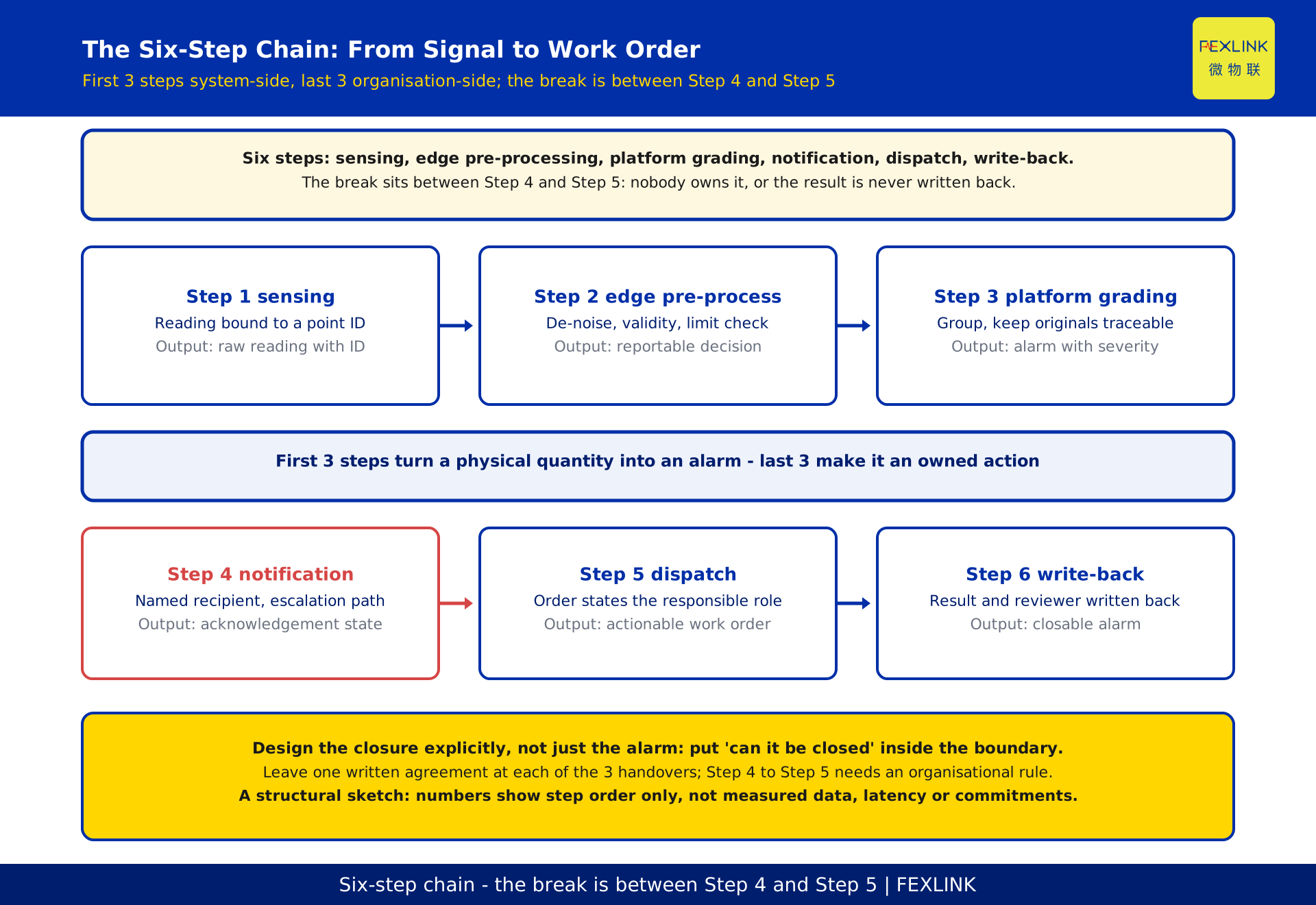
A temperature reading becomes a work order someone handles through six steps: sensing, edge pre-processing, platform alarm grading, notification to a named person, dispatch and field action, and closure write-back. The first three are system-side; the last three are organisation-side. The chain rarely breaks at sensing or at the algorithm. It breaks between Step 4 and Step 5: a message goes out, but nobody is named as responsible, or the field work finishes and nobody writes the result back. The architecture must design the closure explicitly, not stop at "alarm sent". Numbers here count steps, categories and self-check questions only; they are not measured data, latency figures or performance commitments.
The six-step chain: a complete history of one alarm
Every step needs one input/output definition that could go into an interface document.
| Step | Input | Output | Owner |
|---|---|---|---|
| Step 1 sensing | Physical temperature in the cabinet | Raw reading with a point identifier | Sensing device and access side |
| Step 2 edge pre-processing | Raw reading | Cleaned value and limit-crossing decision | Edge side |
| Step 3 platform grading | Decision plus context | Alarm with object and severity | Platform side |
| Step 4 notification | Alarm | Named recipient and acknowledgement state | Shift organisation |
| Step 5 dispatch | Acknowledged alarm | Work order with a responsible role | Operations process |
| Step 6 write-back | Field result | Closable alarm and ledger record | Review role |
The point is not technical difficulty but that the output changes kind: physical quantity, reading, alarm, signed record. Many designs specify the first 3 steps in detail and cover the last 3 with one line about "pushing to relevant staff". That is where the chain collapses.
System side: from a physical quantity to a meaningful alarm
Step 1 is sensing. A reading carries no meaning until it is bound to a point identifier: which cabinet, which circuit, which joint. Point naming must share one source with the drawings and the asset ledger; a temporary label such as "temperature one" leaves the grouping in Step 3 and the write-back in Step 6 without an anchor.
Step 2 is edge pre-processing. Protocol conversion and multi-protocol access live here. The FEXLINK ESX/CW series edge computing gateway and the equipment wristband are named in the registry for this role: arranging signals from different sources into one readable form. The name is a registered role only — no model, range, channel count or communication parameter is specified. De-noising, validity checks and limit decisions also happen here, judged by sustained rather than instantaneous excursions. The limit comes from the site equipment list and operating rules; no value or fixed threshold is given.
Step 3 is platform alarm grading. The platform turns a limit decision into an actionable object: device, location, severity, first-seen time and underlying raw readings. The grouping rule must be written down — signals from the same device, in the same period, pointing to the same field action may become one alarm, but the original signals remain traceable.
Organisation side: from an alarm to an owned action
Step 4 is notification to a person, not to a group. Each alarm needs a named recipient, a shift, and an escalation path when nobody acknowledges. A group post is a broadcast, with no acknowledgement state and no starting point for responsibility.
Step 5 is dispatch and field action. Once acknowledged, the alarm generates a work order stating the responsible role, the permitted action scope, and what the field visit must bring back. If the system stops at "read", the operator knows something happened but nobody has been sent. Authority matters too: the action entry point must sit on the same chain, not behind a second login.
Step 6 is closure write-back. The field result, the reviewer and the state change are written back to the original alarm, and only then may it close. The test: any historical alarm must answer who took it, what was done and who confirmed closure; otherwise the first 5 steps produced messages, not results.
Three handovers: where the responsibility boundary is written
Document the handovers, not each step's implementation: three written agreements beat ten extra screenshots.
| Handover | Position | Agreement to state | Symptom when missing |
|---|---|---|---|
| Edge to platform | Between Step 2 and Step 3 | Mapping from raw readings to alarms; local buffering and backfill duty during an outage | Alarm has a severity but no readable origin |
| Platform to shift | Between Step 3 and Step 4 | Named recipient, shift coverage, escalation target when unacknowledged | Message sent, nobody claims it |
| Shift to ledger | Between Step 5 and Step 6 | Shared identifier for order and alarm, who fills write-back fields, closing condition | Work done, system still shows open |
Two of the three are organisational agreements, and they are the ones most often skipped: technical side and owner each assume the other owns them. Naming the document and role that sets each agreement is an architecture deliverable.
Time scale: why latency is a relative quantity
Four rhythms must be separated. Sensing is a continuous or fixed-cycle device action. Edge pre-processing is an immediate device-side judgement. Platform grading and grouping run in batches and need not be synchronous. Notification, dispatch and write-back advance on human shifts and ledger cycles.
No millisecond, second or minute figures are given here, and no response time is set. Such values must be measured on site and written into requirements, not copied from a template. Judge rhythm mismatch instead: treating a shift-paced action as second-paced, or pushing an immediate limit signal into a daily report. Solution names from the registry are recorded as names only and carry no timing parameters.
The last mile: 4 causes of the break between Step 4 and Step 5
The break between notification and dispatch is an organisational and interface problem, not an algorithm problem, with 4 recurring causes.
One, the recipient is vague. The alarm points to a role or a group, with no named person on shift and no escalation target. Test: pick any alarm and name a person or staff ID.
Two, authority is undefined. The operator sees the alarm but has no entry point to generate an order, so the only route is a phone call. Test: does going from alarm to order require a system switch or an offline conversation?
Three, there is no order as a carrier. Action is agreed verbally and cannot be matched back to the alarm. Test: do the order and the alarm share one identifier?
Four, there is no closing condition. The field work finishes, but nobody defined "finished" and nobody writes back, so the alarm hangs open. Test: is a field result and a reviewer required before the close action?
Any one of the 4 leaves Step 6 unreachable. Diagnose backwards: closing condition, shared identifier, authority, recipient.
Why write-back decides whether the system is worth anything
Closure is not a reporting feature; it is the only way the system can demonstrate value. First, review becomes possible: a full trace shows whether the limit, the point or the process was at fault. Second, workload becomes visible: repeated points and empty actions appear only in write-back records. Third, grouping rules can be tuned against field results rather than guesswork.
This yields one decision rule for the project brief: put "can an alarm be closed" inside the functional boundary instead of treating "can an alarm be sent" as completion. The former requires a carrier, named owners and write-back fields across the last 3 steps; the latter requires only a push channel. Conflating the two at requirements stage guarantees a dispute at handover.
A swimlane sequence for the alarm-to-order flow
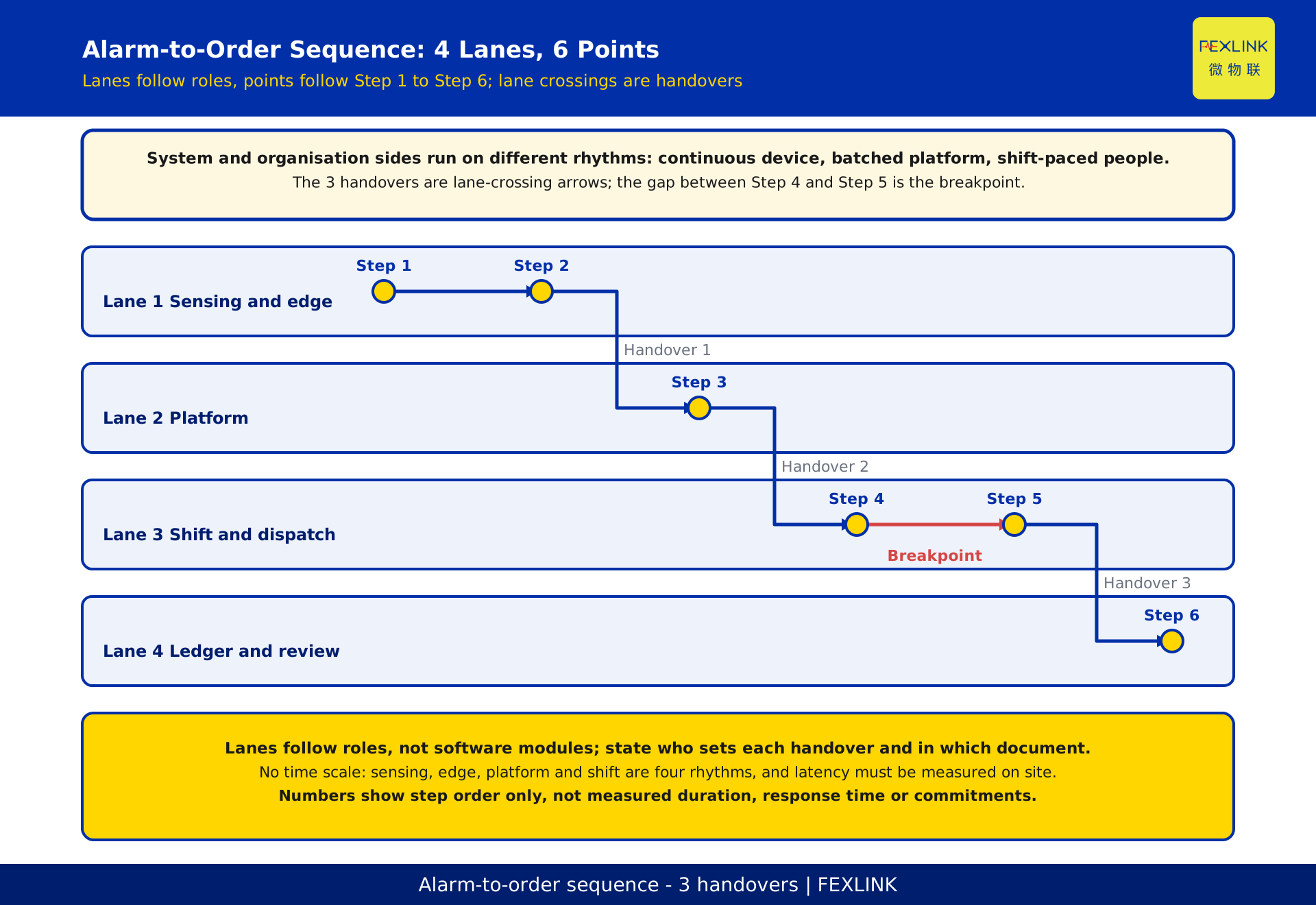
The swimlane sequence is, in document form, 4 lanes: sensing and edge, platform, shift and dispatch, ledger and review. The 6 points follow the steps in order: sensing and edge cover Step 1 and Step 2, the platform covers Step 3, shift and dispatch cover Step 4 and Step 5, ledger and review covers Step 6.
Draw the 3 handovers as arrows crossing lanes, and mark the gap between Step 4 and Step 5 separately as the breakpoint, in a different colour, labelled as needing an organisational agreement. One picture answers which leg holds the data, which holds responsibility, and which is most likely to drop it. Lanes follow roles, not modules, so this aligns better with a process owner than a functional diagram. Numbering shows step order only.
Scene: one temperature alarm in a distribution room
A park's distribution room was upgrading its monitoring. One cabinet temperature excursion travelled the six steps: the reading was uploaded, the edge confirmed a sustained excursion, the platform grouped it into one alarm using the same-cabinet and same-period rule, the on-shift operator acknowledged it by name and raised an inspection order, the field visit checked terminations and ventilation and recorded its result, and the reviewer wrote back and closed the alarm.
Earlier practice: alarm into a group chat, a glance, inspection arranged by phone, no write-back. That alarm stayed open and the monthly summary showed nothing about handling. Adding Step 5 and Step 6 changed almost nothing technically — the change sat in the order carrier, the named owner and the closing condition. The scene is generic and anonymised, not a real customer, and is neither a performance comparison nor a selection recommendation.
Five architecture self-check questions
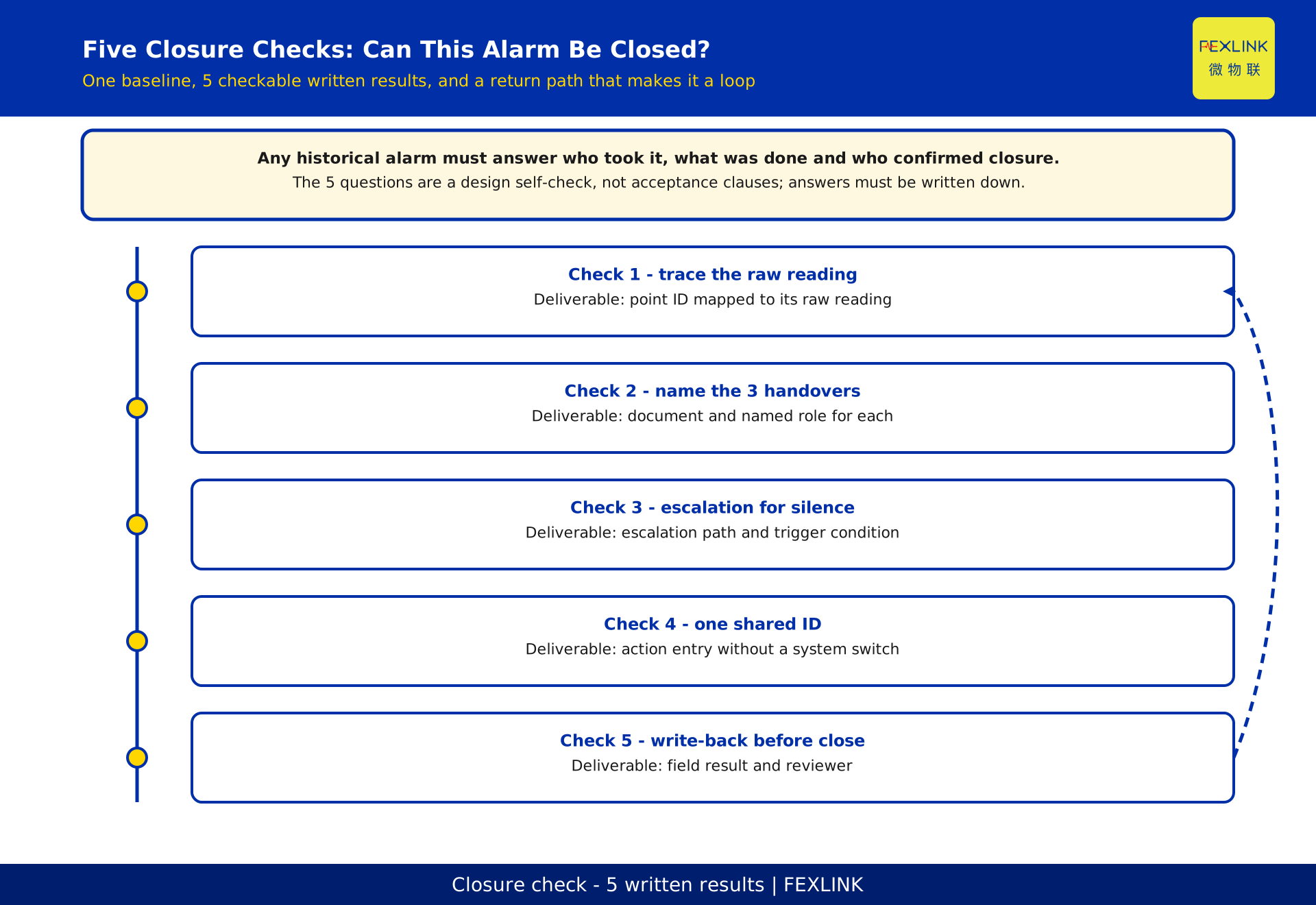
Before review, find a written answer to each of these 5 questions. Only then is the closure designed in.
- Can any alarm be traced back to the raw reading and point identifier that produced it?
- Which document holds each of the 3 handover agreements, and is the responsible role named?
- What is the escalation path for an unacknowledged alarm, and who triggers it, on what condition?
- Do alarm and order share one identifier, and does the action entry require a system switch?
- Is a field result and a reviewer mandatory before an alarm can be closed?
If one of the 5 cannot be answered, fix the document before adding a feature; more sensing points or more frequent pushes will not close this gap.
Frequently asked questions (FAQ)
Q: If the chain breaks at the last mile, is the platform missing a feature?
Usually not. The 4 causes concern recipients, authority, the order carrier and the closing condition, all on the organisation side. Extra channels only let more people see an alarm nobody owns; they create neither an owner nor a write-back.
Q: Can we skip the work order and let the operator just mark an alarm "handled"?
Not routinely. "Handled" is a state, not a record; without a role, an action and a reviewer, neither review nor workload measurement is possible. If the project is that small, at minimum bind the state change to a named person and a result note — otherwise Step 6 fails.
Q: What latency should we specify for each step?
No figures are given, and copying another project's values is inadvisable. Sampling cycles, edge rhythm, platform batches and shift cycles differ in order of magnitude and must be measured on site, then written into requirements. Specify the mismatch test and the buffering/backfill duty during outages, not a standalone number of seconds.
Q: Does closure write-back inflate the workload on shift?
It depends on whether an old action is removed. If write-back is one more entry on top of the paper ledger, workload rises. Make the order write-back the replacement entry for that ledger, so one entry satisfies both the shift record and the system state. The test is that the net number of actions must not increase.
Q: Can these six steps be used directly as acceptance clauses?
No. The six steps, 3 handovers, 4 causes and 5 questions are a structural synthesis and a self-check tool, not measured data, latency targets, quantity thresholds or performance commitments, and they are not a conformity judgement. Acceptance clauses must be set separately by the owner against site shift rules, contract scope and formal requirements. No clause text is provided, and because the registry's standards field is empty, the article contains no standard numbers.
Scope and limitations
This article applies to electrical safety, equipment temperature and distribution room monitoring projects where a signal has to reach a person who acts on it — especially at review, when the technical side and the operations process owner must align. Its increment is making the frequently omitted last-mile closure explicit in the architecture. It does not discuss where computation sits across device, edge and cloud; the neighbouring article identifier is kept only in structured metadata.
Four limitations apply. One, the six steps divide the chain structurally and are not a vendor's fixed module split; a real system may merge or split steps. Two, the 3 handovers, 4 causes and 5 questions are methodological syntheses, not survey findings, and carry no occurrence rates, false alarm rates, response times, count thresholds or amounts. Three, related products and solutions appear only as registered role names, without models, parameters, selection advice or performance commitments; step latency must be measured on site and no values are given. Four, the scene is a generic anonymised example, not a real customer or project. All deliverables are drafts pending independent review and are not acceptance criteria, quotations or commitments. Numbers here count step numbers, categories and self-check questions only.
Frequently Asked Questions
From a Single Temperature Sensor to a Work Order
A temperature reading becomes a work order someone handles through six steps: sensing, edge pre-processing, platform alarm grading