 FEXLINK Research Institute
Direct Answer
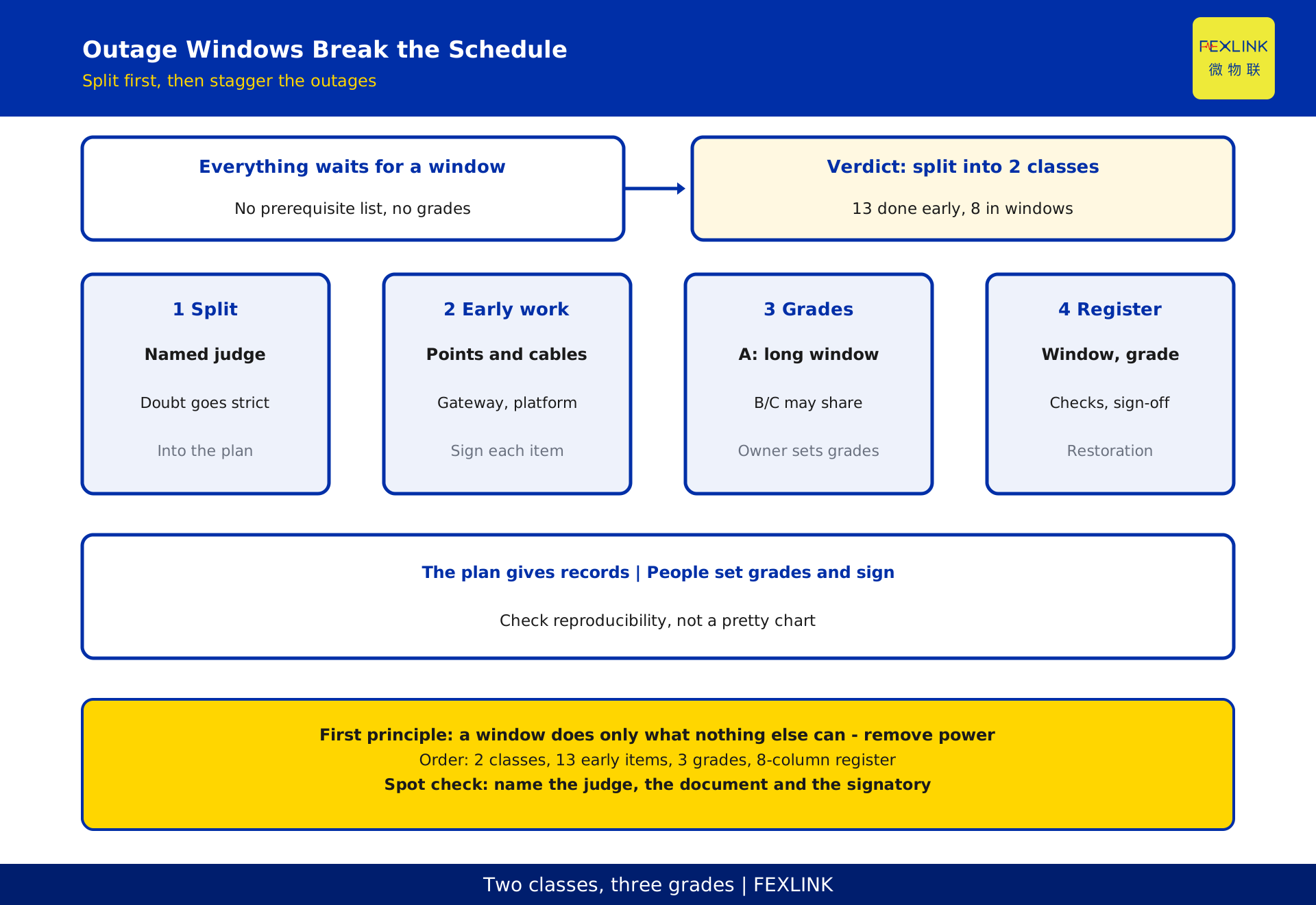
On brownfield projects the schedule breaks on outage windows, not work volume. Split every task into 2 classes: work that needs no de-energization, and work that cannot be done without one. Finish the first before any window, admit only the second into a window, then stagger those tasks across 3 circuit grades with the owner's production plan. Reverse that order and the crew waits on site for a shutdown. This is a planning method, not a safety procedure: live status, isolation, voltage testing and sign-off are decided by qualified electrical personnel under work permits, safety rules, design documents and site conditions. No operating steps, safety rulings or schedule guarantees are given.
1. Why Outage Windows Fragment the Schedule
New-build work follows construction logic; brownfield work follows the windows the owner can grant. Windows are scattered, vary in length and dodge production shifts; a week without one stops the chain. The common waste is waiting for a window for everything: point verification, cable routing, gateway installation and platform configuration are pushed into the same outage, so preparation eats the scarce hours, genuine outage work is left unfinished, and another shutdown is requested.
That produces a loop: fewer windows, more crammed in, preparation overruns, restoration squeezed, owner less willing next time. Breaking it means separating outage-dependent from outage-independent tasks at planning level, so a window does only what nothing else can: remove power.
2. Split the Work into Two Classes Before Planning
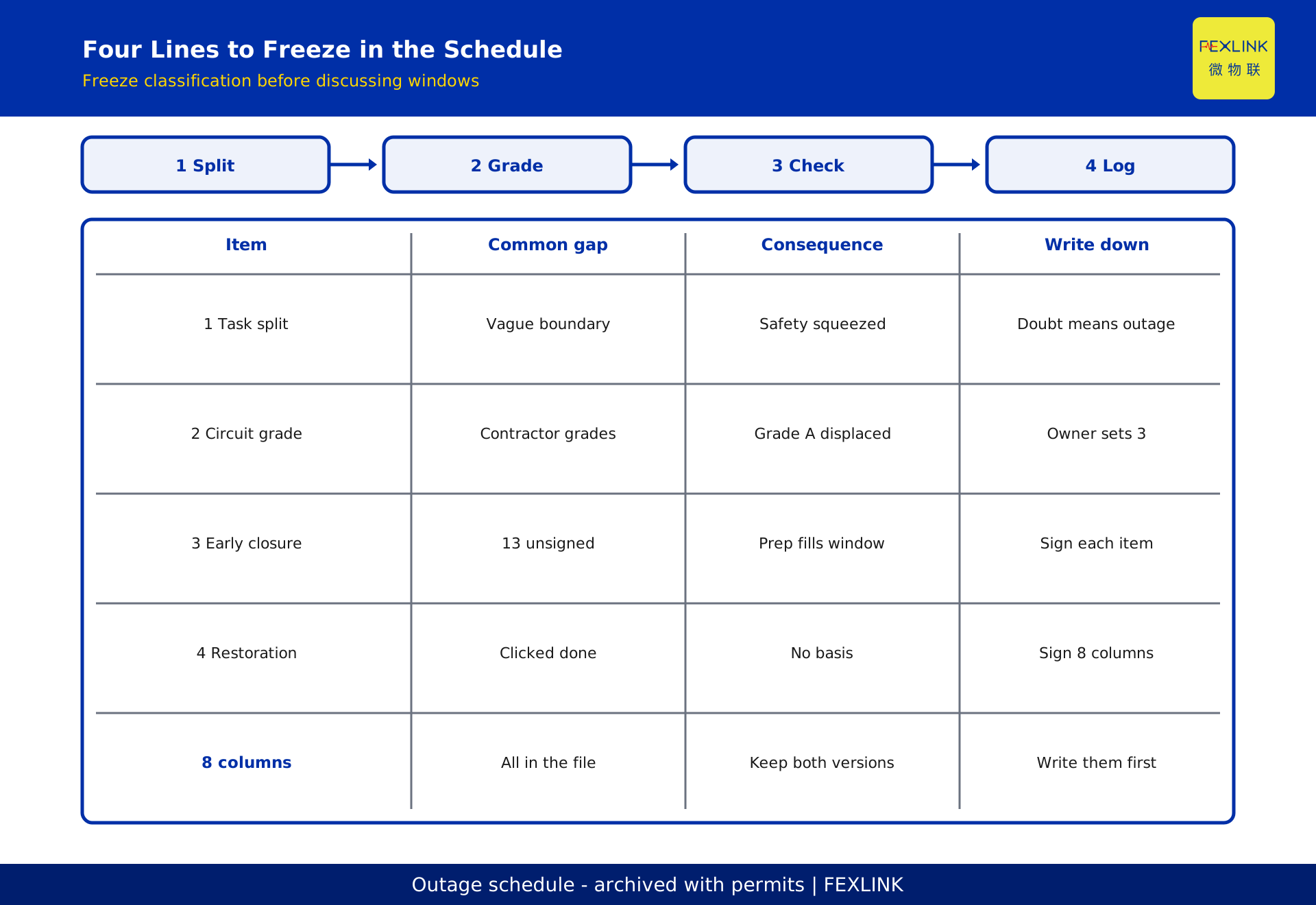
The test is "must the primary circuit be de-energized", not importance or difficulty. Walk the design list, tag each task with one of the 2 classes, and record the judge, the supporting document and the reviewer. Freeze the classification in the plan after sign-off; changes are re-signed.
| Class | Test | Typical tasks | Where it goes | Common misjudgement |
|---|---|---|---|---|
| No-outage side | Can it be done without touching energized primary conductors or re-terminating secondary circuits? | External sensor mounting, communication cable routing, gateway installation and configuration, point-list verification | Before any window | Treating "no main circuit contact" as "anything goes" |
| Outage-only side | Is it impossible to do safely while energized? | Connections into primary circuits, work requiring busbar or incomer modification | Inside a window | Counting preparation as outage hours |
Neither class is fixed: the same task can change class with cabinet type or operating arrangement. Judgement belongs to the work permit and design documents, not the crew; anything doubtful goes to the outage-only side. Keep a "basis" column so any row names its decision-maker and document.
3. The Live-Work Side: What to Finish Before Any Window
The no-outage side shortens every window. Close each de-energization-independent item first: point-to-circuit verification, external sensor mounting, cable routing and labelling, gateway installation and network connection, platform modelling and parameter checks, historical data checks, and the alarm recipient list. Then only connection and verification remain inside the window.
| Prerequisite | Deliverable | Why it must come first |
|---|---|---|
| Point-to-circuit verification | Row-by-row signed comparison sheet | Finding a wrong circuit inside a window leaves no time to fix it |
| External devices and cabling | Installation records and labels | Longest lead time, and no outage needed |
| Gateway and network | Connectivity records | Troubleshooting inside a window consumes restoration time |
| Platform model and parameters | Frozen configuration version | Needed to judge whether in-window readings are correct |
| Recipient list | Contacts and escalation path | Prevents unattended alarms after re-energization |
Each prerequisite needs an acceptance step: record, version, signatory. Open items must not be carried into a window as "do it while we are there". A list with deliverables, not vague "preparation first", makes the plan executable.
4. A Safety Correction: CT Secondary Circuits Are Not Default Live Work
The registry lists "opening/closing CT circuits" alongside wireless temperature sensing as work that can be completed in advance. This article does not follow that classification. An open current-transformer secondary circuit in service can produce dangerous high voltage. For tasks involving CT secondary circuits, protection circuits or primary conductors, live status, isolation and protection must be determined case by case by qualified electrical personnel under work permits, safety rules and design documents. No operating method is provided and no "live work is acceptable" conclusion is drawn. Such tasks require specific assessment, are excluded from the default no-outage list, and are left to the work permit.
The same applies to boundary cases such as power taps, cabinet drilling or work near energized parts: when unclear, assign the task to the outage-only side and accept an extra window rather than simplifying on experience. "May be done live" is a permit, not a schedule label; writing that in keeps schedule pressure from eroding safety.
5. The Outage Side: What Really Needs a Window
Organize outage-only tasks around the shortest de-energized duration, not trade sequence. For each, state four things: circuits, isolation scope, expected duration, and verification before restoration. Narrow the scope to a single circuit where possible, and merge adjacent circuits in advance to avoid repeated shutdowns.
| Element | What to write | Review use |
|---|---|---|
| Circuit and scope | Cabinet number, circuit ID, isolation point | Whether the outage can be narrowed |
| Preconditions | Materials, drawings, personnel, work permit | Checked off before the window opens |
| Duration | From permit to ready-for-restoration | Matched against window length |
| Verification | Termination check, connectivity, reading comparison | Decides whether restoration can proceed on time |
| Rollback | Steps to restore if work cannot finish | Prevents overrunning the window |
Leave restoration margin in every window. If verification fails, restore supply under the rollback plan and move unfinished work to a later window; never compress verification. Permits, supervision, isolation and voltage testing take priority over planning.
6. Circuit Grading: Staggering Outages
Grade circuits into 3 levels by production impact; the owner's production department sets the boundaries, not the contractor. Grade A goes into a long window aligned with maintenance; B tolerates short switching and may share; C fills scattered windows. In a shared window, higher grades go first with ample restoration time.
| Grade | Impact | Window strategy | Constraint |
|---|---|---|---|
| A | Stops mainline production | Dedicated long window, aligned with maintenance | Not shared with other grades |
| B | Short switching possible | Shared with same-grade circuits | Switching conditions confirmed |
| C | Negligible impact | Fills scattered windows | Acts as buffer for changes |
Grading gives changes a rule: when a window is compressed, keep A and defer C instead of cramming tasks into the remaining time. Freeze the grade list with the window plan; cross-grade changes go back to the owner for confirmation.
7. Aligning with the Production Plan
A window is a concession from the owner's production plan, not an internal resource. Fix three things: application lead time (task list, circuit scope, duration and rollback plan submitted together); change notification (announced by the owner, not agreed verbally with a workshop); and sign-off (preconditions checked before each window, actual start, stop and restoration recorded afterwards).
Use one 8-column register as the single reconciliation record: window ID, date and slot, circuit and grade, tasks, precondition status, responsible person, verification result, restoration sign-off. Both parties maintain it; any row should explain the assignment, precondition status and who confirmed restoration. Verbal arrangements leave no trace and are disputed first when the schedule slips.
8. A De-identified Example: Two-Lane Schedule
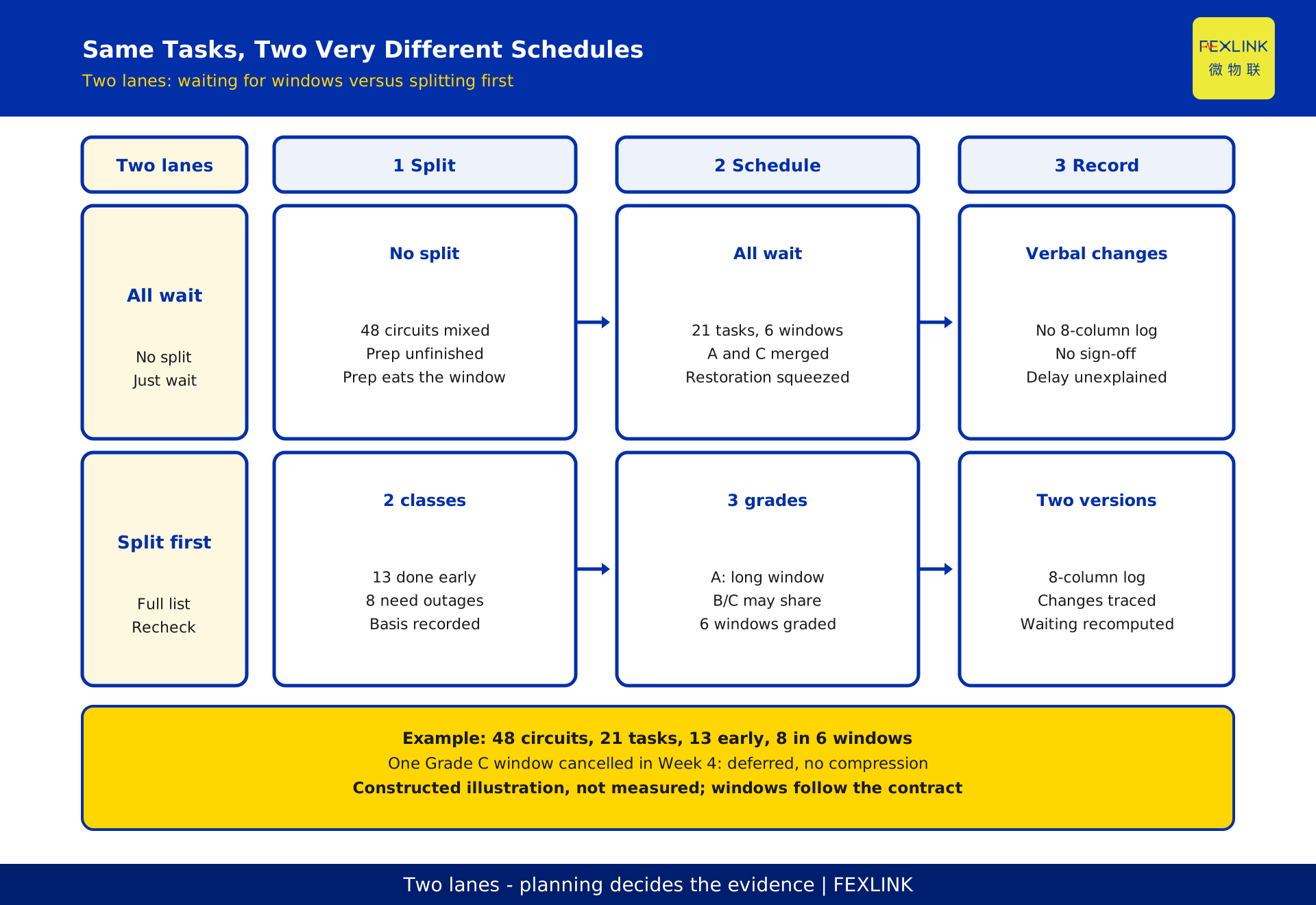
The following is a constructed pattern, not a real project, measured data or a recommended duration. Assume a retrofit covering 48 circuits and 21 tasks: 13 on the no-outage side and 8 on the outage-only side. The owner grants 6 windows; circuits form 3 grades.
| Phase | No-outage lane | Outage lane | Deliverable |
|---|---|---|---|
| Week 1 | 12 prerequisite tasks | No window | Prerequisite list and configuration version |
| Week 2 | Remaining 1 task and review | 2 Grade A windows | Grade list and work permits |
| Week 3 | Verification support | 2 Grade B windows | Connectivity and reading records |
| Week 4 | Close-out and archive | 2 Grade C windows | 8-column register and restoration sign-offs |
Constructed outcome: each of the 6 windows carries 1 to 2 outage-only tasks; all 13 no-outage tasks close beforehand. In Week 4, 1 Grade C window is cancelled and its work moves to the next same-grade window, with no compression of A, no added tasks and no reduction in verification. Structure only, no promise of duration or efficiency; real counts, lengths and volumes follow site conditions and the contract.
9. When a Window Shrinks or Disappears
Window changes are normal, so prescribe responses rather than improvise. In priority order: confirm the Grade A window survives; defer Grade C tasks to a same-grade buffer; if shortened rather than cancelled, reduce tasks but not verification or restoration margin; update the 8-column register and re-sign.
Prohibit four practices explicitly: carrying unfinished no-outage preparation into a window; merging A with other grades; restoring without verification; re-agreeing a cancelled window verbally without updating the register. Keep both record versions so the parties can recompute time spent waiting for an outage - often the only usable basis for a schedule-extension discussion.
10. Solution Roles and Responsibilities
Related solutions are the predictive maintenance solution and the digital electrical supervision platform, a qualitative division only: sensing data acquisition and analysis versus platform-side aggregation, display and records. They mark which steps close before a window and which need in-window verification. No model parameters, capability assessments, performance inferences or procurement commitments are made; nothing here replaces the contract, design documents or qualified opinions. The registry lists no related products, so no model numbers appear.
Responsibility splits three ways: the contractor submits classification, window applications and rollback plan, then executes; the owner's production and electrical departments confirm grades, timing and safety boundaries; the supervisor or an independent reviewer checks preconditions, verification records and restoration sign-offs. Planning and self-judging are incompatible roles.
Frequently Asked Questions (FAQ)
Q: With so few windows, can we combine several outage tasks into one?
Only if scope, duration and restoration margin all hold up. By grade, B and C may share a window while A does not share with other grades. Combined tasks still need item-by-item verification; a single restoration is no substitute for item-by-item records.
Q: Why can't point verification and gateway installation wait for a window?
They do not depend on de-energization, and finishing them early reserves the window for the one thing that cannot be replaced. Pushing them inside consumes connection and verification time and creates demand for more windows. The precondition is that they genuinely avoid energized conductors; unclear boundaries follow Section 4.
Q: The registry says opening/closing CT circuits can be done in advance. Why the change here?
An open CT secondary circuit in service can produce dangerous high voltage, so live status must be ruled on by qualified personnel under a work permit and safety rules. No operating method is offered, and the task is not in the default no-outage list. A schedule cannot replace a safety permit.
Q: If the owner cancels a window, what evidence supports a schedule extension?
Keep both versions of the 8-column register, the window notice, the deferred task list and the precondition status. What matters is being able to recompute how many days were lost waiting for an outage, not a single line saying "owner cancelled".
Q: Does following this plan guarantee the project finishes on time?
No. This is a method for classifying tasks and organizing windows, not a promise on duration or efficiency. Real progress depends on production planning, site conditions, deliveries and work-permit approval; the schedule is governed by the contract and the jointly signed plan.
Scope and Limitations
This applies to brownfield electrical monitoring retrofits with defined outage windows, item-by-item task splitting, and agreed circuit grading and independent review; not to new-build projects, sites without a work-permit process, or plans substituting one deadline for staged planning. The registry lists no related standards, so no standard numbers, clause numbers or compliance tables appear. No live-work operating steps, isolation or voltage-testing methods, safety distances, voltage levels, permit templates or schedule guarantees are given; live status is decided by qualified electrical personnel under work permits, safety rules, design documents and site conditions. In Section 8, the 48 circuits, 21 tasks, 13 no-outage tasks, 8 outage-only tasks, 3 grades, 6 windows, 8-column register and 4-week phasing are constructed illustrations, not measured or recommended values. Solution names are qualitative labels without procurement commitment.
Frequently Asked Questions
Half the Schedule Is Waiting for a Shutdown Window
On brownfield projects the schedule breaks on outage windows, not work volume