 FEXLINK Research Institute
Direct Answer
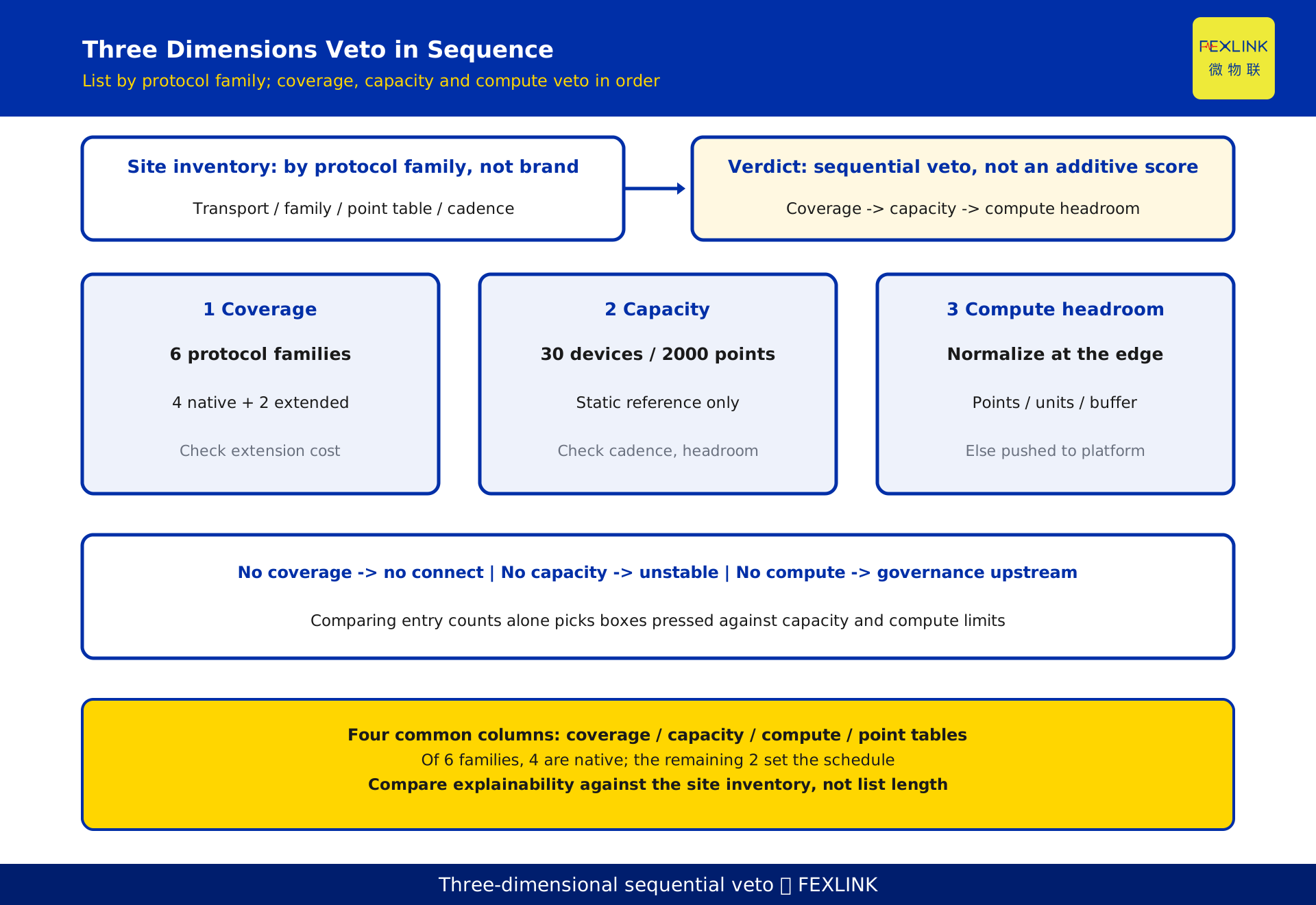
When a site has dozens of device brands, choosing a unifying gateway is not about finding the box with the longest protocol list. Three questions have to be separated: protocol coverage, concurrent access capacity, and local compute headroom. If any one falls short, every new device type later means another gateway or a replacement. The conclusion up front: prefer a gateway that covers the families actually present, leaves device and point-count headroom, and normalizes data at the edge. A pure pass-through box only forwards frames and pushes point-table mapping, unit conversion and timestamp repair to the platform, making every expansion a platform change. The 30 devices / 2000 points level is a static-capacity reference, not the whole answer; three-dimensional sizing belongs to a companion article. No clause numbers, version years, accuracy figures or prices are cited, and related products are treated only as qualitative roles.
Connecting One Device Is Not Sustaining Many
Reading one frame successfully and running dozens of device types for years are different problems. The first needs a driver; the second needs a coverage list, point-table governance, polling schedules and normalized upstream data. A common mistake is to treat a single-device demo as proof of fit. When the second batch arrives, a protocol is missing from the built-in list, so another gateway is added for forwarding. The result is one gateway per device type.
The first step is to list field devices by protocol family and transport, not by brand. Different series from one vendor may speak different protocols, while unrelated vendors may share register definitions. For each class, record the transport, protocol family, source of the point table, and sampling cadence. Those four items define what the gateway must do.
Three Dimensions: Coverage, Capacity, Compute Headroom
Coverage means how many field protocol families the gateway parses natively, and whether missing ones can be added through configurable point tables or driver extensions. Concurrent capacity covers two static ceilings, device count and point count, plus the throughput implied by sampling cadence; 30 devices / 2000 points is enough as a reference here. Local compute headroom means whether the gateway can map point tables, convert units, judge limit violations, buffer and replay, and align timestamps instead of merely forwarding.
These are not scored in parallel. They veto in sequence: without coverage the device never connects; without capacity it connects but runs unreliably; without compute headroom raw data goes upstream and governance cost lands on the platform. Comparing only the number of supported protocol entries often selects a long list with capacity and compute pressed against their limits.
Coverage Has Layers, Not a Flat List
Treating protocols as a flat checklist loses information. A three-layer view works better. The bottom layer is transport: RS-485 serial buses, Ethernet and wireless links, which set physical interfaces, addressing and polling cadence. The middle layer is protocol families: DL/T 645 and DL/T 698 series on the metering side, Modbus in both serial and Ethernet forms across general industrial devices, plus vendor-private protocols. The top layer is upstream integration, where the gateway emits parsed data against the platform model.
The middle layer causes most trouble. The same protocol name can hide different register offsets, byte orders and scaling conventions, so sharing a name does not mean sharing a point table. "Supports a protocol" is only an entry ticket. Ask whether point tables are user-definable, whether scaling and byte order can be set per point, and whether malformed frames are handled separately. Serial buses are bounded by distance and node count, while Ethernet devices depend on subnet planning, so mixed devices usually need separate polling schedules.
A Constructed Example: Six Families, Four Native
A de-identified construction shows how to read the list. Suppose the survey finds 6 protocol families, with 4 inside the gateway's native driver list and 2 requiring custom point tables or driver extensions. Looking only at "4 covered" suggests decent coverage. But those 2 decide the schedule: each needs manual cross-checking of addresses, data types and scaling against the vendor manual, plus a matching platform model. Commissioning and rework concentrate there.
Read coverage as three terms together: native coverage, extensible coverage, and extension cost. Extension cost includes point-table configuration, whether custom development is needed, whether extensions survive firmware upgrades, and whether a new protocol crowds the polling schedule. If a vendor supplies only partial documentation, require the point table at bid stage. These counts are illustrative, not ratios or empirical values.
Capacity: A Reference, Not an Answer
At selection stage, capacity only needs to be sufficient with room to grow; full unit-count sizing is unnecessary. Compare the surveyed device total and point-table row count against one gateway's static ceilings, then allow for planned growth. The 30 devices / 2000 points level answers how large a point table fits, not what cadence is used or how many frames move per unit of time.
Three things belong on the selection sheet: which year's point and cadence plan the sizing uses, what triggers expansion, and whether expansion means adding a unit or replacing one. A few fast points can consume most of the throughput, the usual blind spot. Capacity stays one of three dimensions here; the conversion and unit-count formula belong to the capacity article, and the two should be used together without substituting for each other. Device and point ceilings come from vendor documentation; no absolute values are asserted.
Pass-Through Versus Edge Compute: Where Data Becomes Normalized
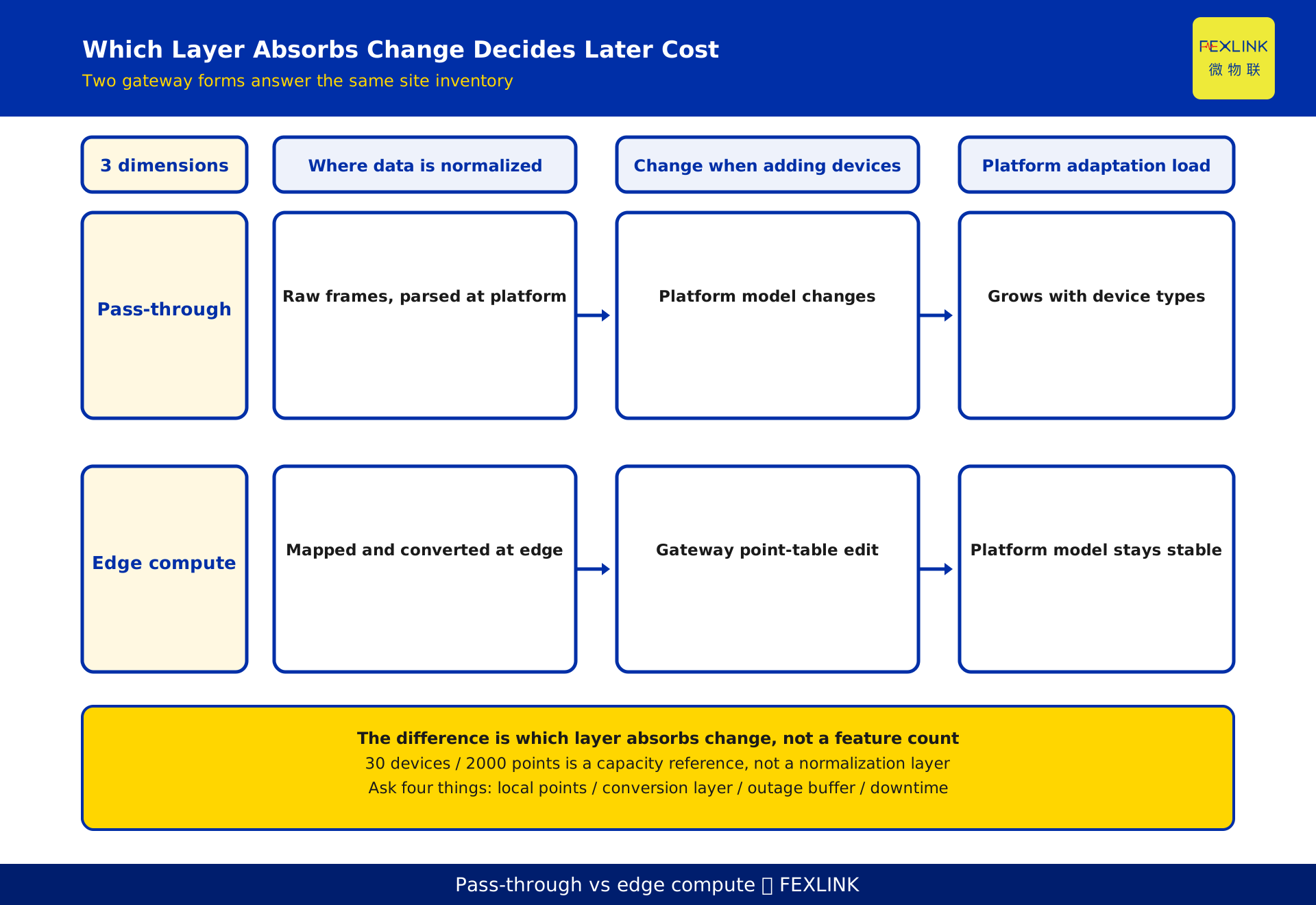
This is the choice with the largest downstream cost. A pure pass-through gateway converts links and forwards frames in device-native form, so the platform parses, converts units and repairs timestamps for every device class. As types multiply, the platform becomes the protocol adaptation hub. A gateway with edge compute performs point-table mapping, unit normalization, limit checks and local buffering, sending already-normalized data upstream.
The difference is not a feature count but which layer absorbs change. Adding a device means a platform edit under pass-through, versus a gateway-side point-table edit under edge compute, keeping the platform model stable. Local buffering also decides whether history stays continuous across an outage. Do not accept "supports edge computing" as evidence. Ask four things: can point tables be configured locally, which layer holds conversion rules, can the gateway buffer during an outage, and does a configuration change require downtime.
Point Tables Are What Actually Consume the Schedule
In multi-vendor projects, the slow part is rarely mounting hardware. It is translating dozens of device manuals into one point table that matches the platform model. The same quantity may sit at different register addresses, use different byte orders and scaling, or even change meaning between firmware versions. A protocol family defines how to ask; the point table defines what to ask and what the reply means, and there is no universal answer to the latter.
Make adaptation a separate selection row: can point tables be imported and exported, can scaling and data types be set per point, can points be added without a firmware change, and can configuration be backed up and reused. Those four decide whether growth is one configuration edit or a full re-commissioning. Settle in the design phase whether point-table governance sits at the gateway or the platform.
A Four-Column Selection Sheet
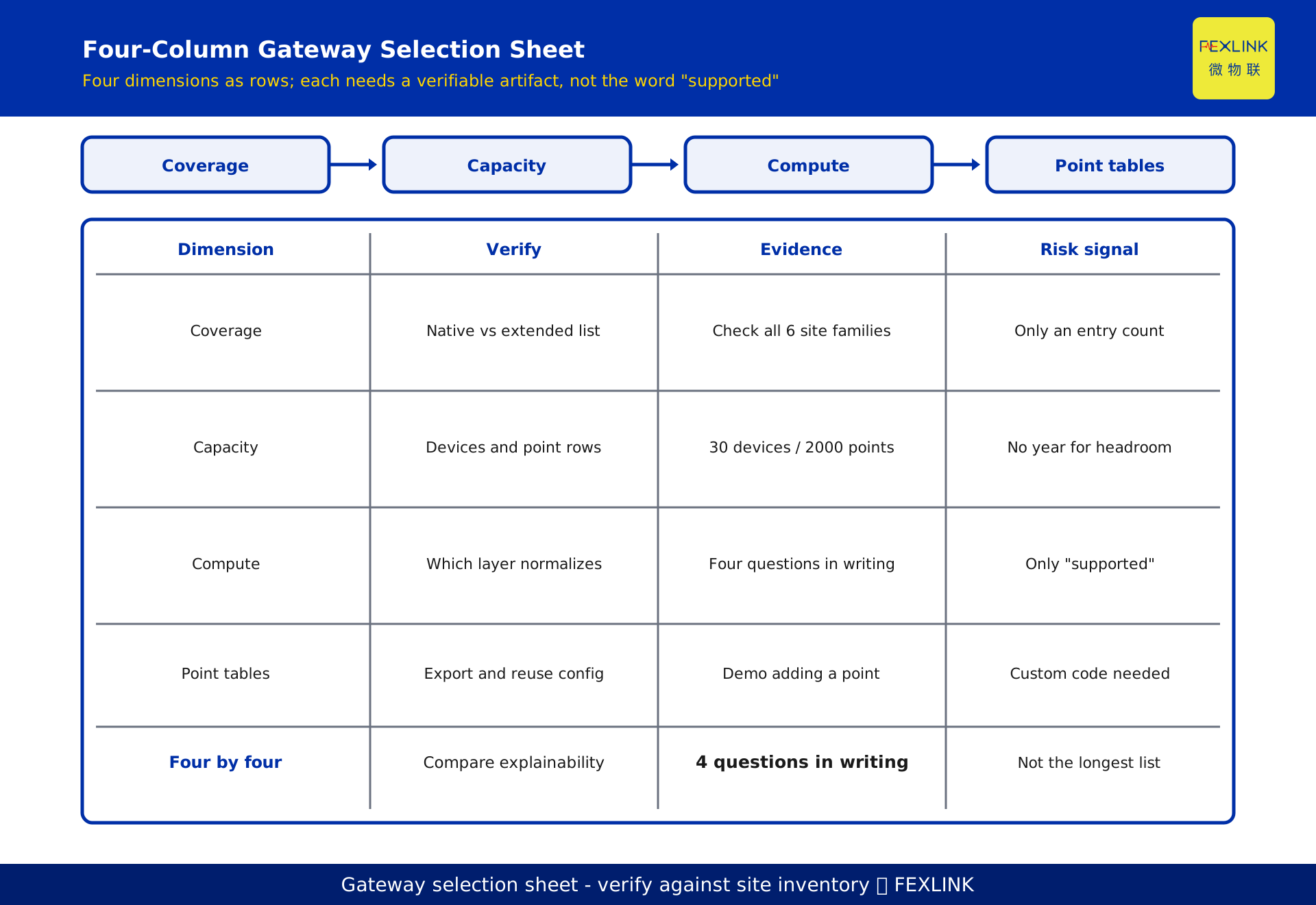
One sheet is enough: four dimensions as rows, candidate models as columns, plus verification method and risk signal columns. The four dimensions are protocol coverage, concurrent capacity, local compute headroom, and point-table adaptation. Every row should require a verifiable evidence artifact from the vendor, not the word "supported".
Four questions keep it honest. Is each protocol family on the site list native or extended, and who carries the extension cost? Which year's inventory sets the device and point headroom? Do point-table mapping and unit conversion sit at the gateway or the platform, and can configuration be exported and reused? Does adding a device class mean a configuration change, an additional licence, or a hardware swap? All four require written clarification. The verdict is not "the longest protocol list" but "the highest explainability against the site inventory across coverage, capacity, compute and adaptation".
Where Related Products Fit on the Sheet
The ESX, CW and CX edge computing gateway series in the registry play a node role in the device-edge-cloud architecture: attaching multiple field device classes downstream and delivering normalized data to the platform upstream. They map to the coverage and compute-headroom rows, so the checks are the intersection between the site protocol inventory and native coverage, how point tables are configured, and whether upstream data is already normalized. The associated multi-protocol access solution supplies a layered-decoupling approach, not a capacity commitment.
This is a qualitative role description only. No interface counts, capacity ceilings, accuracy or prices are given, and no model is presented as a ready selection. Whether a site inventory is covered must be confirmed against the current selection manual, the vendor's point-table support statement and on-site commissioning results. No selection or procurement recommendation is made. The sibling boundary is fixed: the capacity article answers how many devices one gateway carries; this article answers how to select for multi-vendor protocol unification. The two do not replace each other, though both belong in one design.
Frequently Asked Questions (FAQ)
Q: Does a longer supported-protocol list mean a better gateway?
No. The entry count says nothing about how deeply each protocol's point table is handled, nor about concurrent capacity and local compute headroom. Compare native coverage and extension cost against the real site inventory, then check growth headroom, then check which layer normalizes the data.
Q: If a vendor-private protocol exists, must we add another gateway?
Not necessarily. First ask whether it can be added through a custom point table or driver extension, whether the extension survives a firmware upgrade, and whether it crowds the polling schedule. Only when extension is infeasible, or the device cadence conflicts with normal zoning, should a separate channel or dedicated gateway be considered.
Q: Is a pure pass-through gateway always cheaper and therefore the right choice?
It depends on which layer absorbs total cost. Pass-through pushes parsing, conversion and timestamp repair to the platform, so adaptation and change cost concentrate there as device types grow. With a small, stable protocol set, pass-through is workable; with an expanding inventory, point-table governance at the edge is more controllable. No price comparison is offered.
Q: Can 30 devices / 2000 points be used directly as the selection ceiling?
No. It is only a static-capacity reference describing how large a point table fits; it says nothing about sampling cadence or per-unit-time throughput. The unit-count and throughput conversion belongs to the capacity article. Here capacity is one of four selection dimensions and is not developed into a calculation.
Q: Which article should I read, this one or the gateway capacity one?
That article answers how many devices, points and sampling rates one gateway can carry. This one answers how to choose a gateway when brands and protocols are mixed. Use both when building a design checklist, but do not substitute capacity sizing for protocol coverage selection, or a selection sheet for unit-count arithmetic.
Scope and Limitations
- Applies to selection and bid clarification for unified access gateways during multi-vendor integration of non-classified monitoring, supervision and electrical safety platforms in China. Single-brand, single-protocol one-off deliveries are out of scope.
- Registry-related protocols are cited by family name only (DL/T 645, DL/T 698, Modbus). No version years, clause numbers, technical requirement tables or assessment scores appear. Current status and version validity must be checked against the latest standards announcements at bid time and against vendor documentation; no timeliness or compliance determination is made here.
- Related products are described qualitatively. No interface counts, capacity ceilings, accuracy, compute, buffer duration or price figures are cited, and no model number constitutes a ready selection conclusion.
- The 6 / 4 / 2 family counts in the constructed example are de-identified illustrations, and 30 devices / 2000 points is a reference level. No customer, project or place names appear; nothing here represents a real project, ratio or empirical value, and nothing forms a budget basis.
- Transport, protocol extension methods, point-table configuration and service boundaries follow tender documents, vendor materials, contracts and written clarification. This is a method discussion, not a substitute for an evaluation committee's judgement.
- Three-dimensional capacity sizing, unit-count formulas and protocol conformance testing belong to other articles. Here they appear only as selection dimensions and are not developed into algorithms. No performance claims enter the conclusions.
Frequently Asked Questions
Dozens of Vendor Devices on Site
When a site has dozens of device brands, choosing a unifying gateway is not about finding the box with the longest protocol list